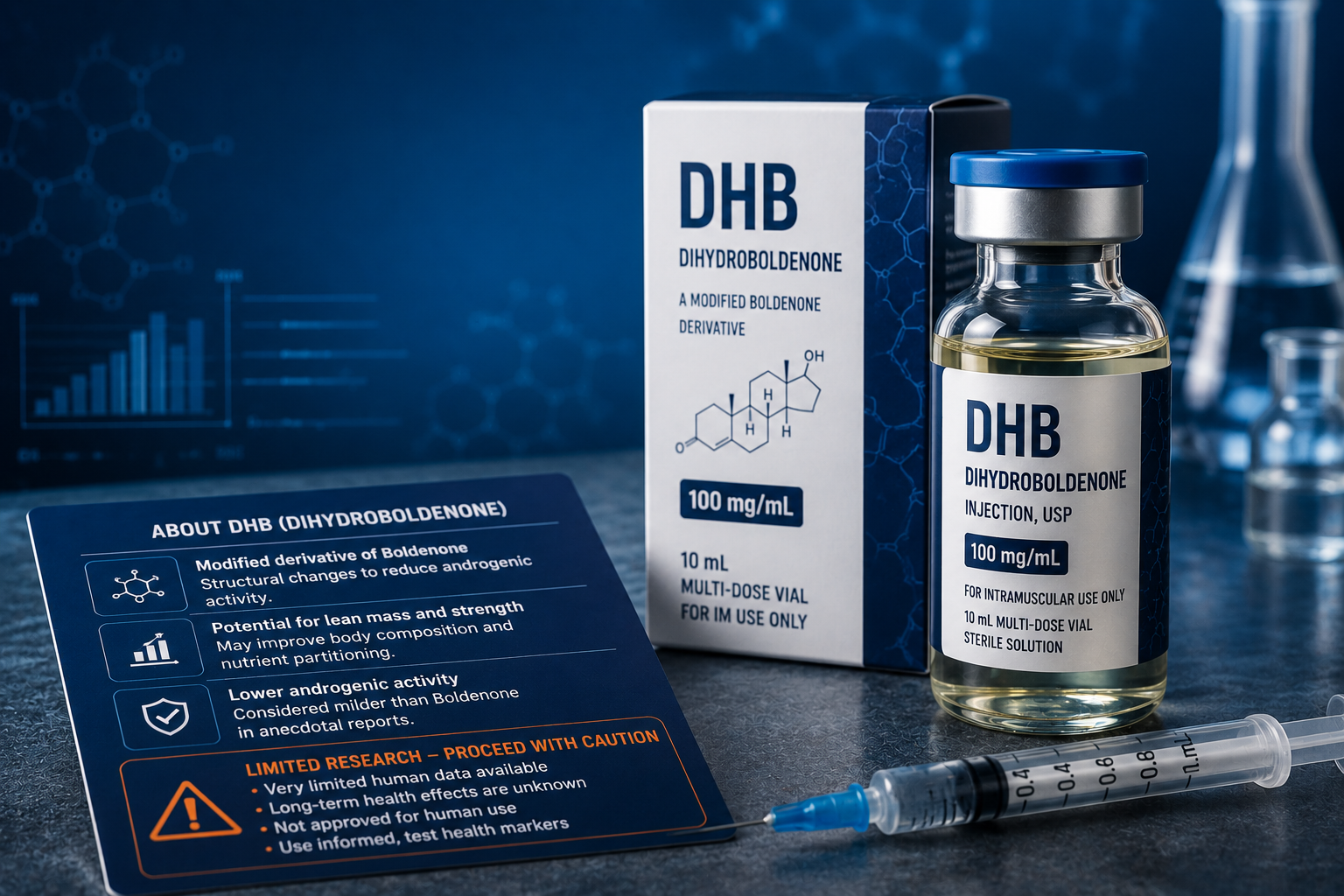
Considering DHB for lean muscle gains? This modified boldenone derivative promises dry gains without estrogen but limited research makes it high-risk. Here’s what’s known.
You’ve heard DHB gives quality muscle gains without water retention. Stronger than testosterone, no aromatization, clean gains.
You’re intrigued by the “dry gains” promise but uncertain about safety, proper dosing, and whether limited human data makes it too risky.
You’ve been told:
- “DHB is like masteron but builds more mass”
- “All the gains, none of the bloat”
- “It’s just modified boldenone, very safe”
- “Better than testosterone for lean gains”
Partially true but oversimplified. The truth: DHB (dihydroboldenone, also called 1-testosterone) is a reduced form of boldenone, structurally similar to DHT derivatives like masteron. It’s highly anabolic (stronger than testosterone mg-for-mg), does NOT aromatize (zero estrogen conversion = no gyno, no water retention), promotes lean, dry muscle gains with strength increases. BUT it’s never been approved for human use, research is extremely limited, optimal dosing uncertain (user reports: 100-200mg weekly for 8-12 weeks), causes standard DHT-derivative sides (acne, hair loss if prone, virilization in women), cardiovascular stress (worse than testosterone/nandrolone but better than orals), possible hepatic stress (increases liver weight in studies), and complete testosterone suppression. Also notorious for severe injection site pain (PIP) due to poor solubility.
In this comprehensive guide, I’ll explain what DHB is (chemical structure and relationship to boldenone/DHT), reveal the benefits (lean mass, strength, no estrogen), detail typical protocols (dosing and duration based on limited data), show all side effects (androgenic, cardiovascular, hepatic concerns), address the injection pain issue (why PIP is severe), and provide honest assessment (limited research = unknown long-term risks).
Whether you’re considering DHB or just curious about exotic compounds, understanding the incomplete safety picture is essential.
Let’s examine DHB with scientific honesty about what’s known and what remains uncertain.
TABLE OF CONTENTS
What Is DHB (Dihydroboldenone)?
The modified boldenone.
The Basic Definition
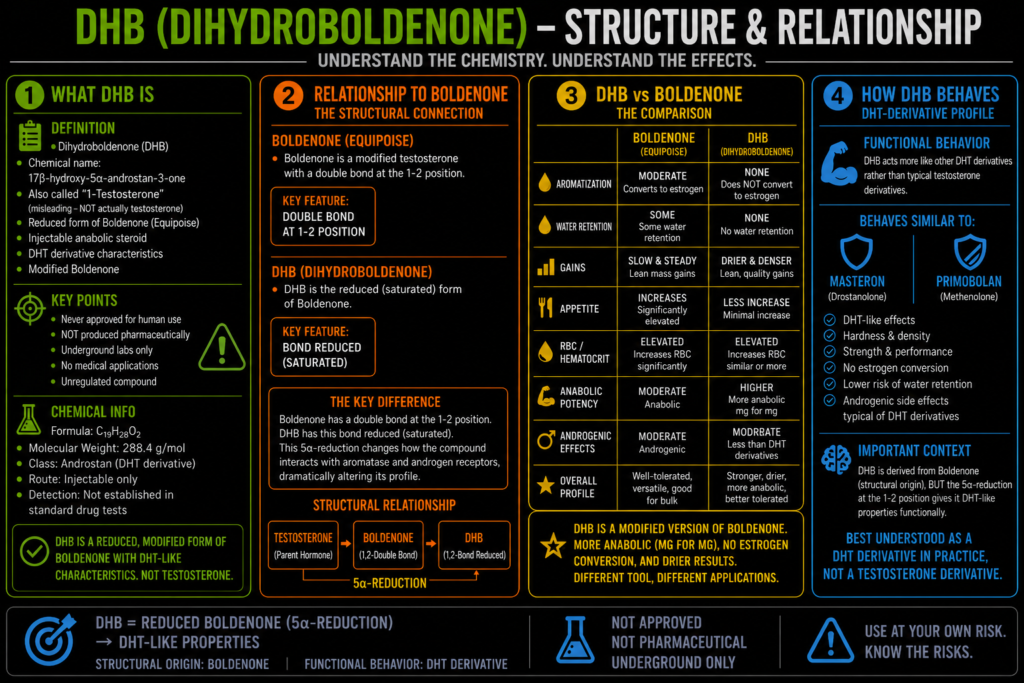
What it is:
- Dihydroboldenone (chemical name)
- Also called: 1-testosterone (misleading name)
- Reduced form of boldenone (equipoise)
- Injectable anabolic steroid
- DHT-derivative characteristics
- Modified boldenone
Alternative names:
- DHB (abbreviation)
- 1-testosterone (misnomer – not actually testosterone)
- 1-test
- Multiple designations
Legal and approval status:
- Never approved for human use
- Not produced pharmaceutically
- Underground labs only
- No medical applications
- Unregulated compound
The Chemical Structure
The relationship to boldenone:
- Boldenone (equipoise) = modified testosterone
- DHB = reduced boldenone (5α-reduced)
- Similar to how DHT is reduced testosterone
- Structural reduction
The key difference:
- Boldenone has double bond at 1-2 position
- DHB has this bond reduced (saturated)
- Changes aromatization properties
- Changes androgenic/anabolic profile
- Critical modification
Why called “1-testosterone”:
- Structure similar to testosterone with methyl group at position 1
- But behaves more like DHT derivative
- Name is misleading
- Misnomer
DHB vs. Boldenone (Equipoise)
Boldenone characteristics:
- Moderate aromatization (converts to estrogen, but less than testosterone)
- Some water retention
- Slow, steady gains
- Increases appetite significantly
- Elevated RBC production
- Parent compound
DHB characteristics:
- NO aromatization (doesn’t convert to estrogen)
- No water retention
- Drier, denser gains
- Less appetite increase
- Elevated RBC production (similar)
- More anabolic mg-for-mg
- Modified version
The comparison:
- DHB stronger for lean mass
- Boldenone better tolerated (less harsh)
- DHB for cutting/recomposition
- Boldenone for slow bulk
- Different applications
DHB Behaves Like DHT Derivatives
Despite boldenone origin:
- Acts more like masteron or primobolan
- DHT-like effects (hardness, density, strength)
- No estrogen conversion
- Androgenic side effects
- DHT-derivative profile
The confusion:
- Derived from boldenone (structural origin)
- But reduction creates DHT-like properties
- Best understood as DHT derivative functionally
- Functional classification
Benefits of DHB
The positive effects.
Benefit 1: Lean Muscle Growth
The anabolic potency:
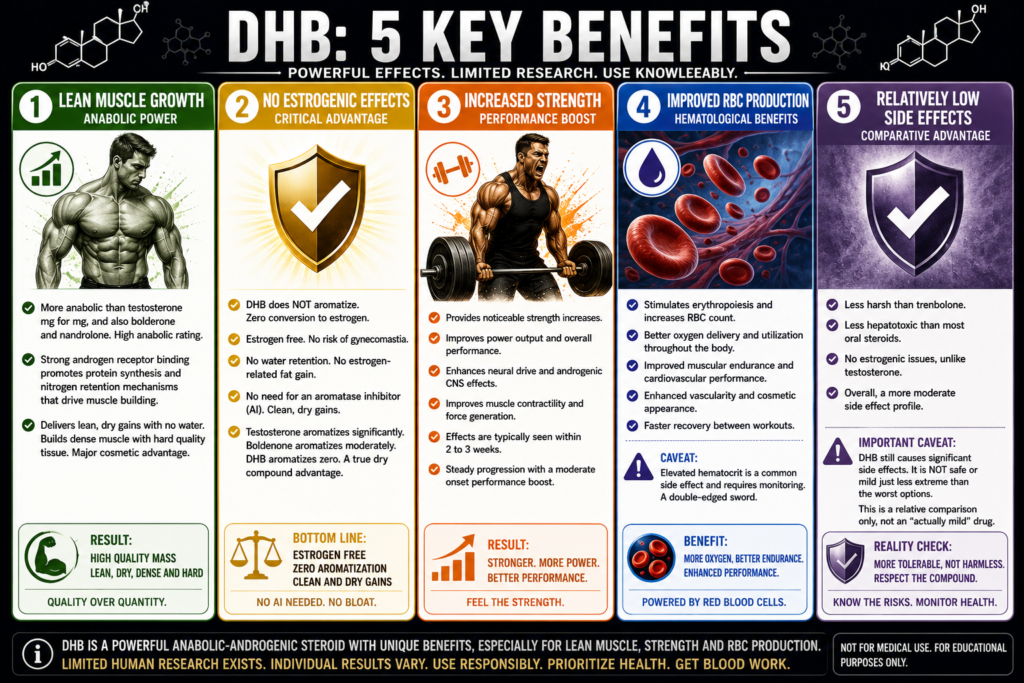
- More anabolic than testosterone mg-for-mg
- More anabolic than boldenone
- More anabolic than nandrolone
- High anabolic rating
The muscle-building mechanisms:
Mechanism 1: Strong androgen receptor binding
- High affinity for androgen receptors
- Activates muscle protein synthesis
- Direct anabolic signaling
Mechanism 2: Enhanced protein synthesis
- Increases rate of muscle protein production
- More efficient muscle building
- Anabolic acceleration
Mechanism 3: Improved nitrogen retention
- Positive nitrogen balance essential for growth
- DHB enhances nitrogen retention
- More anabolic environment
- Muscle preservation and growth
The muscle quality:
- Lean, dry gains (no water)
- Dense muscle appearance
- Hard, quality tissue
- Cosmetic advantage
Benefit 2: No Estrogenic Effects
The critical advantage:
- DHB does NOT aromatize
- Zero conversion to estrogen
- Estrogen-free
What this means:
- No gynecomastia risk (from DHB itself)
- No water retention
- No estrogen-related fat gain
- No need for AI (aromatase inhibitor)
- Clean gains
The comparison:
- Testosterone: Aromatizes significantly
- Boldenone: Aromatizes moderately
- DHB: Zero aromatization
- Dry compound
Benefit 3: Increased Strength
The strength gains:
- Noticeable strength increase
- Improves power output
- Enhanced neural drive
- Performance boost
The mechanism:
- Androgenic CNS effects
- Improved muscle contractility
- Better force generation
- Multi-factorial
The timeline:
- Effects within 2-3 weeks
- Steady progression
- Moderate onset
Benefit 4: Improved Red Blood Cell Production
The effect:
- Stimulates erythropoiesis
- Increased RBC count
- Better oxygen delivery
- Hematological enhancement
The benefits:
- Improved muscular endurance
- Better cardiovascular performance
- Enhanced vascularity (cosmetic)
- Faster recovery
- Performance and aesthetic
The risk:
- Elevated hematocrit (side effect)
- Requires monitoring
- Double-edged sword
Benefit 5: Relatively Low Side Effect Profile (Compared to Harshest Steroids)
The comparative assessment:
- Less harsh than trenbolone
- Less hepatotoxic than oral steroids
- No estrogen issues (unlike testosterone)
- Moderate side effect profile
The caveat:
- Still causes significant sides
- Not “safe” or “mild”
- Just less extreme than worst options
- Relative comparison only
Typical DHB Protocols
Limited data, user-reported dosing.
Critical Disclaimer
No approved human use:
- Never studied extensively in humans
- No pharmaceutical guidelines
- All information anecdotal
- Experimental compound
Unknown long-term effects:
- Safety data lacking
- Optimal dosing unknown
- Risk profile incomplete
- Significant uncertainty
Dosing Range (Anecdotal)
Low dose:
- 100mg weekly
- Minimal but noticeable effects
- Reduced side effects
- Conservative approach
Moderate dose:
- 200mg weekly
- Standard user approach
- Balance of results and manageability
- Typical dosing
High dose:
- 300-400mg weekly
- More aggressive
- Increased side effects
- Advanced use
Dosing frequency:
- 2-3x weekly typical
- Example: 100mg Monday/Thursday (200mg weekly)
- Some use EOD for stability
- Split dosing
Cycle Duration
Standard cycles:
- 8-12 weeks typical
- Similar to other injectables
- Moderate duration
Why not longer:
- Cardiovascular stress accumulates
- Testosterone suppression prolonged
- Diminishing returns
- Time-limited benefits
Stacking
Common stacks:
Cutting/recomposition:
- DHB (200mg weekly) + Testosterone (200-300mg weekly)
- DHB + Trenbolone (lean mass stack)
- DHB + Masteron (extreme dryness)
- Dry compound combinations
Lean bulk:
- DHB (200mg weekly) + Testosterone (400-500mg weekly)
- DHB + Primobolan
- Quality mass stacks
The testosterone base debate:
- Some use DHB without testosterone base
- Most include testosterone (prevent low-T symptoms)
- Individual preference
- Optional base
Injection Site Pain (PIP) Problem
The critical issue:
- DHB notorious for severe post-injection pain
- Among worst compounds for PIP
- Universal complaint
- Major drawback
Why PIP occurs:
- Poor solubility in oil
- Crystallization at injection site
- Inflammatory response
- Chemical property
Severity:
- Severe pain for 2-5 days post-injection
- Limping common (if injected in leg)
- Difficult to perform daily activities
- Debilitating for some
Mitigation strategies:
- Dilute with sterile oil (reduce concentration)
- Warm oil before injection
- Massage injection site
- Rotate sites extensively
- Some labs use special carriers (less PIP)
- Damage control
The reality:
- PIP likely regardless of precautions
- Deal-breaker for many users
- Major quality-of-life impact
- Significant downside
Side Effects of DHB
Known and suspected effects.
Androgenic Side Effects
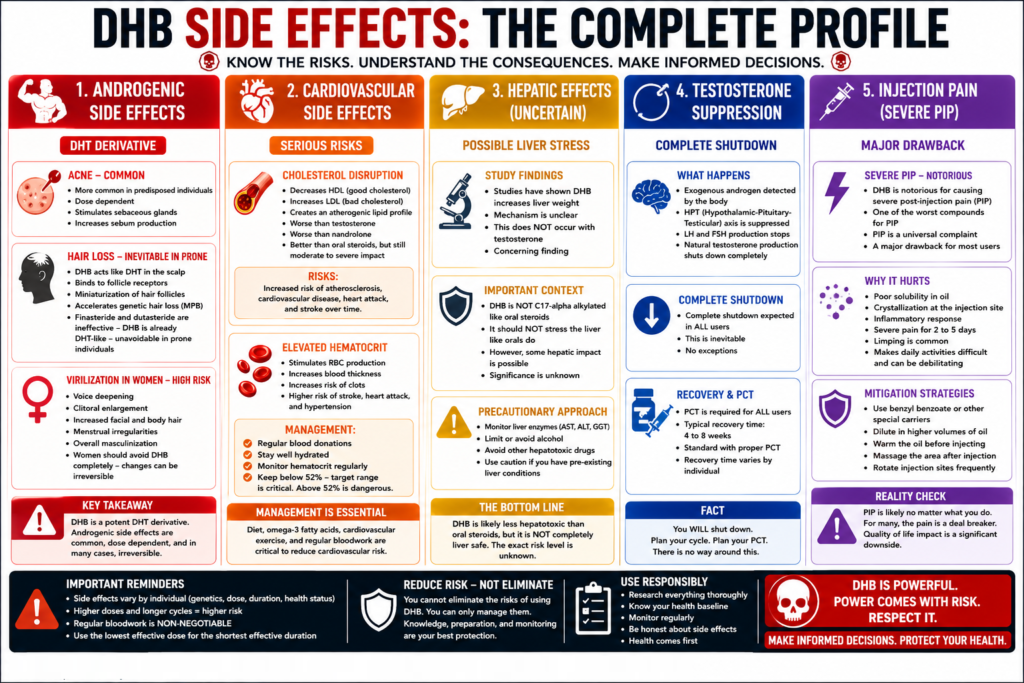
Side Effect 1: Acne
The mechanism:
- DHT-derivative properties
- Stimulates sebaceous glands
- Increased sebum production
- Androgenic skin effect
Likelihood:
- Common in predisposed individuals
- Dose-dependent
- Moderate to high occurrence
Side Effect 2: Hair Loss
The mechanism:
- DHB acts like DHT on scalp
- Follicle miniaturization (if genetically prone)
- Androgenic alopecia
Who’s affected:
- Only those with MPB genes
- Accelerates genetic hair loss
- Genetic requirement
Prevention:
- Finasteride/dutasteride ineffective (DHB doesn’t convert from testosterone)
- DHB already DHT-like
- No effective prevention
- Unavoidable if prone
Side Effect 3: Virilization in Women
The risk:
- DHT-derivative = high virilization risk
- Voice deepening
- Clitoral enlargement
- Facial/body hair
- Menstrual irregularities
- Masculinization
The recommendation:
- Women should avoid DHB
- High virilization potential
- Irreversible changes possible
- Not appropriate for women
Cardiovascular Side Effects
Side Effect 4: Cholesterol Disruption
The effect:
- HDL (good cholesterol) decreases
- LDL (bad cholesterol) increases
- Atherogenic lipid profile
The severity:
- Worse than testosterone or nandrolone
- Better than oral steroids
- Moderate-severe impact
- Significant disruption
The risk:
- Atherosclerosis acceleration
- Cardiovascular disease risk
- Long-term danger
Management:
- High-fiber diet
- Omega-3 supplementation
- Regular cardio exercise
- Monitor bloodwork
- Mitigation strategies
Side Effect 5: Elevated Hematocrit
The mechanism:
- Stimulates RBC production
- Hematocrit elevation
- Blood thickening
- Hematological effect
The risk:
- Increased clotting risk
- Stroke, heart attack possible
- Hypertension
- Cardiovascular danger
Management:
- Blood donation
- Hydration
- Monitor levels (<52% target)
- Proactive control
Hepatic Effects (Uncertain)
Side Effect 6: Possible Liver Stress
The concern:
- Studies show DHB increases liver weight
- Mechanism unclear
- Doesn’t occur with testosterone
- Concerning finding
The uncertainty:
- Not C17-alpha alkylated (not like oral steroids)
- Shouldn’t stress liver like orals
- But some hepatic impact possible
- Unknown significance
The caution:
- Monitor liver enzymes
- Limit alcohol
- Avoid other hepatotoxic drugs
- Precautionary approach
The verdict:
- Likely less hepatotoxic than orals
- But not completely liver-safe
- Unknown risk level
Testosterone Suppression
Side Effect 7: Complete Natural Shutdown
The mechanism:
- Exogenous androgen detected
- HPT axis suppresses
- Natural testosterone production stops
- Universal suppression
The severity:
- Complete shutdown expected
- All users affected
- Inevitable
Recovery:
- PCT required
- Typical steroid recovery timeline
- 4-8 weeks with PCT
- Standard recovery
DHB vs. Similar Compounds
Comparison to alternatives.
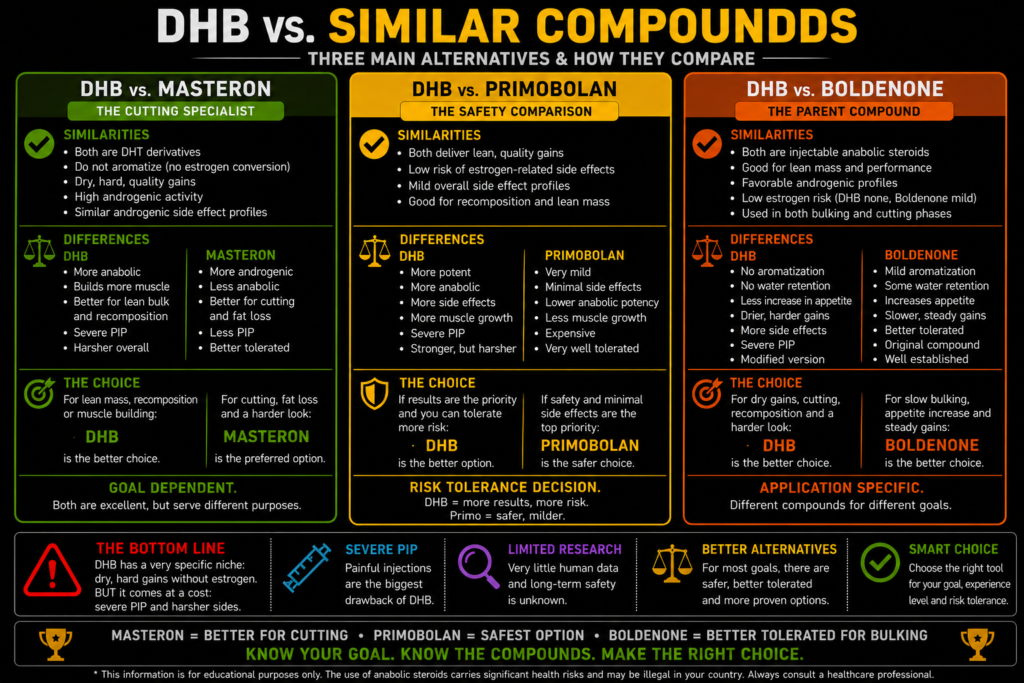
DHB vs. Masteron (Drostanolone)
Similarities:
- Both DHT derivatives
- No aromatization
- Dry, hard gains
- Androgenic side effects
- Similar profiles
Differences:
Masteron:
- More androgenic
- Less anabolic (muscle-building)
- Better for cutting (fat loss)
- Less PIP
- Better tolerated
- Cutting specialist
DHB:
- More anabolic
- Builds more muscle
- Better for lean bulk/recomposition
- Severe PIP
- Harsher overall
- Lean mass builder
The choice:
- Cutting: Masteron preferred
- Lean mass: DHB preferred
- Goal-dependent
DHB vs. Primobolan (Methenolone)
Similarities:
- Lean, quality gains
- Low side effects (relatively)
- No estrogen issues
- Mild profiles
Differences:
Primobolan:
- Very mild
- Minimal sides
- Lower anabolic potency
- Expensive
- Well-tolerated
- Safest option
DHB:
- More potent
- More side effects
- More muscle growth
- Severe PIP
- Stronger but harsher
The choice:
- Safety priority: Primobolan
- Results priority: DHB
- Risk tolerance
DHB vs. Boldenone (Equipoise)
The parent compound:
Boldenone:
- Mild aromatization
- Some water retention
- Increases appetite
- Slow, steady gains
- Better tolerated
- Original compound
DHB:
- No aromatization
- No water retention
- Less appetite increase
- Drier gains
- More side effects
- Severe PIP
- Modified version
The choice:
- Slow bulk, appetite boost: Boldenone
- Dry gains, cutting: DHB
- Application-specific
The Honest Assessment
Evidence-based recommendation.
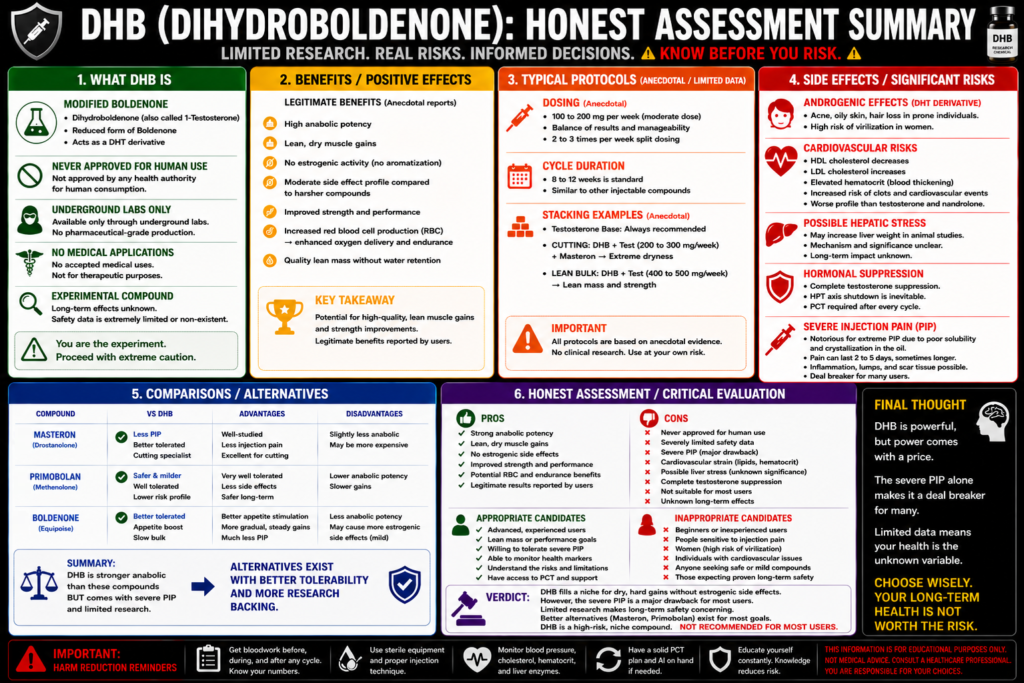
The Pros
What DHB offers:
- Strong anabolic potency
- Lean, dry muscle gains
- No estrogen issues
- Moderate side effects (compared to harshest compounds)
- Legitimate benefits
The Cons
What’s problematic:
- Never approved for human use
- Limited safety data
- Severe injection pain (PIP)
- Cardiovascular stress
- Unknown hepatic effects
- Complete testosterone suppression
- Significant drawbacks
Who Might Consider DHB
Appropriate candidates:
- Advanced users (multiple cycles completed)
- Lean mass/recomposition goals
- Willing to tolerate severe PIP
- Able to monitor health closely
- Understand limited safety data
- Experienced only
Who Should Avoid DHB
Inappropriate for:
- Beginners
- Those sensitive to injection pain
- Women (virilization risk)
- Anyone with cardiovascular issues
- Those seeking maximum mass (other compounds better)
- Most people
Better Alternatives
For similar goals:
Lean mass building:
- Testosterone (foundation)
- Primobolan (safer dry gains)
- Anavar (oral option, milder)
- Proven options
Cutting/hardening:
- Masteron (less PIP, proven)
- Trenbolone (if willing to accept harshness)
- Anavar
- Established choices
The verdict:
- DHB fills niche (dry gains without estrogen)
- But severe PIP major drawback
- Limited research concerning
- Better alternatives exist for most goals
- Niche compound with significant downsides
This article is informational only. We do not condone or recommend DHB use. DHB has never been approved for human use, safety data is extremely limited, and severe injection site pain makes it impractical for many users. Cardiovascular stress, unknown hepatic effects, and standard steroid side effects all apply. Better-researched alternatives exist. If considering any anabolic steroid, work with qualified medical professionals and understand the serious health risks involved.
REFERENCES
SECTION 1 — Primary characterization study: anabolic potency, AR binding, and hepatic effects
[1] Friedel A et al. — PubMed/Toxicology Letters, 2006 The only peer-reviewed study to characterize DHB in a controlled experimental setting; conducted after DHB was reclassified as a Schedule III controlled substance in the US to determine whether it functioned as a true anabolic-androgenic steroid rather than a prohormone; DHB bound highly selectively to the androgen receptor and showed high potency for stimulating androgen receptor-dependent transactivation; in castrated rat bioassays, an equimolar dose of DHB demonstrated the same potency as testosterone propionate for stimulating prostate, seminal vesicle, and androgen-sensitive levator ani muscle growth; unlike testosterone propionate, DHB also significantly increased liver weight in the treated animals; the primary scientific source for the article’s description of DHB’s anabolic potency, AR-selective activity, and hepatic effect, and the basis for the article’s caution about unknown hepatic risks https://pubmed.ncbi.nlm.nih.gov/16490326/
SECTION 2 — AAS cardiovascular effects: dyslipidemia as a class effect
[2] Hartgens F & Kuipers H — PubMed/Sports Medicine, 2004 Comprehensive review of androgenic-anabolic steroid effects on body composition and performance; among the most consistently documented adverse effects of AAS use is dyslipidemia, with HDL suppression and LDL elevation universally observed across compound classes; the magnitude of HDL suppression varies by compound, route of administration, and dose, with oral 17-alpha-alkylated steroids causing greater effects than injectables, and injectable non-aromatizing compounds causing intermediate HDL suppression; DHT derivatives as a class consistently suppress HDL; applies the general AAS cardiovascular evidence base to DHB, a DHT derivative, supporting the article’s description of cholesterol disruption as a significant and expected side effect https://pubmed.ncbi.nlm.nih.gov/15248788/
SECTION 3 — Testosterone suppression and HPT axis shutdown from AAS
[3] Desai NB et al. — PubMed/Translational Andrology and Urology, 2022 Review of AAS-induced spermatogenic suppression and recovery mechanisms; all AAS suppress the hypothalamic-pituitary-testicular axis through negative feedback, suppressing LH and FSH secretion and shutting down endogenous testosterone production; recovery is variable and may be prolonged, particularly with longer ester formulations; applies directly to DHB, which as an exogenous androgen activates the same HPT axis negative feedback mechanism; provides the hormonal mechanism for the article’s statement that DHB causes complete testosterone suppression and requires post-cycle therapy for hormonal recovery https://pubmed.ncbi.nlm.nih.gov/35280672/
SECTION 4 — Injection site reactions from pharmaceutical compounds: poor solubility as a mechanism
[4] Larsen C et al. — PMC/European Journal of Pharmaceutics and Biopharmaceutics, 2008 Review of the mechanisms underlying injection site pain and reactions from intramuscular drug formulations; crystal formation at the injection site following injection of poorly soluble drugs dissolved in oil vehicles is a primary cause of post-injection pain (PIP) and inflammatory reactions; the precipitation of crystals in interstitial fluid after injection triggers an inflammatory cascade producing pain, swelling, and induration lasting days; highly lipophilic compounds with poor aqueous solubility are most prone to this crystallization phenomenon; provides the pharmacological mechanism underlying the severe post-injection pain that DHB is notoriously associated with, which the article identifies as a major practical limitation of the compound https://pmc.ncbi.nlm.nih.gov/articles/PMC2677893/





Leave a Reply
You must be logged in to post a comment.