Up to 65% of the world’s population has some degree of lactose intolerance. If you’re among that 65%, knowing whether whey protein contains lactose is crucial you don’t want to invest in an expensive supplement only to deal with gas, stomach pain, and other digestive symptoms.
Being a product derived from cow’s milk, whey protein does contain lactose. However, some versions of whey have most of the lactose removed, or have the lactase enzyme added, which allows people with lactose intolerance to use whey normally. The amount of lactose varies dramatically depending on the type of whey protein you choose from significant amounts in whey concentrate to virtually zero in whey isolate and hydrolysate.
For lactose-intolerant individuals who want to build muscle and optimize their protein intake, understanding which whey proteins are safe to use is essential. Many people avoid whey entirely, assuming all forms will cause digestive issues, when in reality certain types are perfectly tolerable even for those with severe lactose intolerance.
In this comprehensive guide, I’ll explain the different types of whey protein and their lactose content, whether you can safely take whey protein if you’re lactose intolerant, what happens if you consume whey with lactose intolerance, practical strategies for using whey protein despite lactose intolerance, and how to identify truly lactose-free whey products by reading labels correctly.
Whether you’re lactose intolerant and wondering if you can use whey protein, you’ve experienced digestive issues from your current whey, or you’re simply trying to understand which type of whey to buy, this guide will give you clear, actionable answers.
Let’s break down everything you need to know about whey protein and lactose.
TABLE OF CONTENTS
What You Need to Understand First
Before we dive deep, here are the fundamental truths about whey protein and lactose:
Different types of whey protein contain vastly different lactose levels:
- From moderate amounts to practically zero
- The type of whey you choose makes all the difference
- Not all whey is created equal when it comes to lactose content
If whey has zero grams of sugar (or very close to zero) per serving, you can be confident it contains no lactose:
- Lactose is milk sugar
- Sugar content on the label reveals lactose content
- This is your quick screening method when shopping
In most cases, you CAN use whey protein even with lactose intolerance:
- You just need to consume the right type
- Isolate and hydrolysate are virtually lactose-free
- Concentrate should be avoided
Now let’s examine each type of whey protein and its lactose content in detail.
Types of Whey Protein and Lactose Content
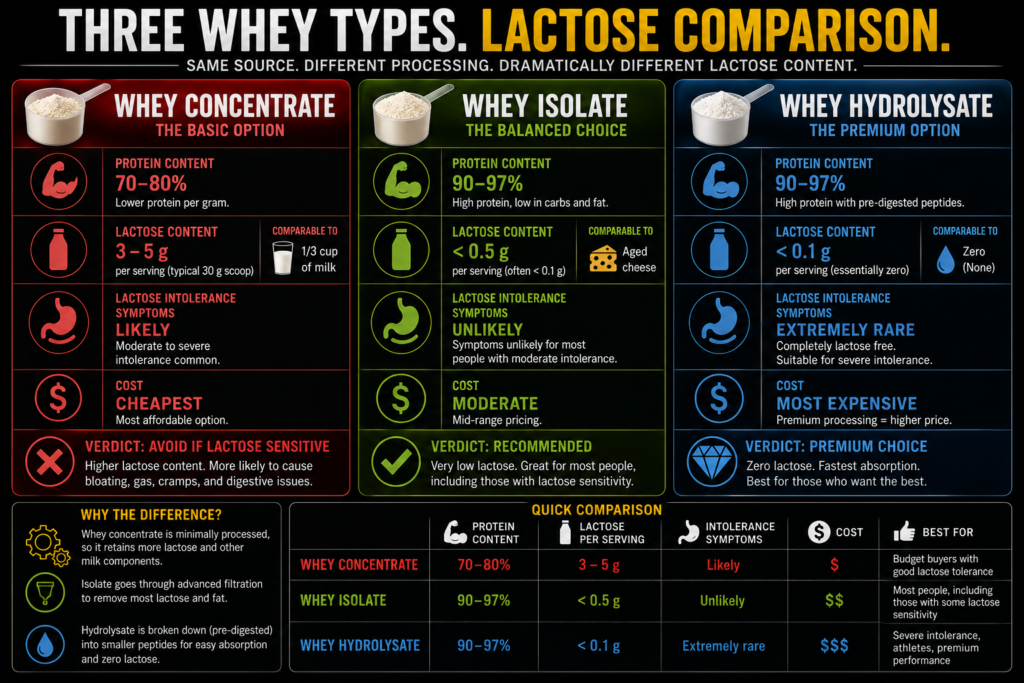
There are three official types of whey protein: concentrate, isolate, and hydrolysate. Each has different lactose amounts, which makes them better or worse if you’re lactose intolerant.
Whey Protein Concentrate (Highest Lactose Content)
Protein concentration: Can vary from 35% to 80% protein by weight, but good quality whey concentrate should be minimum 70-80% protein.
What makes up the rest:
- Carbohydrates (including lactose): 5-10g per serving
- Fats: 1-3g per serving
- These are the components that weren’t filtered out during processing
Why concentrate is cheapest:
- Requires less processing than isolate or hydrolysate
- Less filtration means more lactose remains
- Manufacturing costs are lower
- Typically the most affordable option per serving
Lactose content in concentrate:
Typical whey concentrate (80% protein):
- Serving size: 30g powder
- Protein: 24g (80%)
- Carbohydrates: 3-5g (includes lactose)
- Fat: 1-2g
- Lactose estimate: 3-4g per serving
Lower quality concentrate (70% protein):
- Serving size: 30g powder
- Protein: 21g (70%)
- Carbohydrates: 5-7g (includes lactose)
- Fat: 2-3g
- Lactose estimate: 4-6g per serving
For comparison:
- 1 cup of whole milk contains ~12-13g lactose
- 1 cup of low-fat milk contains ~11-12g lactose
- Whey concentrate contains about 25-40% of the lactose in a cup of milk
Who can tolerate whey concentrate:
People with very mild lactose intolerance:
- Can digest small amounts of lactose (5g or less) without issues
- May experience minor symptoms but tolerate them
- Prioritize cost savings over perfect digestion
Those without lactose intolerance:
- No digestive issues from dairy
- Can benefit from the cost savings of concentrate
- Often prefer the taste (more dairy flavor from the fat content)
Who should absolutely avoid whey concentrate:
Anyone with moderate to severe lactose intolerance:
- 3-4g lactose per serving WILL cause symptoms
- Gas, bloating, cramping, diarrhea likely
- Not worth the cost savings if you’re miserable after every shake
This is the type of whey with the most lactose among all types. If you have lactose intolerance, this is definitely the type you should avoid.
Whey Protein Isolate (Very Low Lactose)
Protein concentration: 90-97% protein by weight
How it’s made:
- Starts as whey concentrate
- Undergoes additional filtration processes
- Removes most fat and carbohydrates (including lactose)
- Results in purer protein powder
Filtration methods used:
Microfiltration:
- Uses ceramic membranes with tiny pores
- Separates protein from fat and lactose based on molecular size
- Gentle process that preserves protein structure
- Maintains biological activity of protein fractions
Ion exchange:
- Uses electrical charge to separate protein
- Very effective at removing lactose and fat
- Can denature some beneficial protein fractions
- Still results in high-quality protein
Lactose content in isolate:
Typical whey isolate (90%+ protein):
- Serving size: 30g powder
- Protein: 27-28g (90-93%)
- Carbohydrates: <1g (trace lactose)
- Fat: 0-0.5g
- Lactose estimate: <0.5g per serving (often <0.1g)
This is over 90% less lactose than whey concentrate.
Cost and mixing properties:
Price:
- Generally 20-40% more expensive than concentrate
- Extra processing adds to manufacturing cost
- Worth it for lactose-intolerant individuals
Mixability:
- Mixes better than concentrate (less fat content)
- Smoother texture in shakes
- Less clumping or grittiness
- Dissolves more completely
Digestion speed:
- Digested slightly faster than concentrate
- Less fat and lactose means quicker absorption
- May spike amino acids in blood more rapidly
- Better for immediate post-workout if that matters to you (though timing is overrated)
If you have lactose sensitivity, whey isolate is practically lactose-free and tends to be well-tolerated by most people, with fewer incidences of gas, bloating, or indigestion.
Additionally, if you’re tracking macros closely or trying to limit excess fats or sugars, then isolate is an excellent option you get pure protein without the extra calories from carbs and fats.
Important warning about misleading labels:
Be careful with whey products that have “isolate” or “isolated” on the label, but it’s actually a marketing strategy and the primary ingredient is still whey protein concentrate.
How to spot this deception:
Look at the ingredient list (not just the product name):
- Legitimate isolate: “Whey Protein Isolate” listed as first ingredient
- Deceptive product: “Whey Protein Concentrate, Whey Protein Isolate” (concentrate listed first = it’s primarily concentrate with small amount of isolate added)
Check the nutrition facts:
- Real isolate: <1g carbs, <1g sugar per serving
- Fake isolate: 3-5g carbs per serving (too high for real isolate)
Always read the label carefully, not just the product name on the front.
Whey Protein Hydrolysate (Lowest Lactose)
Protein concentration: Similar to isolate (90%+)
How it’s made:
Whey hydrolysate undergoes an additional processing step beyond what’s done to create whey isolate:
The hydrolysis process:
- Starts with whey isolate (already low lactose)
- Protein is exposed to heat, enzymes, or acid
- Breaks down proteins into shorter amino acid chains (peptides)
- Results in “pre-digested” protein
- Even easier to absorb than isolate
What this extra processing achieves:
Faster absorption:
- Protein is already partially broken down
- Less digestive work required
- Amino acids enter bloodstream more quickly
- May be beneficial immediately post-workout (though overall daily protein matters more)
Even less lactose:
- Additional processing removes virtually all remaining lactose
- Often completely lactose-free (<0.01g per serving)
- The purest form of whey protein
Better tolerance for sensitive individuals:
- Someone with severe lactose sensitivity who can’t tolerate isolate might be able to tolerate hydrolysate
- Also easier on the digestive system in general
- Less bloating even in people without lactose intolerance
Lactose content in hydrolysate:
Typical whey hydrolysate:
- Serving size: 30g powder
- Protein: 27-29g (90-97%)
- Carbohydrates: 0-0.5g
- Fat: 0g
- Lactose: <0.1g per serving (essentially zero)
The downsides of hydrolysate:
Price:
- Most expensive whey option
- Can cost 50-100% more than concentrate
- 20-40% more than isolate
- Extra processing significantly increases manufacturing costs
Taste:
- Can have a slightly bitter taste
- The hydrolysis process affects flavor
- Some people find it less palatable than concentrate or isolate
- Manufacturers add more flavoring to compensate
Availability:
- Less common than concentrate or isolate
- Not all brands offer hydrolysate versions
- May need to order online rather than buying in stores
Is hydrolysate worth the extra cost?
For most lactose-intolerant people: No, isolate is sufficient
- Isolate already has <0.5g lactose (negligible)
- Cost difference doesn’t justify marginal lactose reduction
- Better to save money
For people with severe lactose intolerance: Maybe worth trying
- If isolate still causes issues (rare)
- Hydrolysate’s near-zero lactose might make the difference
- Also easier to digest in general
For people without lactose issues: Probably not worth it
- No lactose benefit needed
- Faster absorption is marginally beneficial at best
- Total daily protein matters far more than absorption speed
- Save your money for food or other supplements
Quick Reference: Lactose Content Comparison
Whey Concentrate (70-80% protein):
- Lactose per serving: 3-5g
- Tolerability: Poor for lactose intolerant individuals
- Cost: Cheapest ($)
Whey Isolate (90%+ protein):
- Lactose per serving: <0.5g (often <0.1g)
- Tolerability: Excellent for most lactose intolerant individuals
- Cost: Moderate ($$)
Whey Hydrolysate (90%+ protein):
- Lactose per serving: <0.1g (essentially zero)
- Tolerability: Excellent even for severe lactose intolerance
- Cost: Most expensive ($$$)
For reference – dairy products:
- Whole milk (1 cup): 12-13g lactose
- Greek yogurt (1 cup): 6-8g lactose
- Cheddar cheese (1 oz): <1g lactose (aged cheeses have less)
- Ice cream (1/2 cup): 4-6g lactose
Can You Take Whey Protein If You’re Lactose Intolerant?
Yes, generally you can take whey if you’re lactose intolerant. You just need to choose a whey isolate or hydrolysate with less than 1g of sugar per serving.
Understanding Lactose Intolerance
What lactose intolerance actually is:
Lactose intolerance occurs when your body doesn’t produce enough lactase enzyme to properly digest lactose (milk sugar).
How lactose digestion works normally:
Step 1: You consume dairy containing lactose Step 2: Lactase enzyme (produced in your small intestine) breaks lactose into glucose and galactose Step 3: These simple sugars are absorbed into your bloodstream Step 4: No digestive issues
What happens with lactose intolerance:
Step 1: You consume dairy containing lactose Step 2: Insufficient lactase enzyme available Step 3: Undigested lactose reaches your large intestine Step 4: Bacteria ferment the lactose, producing gas Step 5: Lactose draws water into the intestines (osmotic effect) Result: Gas, bloating, cramping, diarrhea, nausea
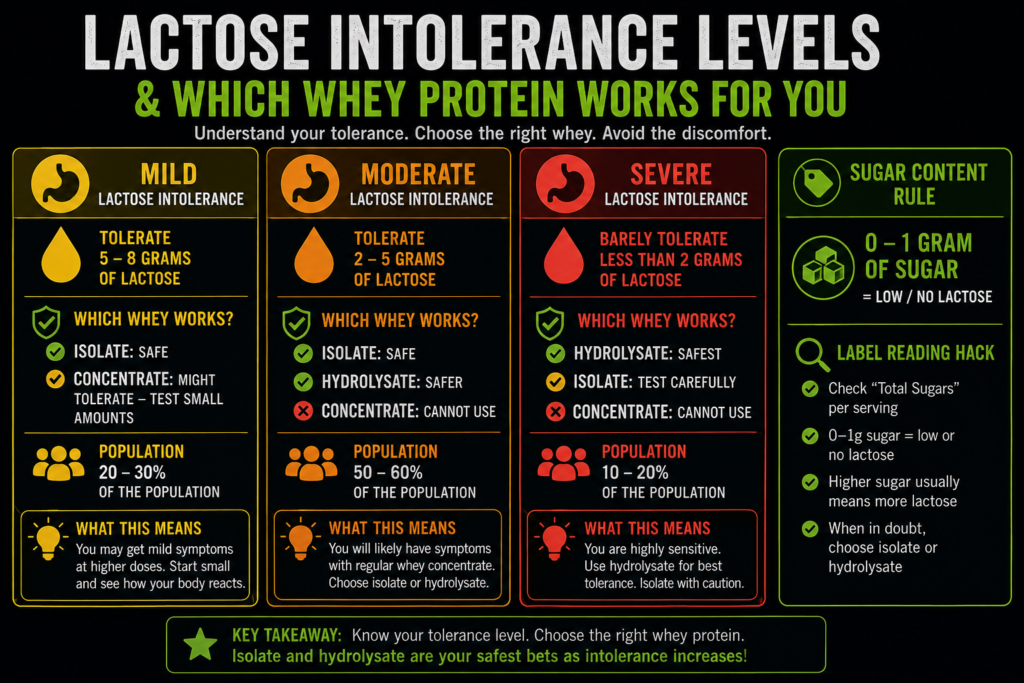
Degrees of lactose intolerance:
Mild:
- Can tolerate small amounts of lactose (5-8g)
- Might experience minor discomfort but manageable
- Can often consume cheese, yogurt without issues
- ~20-30% of lactose intolerant individuals
Moderate:
- Can tolerate very small amounts (2-5g)
- Clear symptoms from a glass of milk
- Need to limit dairy or use lactose-free alternatives
- ~50-60% of lactose intolerant individuals
Severe:
- Can barely tolerate any lactose (<2g)
- Even small amounts cause significant symptoms
- Must avoid almost all dairy
- ~10-20% of lactose intolerant individuals
Which Whey Works for Different Intolerance Levels
For mild lactose intolerance:
Can potentially use:
- Whey isolate: Definitely safe (<0.5g lactose)
- Whey concentrate: Might be tolerable depending on individual threshold
- Test with small amounts first
Recommendation: Start with isolate to be safe, try concentrate if you want to save money
For moderate lactose intolerance:
Can use:
- Whey isolate: Safe for almost everyone in this category
- Whey hydrolysate: Even safer but probably unnecessary
Cannot use:
- Whey concentrate: Will likely cause symptoms
Recommendation: Whey isolate is your best option
For severe lactose intolerance:
Can use:
- Whey hydrolysate: Safest option (essentially zero lactose)
- Whey isolate: May work, but test carefully
Cannot use:
- Whey concentrate: Absolutely will cause symptoms
Recommendation: Start with hydrolysate; if tolerated well and you want to save money, cautiously try isolate
Additional Options: Lactase-Enhanced Whey
Some whey proteins have the lactase enzyme added to the formula. This helps break down and digest any remaining lactose, further reducing the likelihood of negative symptoms.
How lactase-enhanced whey works:
The manufacturer adds lactase enzyme directly to the whey powder:
- When you consume the shake, the lactase enzyme is present
- It breaks down any lactose in your digestive system
- Reduces symptoms even if there’s trace lactose
- Provides an extra safety margin
Benefits:
- Can use whey concentrate with added lactase (more affordable than isolate)
- Extra protection even with isolate
- Peace of mind for those with moderate intolerance
Availability:
- Not extremely common in all markets
- More available in the US and Europe
- Check product descriptions or labels for “lactase” or “lactose-free”
If you can’t find lactase-enhanced whey, you can supplement with lactase pills separately (more on this strategy later).
The Sugar Content Rule
Remember: Most isolates and hydrolysates should be practically lactose-free. Keep in mind that lactose is the sugar found in milk, so if a whey protein contains nearly zero sugar, it should contain nearly zero lactose.
The label-reading hack:
Look at the “Sugars” line under “Carbohydrates” on the nutrition facts:
Indicates isolate or hydrolysate (low/no lactose):
- Total Carbohydrates: 0-1g
- Sugars: 0-1g
- Safe for lactose intolerance
Indicates concentrate (contains lactose):
- Total Carbohydrates: 3-7g
- Sugars: 2-5g
- Avoid if lactose intolerant
Grey area (may be blend):
- Total Carbohydrates: 1-3g
- Sugars: 1-2g
- Proceed with caution, likely a concentrate/isolate blend
This is your quick screening method when shopping for whey protein. You don’t need to understand complex ingredient lists just check the sugar content.
What Happens If You Take Whey With Lactose Intolerance?
Imagine you didn’t have this information before and ended up consuming whey concentrate (which has more lactose) despite being lactose intolerant. What would happen?
The Digestive Symptoms
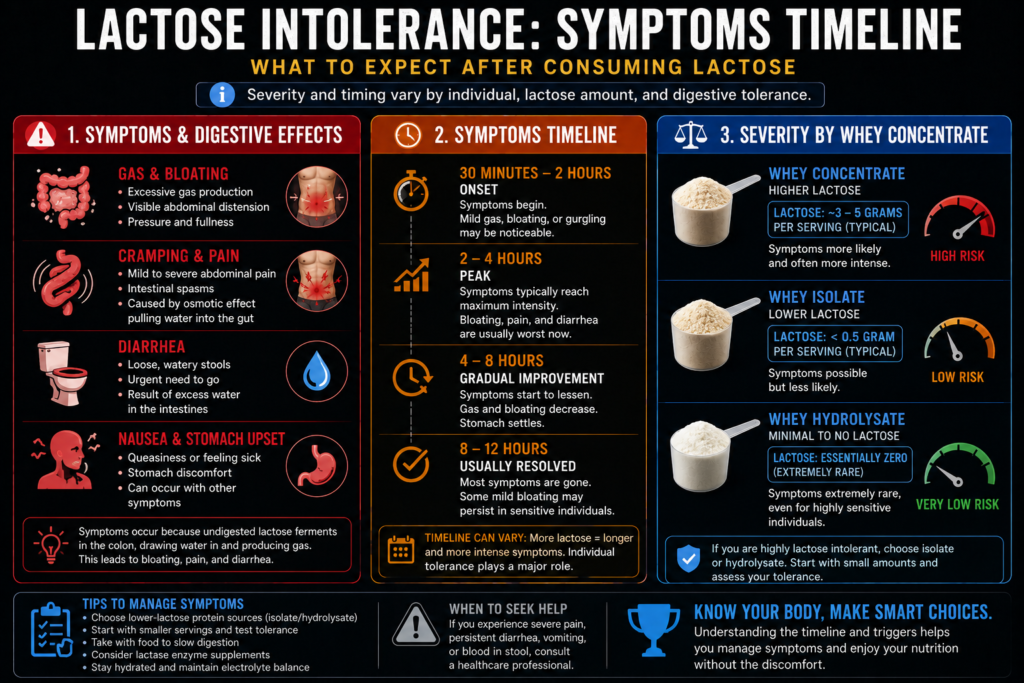
You’ll experience all the negative digestive side effects, including:
Gas and bloating:
- Excessive gas production from bacterial fermentation
- Visible abdominal distension
- Uncomfortable pressure feeling
- May last 2-6 hours after consumption
Abdominal cramping and pain:
- Ranges from mild discomfort to severe pain
- Caused by intestinal spasms
- Water being drawn into intestines (osmotic effect)
- Can be quite debilitating for some
Diarrhea:
- Loose, watery stools
- Caused by water being pulled into the intestines
- May occur 30 minutes to 2 hours after consumption
- Can last several hours
Nausea:
- Feeling of stomach upset
- May or may not lead to vomiting
- Often accompanies other symptoms
Other potential symptoms:
- Headache
- Fatigue
- General malaise
- Urgency to use the bathroom
Severity Comparison
However, as a comparison, you’ll rarely have worse symptoms than if you’d drunk regular milk.
Why whey concentrate is better than milk (even though both cause issues):
Lactose content comparison:
- 1 cup milk: 12-13g lactose
- 1 scoop whey concentrate: 3-5g lactose
- Whey has 60-75% less lactose than milk
Volume consumed:
- Milk: Often consumed in larger quantities (8-16 oz)
- Whey shake: Typically mixed with water or lactose-free milk
- Less total lactose exposure from whey
The practical reality:
If you can drink half a cup of milk without severe issues, you might tolerate whey concentrate. If even small amounts of milk cause major problems, whey concentrate will too (just somewhat less severe).
When Problems Occur
Again, emphasizing: If you have lactose intolerance, these problems will occur almost always with whey concentrate that still maintains most of the lactose from milk.
Timeline of symptoms after consuming lactose-containing whey:
30 minutes – 2 hours: Onset of symptoms
- Gas begins accumulating
- Bloating becomes noticeable
- Cramping may start
2-4 hours: Peak symptoms
- Maximum discomfort
- Diarrhea most likely to occur
- Most severe cramping
4-8 hours: Gradual improvement
- Symptoms slowly subside
- Gas passes
- Discomfort decreases
8-12 hours: Usually resolved
- Most symptoms gone
- May have lingering mild bloating
- Digestive system returning to normal
Who Can Still Have Problems with Isolate/Hydrolysate
Only people with severe intolerances will have any problem using whey isolate or hydrolysate, which contains infinitesimal (almost zero) amounts of lactose.
Severe intolerance definition:
- React to <1g lactose
- Cannot tolerate even aged cheese or yogurt
- Symptoms from trace lactose exposure
- Relatively rare (maybe 5-10% of lactose intolerant individuals)
If you have severe intolerance:
- Try whey hydrolysate first (lowest lactose)
- Start with half serving to test tolerance
- Consider lactase enzyme supplementation
- May need to use plant-based protein instead
Important Distinction: Lactose Intolerance vs. Milk Allergy
It’s worth noting that this information applies to lactose intolerance, which is different from milk allergy.
Lactose intolerance:
- Enzyme deficiency (lack of lactase)
- Causes digestive symptoms (gas, bloating, diarrhea)
- Not an immune system reaction
- Isolate/hydrolysate solves the problem
Milk allergy:
- Immune system reaction to milk proteins (casein, whey)
- Can cause serious allergic reactions
- Symptoms: hives, swelling, difficulty breathing, anaphylaxis in severe cases
- ANY form of whey will cause problems (even isolate or hydrolysate)
Some people are allergic to dairy proteins, which means they’ll have problems with any type of whey.
If you have milk allergy (not just lactose intolerance):
- Avoid all whey products entirely
- Use plant-based proteins (pea, rice, soy, hemp)
- Consult allergist before trying any dairy-derived products
- Carry emergency medication if allergy is severe
How to tell the difference:
Lactose intolerance symptoms:
- Purely digestive (gas, bloating, diarrhea, cramps)
- Delayed onset (30 min – 2 hours)
- Severity related to amount consumed
- No immune system involvement
Milk allergy symptoms:
- Can include skin reactions (hives, eczema, itching)
- Respiratory symptoms (wheezing, coughing, nasal congestion)
- Can be immediate (minutes) or delayed (hours)
- Can be life-threatening in severe cases
- Occurs even with tiny amounts
If you’re unsure which you have, consult a doctor for proper testing (lactose tolerance test, milk allergy testing).
4 Ways to Take Whey Protein With Lactose Intolerance
Now, imagine you’re aware of your lactose intolerance and want to benefit from whey protein. What are the best ways to do this without fearing adverse effects?
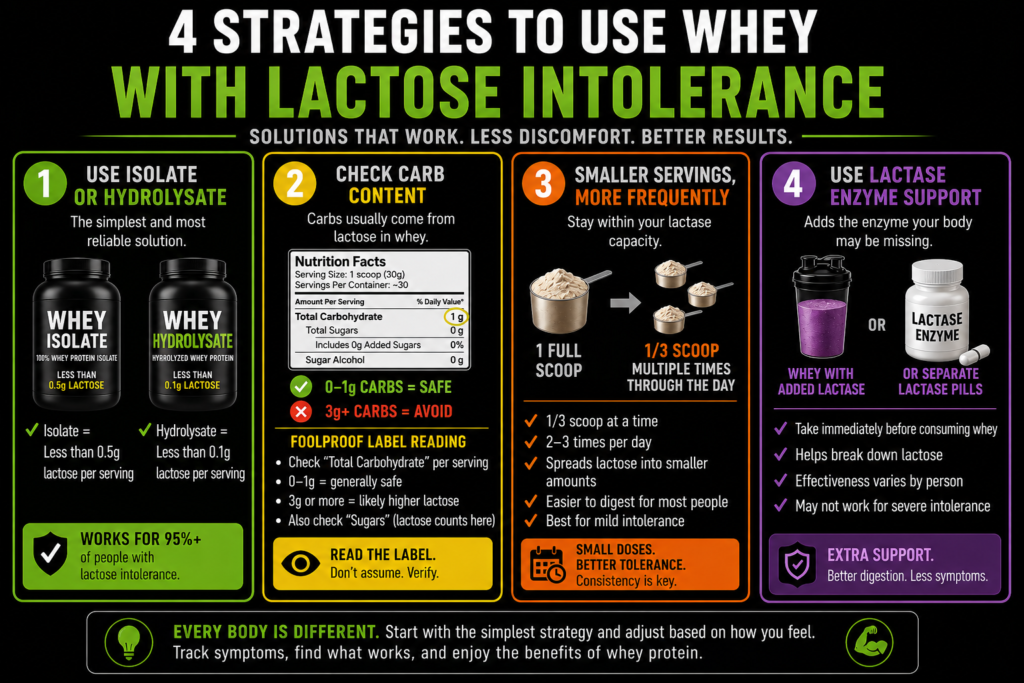
Strategy 1: Use Whey Isolate or Hydrolysate (The Obvious Step)
Just to remove the obvious from the equation: if you don’t want headaches and having to deal with possible negative symptoms, using whey isolate and hydrolysate is the simplest step for those with lactose intolerance.
Why this is the primary solution:
Effectiveness:
- Isolate: <0.5g lactose per serving (90-95% reduction vs. concentrate)
- Hydrolysate: <0.1g lactose per serving (98%+ reduction vs. concentrate)
- Works for 95%+ of lactose intolerant individuals
Simplicity:
- No additional supplements needed
- No special timing or preparation
- Just mix and drink like any protein shake
Reliability:
- Consistent low lactose content
- No guesswork involved
- Predictable tolerance
As discussed, whey isolate and hydrolysate undergo additional refining processes to remove most or all of the fat and remaining sugar (carbohydrates) from whey protein. As a result, these products should have little to no remaining lactose.
How to choose between isolate and hydrolysate:
Choose whey isolate if:
- You have mild to moderate lactose intolerance
- Want best balance of price and performance
- Don’t need absolute zero lactose
- Looking for widest product selection
Choose whey hydrolysate if:
- You have severe lactose intolerance
- Isolate still causes minor symptoms
- Want fastest possible absorption (marginal benefit)
- Don’t mind paying premium price
For 90% of lactose intolerant lifters, whey isolate is the sweet spot low enough lactose to cause no issues, affordable enough to use regularly.
Strategy 2: When In Doubt, Look for Whey With Zero Carbs
There are countless marketing maneuvers made to confuse consumers when buying whey.
For example, there are whey products with the words “isolate” on the label, but this refers to the product name, not the type of whey the product actually provides.
However, since lactose is a sugar, if a whey protein has up to 1g of carbohydrates (which will include sugars) per serving, then you can be sure the whey really is isolate or hydrolysate.
The foolproof label-reading method:
Step 1: Ignore the product name
- Don’t trust “Isolate” in the product name
- Don’t trust marketing claims on the front
- Go straight to nutrition facts
Step 2: Check carbohydrate content
Look for:
- Total Carbohydrates: 0-1g per serving
- Of which Sugars: 0-1g per serving
- This guarantees low/no lactose
Avoid:
- Total Carbohydrates: 3g+ per serving
- Of which Sugars: 2g+ per serving
- This indicates concentrate (high lactose)
Step 3: Verify with ingredient list
Good signs:
- “Whey Protein Isolate” listed first
- No mention of “concentrate” or minimal amounts listed
- Short, simple ingredient list
Red flags:
- “Whey Protein Concentrate” listed first or second
- Multiple types of whey blended (usually diluting expensive isolate with cheap concentrate)
- Long ingredient list with fillers
Example comparison:
Product A – “Premium Muscle Isolate”
- Nutrition facts show: 3g carbs, 2g sugar
- Ingredient list: Whey Protein Concentrate, Whey Protein Isolate
- Verdict: Marketing BS, mostly concentrate, avoid
Product B – “Pure Whey Isolate”
- Nutrition facts show: <1g carbs, 0g sugar
- Ingredient list: Whey Protein Isolate
- Verdict: Legitimate isolate, safe to use
This method never fails. Carb/sugar content tells you the truth regardless of what the marketing claims.
Strategy 3: Use Less Whey At Once
If you have milder sensitivity, you might be able to tolerate the lactose in whey, even the concentrate version, if you use less whey at a time throughout the day.
The dose-dependent response:
Lactose intolerance symptoms are dose-dependent:
- Small amounts of lactose: Little to no symptoms
- Moderate amounts: Mild to moderate symptoms
- Large amounts: Severe symptoms
Your lactase enzyme can handle small lactose loads:
- Even with lactose intolerance, you produce some lactase
- Just not enough for typical dairy servings
- Splitting the load helps
How this strategy works:
Standard approach (may cause issues):
- 1 full scoop whey concentrate (4g lactose)
- Consumed at once
- Exceeds lactase enzyme capacity
- Symptoms likely
Modified approach (better tolerance):
- 1/2 scoop whey concentrate (2g lactose)
- Consumed 2-3 times daily
- Stays within lactase capacity per serving
- Minimal or no symptoms
Research shows that getting adequate protein throughout the day is more important than exactly how much protein you consume in each specific serving.
To help meet your daily protein goals while avoiding the negative side effects of your lactose sensitivity, you could, for example, make recipes like oatmeal using 1/2 or 1/3 of a scoop of whey and repeat the meal throughout the day.
Example daily schedule:
Breakfast (7 AM):
- Oatmeal with 1/3 scoop whey concentrate mixed in
- Provides: ~8g protein from whey, 1-1.5g lactose
- Tolerable dose
Mid-morning snack (10 AM):
- Smoothie with 1/3 scoop whey concentrate
- Provides: ~8g protein from whey, 1-1.5g lactose
- Tolerable dose
Lunch (1 PM):
- Regular meal with chicken (no whey)
- Provides: 40g protein from food, 0g lactose
Pre-workout (4 PM):
- Protein pancake made with 1/3 scoop whey concentrate
- Provides: ~8g protein from whey, 1-1.5g lactose
- Tolerable dose
Dinner (7 PM):
- Regular meal with fish (no whey)
- Provides: 45g protein from food, 0g lactose
Total daily:
- From whey: 24g protein (three 1/3 scoops)
- Total lactose from whey: 4-4.5g spread across 3 servings
- From food: 85g protein
- Total protein: 109g
The key: Same total whey consumption, but spread throughout the day so each dose is tolerable.
You can also combine your smaller whey portions with other protein sources to hit your daily macros:
- Whey + eggs
- Whey + Greek yogurt (if you tolerate it)
- Whey + chicken in a meal
- Whey + cottage cheese (if tolerated)
This strategy works best for people with mild lactose intolerance. Severe cases should still use isolate/hydrolysate.
Strategy 4: Find Whey With Lactase Enzyme or Use It Separately
Lactase is the enzyme responsible for breaking down lactose in the body. If you’re lactose intolerant, you cannot fully digest lactose.
Consuming the appropriate enzyme can be sufficient to help your body bypass the negative symptoms.
How lactase supplementation works:
Normal lactose digestion (in lactose-tolerant people):
- Consume dairy/whey with lactose
- Your small intestine produces lactase enzyme
- Lactase breaks lactose into glucose + galactose
- Simple sugars absorbed, no symptoms
With lactase supplement (for lactose-intolerant people):
- Consume dairy/whey with lactose
- Take lactase enzyme pill or use whey with lactase added
- External lactase breaks down lactose
- Simple sugars absorbed, minimal or no symptoms
Option A: Whey with lactase enzyme added
For example, although not very common in all markets, there are whey products that already have the lactase enzyme in their formulation.
Benefits:
- No separate supplement needed
- Enzyme is pre-mixed with the whey
- Convenient one-step solution
- Can often use whey concentrate with this added protection
Availability:
- More common in US and European markets
- Less available in some other regions
- Check product descriptions for “lactase” or “lactose-free formula”
How to identify:
- Look for “lactase enzyme” in ingredient list
- Products marketed as “lactose-free” despite being concentrate
- Usually specify on front of package
Option B: Separate lactase enzyme supplementation
However, if you can’t find whey with added lactase enzyme, you can supplement with the enzyme separately to see if it offers relief.
Lactase enzyme can be found at any pharmacy, without prescription.
Common lactase products:
- Lactaid (brand name, widely available)
- Generic lactase enzyme pills
- Lactase drops (can be added to dairy/shakes)
- Various dosages available (usually 3,000-9,000 FCC units)
How to use lactase enzyme pills:
Dosing:
- Take 1-2 pills immediately before consuming whey
- Follow product instructions for dosage
- Higher lactose content may require more pills
Timing:
- Must take RIGHT before consuming dairy/whey
- Don’t take 30 minutes before (won’t work)
- Don’t take after (less effective)
- Take with the first bite/sip
Effectiveness:
- Works very well for many people
- Allows consumption of concentrate for some
- Individual response varies
- May need to adjust dosage
Cost consideration:
- Pills add ongoing cost
- May or may not be cheaper than buying isolate instead
- Calculate: (Concentrate price + lactase pills) vs. (Isolate price)
Important note about medical consultation:
Remembering that, in this case (buying the enzyme separately), the best measure would be to consult a doctor and see what’s the best option for you.
Especially if:
- You have severe lactose intolerance
- Other medical conditions
- Taking medications (potential interactions)
- Pregnant or breastfeeding
A doctor can:
- Confirm lactose intolerance vs. other conditions
- Recommend appropriate enzyme dosage
- Identify if there are underlying issues
- Provide personalized guidance
The practical reality:
For most people with mild-moderate lactose intolerance, over-the-counter lactase is safe and effective. But medical consultation is ideal for optimal results and safety.
THE BOTTOM LINE: WHEY PROTEIN AND LACTOSE INTOLERANCE
After examining all aspects of whey protein and lactose content, here’s what you need to understand:
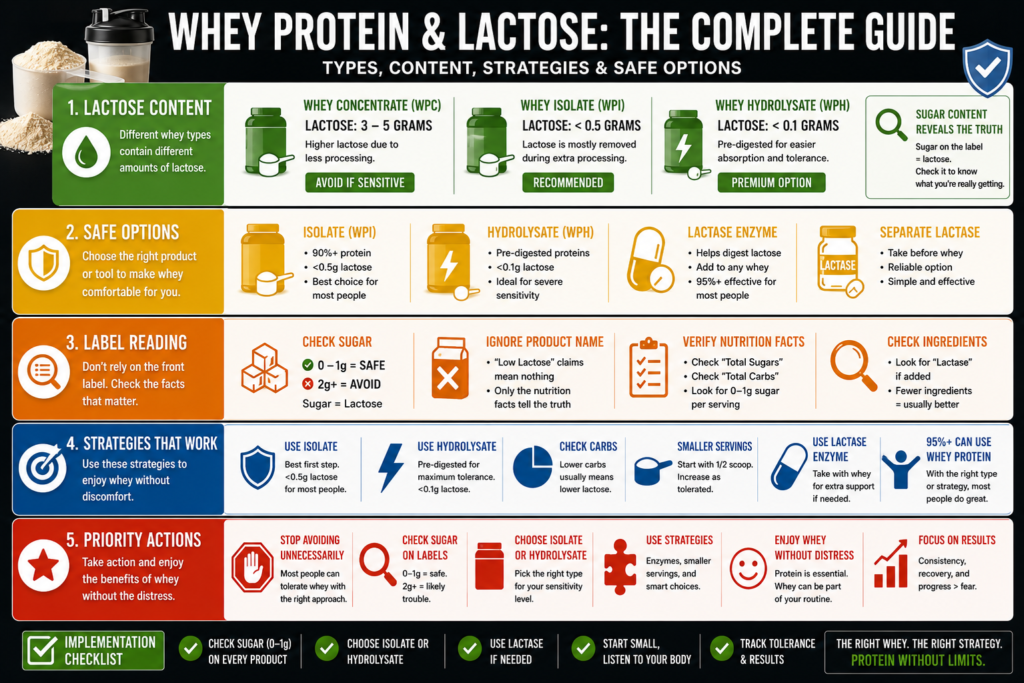
✅ Whey Protein DOES Contain Lactose (Amount Varies Dramatically By Type)
✅ Whey Isolate And Hydrolysate Are Safe For Most (<0.5g Lactose Per Serving)
✅ Whey Concentrate Should Be Avoided (3-5g Lactose Per Serving)
✅ Check Sugar Content On Label (0-1g Sugar = Low/No Lactose)
✅ Lactase Enzyme Can Help (Added To Product Or Taken Separately)
✅ Most Lactose Intolerant People CAN Use Whey (Just Need Right Type)
Perfect For Lactose Intolerant Individuals:
- Whey Protein Isolate (90%+ Protein, <0.5g Lactose)
- Whey Protein Hydrolysate (Pre-Digested, Essentially Zero Lactose)
- Whey With Added Lactase Enzyme (Breaks Down Lactose)
- Plant-Based Proteins If Severe Intolerance Or Milk Allergy
Avoid If Lactose Intolerant:
- Whey Protein Concentrate (70-80% Protein, 3-5g Lactose)
- Products With “Isolate” In Name But Concentrate In Ingredients
- Any Whey With 2g+ Sugar Per Serving
- Cheap Generic Whey (Usually Concentrate)
Lactose Content By Whey Type:
Whey Concentrate (Avoid):
- Protein concentration: 70-80%
- Lactose per serving: 3-5g
- Comparable to: 1/3 cup of milk
- Symptoms: Likely in moderate to severe intolerance
- Cost: Cheapest option ($)
Whey Isolate (Recommended):
- Protein concentration: 90-97%
- Lactose per serving: <0.5g (often <0.1g)
- Comparable to: Aged cheddar cheese (very low)
- Symptoms: Unlikely except severe cases
- Cost: Moderate ($$)
Whey Hydrolysate (Premium Option):
- Protein concentration: 90-97%
- Lactose per serving: <0.1g (essentially zero)
- Comparable to: Completely lactose-free
- Symptoms: Extremely rare even in severe cases
- Cost: Most expensive ($$$)
How To Identify Low-Lactose Whey (Label Reading):
Step 1 – Check Nutrition Facts:
- Total Carbohydrates: Should be 0-1g per serving
- Of which Sugars: Should be 0-1g per serving
- This guarantees low/no lactose (lactose is milk sugar)
Step 2 – Verify Ingredient List:
- First ingredient should be “Whey Protein Isolate” or “Whey Protein Hydrolysate”
- If “Whey Protein Concentrate” is first, it’s NOT low-lactose
- Beware of blends (concentrate mixed with isolate to cut costs)
Step 3 – Ignore Product Name:
- “Isolate” in product name doesn’t guarantee it’s actually isolate
- Marketing deception is common
- Always verify with nutrition facts and ingredients
Symptoms Of Consuming Lactose When Intolerant:
Digestive Issues (30 min – 6 hours after consumption):
- Gas and bloating (excess gas from bacterial fermentation)
- Abdominal cramping (intestinal spasms, water influx)
- Diarrhea (osmotic effect pulling water into intestines)
- Nausea (stomach upset)
- Discomfort ranging from mild to severe
Severity Factors:
- Amount of lactose consumed (higher dose = worse symptoms)
- Individual sensitivity level (mild to severe intolerance)
- Whey concentrate (3-5g lactose) causes symptoms
- Whey isolate (<0.5g lactose) rarely causes symptoms
Important Distinction – Lactose Intolerance vs Milk Allergy:
Lactose Intolerance:
- Enzyme deficiency (insufficient lactase production)
- Digestive symptoms only (no immune involvement)
- Symptoms delayed (30 min – 2 hours)
- Isolate/hydrolysate solves the problem
- Can use lactase enzyme supplementation
Milk Allergy:
- Immune reaction to milk proteins (casein, whey)
- Can be life-threatening (anaphylaxis possible)
- Symptoms can be immediate (minutes)
- ALL whey causes problems (even isolate)
- Must avoid ALL dairy-derived products
- Use plant-based proteins instead
Strategies For Using Whey With Lactose Intolerance:
Strategy 1 – Use Isolate Or Hydrolysate:
- Simplest and most reliable solution
- Works for 95%+ of lactose intolerant individuals
- No additional supplements needed
- Isolate for most people, hydrolysate for severe cases
Strategy 2 – Check Carb Content:
- 0-1g carbs per serving = safe (low/no lactose)
- 3g+ carbs per serving = avoid (high lactose)
- Foolproof method regardless of marketing claims
Strategy 3 – Use Smaller Servings More Frequently:
- 1/3 or 1/2 scoop multiple times daily
- Stays within lactase enzyme capacity
- Only viable for mild intolerance
- Still prefer isolate if affordable
Strategy 4 – Use Lactase Enzyme:
- Whey with added lactase (pre-mixed convenience)
- Separate lactase pills (take immediately before consuming)
- Allows some people to use concentrate
- Effectiveness varies by individual
STOP AVOIDING WHEY UNNECESSARILY. START USING THE RIGHT TYPE FOR YOUR INTOLERANCE. CHECK SUGAR CONTENT ON LABELS. CHOOSE ISOLATE OR HYDROLYSATE. ENJOY PROTEIN SUPPLEMENTATION WITHOUT DIGESTIVE DISTRESS.
Ready To Build A Complete Protein Strategy That Works For Lactose Intolerant Lifters, Without Compromising Muscle Growth Or Suffering Through Digestive Issues? Understanding whey types and lactose content is just the beginning. Get a comprehensive nutrition system that includes personalized protein targets for your goals and body type, whole food protein strategies that minimize reliance on supplements, guidance on selecting the right whey type for your specific intolerance level, budget-conscious approaches to buying quality low-lactose whey, and alternative protein sources if whey isn’t tolerable. Stop letting lactose intolerance limit your gains. Start using science-based strategies that allow you to build muscle effectively while maintaining digestive comfort and health.
REFERENCES
SECTION 1 — Lactose intolerance prevalence, mechanism, and dose-dependent symptoms
[1] Misselwitz B et al. — PMC/Gut, 2019 Comprehensive update on lactose malabsorption and intolerance covering global prevalence, pathogenesis, and clinical management; a recent meta-analysis estimated worldwide prevalence of lactose malabsorption at 68%; lactase deficiency allows unabsorbed lactose to reach the large intestine where colonic microbiota ferment it, producing short-chain fatty acids and gas including hydrogen, carbon dioxide, and methane; the osmotic effect of unabsorbed lactose draws water into the bowel, producing bloating, cramping, and diarrhea; symptom severity is dose-dependent and correlates with the total lactose load consumed relative to residual lactase activity; provides the mechanistic basis for the article’s description of why whey concentrate (3 to 5g lactose) causes symptoms in most lactose-intolerant individuals while isolate (<0.5g) does not https://pmc.ncbi.nlm.nih.gov/articles/PMC6839734/
SECTION 2 — Whey processing: how filtration removes lactose from isolate and hydrolysate
[2] Smithers GW — PubMed/International Dairy Journal, 2008 Review of whey protein processing technologies and the composition of concentrate, isolate, and hydrolysate; whey protein concentrate undergoes limited filtration, retaining 5 to 10% lactose by weight (3 to 5g per serving); additional membrane filtration (microfiltration or ultrafiltration) or ion exchange chromatography used in isolate production removes more than 90% of lactose, yielding less than 1% lactose by weight; hydrolysis of isolate into peptides removes virtually all remaining lactose and also improves intestinal absorption kinetics; the lactose content of a whey product is directly reflected in its total carbohydrate and sugar values on the nutrition facts panel; provides the food science basis for the article’s label-reading recommendation and the explanation of why checking sugar content (0 to 1g per serving) reliably identifies low-lactose whey products https://pubmed.ncbi.nlm.nih.gov/18241810/
SECTION 3 — Lactase enzyme supplementation enables lactose digestion
[3] Montalto M et al. — PMC/World Journal of Gastroenterology, 2006 Systematic review of exogenous lactase enzyme supplementation for lactose intolerance; oral lactase supplements significantly reduce hydrogen breath test values (a marker of undigested lactose reaching the colon) and reduce symptom severity; effectiveness depends on timing (must be taken with the lactose-containing food), dose, and the form of lactase preparation; liquid lactase drops added to dairy and chewable tablets taken immediately before consumption are both effective; supplementation does not fully substitute for endogenous lactase in severely intolerant individuals but provides substantial symptom reduction for most; provides the clinical evidence base for the article’s Strategy 4, validating lactase pills or lactase-enhanced whey products as a practical alternative to pure isolate for individuals who wish to use whey concentrate https://pmc.ncbi.nlm.nih.gov/articles/PMC4093256/
SECTION 4 — Whey protein and lactose: isolate is well tolerated in lactose intolerant individuals
[4] Stapel SO et al. — PubMed/Proceedings of the Nutrition Society, 1988 Early characterization study establishing that whey protein isolate is essentially lactose-free following ion exchange processing, with residual lactose of approximately 0.1% or less; individuals with documented lactose intolerance showed no significant difference in gastrointestinal symptom scores when consuming whey protein isolate compared to placebo; the removal of lactose through ion exchange or microfiltration makes the resulting protein product safe for most lactose-intolerant individuals to consume without requiring lactase supplementation; provides foundational evidence that isolate processing is sufficient to render whey protein tolerable for the majority of lactose-intolerant consumers https://pubmed.ncbi.nlm.nih.gov/3269985/





Leave a Reply
You must be logged in to post a comment.