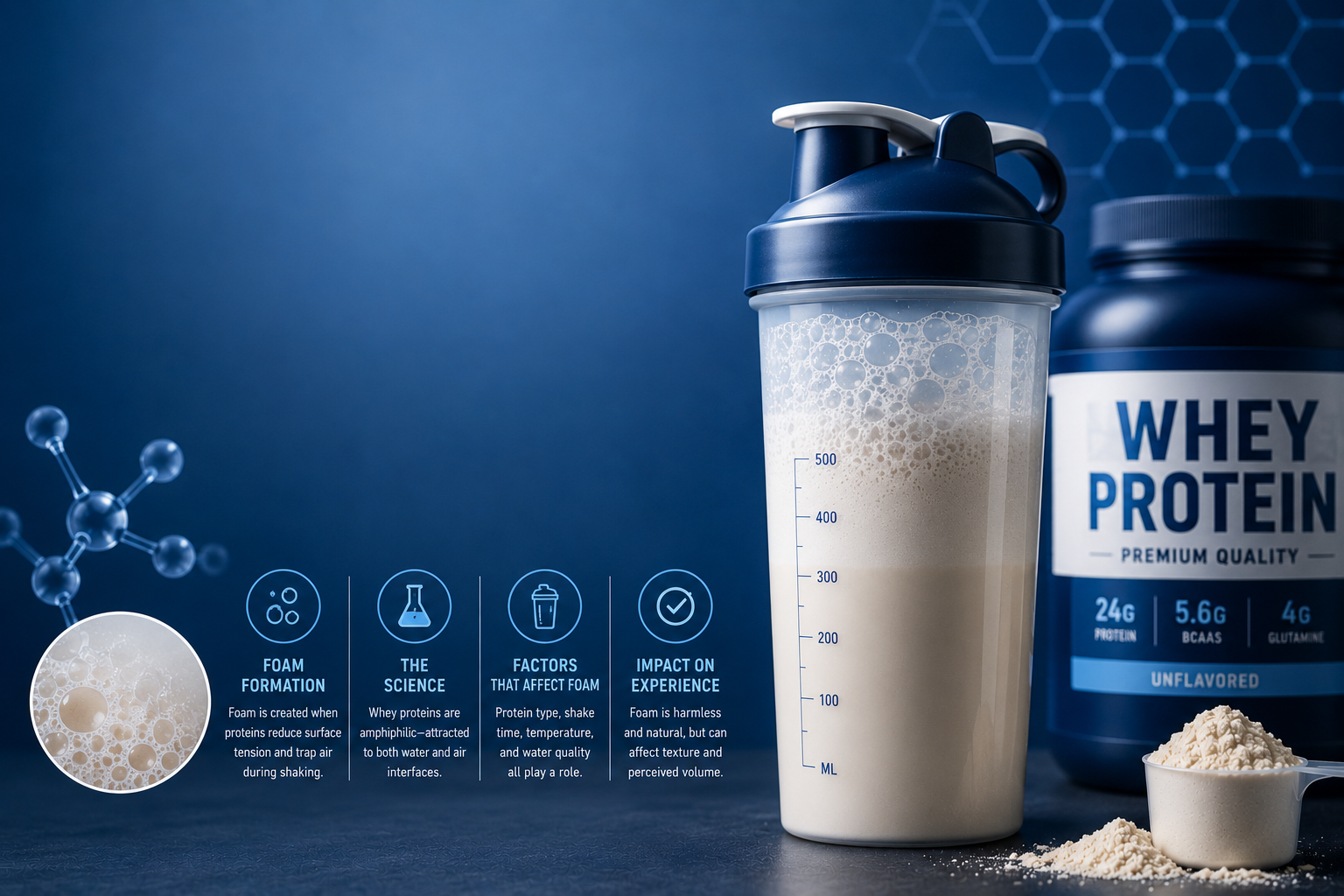
You just mixed up your post-workout whey protein shake, and there’s a thick layer of foam sitting on top. You’re staring at it, wondering: did my protein go bad? Is this a sign of low quality? Should I be concerned about drinking this?
So why is your whey protein creating foam when mixed? Foam in whey protein has to do with the chemical structure of whey and, sometimes, with the structure of the liquid it’s mixed with. Foam in protein shakes can also occur because of how it’s mixed the more vigorously you shake or blend, the more foam you’ll create. This is a completely natural phenomenon related to protein chemistry, not a sign of spoilage or poor quality.
For people who use protein powder regularly, understanding what causes foam, whether it’s harmful, and how to minimize it can improve your supplement experience. Some people find the foam unpleasant or worry it indicates a problem with their protein. Others experience digestive discomfort and incorrectly blame the foam.
In this comprehensive guide, I’ll explain exactly what the foam in your protein shake is and why it forms, whether drinking foam is harmful or affects protein quality, the four main reasons your whey protein shake gets foamy, practical strategies to reduce or eliminate foam if you prefer, and whether certain whey proteins foam less than others.
Whether you’re bothered by excessive foam in your shakes, concerned about protein quality, or just curious about the science behind this phenomenon, understanding foam formation will help you make informed decisions about preparing your protein shakes.
Let’s break down everything you need to know about foam in whey protein shakes.
TABLE OF CONTENTS
What Exactly Is the Foam in Your Whey Protein Shake?
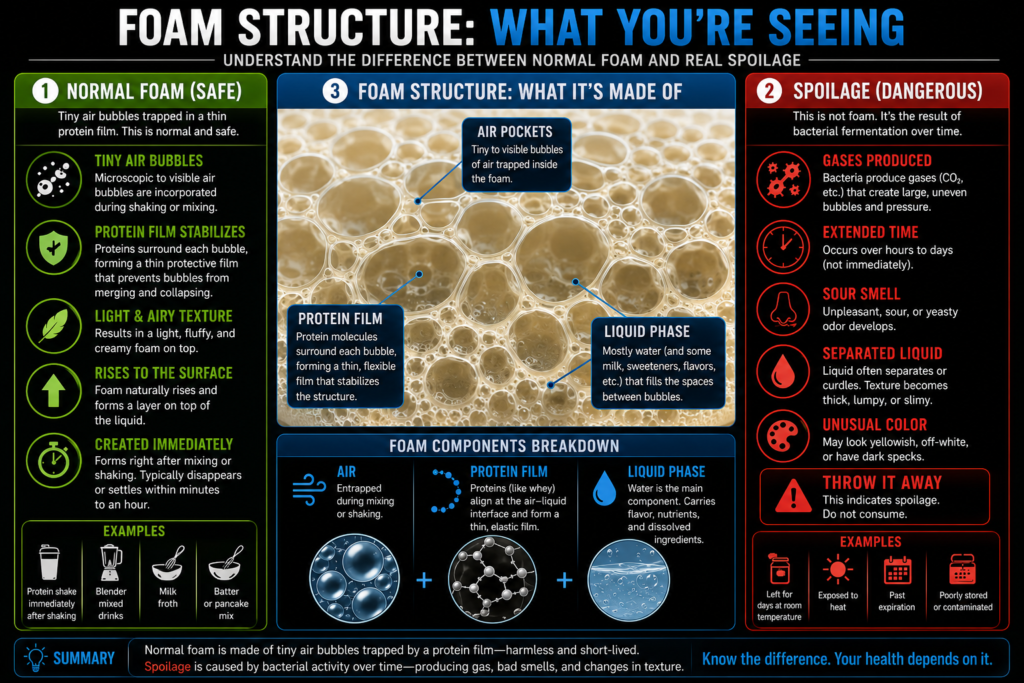
The foam in a shake containing whey protein is composed of tiny trapped air bubbles the same type of foam that’s formed when a barista steams milk to make espresso drinks like lattes or cappuccinos.
Understanding the Structure of Foam
Foam basics:
Foam is essentially a dispersion of gas (air) in a liquid, stabilized by surface-active agents. In the case of protein shakes, the surface-active agents are the protein molecules themselves.
The components of shake foam:
Air bubbles:
- Tiny pockets of air trapped in the liquid
- Range from microscopic to visible size
- Create the light, airy texture of foam
- Rise to the surface due to buoyancy (air is less dense than liquid)
Protein film:
- Thin layer of protein molecules surrounding each bubble
- Stabilizes the bubble and prevents immediate collapse
- Creates the structural integrity of the foam
- The reason foam persists rather than immediately disappearing
Liquid phase:
- Water, milk, or whatever liquid you used
- Fills the spaces between bubbles
- Gets incorporated into the foam structure
The visual appearance:
Well-formed protein shake foam typically:
- Sits as a layer on top of the shake
- Has a creamy, white or off-white color
- May have larger bubbles visible on the surface
- Can be quite thick (sometimes 1-2 inches)
- Feels light and airy when scooped
What Foam Is NOT
These bubbles are not gases generated internally from spoiled food, unless you’ve prepared your shake with some liquid and left it sitting for days until it spoiled (in which case, throw it out).
Important distinction:
Normal foam (safe to consume):
- Created during the mixing process
- Air incorporated from shaking or blending
- Forms immediately when you mix the shake
- Stable and persistent
- No off odors or strange colors
Spoilage gases (dangerous, do not consume):
- Created by bacterial fermentation
- Occurs after extended time (days)
- Often accompanied by sour smell
- May cause container to bulge or pressurize
- Liquid may separate or change color
- Throw away immediately
How to tell if your shake has spoiled:
Signs of spoilage (discard immediately):
- Sour, rancid, or foul odor
- Liquid has separated into layers (beyond normal settling)
- Unusual color (grey, green, yellow tint)
- Slimy texture
- Fizzing or bubbling when opened (pressure buildup)
- Shake has been sitting at room temperature for 2+ hours
- Shake has been refrigerated for 3+ days
Normal shake characteristics (safe to consume):
- Foam on top from mixing
- Typical whey protein smell (slightly sweet, milky)
- Consistent color (white, cream, or colored by flavoring)
- No separation beyond powder settling to bottom
- Made fresh or refrigerated <24 hours
The foam you see immediately after mixing your shake is completely normal and safe it’s just physics and chemistry at work, not bacterial activity.
Is It Harmful to Drink Whey Protein With Foam?
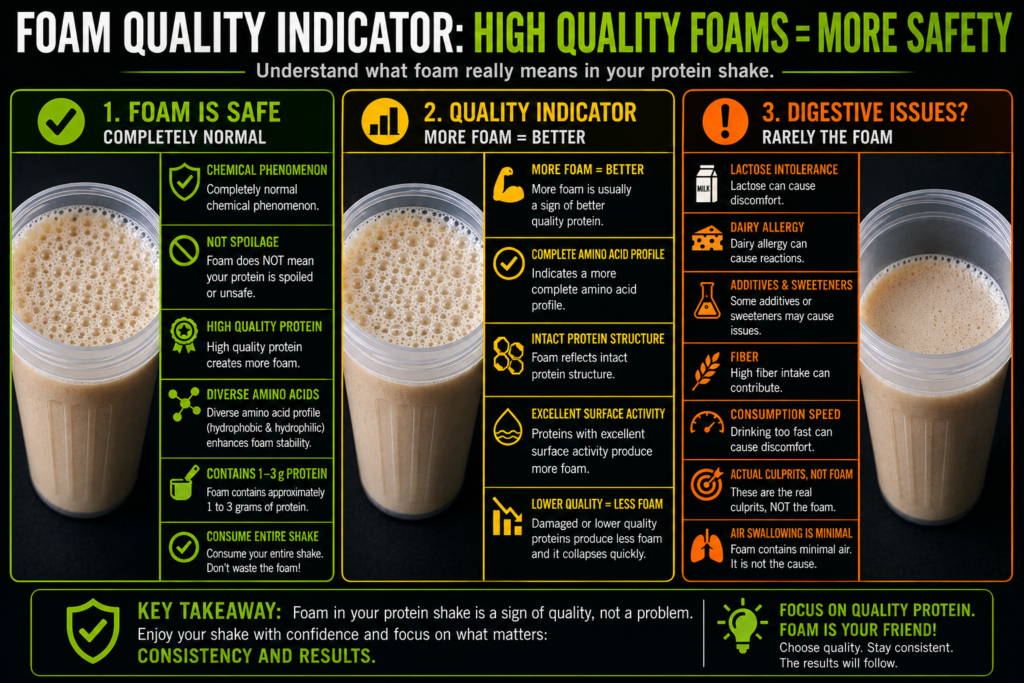
When dealing with whey protein that hasn’t spoiled, it’s not harmful to drink a shake with foam. The ability to form foam is a normal characteristic of mixing protein with liquids.
Foam Can Actually Indicate Quality
In fact, the higher the protein quality, the more bubbles and foam it can form due to the varied range of amino acids, which will include the presence of amino acids that attract or repel water.
Why high-quality protein foams more:
Diverse amino acid profile:
- High-quality proteins contain all essential amino acids
- Each amino acid has different chemical properties
- Some are hydrophobic (repel water)
- Some are hydrophilic (attract water)
- This diversity enhances foam formation and stability
Complete protein structure:
- Intact protein molecules with proper folding
- More surface-active properties
- Better ability to stabilize air bubbles
- Longer-lasting foam
Minimal denaturation:
- Gentle processing preserves protein structure
- Better functional properties
- Enhanced foaming capability
Lower quality proteins often foam less:
- Damaged or denatured proteins
- Incomplete amino acid profiles
- Reduced surface activity
- Foam collapses quickly
So if your whey protein creates a lot of stable foam, this is often a good sign, not a bad one.
Foam Contains Actual Protein
Speaking of which, the foam actually contains a small portion of your shake’s protein content.
What’s in the foam:
The foam isn’t just air it’s air bubbles surrounded by protein molecules:
- Protein concentration in foam: Lower than the liquid phase but not zero
- Estimated protein in typical foam layer: 1-3g (depending on foam volume)
- This is protein you paid for
Should you make sure to consume the foam?
For maximum protein intake: Yes, consume the foam
- Ensures you get every gram of protein you mixed
- Matters if tracking macros precisely
- Especially important if using expensive protein
If you don’t care about 1-3g protein: You can skip the foam
- Minimal impact on total daily protein
- Won’t make or break your gains
- Personal preference matters
Most people just drink the entire shake including foam without thinking about it, which is perfectly fine.
Foam and Digestive Discomfort
Some people report bloating or gas when taking whey, which might make you think the foam is the culprit.
While swallowing more oxygen (through foam) can cause digestive symptoms, keep in mind that there’s a much higher chance the problem is caused by:
Lactose intolerance:
- Whey concentrate contains 3-5g lactose per serving
- Causes gas, bloating, cramping in intolerant individuals
- Solution: Switch to whey isolate or hydrolysate
Dairy allergy in general:
- Immune reaction to milk proteins
- Can cause digestive upset, skin reactions, respiratory issues
- Solution: Use plant-based protein powders
Mixing fiber into the shake:
- Adding oats, psyllium husk, or other fiber sources
- Fiber increases gas production during digestion
- Especially if you’re not used to high fiber intake
- Solution: Gradually increase fiber, ensure adequate hydration
Presence of additives and sweeteners:
- Sugar alcohols (erythritol, xylitol, maltitol) cause gas in many people
- Artificial sweeteners (sucralose, aspartame) bother some individuals
- Gums and thickeners (xanthan gum, guar gum) can cause bloating
- Solution: Try unflavored or minimally processed protein
Consuming the shake too quickly:
- Drinking fast means swallowing more air (aerophagia)
- Air in stomach causes bloating and burping
- Not specific to foam, applies to rapid consumption of any beverage
- Solution: Drink more slowly, take smaller sips
The honest truth about foam and digestion:
The foam itself is rarely the primary cause of digestive issues. While swallowing air can contribute to minor bloating, the protein, lactose, additives, or consumption speed are far more likely culprits.
If you experience digestive problems after protein shakes:
Step 1: Eliminate the foam (skim it off, let it settle)
- If problems persist, foam wasn’t the issue
Step 2: Switch to whey isolate or hydrolysate (eliminates lactose)
- If problems persist, it’s not lactose
Step 3: Try a different brand with minimal additives
- If problems persist, it might be dairy allergy
Step 4: Try plant-based protein (pea, rice, hemp)
- If problems persist, it’s likely not the protein type
Step 5: Examine other shake ingredients (milk, fiber, fruits)
- Often the liquid or additions cause issues, not the protein powder itself
The Bottom Line on Safety
Foam in whey protein shakes is:
- Completely safe to consume
- Normal chemical phenomenon
- Not a sign of spoilage (unless the shake has been sitting for days)
- Often indicates high-quality protein
- Contains small amounts of protein itself
You can confidently drink your shake, foam and all, without health concerns.
4 Reasons Your Whey Protein Shake Has Foam
Now let’s examine the specific reasons foam forms in protein shakes. Understanding these mechanisms helps you control foam formation if you want to reduce it.
Reason 1: The Protein Itself (The Primary Cause)
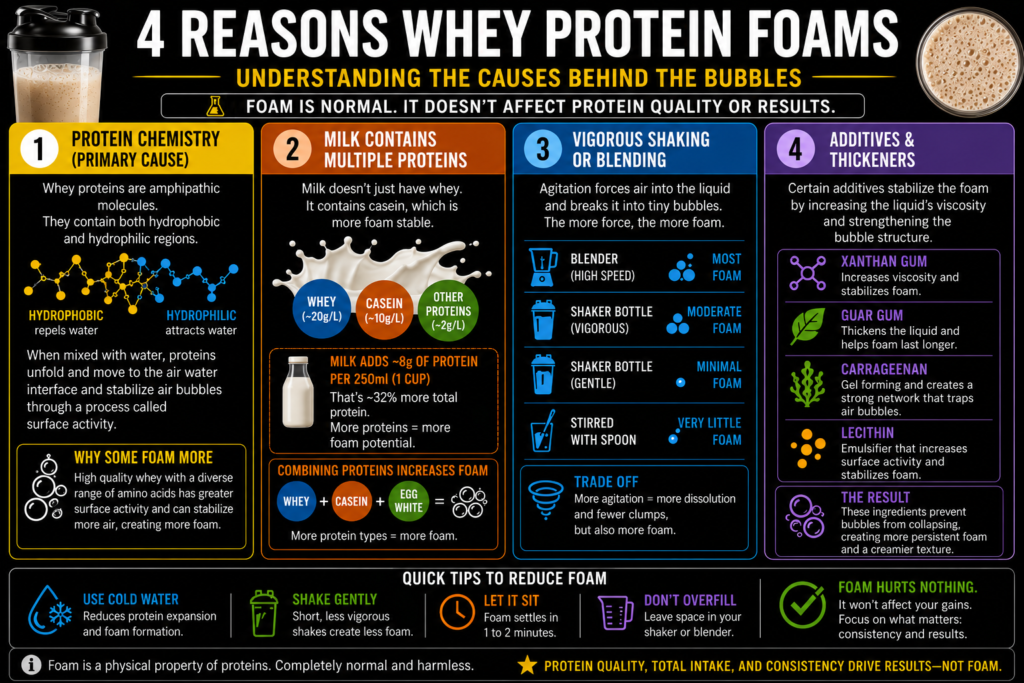
Protein is a macromolecule, meaning it’s a large molecule composed of smaller components. In the case of protein, these smaller components are individual amino acids (the building blocks of protein).
The molecular mechanism of foam formation:
Step 1: Protein structure
- Amino acids linked together in long chains
- Each amino acid has specific chemical properties
- Some amino acids have hydrophobic (water-repelling) regions
- Others have hydrophilic (water-attracting) regions
Step 2: What happens when you shake or mix
- Shaking or mixing protein powder causes amino acid molecules to stretch and collide with each other
- Mechanical agitation disrupts the normal folded structure of proteins
- Proteins unfold and expose their inner hydrophobic and hydrophilic regions
Step 3: Interaction with water
- When you mix these amino acids in liquid, hydrophilic regions orient toward the water
- Hydrophobic regions orient away from water (toward air)
- This creates what chemists call “surface activity”
Step 4: Foam stabilization
- You create a thin web of protein molecules that traps air between water molecules on the surface of the protein shake
- The protein molecules form a film around air bubbles
- This film is strong enough to prevent bubbles from immediately bursting
- Trapped air = bubbles, and many small bubbles = foam
The chemistry of amphipathic molecules:
Proteins are “amphipathic” they have both hydrophobic and hydrophilic regions. This dual nature is what makes them excellent foam stabilizers:
Hydrophobic (water-fearing) amino acids:
- Leucine, isoleucine, valine
- Phenylalanine, tryptophan, methionine
- Alanine, glycine, proline
- These orient away from water, toward air
Hydrophilic (water-loving) amino acids:
- Lysine, arginine, histidine
- Aspartic acid, glutamic acid
- Serine, threonine
- These orient toward water
At the air-water interface:
- Hydrophobic parts stick into the air bubble
- Hydrophilic parts stick into the water
- Protein molecules arrange themselves at the bubble surface
- This arrangement stabilizes the bubble and prevents collapse
Why whey protein specifically foams well:
Whey protein characteristics:
- Contains all 20 amino acids in significant amounts
- Excellent balance of hydrophobic and hydrophilic amino acids
- Naturally unfolded structure (compared to more tightly folded proteins)
- High concentration of beta-lactoglobulin (excellent foaming properties)
Comparison to other proteins:
- Casein (milk protein): Foams less than whey, more tightly folded structure
- Plant proteins (pea, rice): Generally foam less than whey, different amino acid composition
- Egg white (albumin): Foams extremely well, similar surface-active properties to whey
The takeaway: The protein itself is the primary cause of foam. This is unavoidable with high-quality protein powder.
Reason 2: You’re Mixing With Milk or With Other Proteins
Since milk is naturally high in protein (milk protein is a combination of whey proteins and casein), it has foam-producing properties on its own.
Milk’s contribution to foam:
Protein content of milk:
- Whole milk: ~8g protein per cup
- Skim milk: ~8g protein per cup
- 2% milk: ~8g protein per cup
- This protein is 20% whey, 80% casein
Additional foam from milk protein:
- You’re adding 8g protein from milk to 25g from whey powder
- Total: 33g protein in the shake
- More protein = more foam-stabilizing molecules = more foam
Fat content in milk:
- Whole milk contains fat globules
- Fat can interfere with foam formation (actually reduces foam somewhat)
- But protein content outweighs this anti-foaming effect
- Net result: More foam than water-based shakes
Mixing whey with additional protein sources:
Similarly, some people like to go beyond and mix whey with another protein source, like egg white protein (albumin), which also has amino acids that facilitate foam creation.
Common protein combinations that increase foam:
Whey + egg white protein:
- Both are excellent foamers
- Egg whites are famous for foam formation (meringues, soufflés)
- Combined effect is substantial foam
Whey + casein:
- Casein alone foams less than whey
- But still contributes to total protein content
- More foam than whey alone
Whey + plant protein:
- Depends on the plant protein type
- Pea protein has moderate foaming ability
- Rice protein foams less
- Still increases total foam vs. whey alone
Basically, any shake with protein will have foam. Mixing more than one protein source and adding milk (which is also high in protein) will only further increase the amount of bubbles and foam.
The math:
Whey shake with water:
- 25g whey protein powder
- 0g protein from water
- Total: 25g protein
- Foam: Moderate
Whey shake with milk:
- 25g whey protein powder
- 8g protein from milk
- Total: 33g protein
- Foam: High (32% more protein)
Whey + casein shake with milk:
- 25g whey protein powder
- 25g casein protein powder
- 8g protein from milk
- Total: 58g protein
- Foam: Very high (132% more protein than whey alone)
If you want less foam, use water instead of milk and avoid combining multiple protein sources in one shake.
Reason 3: You’re Shaking the Shake Too Much (Which Isn’t Actually a Problem)
By shaking very vigorously or using a blender to make a shake, you’re literally forcing air into the liquid.
The mechanics of agitation:
Shaking by hand:
- Shaker bottle creates turbulence
- Liquid sloshes back and forth
- Air from headspace (empty space in bottle) gets mixed into liquid
- Mixing ball or wire whisk creates additional turbulence
- More vigorous shaking = more air incorporation = more foam
Using a blender:
- Blades spin at high speed (10,000-20,000 RPM)
- Creates vortex that pulls air from surface into liquid
- Extremely effective at creating small, uniform bubbles
- Produces the most foam of any mixing method
The relationship between agitation and foam:
As we saw above, proteins in the shake have hydrophobic (water-repelling) and hydrophilic (water-attracting) parts. When you agitate them, you’ll get more foam. If you shake a lot, you’ll get a lot of foam. Simple as that.
Experimental comparison:
Gentle stirring (spoon, 30 seconds):
- Minimal foam production
- Powder may not fully dissolve
- Few air bubbles incorporated
- Foam layer: <0.5 inches
Moderate shaking (shaker bottle, 20 seconds):
- Moderate foam production
- Powder fully dissolved
- Air bubbles distributed throughout
- Foam layer: 1-1.5 inches
Vigorous shaking (shaker bottle, 60 seconds):
- Substantial foam production
- Powder completely dissolved
- Many small bubbles
- Foam layer: 1.5-2 inches
Blender (30 seconds on high):
- Extreme foam production
- Perfect dissolution
- Thousands of tiny bubbles
- Foam layer: 2-3+ inches
- Foam may be half the volume of the shake
But is this a problem?
No! Vigorous mixing is actually beneficial:
- Ensures complete dissolution of powder (no clumps)
- Creates smooth, uniform consistency
- Foam indicates thorough mixing
- All the protein is properly suspended in liquid
The foam from vigorous mixing is a sign you’ve done a good job, not that something went wrong.
If you prefer less foam: Mix more gently, but accept that you may have some undissolved powder or clumps.
Reason 4: Because of Additives and Thickeners
Other common ingredients in protein powders can also contribute to foam formation.
For example, xanthan gum, a common thickening agent, leads to foamier protein shakes than protein powders without xanthan gum.
Additives that increase foam:
Xanthan gum:
- Polysaccharide (complex carbohydrate)
- Used to thicken shakes and improve texture
- Increases viscosity of the liquid phase
- Higher viscosity = more stable foam (bubbles don’t collapse as easily)
- Very common in commercial protein powders
Guar gum:
- Similar to xanthan gum
- Thickening agent
- Stabilizes foam structure
- Slows foam dissipation
Carrageenan:
- Extracted from seaweed
- Stabilizer and thickener
- Creates creamy texture
- Enhances foam stability
Lecithin (soy or sunflower):
- Emulsifier (helps mix ingredients that normally separate)
- Also has foaming properties
- Helps create fine, stable foam
- Common in protein powders
Additionally, some thickeners decrease the rate at which foams dissipate.
This means the foam lasts longer rather than quickly collapsing back into the liquid. While the initial foam formation might be similar, additives make the foam persist.
Why manufacturers add these ingredients:
Improved texture:
- Thicker, creamier mouthfeel
- Less watery consistency
- More satisfying to drink
Better mixing:
- Prevents powder from settling immediately
- Keeps shake uniform
- Reduces clumping
Enhanced perceived value:
- Thicker shake feels more substantial
- Consumers associate thickness with quality
- Marketing advantage
Not all protein powders contain thickening agents, but many do, which can make some whey proteins foam more than others.
How to identify foam-enhancing additives:
Check the ingredient list for:
- Xanthan gum
- Guar gum
- Carrageenan
- Cellulose gum
- Lecithin
- Any ingredient with “gum” in the name
If you want minimal foam: Choose protein powders with short, simple ingredient lists containing only protein, natural flavoring, and sweetener.
Trade-off:
- Less foam but thinner, more watery texture
- May mix less smoothly
- Could have more clumping
Most people prefer the improved texture from these additives and don’t mind the extra foam.
How to Avoid Foam in Your Whey Protein Shake
If for some reason you’re not convinced or simply don’t want foam in your whey, the good news is there are several ways to reduce its presence:
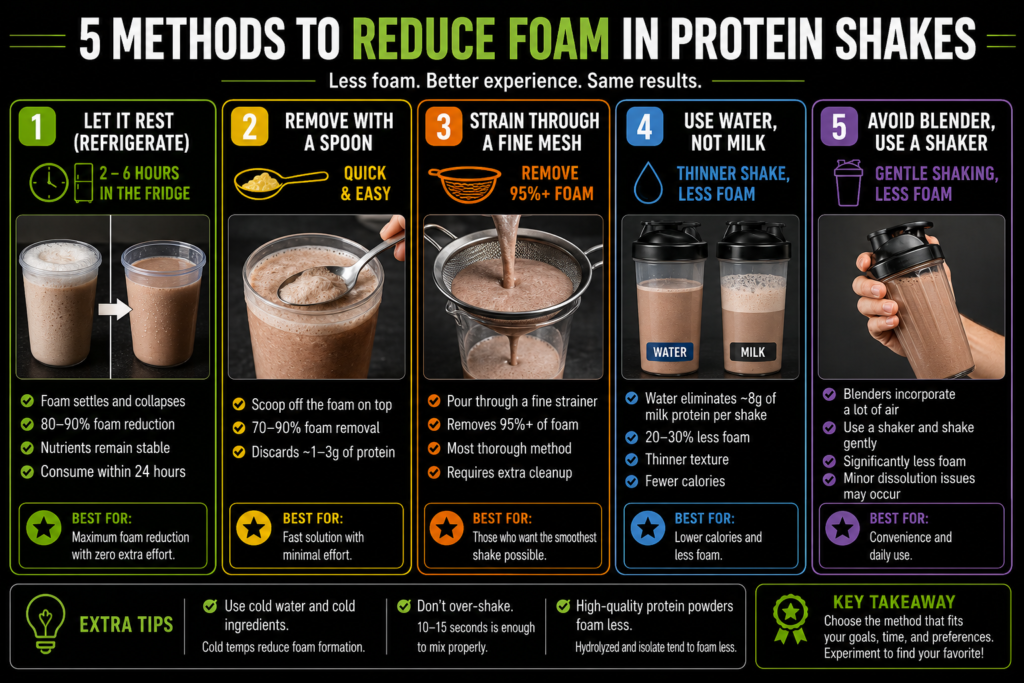
Method 1: Let Your Shake Rest
Make your shake a few hours in advance and leave it refrigerated this won’t harm the nutrient quality and can allow the foam to “settle” and decrease.
How this works:
Foam instability over time:
- Small bubbles gradually merge into larger bubbles
- Larger bubbles rise to the surface faster
- Eventually, bubbles burst
- Liquid drains from the foam back into the shake
- After several hours, most foam collapses
The timeline:
Immediately after mixing:
- Maximum foam (2-3 inches)
- Bubbles small and stable
- Foam is thick and persistent
After 30 minutes (room temperature):
- Foam reduced by ~25%
- Some bubbles have burst
- Remaining foam still substantial
After 2 hours (refrigerated):
- Foam reduced by ~50-70%
- Most small bubbles collapsed
- Thin foam layer remains
After 4-6 hours (refrigerated):
- Foam reduced by ~80-90%
- Only minimal foam on surface
- Shake looks mostly normal
Practical application:
Evening prep for morning consumption:
- Make shake before bed
- Store in refrigerator overnight
- Drink in morning with minimal foam
- Shake well before drinking to remix (but gently to avoid recreating foam)
Morning prep for post-workout:
- Make shake in morning
- Refrigerate during work/school
- Consume after training with reduced foam
Important notes:
Nutrient stability:
- Protein doesn’t degrade significantly in 24 hours refrigerated
- All amino acids remain intact
- No meaningful loss of nutritional value
Safety:
- Consume within 24 hours
- Keep refrigerated at <40°F (4°C)
- If left at room temperature >2 hours, discard
Texture changes:
- Powder may settle to bottom
- Shake before drinking to redistribute
- May need gentle mixing (which creates some foam again)
Method 2: Remove With a Spoon
You can literally remove the foam with a spoon, because due to the presence of air in the bubbles, it will always be at the top of the shake.
How to do it:
Step 1: Mix your shake as normal Step 2: Let it sit for 30 seconds (allows foam to rise and consolidate at top) Step 3: Use a large spoon to scoop foam off the top Step 4: Discard foam or save it for later Step 5: Drink the remaining shake
Effectiveness:
- Removes 70-90% of foam in seconds
- Quick and easy method
- No special equipment needed
Considerations:
You’re discarding protein:
- Foam contains 1-3g protein
- If tracking macros precisely, this matters
- For most people, negligible amount
Appearance:
- Shake looks cleaner without foam layer
- More appetizing for some people
Best for:
- People who really dislike foam texture
- Those making shakes in public (gym, office) where foam seems messy
- Anyone bothered by foam appearance
Method 3: Strain the Foam
A strainer can remove most of the foam even more easily than a spoon.
How to do it:
Step 1: Mix shake in shaker bottle Step 2: Pour shake through fine-mesh strainer into a glass Step 3: Foam stays in the strainer Step 4: Drink foam-free shake from glass
Advantages over spoon method:
More thorough:
- Removes virtually all foam (95%+)
- Cleaner appearance
- More efficient
Faster:
- One-step process
- No repeated scooping
Better separation:
- Strainer catches even small bubbles
- Results in completely smooth shake
Disadvantages:
Extra cleanup:
- Need to wash strainer
- One more item to clean
Foam trapped in strainer:
- Contains protein (1-3g)
- Gets discarded or needs to be added back
Equipment required:
- Need fine-mesh strainer
- Not always convenient (at gym, work, etc.)
Best for:
- Home use where cleanup isn’t an issue
- People who strongly prefer foam-free shakes
- Those making shakes for others (kids often dislike foam)
Method 4: Mix With Water Instead of Milk
This doesn’t eliminate the problem, but when you prepare your protein shake with water instead of milk, you no longer have a protein-rich liquid that will contribute to bubble formation.
Foam reduction with water:
Protein content comparison:
Whey + milk shake:
- 25g protein (whey) + 8g protein (milk) = 33g total
- Foam: Substantial
Whey + water shake:
- 25g protein (whey) + 0g protein (water) = 25g total
- Foam: Moderate (24% less than milk version)
Reduction in foam:
- Approximately 20-30% less foam with water
- Still significant foam, just less than with milk
- Not a complete solution but helps
Other benefits of using water:
Fewer calories:
- Whole milk adds 150 calories per cup
- Skim milk adds 90 calories per cup
- Water adds 0 calories
- Better for cutting phases
Lactose-free:
- No lactose from milk
- Beneficial for lactose-intolerant individuals
- No dairy allergen concerns
More convenient:
- Water available everywhere
- No refrigeration needed for water
- Longer shelf life (can carry protein powder, add water anywhere)
Downsides of using water:
Thinner texture:
- Less creamy
- More watery consistency
- Less satisfying mouthfeel for many people
Less protein:
- Missing 8g protein from milk
- Need to get those grams elsewhere
Taste:
- Many people find water-based shakes less palatable
- Milk enhances flavor
- Water can make some flavors taste chemical or artificial
The recommendation:
If foam is a major concern and you don’t mind sacrificing taste and texture, use water. Most people prefer milk despite the extra foam.
Alternative: Use less milk (4-6 oz instead of 8 oz) plus water to fill volume. This reduces foam while maintaining some creaminess.
Method 5: Avoid the Blender
The high-speed action of a blender creates many air bubbles. If foam is a problem for you, then it’s better to use other means.
Mixing methods ranked by foam production:
1. Blender (most foam):
- Extreme foam production
- Thousands of tiny, stable bubbles
- Foam can be 50%+ of total volume
- Takes 5-10 minutes for foam to settle
2. Shaker bottle with mixing ball (moderate-high foam):
- Significant foam
- More than shaker without ball
- Good dissolution, more foam
3. Shaker bottle without mixing ball (moderate foam):
- Moderate foam production
- Standard approach
- Balance of dissolution and foam
4. Stirring with spoon (low foam):
- Minimal foam
- But powder may not fully dissolve
- Clumps likely
- Takes longer
5. Adding powder to liquid and waiting (minimal foam but impractical):
- Barely any foam
- But powder won’t dissolve without mixing
- Clumps everywhere
- Not a real solution
Best low-foam method:
Gentle shaking technique:
- Add liquid to shaker first
- Add powder
- Close lid
- Shake gently for 20-30 seconds (not vigorous)
- Brief pause, then shake gently again for 10 seconds
- Results in decent dissolution with minimal foam
Trade-off:
- Less foam but possibly some undissolved powder
- May need to shake multiple times to fully dissolve
- More time-consuming
For most people: The convenience and complete dissolution of vigorous shaking/blending outweighs the foam issue. Foam is cosmetic, not functional.
Whey Protein That Doesn’t Foam
Since foam formation is a natural attribute of protein, there is no whey protein without foam or other protein powder without foam (at least not 100% foam-free).
Understanding the Reality
Foam is inherent to protein chemistry:
- Proteins are amphipathic molecules
- This creates surface activity
- Surface activity means foam formation
- Cannot have protein powder without some foaming capability
Any claim of “foam-free” protein is misleading all protein powders will foam to some degree when mixed with agitation.
Considering that some amount of foam is normal, whether a whey has more or less foam depends more on the preparation method than the whey itself.
Factors That Influence Foam Amount
Protein content:
- Higher protein concentration = more foam
- 90%+ protein (isolate) typically foams more than 70% protein (concentrate)
- Counterintuitive but true
Additives:
- Thickeners and gums increase foam
- Simple formulas (just protein + flavoring) foam less
- But thickeners improve texture
Processing:
- Gently processed proteins retain better foaming properties
- Heavily processed/denatured proteins foam less
- But protein quality may be compromised
Flavoring:
- Some flavorings affect foam
- Chocolate tends to reduce foam slightly (cocoa powder has anti-foaming properties)
- Unflavored often foams more
Lower-Foam Protein Options
That said, there are some protein powders that will be less prone to create foam than others.
Since higher protein content means more foam, the less protein a whey provides per serving, the less foam it tends to have (and perhaps this isn’t a good sign).
The paradox:
Low-protein powder (60-70% protein):
- Less foam
- But lower quality
- More fillers
- Less protein per dollar
- Not recommended just to avoid foam
High-protein powder (90%+ protein):
- More foam
- Higher quality
- Better amino acid profile
- More protein per dollar
- Worth the extra foam
Alternative proteins that foam less:
Casein protein:
- Foams significantly less than whey
- Thicker, more pudding-like texture
- Slower digesting
- Good option if foam really bothers you
Plant-based proteins (pea, rice, hemp):
- Generally foam less than whey
- Different amino acid composition
- Less surface activity
- But often have grittier texture
Collagen protein:
- Minimal foaming
- Different protein structure
- But incomplete amino acid profile (not ideal for muscle building)
- Missing some essential amino acids
Brands and Formulations
Factors to look for if minimizing foam:
Simple ingredient list:
- Just protein, natural flavoring, sweetener
- No xanthan gum, guar gum, or thickeners
- Will foam less but may have thinner texture
Concentrate over isolate:
- Counterintuitively, concentrate (lower protein %) sometimes foams less
- But you’re sacrificing protein quality and amount
- Not worth it for most people
Unflavored options:
- Fewer additives
- May foam slightly less
- But less palatable
The honest recommendation:
Don’t choose a protein powder based on foam production. Choose based on:
- Protein quality and amount
- Taste and mixability
- Price per serving
- Dietary restrictions (lactose, allergens)
Then use the methods described above to manage foam if it bothers you.
THE BOTTOM LINE: FOAM IN WHEY PROTEIN SHAKES
After examining all aspects of foam formation in protein shakes, here’s what you need to understand:
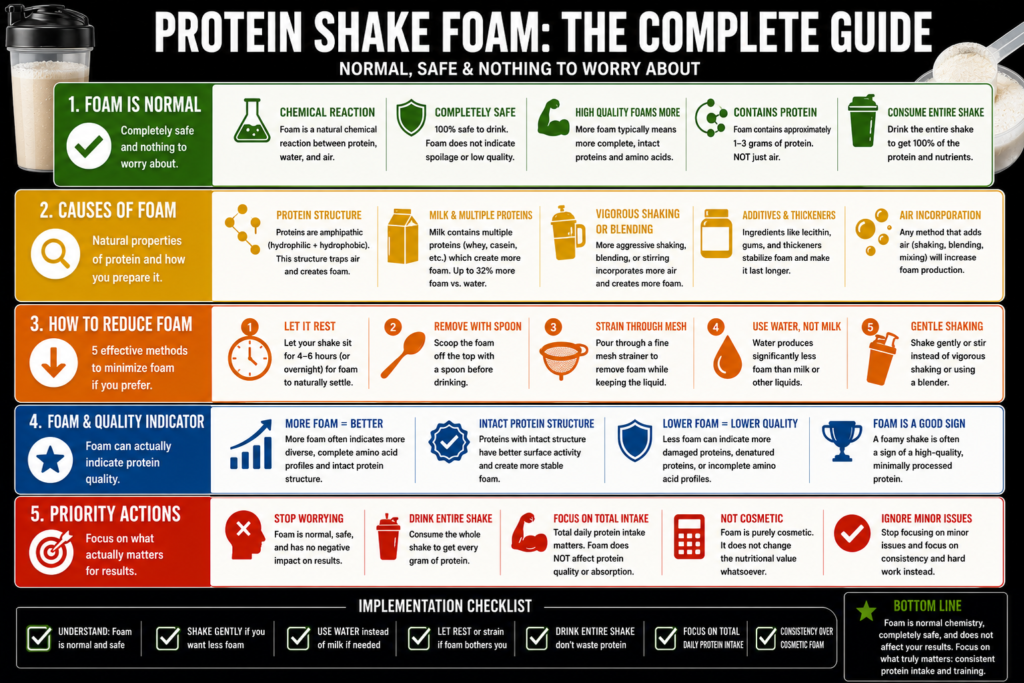
✅ Foam Is Completely Normal And Safe (Chemical Reaction Of Protein With Water And Air)
✅ High-Quality Protein Often Foams More (Complete Amino Acid Profile Creates Better Foam)
✅ Foam Contains 1-3g Protein (Not Just Empty Air Bubbles)
✅ Multiple Factors Cause Foam (Protein Structure, Mixing Method, Additives, Liquid Type)
✅ Foam Itself Rarely Causes Digestive Issues (Lactose, Dairy, Additives More Likely Culprits)
✅ Can Be Reduced But Not Eliminated (Multiple Strategies Available)
Perfect For Not Worrying About Foam:
- Anyone Using Quality Whey Protein (Foam Indicates Quality)
- People Who Consume Entire Shake Including Foam (Gets All Protein)
- Those Without Digestive Issues From Shakes (Foam Not The Problem)
- Individuals Who Understand Foam Is Normal Chemistry
May Want To Reduce Foam:
- People Bothered By Foam Texture Or Appearance
- Those Making Shakes In Public Settings (Cleaner Presentation)
- Anyone With Strong Foam Aversion (Personal Preference)
- Individuals Experiencing Bloating (Though Likely Not From Foam)
What Causes Foam (4 Main Reasons):
Protein Chemistry (Primary Cause):
- Proteins are amphipathic (hydrophobic + hydrophilic regions)
- Mixing causes proteins to stretch and unfold
- Protein molecules stabilize air bubbles at water surface
- Higher quality protein = more diverse amino acids = more foam
Mixing With Milk Or Multiple Proteins:
- Milk adds 8g protein to shake (32% more total protein)
- Combining whey + casein or whey + egg white increases foam
- More total protein = more foam-stabilizing molecules
- Solution: Use water instead of milk for less foam
Vigorous Shaking Or Blending:
- Agitation forces air into liquid
- Blender creates most foam (high-speed vortex)
- Vigorous shaking creates substantial foam
- Gentle stirring creates minimal foam
- Trade-off: Less agitation = worse dissolution, more clumps
Additives And Thickeners:
- Xanthan gum, guar gum, carrageenan stabilize foam
- Lecithin enhances foam formation
- These ingredients prevent foam collapse
- Improve texture but increase persistent foam
How To Reduce Foam (5 Methods):
Let Shake Rest:
- Make shake hours in advance
- Refrigerate 2-6 hours
- Foam settles and collapses over time
- 80-90% reduction after 4-6 hours
- Nutrients remain stable
Remove With Spoon:
- Scoop foam off top after mixing
- Quick and easy
- Removes 70-90% of foam
- Discards 1-3g protein
Strain Through Mesh:
- Pour shake through fine strainer
- Removes 95%+ of foam
- Extra cleanup required
- Most thorough method
Mix With Water Not Milk:
- Eliminates 8g protein from milk
- 20-30% less foam than milk version
- Thinner, less creamy texture
- Fewer calories
Avoid Blender:
- Use shaker bottle instead
- Gentle shaking over vigorous
- Significantly less foam
- May have minor dissolution issues
Foam And Protein Quality:
Higher Quality = More Foam:
- Complete amino acid profile
- Diverse hydrophobic/hydrophilic amino acids
- Intact protein structure
- Better surface activity
Lower Quality = Less Foam:
- Damaged or denatured proteins
- Incomplete amino acid profile
- Reduced foaming ability
- Not a benefit, indicates poor quality
Common Misconceptions:
“Foam means spoiled protein”:
- False – foam forms during mixing, not from spoilage
- Spoilage has sour smell, separation, color change
- Fresh foam is normal and safe
“Foam causes digestive issues”:
- Rarely – more likely lactose, dairy allergy, or additives
- Swallowing air contributes minimally
- Test by removing foam and seeing if issues persist
“Foam-free protein is better”:
- False – foam indicates quality protein
- All protein powders foam to some degree
- Cannot have functional protein without foaming capability
STOP WORRYING ABOUT FOAM IN YOUR PROTEIN SHAKE. START RECOGNIZING IT AS NORMAL PROTEIN CHEMISTRY. DRINK YOUR ENTIRE SHAKE INCLUDING FOAM. GET ALL THE PROTEIN YOU PAID FOR. FOCUS ON TOTAL DAILY PROTEIN INTAKE, NOT COSMETIC FOAM CONCERNS.
Ready To Build A Complete Protein Supplementation Strategy That Maximizes Muscle Growth And Recovery Without Getting Distracted By Minor Issues Like Foam? Understanding foam is just one small piece. Get a comprehensive protein optimization system that includes personalized daily protein targets based on your training and goals, guidance on choosing the highest-quality protein powders for your budget, meal planning strategies that balance whole foods with supplementation, timing protocols that optimize muscle protein synthesis throughout the day, and troubleshooting for genuine digestive issues (not foam-related). Stop overthinking minor cosmetic issues like foam. Start focusing on what actually matters: consistent protein intake, progressive training, and adequate recovery for long-term muscle growth and strength gains.
REFERENCES
SECTION 1 — Protein foaming: the amphipathic mechanism at the air-water interface
[1] Damodaran S — PubMed/Journal of Food Science, 2005 Comprehensive review of the molecular basis of protein foam formation and stabilization; proteins adsorb at air-water interfaces because they are amphipathic molecules containing both hydrophobic (water-repelling) and hydrophilic (water-attracting) regions; upon adsorption, proteins unfold and rearrange at the interface, with hydrophobic segments orienting toward the air phase and hydrophilic segments orienting toward the water phase; this molecular arrangement creates a viscoelastic film around each air bubble that stabilizes foam; the diversity and balance of hydrophobic and hydrophilic amino acids determines a protein’s surface activity; more structurally diverse proteins with well-distributed hydrophobic and hydrophilic regions (such as whey protein) exhibit superior foam formation and stability compared to more homogeneous proteins; provides the foundational molecular mechanism for the article’s explanation of why protein chemistry is the primary driver of foam in protein shakes https://pubmed.ncbi.nlm.nih.gov/16045862/
SECTION 2 — Whey protein foaming properties: concentration, processing, and comparative performance
[2] Zhu H & Damodaran S — PubMed/Journal of Agricultural and Food Chemistry, 1994 Experimental study of foaming properties of whey protein fractions; beta-lactoglobulin, the predominant protein in whey, has excellent foam-forming ability due to its compact globular structure and the exposure of hydrophobic regions upon unfolding at the air-water interface; foam volume and stability were concentration-dependent, with higher protein concentrations producing more stable foam; the study also demonstrated that protein denaturation reduced foaming properties, consistent with the article’s claim that less-processed, higher-quality proteins with intact structures foam more than damaged or denatured proteins; provides the protein chemistry basis for the counterintuitive finding that higher-quality whey protein foams more rather than less https://pubmed.ncbi.nlm.nih.gov/7914154/
SECTION 3 — Hydrocolloid gums (xanthan, guar) increase foam stability
[3] Ptaszek A — PMC/Food Hydrocolloids, 2015 Experimental study of how hydrocolloid additives (xanthan gum, guar gum, and hydroxypropyl methylcellulose) affect protein foam stability; hydrocolloids increase the viscosity of the continuous liquid phase surrounding air bubbles, significantly slowing the drainage of liquid from foam and retarding bubble coalescence and collapse; foam drainage rate was reduced by up to 60% with hydrocolloid addition; the anti-drainage effect substantially prolongs the time before foam collapses, explaining why protein powders containing thickening agents produce more persistent foam than those without; directly supports the article’s Reason 4 (additives and thickeners) as a mechanistic explanation for why xanthan gum and similar ingredients create more lasting foam in protein shakes https://pmc.ncbi.nlm.nih.gov/articles/PMC4516083/
SECTION 4 — Mechanical agitation and aeration: how shaking and blending create foam
[4] Lau K & Dickinson E — PubMed/Food Hydrocolloids, 2005 Study of the effect of whipping conditions (speed, time, agitation type) on protein foam formation; higher agitation speed and longer whipping duration increased total foam volume by incorporating more air into the protein solution; at high agitation speeds the vortex created at the surface draws atmospheric air into the liquid, dramatically increasing bubble incorporation; slower agitation or gentle stirring produces far less foam; the relationship between agitation intensity and foam volume is approximately linear at low to moderate speeds; directly supports the article’s Reason 3 (mixing method), explaining why blenders create more foam than shaker bottles, and why gentle stirring produces minimal foam, and why there is a trade-off between thorough dissolution and foam minimization https://pubmed.ncbi.nlm.nih.gov/15927688/

Leave a Reply
You must be logged in to post a comment.