Confused about when to eat before training for optimal performance? Here’s the science-backed timing guide that actually works.
You’re planning your workout. You know you need to eat beforehand for energy.
But when exactly? How long before training should you eat?
You’ve heard conflicting advice:
- “Eat 3 hours before for proper digestion”
- “30 minutes before is perfect”
- “Doesn’t matter, just eat something”
- “Train fasted for better results”
So what’s actually optimal? When should you eat your pre-workout meal?
Here’s the evidence-based answer: The ideal pre-workout meal timing depends on meal size and composition. Large solid meals (500+ calories with protein, carbs, fats) should be eaten 2-3 hours before training to allow full digestion. Medium meals (300-500 calories) work best 1.5-2 hours before. Small snacks or liquid meals (protein shakes, bananas) can be consumed 30-60 minutes before training. Individual tolerance varies, so experiment to find your optimal timing.
In this comprehensive guide, I’ll explain exactly how meal timing affects training performance and digestion, reveal the optimal timing for different meal types and sizes, show you what to eat at various time points before training, provide complete pre-workout meal examples with precise timing, and help you avoid the foods that cause digestive distress during workouts.
Whether you train early morning, afternoon, or evening, this article will optimize your pre-workout nutrition timing.
Let’s fuel your workouts correctly.
TABLE OF CONTENTS
General Pre-Workout Meal Timing Guidelines
Understanding the framework before specific recommendations.
The Digestive Timeline
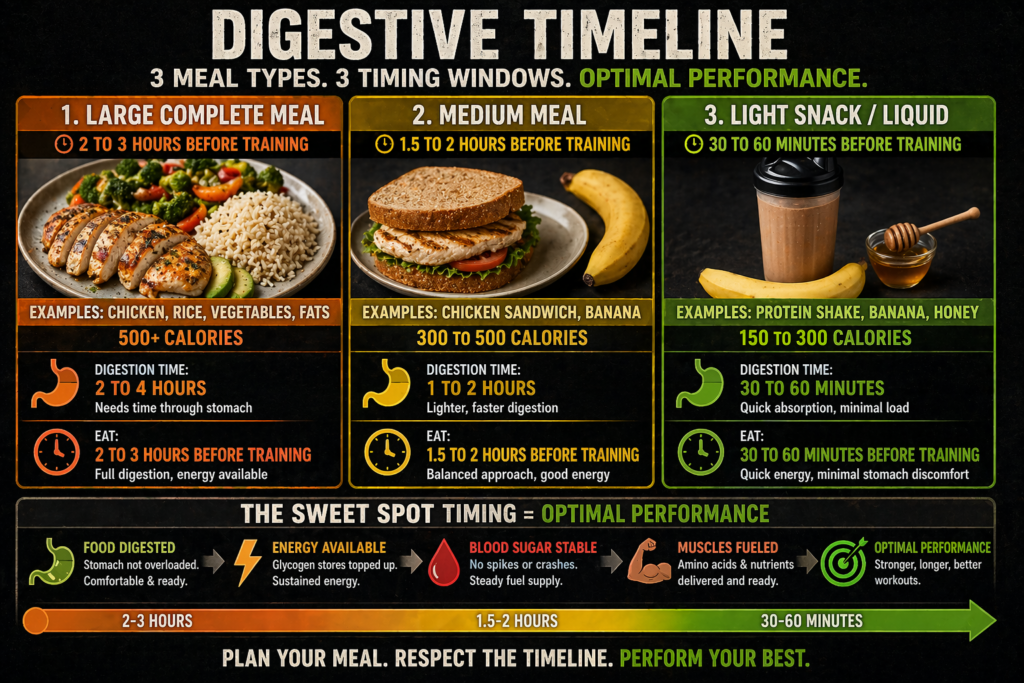
How long different foods take to digest:
Complete solid meals (protein + carbs + fats):
- Digestion time: 2-4 hours
- Example: Chicken, rice, vegetables with olive oil
- Needs time to move through stomach
- Eat 2-3 hours before training
Moderate meals (protein + carbs, minimal fat):
- Digestion time: 1-2 hours
- Example: Chicken sandwich, banana
- Lighter, faster digestion
- Eat 1.5-2 hours before training
Light snacks or liquid meals:
- Digestion time: 30-60 minutes
- Example: Protein shake, banana with honey
- Quick absorption
- Eat 30-60 minutes before training
Why timing matters:
Too close to training:
- Food still in stomach
- Blood diverted to digestion instead of muscles
- Nausea, cramping possible
- Sluggish feeling
- Reduced performance
Too far from training:
- Energy from meal depleted
- Blood sugar dropping
- Feeling hungry during workout
- Less fuel available
- Suboptimal performance
The sweet spot:
- Food digested and energy available
- Stomach comfortable
- Blood sugar stable
- Muscles fueled
- Optimal performance
Individual Variation Matters
Important reality check:
These are guidelines, not laws:
- Some people train well on full stomach
- Others need 4+ hours after eating
- Digestive speed varies individually
- Must experiment personally
Factors affecting your tolerance:
Age:
- Younger: Often faster digestion
- Older: May need more time
- Individual variation large
Training intensity:
- Low intensity: Can eat closer
- High intensity: Need more time
- Heavy compounds: Empty stomach better
Meal composition:
- High fat: Slower digestion
- High fiber: More time needed
- Simple carbs: Faster available
Personal digestive health:
- Fast metabolism: Eat closer
- Slow digestion: More time needed
- IBS or sensitivities: Very individual
The principle: Use recommendations as starting point, adjust based on personal experience.
Optimal Timing by Meal Size and Type
Specific guidelines for different scenarios.
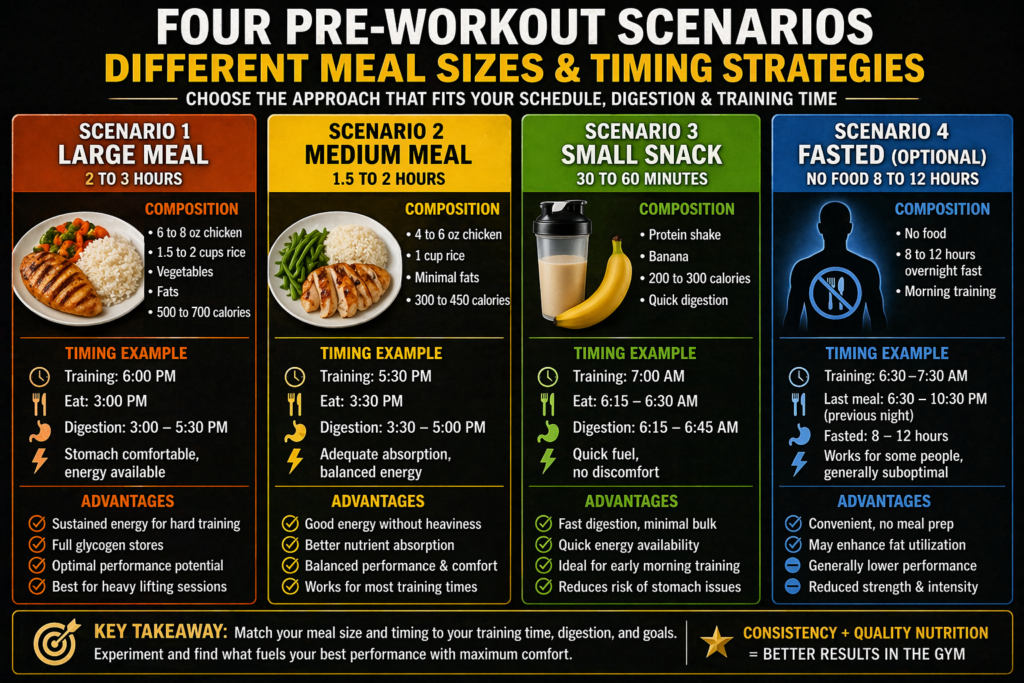
Scenario 1: Large Complete Meal (500+ Calories)
What this looks like:
Typical large pre-workout meal:
- 6-8oz chicken, beef, or fish (40-50g protein)
- 1.5-2 cups rice or potato (60-80g carbs)
- Vegetables
- Some healthy fats (cooking oil, avocado)
- Total: 500-700 calories
Optimal timing: 2-3 hours before training
Why this much time:
- Large volume of food
- Protein and fats slow digestion
- Need time to move through stomach
- Carbs need to be absorbed and stored
- Can’t train with this sitting in stomach
Example schedule:
Training at 6 PM:
- 3:00 PM: Large meal (chicken, rice, vegetables)
- 3:00-5:30 PM: Digestion occurs
- 6:00 PM: Training begins
- Stomach comfortable, energy available
- Optimal performance
What happens if eat too close (1 hour before):
- Food still in stomach
- Nausea during training
- Cramping possible
- Sluggish, uncomfortable feeling
- Poor performance
What happens if eat too early (5+ hours before):
- Energy depleted
- Hungry during workout
- May need small snack to bridge gap
- Suboptimal fueling
Scenario 2: Medium Meal (300-500 Calories)
What this looks like:
Typical medium pre-workout meal:
- 4-6oz chicken or turkey (25-35g protein)
- 1 cup rice or 1 large sweet potato (40-50g carbs)
- Minimal fats
- Total: 300-450 calories
Optimal timing: 1.5-2 hours before training
Why this works:
- Moderate volume
- Less fat = faster digestion
- Adequate time for absorption
- Not too heavy
- Balanced approach
Example schedule:
Training at 5:30 PM:
- 3:30 PM: Medium meal
- 3:30-5:30 PM: Digestion (2 hours)
- 5:30 PM: Training
- Well-fueled, comfortable
Advantages:
- More flexible timing than large meal
- Enough fuel for training
- Won’t feel overly full
- Practical for most schedules
Scenario 3: Small Snack or Liquid Meal (150-300 Calories)
What this looks like:
Option A: Protein shake
- 1 scoop whey protein (24g protein)
- 1 banana (27g carbs)
- Water or light milk
- Total: 200-300 calories
Option B: Solid snack
- 2 rice cakes with honey
- 1 banana
- Total: 150-200 calories
Optimal timing: 30-60 minutes before training
Why this works:
- Small volume
- Quick digestion
- Fast-absorbing carbs
- Minimal fat
- Quick energy boost
Example schedule:
Training at 7 AM:
- 6:15-6:30 AM: Protein shake with banana
- 6:30-7:00 AM: Light digestion
- 7:00 AM: Training
- Quick fuel, no discomfort
When this approach works best:
- Early morning training
- Training immediately after work
- When you ate large meal 3-4 hours earlier
- Convenience and speed
Scenario 4: Training Fasted
What this means:
- No food for 8-12 hours before training
- Typically morning training
- Nothing but water and maybe coffee
- Empty stomach training
When this might work:
For some people:
- Prefer empty stomach
- Feel lighter and more mobile
- Don’t experience energy drops
- Training intensity moderate
- Individual tolerance
For fat loss goals:
- Lower insulin levels
- Body may use more fat for fuel
- Can work for cutting
- Not optimal for muscle building
When fasted training is problematic:
For most people:
- Reduced performance
- Less strength and power
- Harder to maintain intensity
- May lose muscle over time
- Not recommended for serious training
For heavy compound lifts:
- Squats, deadlifts need energy
- Performance suffers significantly
- Safety risk (dizziness)
- Especially problematic
The verdict on fasted training:
- Works for some individuals
- Generally suboptimal for performance
- Can work for light cardio or cutting
- Not ideal for muscle building
- Eat something if possible
What to Eat at Different Time Points
Specific food recommendations by timing.
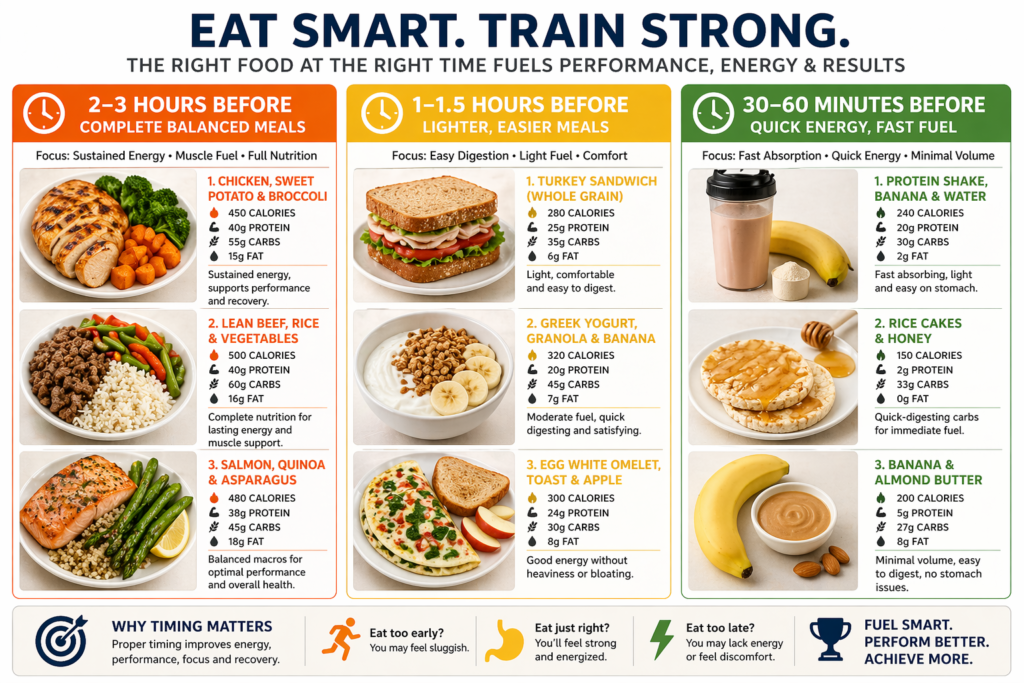
2-3 Hours Before: Complete Balanced Meals
Goal: Sustained energy, complete nutrition
Example Meal 1: Chicken and Sweet Potato
- 6oz chicken breast (40g protein)
- 8oz sweet potato (50g carbs)
- 1 cup broccoli
- 1 tsp olive oil
- Total: ~450 calories, 40g protein, 52g carbs
Example Meal 2: Lean Beef and Rice
- 6oz lean ground beef (40g protein)
- 1.5 cups white rice (60g carbs)
- Mixed vegetables
- Total: ~500 calories, 40g protein, 60g carbs
Example Meal 3: Fish and Quinoa
- 6oz salmon (35g protein)
- 1 cup quinoa (40g carbs)
- Asparagus
- Total: ~450 calories, 35g protein, 40g carbs
Key characteristics:
- Complete protein source
- Complex carbohydrates
- Moderate healthy fats
- Vegetables for micronutrients
- Balanced nutrition
1-1.5 Hours Before: Lighter, Easier Meals
Goal: Good energy without heaviness
Example Meal 1: Turkey Sandwich
- 2 slices whole grain bread (30g carbs)
- 4oz turkey breast (25g protein)
- Mustard (not mayo, too much fat)
- Total: ~280 calories, 25g protein, 30g carbs
Example Meal 2: Greek Yogurt Bowl
- 1 cup Greek yogurt (20g protein)
- 1/2 cup granola (25g carbs)
- 1/2 banana (15g carbs)
- Total: ~320 calories, 20g protein, 40g carbs
Example Meal 3: Egg White Omelet with Toast
- 4 egg whites + 1 whole egg (20g protein)
- 1 slice toast (15g carbs)
- 1 small apple (20g carbs)
- Total: ~280 calories, 20g protein, 35g carbs
Key characteristics:
- Moderate protein
- Quick-digesting carbs
- Minimal fat
- Light and comfortable
30-60 Minutes Before: Quick Energy Sources
Goal: Immediate fuel without discomfort
Example 1: Protein Shake
- 1 scoop whey protein (24g protein)
- 1 banana (27g carbs)
- Water
- Total: ~240 calories, 24g protein, 27g carbs
Example 2: Rice Cakes with Honey
- 2-3 rice cakes (20g carbs)
- 1 tbsp honey (17g carbs)
- Total: ~150 calories, 37g carbs
Example 3: Banana with Nut Butter
- 1 large banana (30g carbs)
- 1 tbsp almond butter (3g protein, 8g fat)
- Total: ~200 calories, 30g carbs
Key characteristics:
- Fast-digesting
- Primarily carbohydrates
- Minimal volume
- Won’t cause stomach issues
Foods to Avoid Before Training
What causes problems and why.
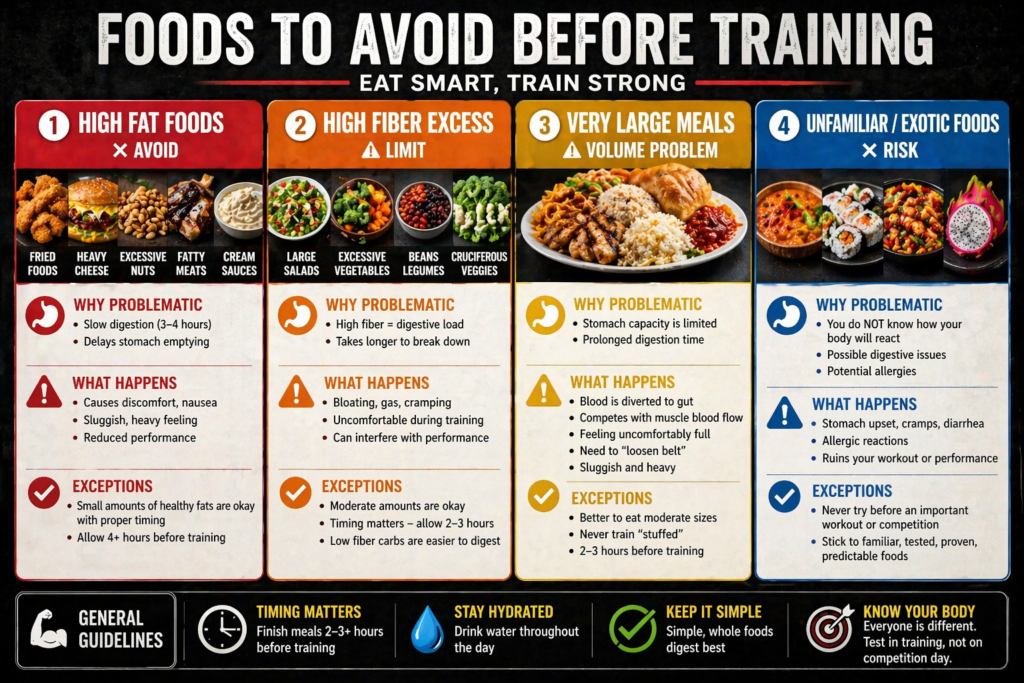
High-Fat Foods
Why they’re problematic:
Slow digestion:
- Fat takes 3-4 hours to digest
- Delays stomach emptying
- Food sits longer
- Causes discomfort
Examples to avoid:
- Fried foods
- Heavy cheese
- Excessive nuts or nut butter (>2 tbsp)
- Fatty cuts of meat
- Cream-based sauces
What happens if consumed:
- Feeling heavy and sluggish
- Nausea during training
- Cramping
- Reduced performance
Exception: Small amounts of fat (1-2 tsp oil, 1 tbsp nut butter) in meal eaten 2-3 hours before is fine.
High-Fiber Foods in Excess
Why they’re problematic:
Digestive load:
- Fiber slows digestion
- Can cause bloating
- Gas production
- Uncomfortable during training
Foods to limit:
- Large salads
- Excessive vegetables
- Whole grain products in large amounts
- Beans and legumes
- Cruciferous vegetables (broccoli, cauliflower)
Moderate amounts okay:
- 1 cup vegetables with meal 2-3 hours before: Fine
- Large salad 30 minutes before: Problematic
Very Large Meals
The volume problem:
Why size matters:
- Stomach capacity limited
- Large volume = prolonged digestion
- Blood diverted to gut
- Competes with muscle blood flow
What constitutes “too large”:
- Feeling uncomfortably full
- Need to loosen belt
- Sluggish after eating
- Individual, but you know it when you feel it
Better approach:
- Moderate meal sizes
- Multiple smaller meals
- Never train feeling stuffed
Simple Sugars Alone (Controversial)
The blood sugar rollercoaster:
What happens:
- Eat candy or pure sugar
- Blood sugar spikes rapidly
- Insulin surge
- Blood sugar crashes
- Energy dip during workout
Examples:
- Candy
- Soda
- Pure sugar
- Without other nutrients
Why it might not matter:
- If training starts immediately after spike
- Sugar gets used during workout
- No crash occurs
- Timing dependent
Better approach:
- Combine sugar with protein or complex carbs
- Honey on rice cakes
- Banana (natural sugars + fiber)
- More stable energy
Unfamiliar or Exotic Foods
The experimentation problem:
Why avoid:
- Don’t know how your body reacts
- Possible digestive issues
- Potential allergies
- Risk not worth it
Never try new foods:
- Right before important workout
- Before competition
- On training days initially
- Test on rest days first
Stick to familiar:
- Foods you know work
- Tested and proven
- Predictable digestion
- Reliability matters
Can You Train Fasted?
The fasted training debate.
What Fasted Training Means
Definition:
- No food for 8-12+ hours
- Typically overnight fast
- Morning training on empty stomach
- Water and coffee okay
- No calories consumed
Potential Benefits (Mostly for Fat Loss)
Theoretical advantages:
Enhanced fat oxidation:
- Lower insulin levels
- Body may use more fat for fuel
- Some research supports this
- Small effect
Convenience:
- No meal prep needed
- Wake up and train
- Saves time
- Practical benefit
Some prefer the feeling:
- Feel lighter
- More mobile
- Less digestive distraction
- Individual preference
Significant Drawbacks (Especially for Muscle Building)
Performance reduction:
Research consistently shows:
- Reduced strength output
- Lower power production
- Decreased training volume capacity
- Earlier fatigue
- Suboptimal performance
Muscle building concerns:
Protein balance:
- Fasted training in catabolic state
- Muscle protein breakdown elevated
- No amino acids available
- Counterproductive for hypertrophy
Training quality:
- Can’t train as hard
- Less total volume
- Weaker stimulus for growth
- Results suffer long-term
Safety issues:
Risk of problems:
- Dizziness
- Lightheadedness
- Fainting possible
- Injury risk increases
- Especially with heavy compounds
When Fasted Training Might Be Okay
Specific acceptable scenarios:
Light cardio:
- Walking
- Easy cycling
- Low intensity
- Not demanding
Short duration (<45 minutes):
- Quick workout
- Not depleting
- Can manage
During cutting phase:
- Already in deficit
- Fat loss priority
- Willing to sacrifice some performance
- Short-term strategy
Individual high tolerance:
- Tested extensively
- Know you perform okay
- Feel fine doing it
- Rare but exists
Better Approach for Most People
Even minimal food helps:
15-30 minutes before training:
- 1 banana (27g carbs)
- Or protein shake
- Or 2 rice cakes
- Small amount makes big difference
Why this is better:
- Provides some fuel
- Prevents extreme catabolism
- Barely impacts fasting benefits (if that’s goal)
- Much better performance
- Best of both worlds
The Bottom Line: Timing Depends on Meal Size
After examining all factors:
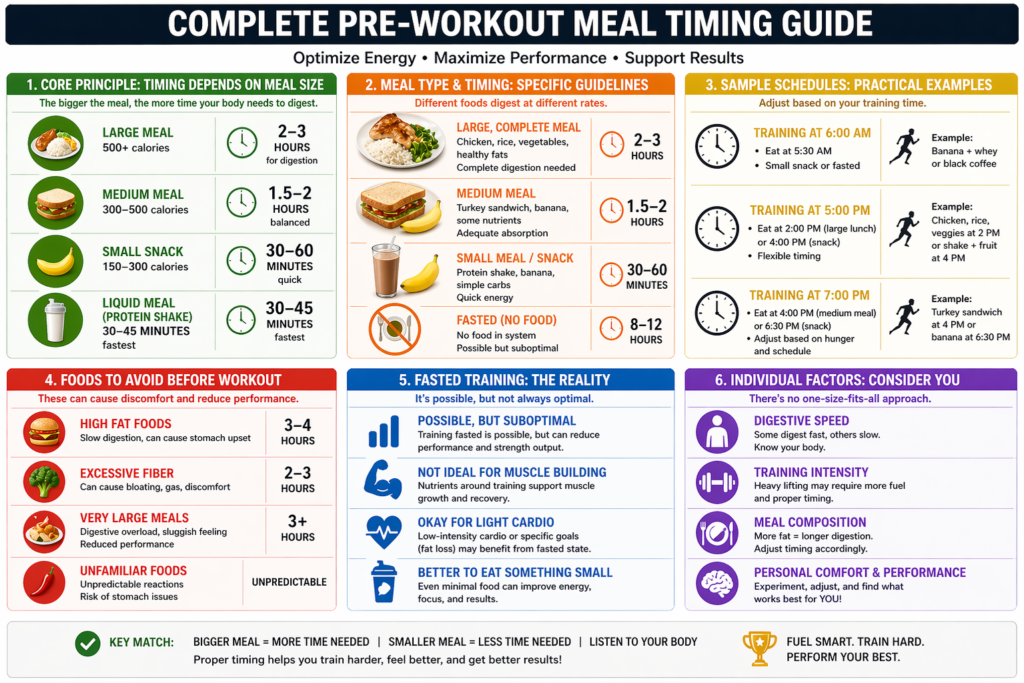
The truth about pre-workout meal timing:
✅ No single perfect timing for everyone (individual variation significant)
✅ Meal size determines timing (larger meals need more time)
✅ 2-3 hours for large meals (500+ calories with fats)
✅ 1-2 hours for medium meals (300-500 calories, moderate fat)
✅ 30-60 minutes for light snacks (liquid meals, simple carbs)
✅ Fasted training possible but suboptimal (performance suffers for most)
Optimal pre-workout timing by meal type:
Large complete meal (500+ calories):
- Composition: Protein + carbs + fats + vegetables
- Timing: 2-3 hours before training
- Example: 6oz chicken, 2 cups rice, vegetables, olive oil
- Allows complete digestion
Medium meal (300-500 calories):
- Composition: Protein + carbs, minimal fat
- Timing: 1.5-2 hours before training
- Example: Turkey sandwich, banana
- Balanced approach
Small snack (150-300 calories):
- Composition: Primarily carbs, some protein
- Timing: 30-60 minutes before training
- Example: Protein shake with banana
- Quick energy
Liquid meal:
- Composition: Protein powder + simple carbs + water
- Timing: 30-45 minutes before training
- Example: Whey shake with honey
- Fastest option
Foods to avoid pre-workout:
- High-fat foods (slow digestion)
- Excessive fiber (bloating, gas)
- Very large meals (digestive overload)
- Unfamiliar foods (unpredictable)
Fasted training reality:
- Possible but suboptimal for most
- Reduces performance
- Not ideal for muscle building
- Okay for light cardio or specific goals
- Better to eat something small
Sample timing schedules:
Training at 6 AM:
- 5:30 AM: Small snack (banana, protein shake)
- Or train fasted if preferred
- Light option
Training at 5 PM:
- 2:00 PM: Large lunch (chicken, rice, vegetables)
- Or 4:00 PM: Small snack if hungry
- Flexible approach
Training at 7 PM:
- 4:00 PM: Medium meal (sandwich, fruit)
- Or 6:30 PM: Banana if needed
- Later training
The key principle:
Match timing to meal size:
- Bigger meal = more time needed
- Smaller meal = less time needed
- Listen to your body
- Experiment and adjust
Individual factors to consider:
- Your digestive speed (fast vs. slow)
- Training intensity (heavy vs. light)
- Meal composition (fat content especially)
- Personal comfort and performance
- Find what works for YOU
EAT 2-3 HOURS BEFORE FOR LARGE MEALS. 1-2 HOURS FOR MEDIUM MEALS. 30-60 MINUTES FOR SNACKS. EXPERIMENT TO FIND YOUR OPTIMAL TIMING.
Ready to optimize your complete nutrition strategy with precise meal timing, optimal food choices for every training scenario, and a sustainable approach that maximizes performance without digestive issues or complicated rules? Pre-workout timing is just one piece of effective sports nutrition. Get a comprehensive guide to calculating exact nutrient needs, building complete meal plans for training and recovery, timing all nutrition optimally, and achieving maximum results from every workout. Stop guessing about meal timing. Start following evidence-based strategies that deliver consistent performance.
REFERENCES
SECTION 1 — Gastric emptying: how food composition and volume affect digestion rate
[1] Camilleri M — PMC/Neurogastroenterology and Motility, 2019 Comprehensive review of gastric emptying physiology; the stomach empties approximately 1 to 4 kcal per minute during the digestive period; water empties rapidly while digestible solids begin leaving only after a lag period and empty slowly over 2 to 3 hours; high-calorie liquids empty significantly more slowly than low-calorie liquids, with 50% remaining in the stomach at 2 hours versus 1 hour for low-calorie options; gastric emptying rate is influenced by volume, osmolality, caloric density, fat and protein content, particle size, and dietary fiber; provides the physiological foundation for the article’s tiered timing recommendations, explaining why large high-fat meals require 2 to 3 hours before training while small liquid snacks clear in 30 to 45 minutes https://pmc.ncbi.nlm.nih.gov/articles/PMC6850045/
SECTION 2 — Pre-exercise meal timing and exercise performance
[2] Schabort EJ et al. — PubMed/Medicine and Science in Sports and Exercise, 2000 Controlled crossover trial comparing exercise performance 3 hours versus 6 hours after consuming a moderate-to-high carbohydrate, low-fat meal; time to exhaustion at moderate to high intensity was significantly better in the 3-hour condition (p=0.0001); respiratory exchange ratios and blood lactate at exhaustion were also higher in the 3-hour condition, indicating greater carbohydrate utilization; post-exercise insulin levels were elevated in the 3-hour condition, supporting greater fuel availability; directly establishes the 2 to 3 hour pre-exercise meal window the article recommends for large complete meals, showing that eating too early (6 hours before) reduces carbohydrate availability and impairs performance https://pubmed.ncbi.nlm.nih.gov/10861332/
[3] Burke LM et al. — PubMed/Journal of Applied Physiology, 1997 Review of the role of meal frequency and timing in physical performance; frequent smaller eating occasions provide a practical strategy allowing athletes to increase energy intake while reducing the gastric discomfort of infrequent large meals; pre-exercise feedings optimize substrate availability and carbohydrate stores for training; post-exercise carbohydrate ingestion promotes muscle and liver glycogen resynthesis; feedings during exercise provide exogenous fuel as endogenous stores deplete; provides the scientific basis for the article’s recommendation to match meal size to timing intervals and use frequent smaller feedings to avoid digestive overload during training https://pubmed.ncbi.nlm.nih.gov/9155497/
SECTION 3 — Exercise intensity affects gastric emptying and GI tolerance
[4] Schubert MM et al. — PubMed/Sports Medicine, 2014 Meta-analysis examining the effects of acute exercise on gastric emptying; a dose-response relationship was found between exercise intensity and gastric emptying rate: at lower intensities gastric emptying was faster, while at high exercise intensities it slowed significantly; meal volume, beverage osmolality, and exercise duration were additional factors moderating emptying rate; running was associated with faster gastric emptying than cycling; the findings explain why training intensity should influence pre-workout meal timing decisions, and why high-intensity training with a full stomach produces greater GI distress than lower intensity exercise; directly supports the article’s recommendation to allow more time before intense sessions https://pubmed.ncbi.nlm.nih.gov/25398225/
SECTION 4 — Fasted vs. fed training: performance and body composition effects
[5] Aird TP et al. — PubMed/Journal of the International Society of Sports Nutrition, 2018 Systematic review and meta-analysis of 46 studies examining fasted versus pre-exercise fed states on continuous aerobic and anaerobic exercise performance; pre-exercise feeding significantly enhanced prolonged aerobic exercise performance (p=0.012) but showed no significant benefit for shorter duration aerobic performance (p=0.687); fasted exercise increased post-exercise circulating free fatty acids compared to fed exercise; pre-exercise feeding blunted signaling pathways in skeletal muscle and adipose tissue involved in mitochondrial adaptation and substrate utilization; provides the primary evidence base for the article’s nuanced conclusion that fasted training is detrimental to prolonged performance but may have specific metabolic applications https://pubmed.ncbi.nlm.nih.gov/29315892/



Leave a Reply
You must be logged in to post a comment.