
Think mental toughness means ignoring pain and emotions? That’s not toughness. That’s brittleness disguised as strength.
You see the “grindset” content everywhere. “No excuses.” “Pain is weakness leaving the body.” “Never quit.”
You try to adopt this mindset. Push through injury. Ignore exhaustion. Suppress emotions. Eventually, you break.
You think mental toughness means:
- Never showing weakness
- Ignoring your body’s signals
- Suppressing all emotions
- Never asking for help
- Working until you collapse
Wrong. That’s not mental toughness. That’s denial, suppression, and self-harm. Real mental toughness is knowing when to push and when to rest. When to persist and when to pivot. When to be hard and when to be soft. It’s wisdom, not ignorance. Resilience, not rigidity.
Here’s what’s actually happening: True mental toughness is the ability to persist through genuine adversity while maintaining self-awareness and adaptability. Toxic “toughness” is ego-driven performance theater that leads to burnout, injury, and psychological damage. The difference: Real toughness includes self-compassion, emotional intelligence, and strategic rest. Toxic toughness rejects all three. One creates sustainable high performance. The other creates broken people who can’t maintain anything long-term.
In this comprehensive guide, I’ll explain what mental toughness actually is (vs. what social media shows), reveal the 5 pillars of healthy mental toughness (none involve ignoring pain), show you the toxic behaviors to avoid (and why they backfire), provide the complete training protocol (evidence-based methods), and explain how to balance toughness with self-care (the integration).
Whether you’re training hard, building a business, or facing life challenges, understanding healthy mental toughness is critical.
Let’s build real strength without the toxic bullshit.
TABLE OF CONTENTS
What Mental Toughness Actually Is
The real definition vs. the social media version.

The Scientific Definition
Psychological resilience research defines it as:
- Ability to perform under pressure
- Persistence in face of adversity
- Recovery from setbacks
- Maintenance of focus despite distractions
- Regulation of thoughts and emotions
- Adaptive capacity
The four components (Jones et al., 2002):
1. Control:
- Emotional regulation
- Life control
- Situation management
- Self-governance
2. Commitment:
- Goal persistence
- Value alignment
- Deep engagement
- Purpose connection
3. Challenge:
- Seeing adversity as opportunity
- Growth mindset
- Comfort zone expansion
- Reframing capacity
4. Confidence:
- Belief in abilities
- Self-efficacy
- Trust in preparation
- Competence trust
What it’s NOT:
- Ignoring pain signals
- Suppressing emotions
- Never resting
- Refusing help
- Toxic masculinity performance
- Common misconceptions
The Toxic Version (What Social Media Sells)
The toxic “grindset” characteristics:
Characteristic 1: Pain glorification
- “No pain, no gain” taken to extreme
- Training through injury
- Ignoring body’s warning signals
- Pride in damage
- Self-harm rebranded
Characteristic 2: Emotion suppression
- “Feelings are weakness”
- Never show vulnerability
- Bottle everything up
- Explosions or breakdowns eventually
- Emotional brittleness
Characteristic 3: Rest rejection
- “Sleep when you’re dead”
- Recovery is weakness
- 24/7 grind mentality
- Burnout glorified
- Unsustainable pace
Characteristic 4: Help refusal
- “Do it yourself or don’t do it”
- Independence extremism
- Therapy/coaching rejected
- Isolation
- Counterproductive self-reliance
Characteristic 5: Zero self-compassion
- Brutal self-criticism
- No forgiveness for mistakes
- Perfectionism
- Self-hatred as motivation
- Internal abuse
Why it’s appealing:
- Simple rules (just push harder)
- Masculine identity performance
- Social media engagement (controversial)
- Ego protection (“I’m tougher than you”)
- Attractive but destructive
Why it fails:
- Leads to injury (physical breakdown)
- Causes burnout (mental exhaustion)
- Creates brittleness (sudden collapse)
- Damages relationships (isolation)
- Unsustainable long-term
- Predictable failure pattern
The examples:
Toxic: Train through torn muscle (causes permanent damage) Healthy: Rest injury, train around it (long-term sustainability)
Toxic: Never show emotion, bottle up stress (explodes eventually) Healthy: Process emotions, express strategically (emotional intelligence)
Toxic: Sleep 4 hours, work 20 hours daily (burnout in months) Healthy: Prioritize sleep, work intensely in windows (sustainable decades)
Toxic: “I don’t need help from anyone” (isolated suffering) Healthy: “I’m strong enough to ask for help” (strategic support)
The Healthy Version (What Actually Works)
The characteristics of real toughness:
1. Discernment:
- Know difference between discomfort and damage
- Push through discomfort, respect damage signals
- Intelligent persistence
2. Emotional intelligence:
- Feel emotions, don’t suppress
- Process and release
- Express strategically
- Emotional maturity
3. Strategic recovery:
- Rest is part of performance
- Sleep prioritized
- Recovery protocols
- Sustainable intensity
4. Adaptive help-seeking:
- Recognize when outside help needed
- Therapy, coaching, mentorship
- Strength in vulnerability
- Strategic support
5. Self-compassion:
- Kind to self in failure
- Learn from mistakes without self-hatred
- Growth-oriented self-talk
- Compassionate accountability
The philosophy:
- Tough on problems, kind to self
- High standards, realistic expectations
- Push hard, recover harder
- Strong enough to be vulnerable
- Balanced approach
Why it works:
- Sustainable long-term
- Prevents burnout and injury
- Builds genuine resilience
- Maintains relationships
- Actually tough
The 5 Pillars of Healthy Mental Toughness
Building real resilience.
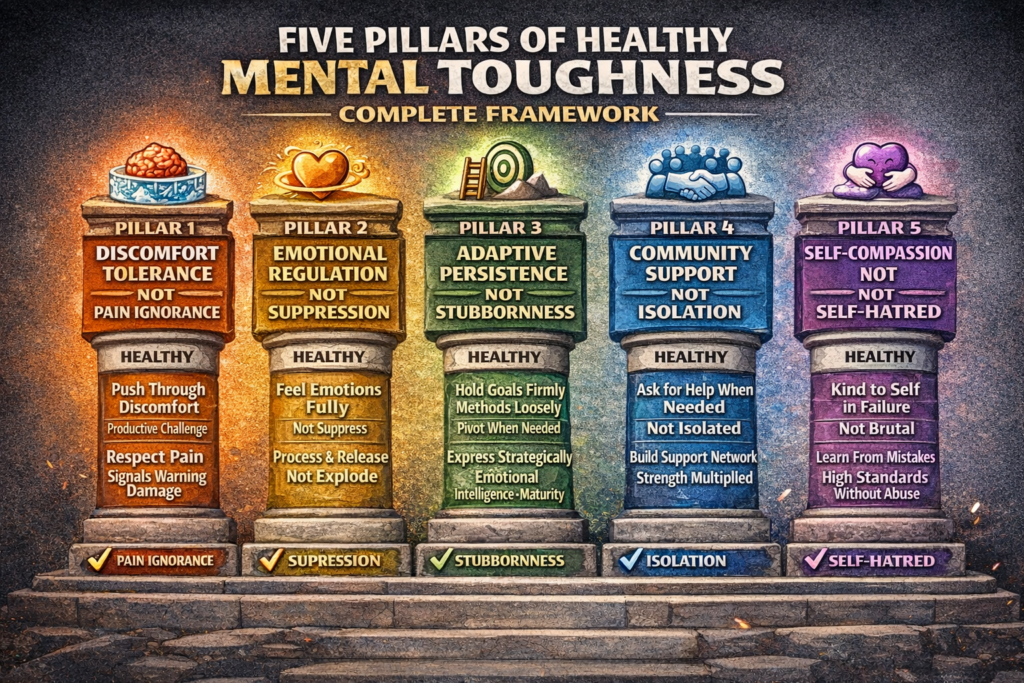
Pillar 1: Discomfort Tolerance (Not Pain Ignorance)
The distinction:
Discomfort:
- Uncomfortable but not harmful
- Challenging but safe
- Growth-producing
- Should push through
- Examples: Muscle burn during workout, cold shower, hard conversation
- Productive challenge
Pain/Damage:
- Body warning of potential injury
- Sharp, acute, worsening
- Risk of harm
- Should respect and address
- Examples: Joint pain, sharp muscle tear, chest pain
- Warning signal
The skill:
- Distinguish between the two
- Push through discomfort
- Respect pain signals
- Intelligent toughness
Training discomfort tolerance:
Deliberate discomfort exposure:
- Cold showers/ice baths
- Extended fasting windows
- Challenging workouts (within safe limits)
- Difficult conversations
- Boredom tolerance
- Controlled exposure
Progressive overload:
- Start small (30 sec cold shower)
- Gradually increase (90 sec, then 2 min)
- Build tolerance systematically
- Gradual adaptation
Mindfulness during discomfort:
- Notice sensations without judgment
- Breathe through it
- Observe thoughts (“This is uncomfortable AND I can handle it”)
- Separate sensation from suffering
- Awareness practice
The outcome:
- Wider discomfort window
- Less reactive to challenge
- Greater resilience
- Expanded capacity
The boundary:
- If pain sharp/acute, stop
- If injury suspected, rest
- Pushing through damage is stupidity, not toughness
- Intelligent limits
Pillar 2: Emotional Regulation (Not Suppression)
The distinction:
Suppression (toxic):
- Push emotions down
- Pretend they don’t exist
- “Be a man”
- Emotions build pressure
- Explosive release eventually
- Emotional avoidance
Regulation (healthy):
- Acknowledge emotions
- Feel them fully
- Process and release
- Express strategically
- Emotional intelligence
The skill:
- Feel emotions without being controlled by them
- Use emotions as information
- Choose response despite emotion
- Emotional mastery
Training emotional regulation:
Labeling practice:
- Name emotion precisely (“I’m feeling anxious about X”)
- Not just “I feel bad”
- Specificity reduces intensity
- Emotion granularity
Body scan:
- Where do you feel emotion in body?
- Chest tightness, stomach knot, etc.
- Physical awareness
- Somatic connection
Expression without explosion:
- Journal feelings
- Talk to trusted person
- Create art
- Controlled release
- Strategic expression
The window of tolerance:
- Emotions within window: Can regulate
- Outside window: Dysregulated (too activated or shut down)
- Goal: Widen window
- Capacity expansion
Why this is tough:
- Facing emotions is harder than avoiding
- Processing is uncomfortable
- Vulnerability requires courage
- Actual strength
The outcome:
- Emotional stability
- Better relationships
- Reduced anxiety/depression
- Authentic toughness
- Integrated strength
Pillar 3: Adaptive Persistence (Not Blind Stubbornness)
The distinction:
Stubbornness (toxic):
- Never quit, ever
- Same approach despite failure
- Ego invested in one path
- Refuse to pivot
- Rigid inflexibility
Adaptive persistence (healthy):
- Persist toward goal
- But adapt methods
- Pivot when needed
- Strategic quitting of wrong paths
- Flexible determination
The skill:
- Distinguish between goal and method
- Hold goals firmly, methods loosely
- Quit wrong paths, persist toward destination
- Strategic flexibility
Examples:
Stubborn (wrong):
- Goal: Get fit
- Method: Heavy squats despite knee injury
- Persist despite pain
- Cause permanent damage
- Destructive persistence
Adaptive (right):
- Goal: Get fit
- Method: Squat until knee pain
- Pivot: Different leg exercises that don’t hurt knee
- Still pursue goal, different path
- Intelligent adaptation
Training adaptive persistence:
Define clearly:
- Goal: “Build strong, healthy body”
- Method: “Current workout program”
- Method is changeable, goal is not
- Clarity
If-then planning:
- “If current approach not working after 8 weeks, then reassess”
- Built-in checkpoints
- Pre-planned adaptability
- Strategic reviews
Seek feedback:
- Coach, mentor, data
- External perspective
- Ego-free assessment
- Objective input
Strategic quitting:
- Quit methods that don’t work
- Never quit meaningful goals
- Distinguish levels
The outcome:
- Reach goals faster
- Avoid dead ends
- Maintain long-term progress
- Effective persistence
Pillar 4: Community and Support (Not Isolated Suffering)
The distinction:
Isolated suffering (toxic):
- “I don’t need anyone”
- Refuse all help
- Suffer in silence
- Weakness to ask for support
- Counterproductive independence
Strategic support (healthy):
- Strong enough to be vulnerable
- Ask for help when needed
- Build support network
- Strength multiplied
- Intelligent interdependence
The skill:
- Recognize when you need help
- Ask without shame
- Accept support gracefully
- Mature strength
Types of support:
Emotional support:
- Someone to talk to
- Validation and empathy
- Not alone in struggle
- Connection
Practical support:
- Help with tasks
- Accountability
- Shared burden
- Tangible assistance
Expertise support:
- Coaches, therapists, mentors
- Specialized knowledge
- Accelerated progress
- Professional guidance
Why this is tough:
- Vulnerability scary
- Ego wants self-sufficiency
- Fear of judgment
- Asking feels weak
- Requires courage
The truth:
- Strongest people have strongest teams
- Elite athletes have coaches
- Successful entrepreneurs have mentors
- Asking for help is strength
- Multiplied capacity
Training community building:
Identify support needs:
- Where are you struggling?
- What kind of help needed?
- Clarity
Reach out:
- One person this week
- “I could use help with X”
- Action
Reciprocate:
- Offer help to others
- Build mutual support
- Give and receive
The outcome:
- Faster progress
- Resilience through connection
- Sustainable growth
- Network strength
Pillar 5: Self-Compassion (Not Self-Hatred)
The distinction:
Self-hatred (toxic):
- Brutal self-criticism
- No forgiveness for mistakes
- Perfectionism
- Motivation through shame
- Internal abuse
Self-compassion (healthy):
- Kind to self in failure
- Learn from mistakes
- Reasonable standards
- Motivation through growth
- Internal support
The misconception:
- “Self-compassion makes you soft”
- “Need to be hard on yourself”
- Wrong
The research:
- Self-compassion INCREASES persistence
- Self-criticism decreases motivation
- Compassion enables growth
- Evidence-based
The skill:
- Talk to yourself like supportive coach
- High standards without self-abuse
- Failure as learning, not identity
- Balanced self-talk
Training self-compassion:
Self-talk audit:
- Notice how you talk to yourself after mistakes
- Would you talk to friend that way?
- If not, change it
- Awareness
Reframe failure:
- Not: “I’m a failure”
- But: “I failed at this attempt and learned X”
- Behavior vs. identity
- Growth mindset
The three components (Kristin Neff):
1. Self-kindness:
- Warm, understanding toward self
- Not harsh judgment
- Gentleness
2. Common humanity:
- Everyone struggles
- Not alone in imperfection
- Shared experience
3. Mindfulness:
- Balanced perspective
- Not over-identifying with failure
- Awareness
The practice:
- After setback: “This is hard. I’m struggling. That’s okay. Everyone struggles. What can I learn?”
- Compassionate response
Why this is tough:
- Cultural messaging: “Be hard on yourself”
- Ego fears softness
- Seems contradictory to toughness
- Requires paradigm shift
The outcome:
- Sustained motivation
- Faster learning
- Resilience to failure
- Durable toughness
Toxic Behaviors to Avoid
The traps that look like toughness.
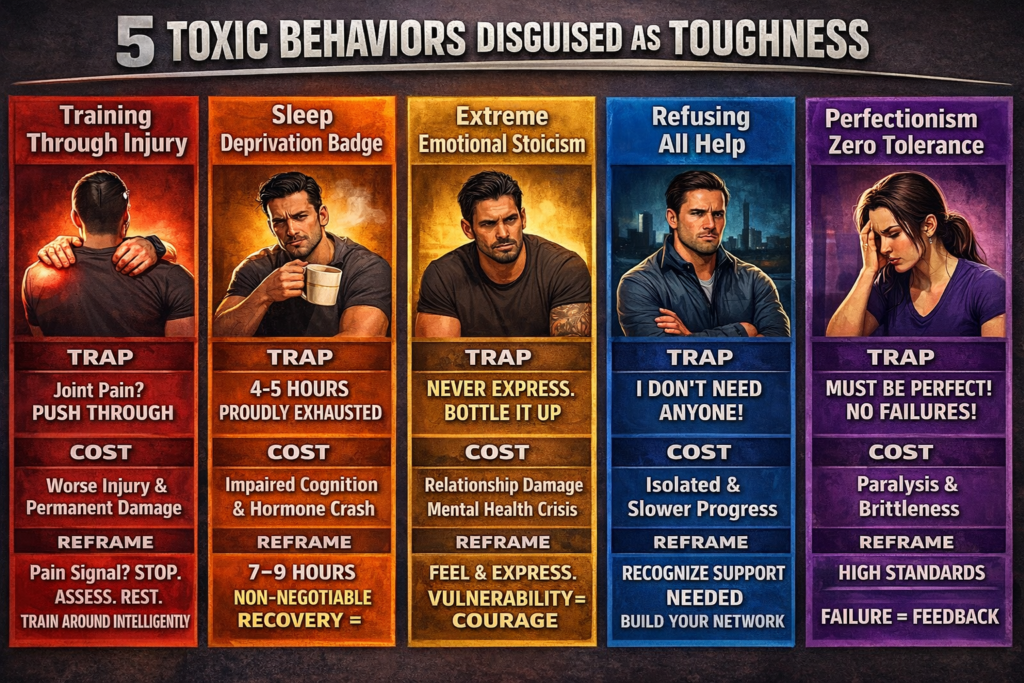
Toxic Behavior 1: Training Through Injury
What it looks like:
- Joint pain during exercise
- “Push through it”
- Make it worse
- Permanent damage
- Self-sabotage
Why people do it:
- Fear of losing progress
- Ego (“I’m tough”)
- Social pressure (“Don’t be weak”)
- Insecurity
The cost:
- Acute injury becomes chronic
- Months of recovery vs. days
- Permanent limitation
- Long-term damage
The healthy alternative:
- Pain signal → stop immediately
- Assess (is this injury?)
- Rest or modify
- Train around injury
- Intelligent response
The mantra:
- “I’m tough enough to rest when needed”
- Training around injury shows wisdom
- Reframe
Toxic Behavior 2: Sleep Deprivation as Badge of Honor
What it looks like:
- “I’ll sleep when I’m dead”
- 4-5 hours nightly
- Pride in exhaustion
- Glorified dysfunction
Why people do it:
- Hustle culture
- Time scarcity
- Productivity theater
- Misguided values
The cost:
- Impaired cognition
- Hormonal disruption (testosterone crashes, cortisol elevated)
- Weakened immunity
- Increased injury risk
- Mental health decline
- Comprehensive damage
The research:
- Sleep < 6 hours: 40% reduced testosterone
- Increased cortisol (muscle breakdown)
- Impaired recovery
- Scientifically stupid
The healthy alternative:
- 7-9 hours non-negotiable
- Recovery IS productivity
- Quality sleep = better performance
- Intelligent priorities
The mantra:
- “I’m tough enough to prioritize recovery”
- Sleep is strength
- Reframe
Toxic Behavior 3: Emotional Stoicism Taken to Extreme
What it looks like:
- Never express emotion
- Bottle everything up
- “Be a man”
- Explosive breakdowns eventually
- Emotional suppression
Why people do it:
- Masculinity norms
- Fear of vulnerability
- Perceived weakness
- Cultural conditioning
The cost:
- Relationship damage (emotional unavailability)
- Mental health crisis (depression, anxiety)
- Physical health issues (suppression causes stress)
- Sudden breakdowns
- Comprehensive harm
The healthy alternative:
- Feel emotions fully
- Express strategically
- Vulnerability with trusted people
- Therapy/coaching
- Emotional intelligence
The mantra:
- “Real strength is facing emotions, not avoiding them”
- Vulnerability is courage
- Reframe
Toxic Behavior 4: Refusing All Help
What it looks like:
- “I don’t need anyone”
- Reject coaching, therapy, support
- Isolated suffering
- Counterproductive independence
Why people do it:
- Ego
- Fear of appearing weak
- Trust issues
- Insecurity
The cost:
- Slower progress
- Preventable mistakes
- Isolation
- Mental health decline
- Unnecessary suffering
The healthy alternative:
- Recognize when help needed
- Hire coach/therapist
- Build support network
- Strategic interdependence
The mantra:
- “I’m strong enough to ask for help”
- Support is multiplier
- Reframe
Toxic Behavior 5: Perfectionism and Zero Tolerance for Failure
What it looks like:
- Must be perfect always
- One mistake = complete failure
- All-or-nothing thinking
- Self-hatred for errors
- Rigid perfectionism
Why people do it:
- Fear of judgment
- Identity protection
- Control attempt
- Insecurity
The cost:
- Paralysis (afraid to try)
- Fragility (one setback breaks you)
- Missed learning (failure teaches)
- Brittleness
The healthy alternative:
- High standards, not perfection
- Failure as feedback
- Learn and adjust
- Growth mindset
The mantra:
- “I’m tough enough to fail and keep going”
- Failure is data
- Reframe
The Complete Mental Toughness Training Protocol
Building healthy resilience systematically.
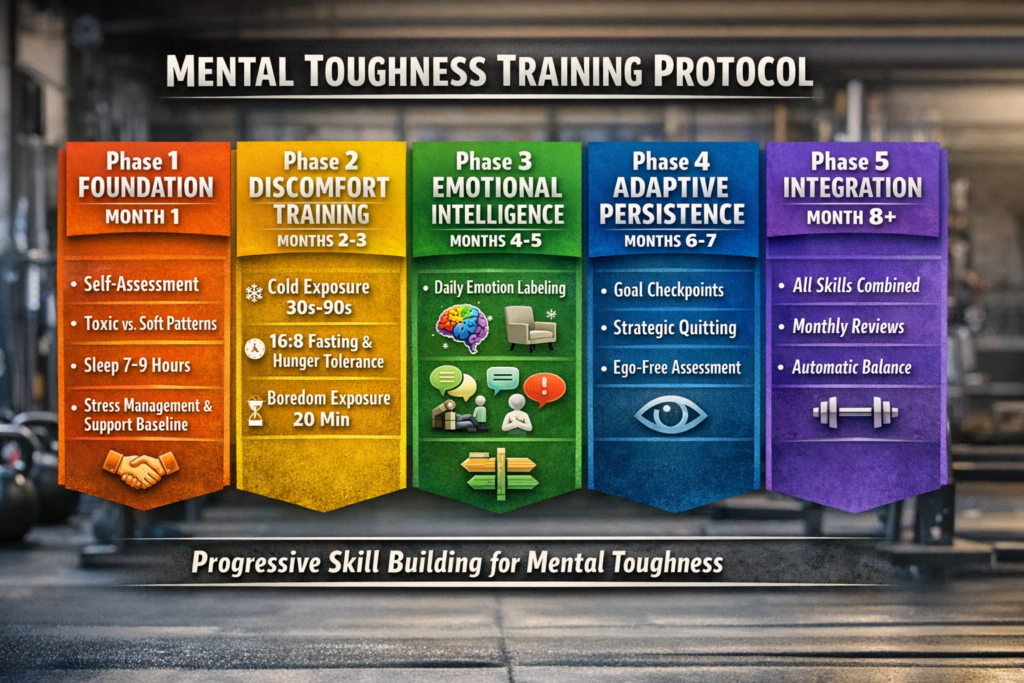
Phase 1: Foundation (Month 1)
Week 1-2: Self-assessment
Evaluate current state:
- Where am I toxic? (checklist above)
- Where am I too soft? (avoiding all discomfort)
- What’s my balance?
- Honest inventory
Journaling prompts:
- “When do I push too hard?”
- “When do I quit too easily?”
- “What emotions do I suppress?”
- “When do I refuse help?”
- Self-awareness
Identify patterns:
- Where toxic toughness shows up
- Triggers for unhealthy behaviors
- Pattern recognition
Week 3-4: Establish foundations
Sleep non-negotiable:
- 7-9 hours nightly
- Consistent schedule
- Foundation of toughness
- Recovery priority
Baseline stress management:
- Daily practice (meditation, breathing, walking)
- 10-20 minutes
- Stress regulation
Support system audit:
- Who can I talk to?
- Do I need therapist/coach?
- Build network
- Connection assessment
Phase 2: Discomfort Training (Month 2-3)
Progressive discomfort exposure:
Week 1-2: Cold exposure
- 30 seconds cold shower daily
- Notice discomfort
- Breathe through it
- Entry-level practice
Week 3-4: Extended cold
- 90 seconds cold shower
- Or ice bath 5 minutes
- Build tolerance
- Progressive challenge
Week 5-6: Fasting windows
- 16:8 intermittent fasting
- Hunger is discomfort
- Practice not immediately satisfying
- Appetite tolerance
Week 7-8: Boredom exposure
- 20 minutes sitting with nothing
- No phone, no entertainment
- Tolerate understimulation
- Patience building
The principle:
- Controlled, safe discomfort
- Progressive increase
- Build tolerance systematically
- Gradual adaptation
Reflection:
- Journal after each practice
- What did I notice?
- How did I respond?
- Learning integration
Phase 3: Emotional Intelligence (Month 4-5)
Emotion processing practice:
Daily labeling:
- Name emotions precisely
- “I’m feeling anxious about X because Y”
- Not just “I feel bad”
- Granularity
Body scan:
- Where emotion shows up physically
- Chest, stomach, shoulders
- Physical-emotional connection
- Somatic awareness
Expression practice:
- Journal 10 minutes daily
- Or talk to trusted person weekly
- Controlled release
- Strategic expression
Therapy/coaching:
- Consider professional help
- Process deeper issues
- Accelerated growth
- Expert support
The practice:
- Weekly difficult conversation
- Express vulnerability to someone
- Ask for emotional support
- Courage building
Phase 4: Adaptive Persistence (Month 6-7)
Strategic flexibility practice:
Goal-method distinction:
- Write primary goal
- List current methods
- Identify: Goal is fixed, methods are flexible
- Clarity
Checkpoint system:
- Every 4 weeks: Review progress
- Is current method working?
- If not, brainstorm alternatives
- Systematic review
Strategic quitting:
- Identify one thing to quit (wrong method)
- Quit without guilt
- Redirect energy
- Pruning
Feedback loops:
- Seek external input
- Coach, mentor, data
- Ego-free assessment
- Objective perspective
Phase 5: Integration (Month 8+)
Synthesizing all pillars:
Weekly practice:
- Discomfort exposure (2-3x)
- Emotional processing (daily)
- Strategic persistence (weekly review)
- Community connection (regular)
- Self-compassion (constant)
- All pillars active
Monthly review:
- Which pillar needs attention?
- Where am I imbalanced?
- Adjust focus
- Continuous calibration
The emergence:
- Healthy mental toughness becomes default
- Balanced approach automatic
- True resilience built
- Integration complete
Balancing Toughness and Self-Care
The integration.
The Paradox
The apparent contradiction:
- Push hard AND rest deeply
- High standards AND self-compassion
- Persist AND pivot when needed
- Strong AND vulnerable
- Both/and, not either/or
The resolution:
- Not contradictory
- Complementary
- Optimal performance requires both
- Integrated strength
The Daily Practice
Morning: Set intention
- “Today I will push through discomfort AND respect damage signals”
- “I will feel emotions AND choose my responses”
- Balanced commitment
During day: Discernment
- Is this discomfort or damage?
- Push or rest?
- Persist or pivot?
- Intelligent choice
Evening: Reflection
- Where did I push well?
- Where did I rest well?
- What did I learn?
- Integration
The Questions to Ask
Before pushing:
- “Is this productive discomfort or potential harm?”
- “Am I pushing from strength or fear?”
- “Will tomorrow-me thank me for this?”
- Discernment check
Before resting:
- “Do I genuinely need rest or am I avoiding challenge?”
- “Is this strategic recovery or avoidance?”
- “Am I being kind or just comfortable?”
- Honesty check
The wisdom:
- Both pushing and resting require courage
- Both require discernment
- Neither is always right
- Context-dependent
The Long-Term Vision
Year 1:
- Building balanced toughness
- Learning discernment
- Establishing patterns
- Foundation
Year 5:
- Automatic balanced approach
- Intuitive discernment
- Sustained high performance
- Mastery
Year 20:
- Decades of consistent performance
- No burnout
- No major injuries
- Still growing
- Sustainable excellence
The proof:
- Toxic toughness: Broken by year 5
- Healthy toughness: Thriving at year 20
- Long-term validation
The Bottom Line: Real Toughness Includes Softness
After explaining everything:
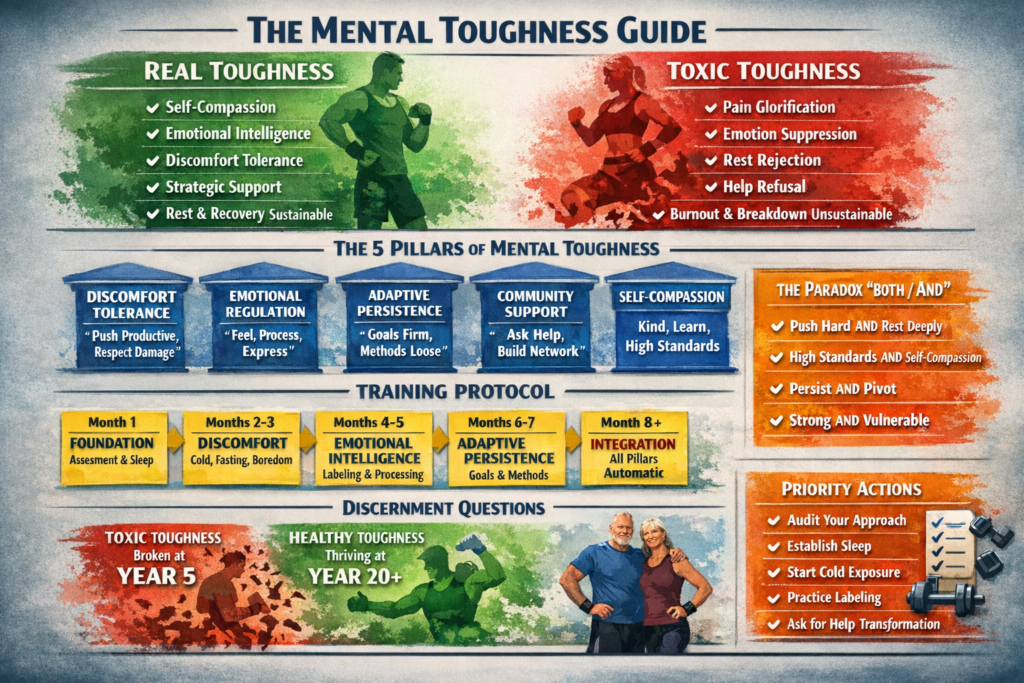
The truth about mental toughness:
✅ Real toughness includes self-compassion and emotional intelligence (not suppression)
✅ Toxic “toughness” leads to burnout, injury, and breakdown (unsustainable)
✅ Discomfort tolerance is different from pain ignorance (intelligent discernment)
✅ Asking for help is strength, not weakness (strategic support)
✅ Sustainable high performance requires rest and recovery (balanced approach)
Key takeaways:
What mental toughness actually is:
- Perform under pressure
- Persist through adversity
- Recover from setbacks
- Regulate thoughts and emotions
- Adaptive resilience
The 4 scientific components:
- Control (emotional regulation)
- Commitment (goal persistence)
- Challenge (adversity as opportunity)
- Confidence (self-efficacy)
- Research-based definition
Toxic version to avoid:
- Pain glorification (training through injury)
- Emotion suppression (bottling up)
- Rest rejection (sleep deprivation)
- Help refusal (isolated suffering)
- Zero self-compassion (self-hatred)
- Destructive patterns
The 5 pillars of healthy toughness:
Pillar 1: Discomfort tolerance
- Push through discomfort (productive challenge)
- Respect pain signals (warning of damage)
- Progressive exposure (cold, fasting, boredom)
- Intelligent persistence
Pillar 2: Emotional regulation
- Feel emotions fully (not suppress)
- Process and release (not explode)
- Express strategically (not impulsively)
- Emotional intelligence
Pillar 3: Adaptive persistence
- Hold goals firmly (persist toward destination)
- Hold methods loosely (pivot when needed)
- Strategic quitting (wrong paths)
- Flexible determination
Pillar 4: Community and support
- Ask for help when needed (not isolated)
- Build support network (multiplied strength)
- Vulnerability as courage (not weakness)
- Strategic interdependence
Pillar 5: Self-compassion
- Kind to self in failure (not brutal)
- Learn from mistakes (not identity)
- High standards without abuse (balanced)
- Compassionate accountability
Toxic behaviors to avoid:
- Training through injury (permanent damage)
- Sleep deprivation pride (hormonal disaster)
- Extreme emotional stoicism (explosion risk)
- Refusing all help (unnecessary suffering)
- Perfectionism (brittleness)
- Common traps
The training protocol:
- Month 1: Self-assessment and foundations
- Month 2-3: Discomfort training (cold, fasting, boredom)
- Month 4-5: Emotional intelligence (labeling, processing, expressing)
- Month 6-7: Adaptive persistence (goal-method distinction, checkpoints)
- Month 8+: Integration (all pillars active)
- Systematic development
The paradox:
- Push hard AND rest deeply
- High standards AND self-compassion
- Persist AND pivot when needed
- Strong AND vulnerable
- Both/and integration
Discernment questions:
- Before pushing: “Is this productive discomfort or potential harm?”
- Before resting: “Do I need rest or am I avoiding challenge?”
- Intelligent choice
Long-term vision:
- Toxic toughness: Broken by year 5
- Healthy toughness: Thriving at year 20+
- Sustainable vs. destructive
Priority actions:
- Audit current approach (toxic or healthy?)
- Establish sleep foundation (7-9 hours non-negotiable)
- Start cold exposure (30 sec daily)
- Practice emotion labeling (daily)
- Ask for help in one area (this week)
- Begin transformation now
STOP CONFUSING BRITTLENESS WITH STRENGTH. BUILD REAL MENTAL TOUGHNESS WITH SELF-COMPASSION, EMOTIONAL INTELLIGENCE, AND STRATEGIC RECOVERY. SUSTAINABLE EXCELLENCE, NOT BURNOUT.
Ready to build complete mental toughness capacity with evidence-based protocols, emotional intelligence training, discomfort tolerance systems, and balanced approaches that create sustainable high performance without burnout, injury, or psychological damage? Understanding healthy toughness is just the beginning. Get a comprehensive guide to systematically developing resilience, integrating self-compassion with high standards, building emotional regulation capacity, and achieving elite performance that lasts decades. Stop performing toxic toughness. Start building real resilience.
REFERENCES
SECTION 1 — The scientific framework of mental toughness: the 4Cs model
[1] Jones G, Hanton S & Connaughton D — The Sport Psychologist, 2007 Qualitative framework study interviewing eight Olympic and world champions, three coaches, and four sport psychologists to define mental toughness in elite performers; the study verified earlier definitional work and identified 30 key attributes clustering into four dimensions: attitude/mindset, training, competition, and post-competition; mental toughness is defined as having a natural or developed psychological edge enabling performers to cope better than opponents with the many demands of sport and remain more consistent and focused under pressure; confirms that mental toughness is a multi-dimensional, acquirable psychological skill rather than a fixed innate trait; provides the foundational empirical evidence base for the article’s multi-component definition of real mental toughness https://journals.humankinetics.com/view/journals/tsp/21/2/article-p243.xml
[2] Connaughton D et al. — PubMed/Journal of Sports Science, 2008 Follow-up longitudinal study with seven participants from the original Jones et al. (2002) framework to examine how mental toughness is developed and maintained over time; findings showed that development is a long-term process encompassing multiple underlying mechanisms that operate in a combined rather than independent fashion; mental toughness requires ongoing maintenance and cannot simply be established once; provides the developmental timeline evidence that supports the article’s 8-month training protocol and explains why mental toughness is a trainable capacity built progressively over years rather than a fixed characteristic https://pubmed.ncbi.nlm.nih.gov/17852671/
SECTION 2 — Self-compassion: the three components and the myth of softness
[3] Neff KD — PubMed/Annual Review of Psychology, 2023 Comprehensive theoretical review by the originator of the self-compassion framework; self-compassion comprises six elements: self-kindness, common humanity, and mindfulness paired with reduced self-judgment, isolation, and overidentification; empirical studies consistently indicate self-compassion engenders mental and physical well-being; the review specifically addresses and refutes common myths that self-compassion is weak, selfish, self-indulgent, or undermines motivation; evidence shows self-compassion is associated with greater persistence, not less; directly supports the article’s Pillar 5 and the counter-intuitive claim that self-compassion increases rather than decreases performance and resilience https://pubmed.ncbi.nlm.nih.gov/35961039/
SECTION 3 — Sleep deprivation reduces testosterone: the hormonal cost of glorifying poor sleep
[4] Leproult R & Van Cauter E — PMC/JAMA, 2011 Clinical study in 10 healthy young men (mean age 24) who spent 3 nights sleeping 10 hours followed by 8 nights restricted to 5 hours; testosterone levels measured every 15 to 30 minutes for 24 hours; after one week of sleep restriction, daytime testosterone levels fell significantly compared to the rested condition (16.5 vs. 18.4 nmol/L, p=0.049), with the effect most pronounced in the afternoon and evening; the decline in testosterone was equivalent in magnitude to aging 10 to 15 years; vigor scores also declined progressively across the restriction period; provides the primary human experimental evidence for the article’s claim that sleep deprivation causes testosterone suppression, directly refuting the “sleep when you’re dead” grindset mentality https://pmc.ncbi.nlm.nih.gov/articles/PMC4445839/
SECTION 4 — Emotional regulation predicts outcomes; self-compassion enables persistence
[5] Neff KD et al. — Journal of Research in Personality, 2007 Two studies examining self-compassion and adaptive psychological functioning; self-compassion (comprising self-kindness, common humanity, and mindfulness) was associated with greater psychological well-being, lower anxiety in ego-threat situations, and higher academic motivation; increases in self-compassion over a one-month interval predicted improved well-being; self-compassionate individuals were less defensive after failure, showed greater emotional stability, and exhibited more adaptive coping strategies; therapist-rated self-compassion predicted better outcomes in psychotherapy; provides the empirical evidence that self-compassion enables rather than undermines persistence after setbacks, directly supporting the article’s claim that “self-compassion INCREASES persistence” https://www.sciencedirect.com/science/article/abs/pii/S0092656606000353




Leave a Reply
You must be logged in to post a comment.