You’ve seen the viral morning routine videos: wake up at 4:30 AM, cold plunge, meditate for 20 minutes, journal three pages, drink celery juice, do a gratitude practice, review your vision board, stretch for 15 minutes, and eat a perfectly prepared organic breakfast. All before the sun comes up. The implication is clear: if you don’t do all of this, you’re leaving gains and productivity on the table.
Then reality hits. Your alarm goes off, you snooze it twice, rush to get ready, grab whatever food is closest, and head to the gym or work feeling like you’ve already failed the day before it started. You feel guilty because some fitness influencer told you that “winning the morning means winning the day” and you clearly didn’t win anything except an extra 18 minutes of sleep.
Here’s the truth that nobody making content about morning routines wants to admit: most of what’s promoted as essential morning habits has zero impact on muscle growth, fat loss, or training performance. The morning routine industry is built on productivity theater and aesthetic content, not exercise science or nutritional evidence.
What actually matters when you wake up, specifically for people training to build muscle, lose fat, or improve performance, is far simpler, far less glamorous, and far more effective than the 27 step morning protocols flooding social media.
In this comprehensive guide, I’ll dismantle the most popular morning routine myths with actual science, explain the 4 things that genuinely matter when you wake up for physique and performance goals, show you how sleep quality the night before trumps everything you do after the alarm, break down optimal morning nutrition strategies for different training schedules, provide practical morning frameworks that take 10 to 15 minutes instead of 2 hours, and give you evidence based protocols that actually move the needle on your goals.
Whether you’re a 5 AM gym goer who needs to optimize pre dawn training nutrition, someone who trains in the evening and wonders if morning habits even matter, or a person who’s been guilt tripped by influencer morning routines into thinking you’re not doing enough, understanding what genuinely impacts your results versus what’s just content filler will save you time, stress, and wasted effort.
Let’s separate what works from what’s just noise.
TABLE OF CONTENTS
The Morning Routine Myth: Why Most Advice Is Wrong
Before covering what matters, let’s understand why the current morning routine culture is misleading, specifically for people focused on physique and performance goals.
The Social Media Morning Routine Problem
What you see online:
The typical fitness influencer morning routine video:
- Wake up at 4:30 AM (because “discipline”)
- Ice bath or cold shower (because “hormesis”)
- 20 minute meditation (because “mindset”)
- Journaling and gratitude practice (because “manifestation”)
- Greens powder in water (because “micronutrients”)
- 45 minute stretching or yoga flow (because “mobility”)
- Perfectly lit and filmed breakfast preparation
- All before training at 6 AM
Total morning routine time: 2 to 2.5 hours
What they don’t tell you:
- This was filmed on a day off, not a real workday
- They went to bed at 8:30 PM to wake at 4:30 AM (most people can’t do this)
- They don’t do this every day (too time consuming)
- Several of these steps have zero evidence for muscle growth
- The routine is designed for content, not results
- They make money from the products shown in the video
- Their physique comes from training, nutrition, sleep, and possibly drugs, not from journaling
The guilt effect:
- You watch these videos and feel inadequate
- Your morning involves surviving, not optimizing
- You assume their results come from the morning routine
- You add unnecessary stress about not doing enough
- Stress itself is counterproductive to your goals
Why “Winning the Morning” Is Overrated
The productivity guru claim:
- “How you start the day determines how the day goes”
- “The first hour sets the tone for everything”
- “Morning people are more successful”
What the research actually shows:
Chronotype matters more than wake up time:
- Some people are naturally early risers (morning chronotype)
- Others are naturally late risers (evening chronotype)
- This is genetically determined, not a character flaw
- Forcing yourself into the wrong chronotype reduces performance
- Studies show evening chronotype individuals perform WORSE when forced to wake early
- Your optimal wake up time is individual, not universal
Consistency matters more than earliness:
- Waking at the same time daily is beneficial (circadian rhythm)
- But that time doesn’t need to be 5 AM
- Consistent 7 AM wake up is better than inconsistent 5 AM
- Sleep quality and duration trump wake up time every time
Morning routines don’t build muscle:
- No study has ever shown that morning journaling increases hypertrophy
- No study links cold plunges to improved muscle protein synthesis
- No study shows gratitude practices enhance training performance
- Muscles grow from progressive overload, adequate protein, and recovery
- The morning routine is irrelevant to these three factors
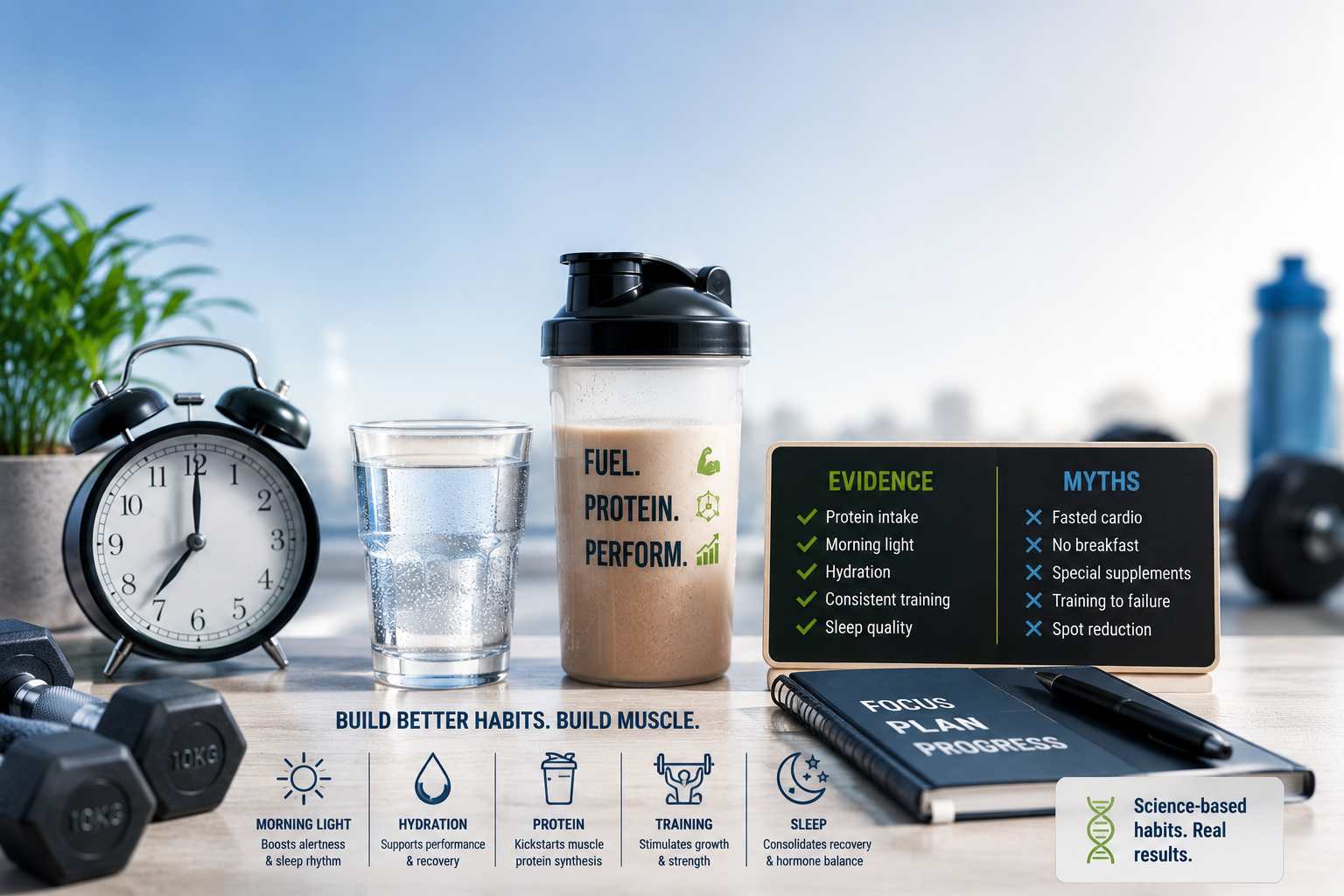
The 4 Things That Actually Matter
What science says impacts your physique and performance when you wake up:
- Sleep quality and duration (what happened BEFORE you woke up)
- Hydration (addressing overnight fluid loss)
- Nutrition timing relative to training (fueling performance or recovery)
- Consistent wake time (circadian rhythm optimization)
That’s it. Everything else is optional, personal preference, or content filler.
Notice what’s NOT on the list:
- Cold showers
- Meditation
- Journaling
- Greens powders
- Celery juice
- Gratitude practices
- Vision boards
- Affirmations
- Stretching routines
- Sunlight exposure protocols
Some of these may have general wellness benefits. But none of them directly impact muscle growth, fat loss, or training performance in any meaningful, evidence based way. If you enjoy them, do them. But don’t feel guilty if you skip them, because your gains won’t suffer.
Factor 1: Sleep Quality (What Happens Before You Wake Up)
The single most important “morning routine” factor has nothing to do with your morning. It’s what happened during the 7 to 9 hours before your alarm went off.
Why Sleep Is the Foundation of Everything
Sleep is when your body actually builds muscle:
During deep sleep (NREM Stage 3 and 4):
- Growth hormone released in largest pulses of the day
- Growth hormone promotes muscle repair and growth
- Protein synthesis rates are elevated
- Damaged muscle fibers from training are repaired
- Glycogen stores replenished
- Immune system strengthened
During REM sleep:
- Neural recovery occurs
- Motor learning consolidated (movement patterns from training)
- Emotional regulation (affects motivation and adherence)
- Memory consolidation (training technique retention)
What poor sleep does to muscle building:
Study: Sleep restriction and muscle mass:
- Group A: 8.5 hours sleep, calorie deficit
- Group B: 5.5 hours sleep, same calorie deficit
- Same training, same diet, same deficit
- Result: Group B lost 60% more muscle and 55% less fat than Group A
- Sleep deprived group preferentially lost muscle instead of fat
The implications are enormous:
- Same diet, same training, same deficit
- Only difference was 3 hours of sleep
- Group B’s body composition change was dramatically worse
- All the morning routines in the world can’t compensate for poor sleep
Study: Sleep and testosterone:
- Men sleeping 5 hours per night had 10 to 15% lower testosterone than men sleeping 8 hours
- Testosterone is primary anabolic hormone
- Lower testosterone = less muscle building potential
- No morning routine can increase testosterone as much as adequate sleep
Study: Sleep and training performance:
- Sleep deprived individuals showed 9 to 20% decrease in maximal strength
- Reduced training volume capacity
- Slower reaction times
- Impaired coordination
- Higher perceived exertion (same weight feels heavier)
- All directly reduce training stimulus quality
How to Optimize Sleep (The Real Morning Routine Hack)
Ironically, the best morning routine starts the night before:
Sleep duration targets:
- Minimum: 7 hours (bare minimum for active individuals)
- Optimal: 7.5 to 9 hours (most people need 8)
- Individual: Some rare individuals function on less (genetic, not trainable)
- More important: Consistency of duration night to night
Sleep quality factors:
Temperature:
- Cool room is better (65 to 68°F / 18 to 20°C)
- Body temperature drops during sleep naturally
- Cool environment facilitates this process
- Hot room disrupts deep sleep stages
- Consider lightweight bedding
Darkness:
- Complete darkness is ideal
- Blackout curtains or sleep mask
- Cover LED lights on electronics
- Even small light exposure reduces melatonin production
- Melatonin is essential for deep, restorative sleep
Consistency:
- Same bedtime and wake time daily (including weekends)
- Within 30 to 60 minute window
- Trains circadian rhythm
- Improves sleep onset (fall asleep faster)
- Improves sleep quality (deeper sleep)
- This is the most underrated sleep improvement strategy
Pre sleep nutrition:
- Casein protein before bed (slow release amino acids throughout night)
- 25 to 40g casein provides 7 to 8 hours of amino acid availability
- Supports overnight muscle protein synthesis
- May reduce overnight muscle breakdown
- One of few evidence based “sleep supplements” for muscle building
What to avoid before bed:
- Caffeine within 6 to 8 hours of bedtime (half life is 5 to 6 hours)
- Large meals within 2 hours (digestive discomfort)
- Alcohol (disrupts sleep architecture, reduces deep sleep by 20 to 40%)
- Intense exercise within 2 to 3 hours (elevated cortisol and body temperature)
- Blue light exposure within 1 to 2 hours (suppresses melatonin)
Evidence based sleep supplements (if needed):
Magnesium glycinate:
- 200 to 400mg before bed
- Supports relaxation and sleep quality
- Many athletes are deficient
- Also supports muscle function and recovery
- Well studied, safe, inexpensive
Melatonin (low dose):
- 0.5 to 1mg (not the 5 to 10mg many people take)
- Helps with sleep onset
- Particularly useful when adjusting schedule
- Lower doses are actually more effective
- Not for long term daily use ideally
What This Means for Your Morning
If you slept well:
- Wake up feeling relatively refreshed
- Mental clarity within 15 to 30 minutes
- Good energy for training
- Positive mood and motivation
- Body is recovered and ready
- Your morning routine barely matters because the foundation is solid
If you slept poorly:
- Wake up groggy and unmotivated
- Brain fog lasting hours
- Reduced training performance
- Higher cortisol (catabolic)
- Lower testosterone
- Impaired recovery from previous training
- No morning routine can fix this. The damage is done.
The lesson: Stop optimizing your morning routine and start optimizing your sleep. The return on investment is incomparably higher.
Factor 2: Hydration (The Simplest Win)
After 7 to 9 hours without fluid intake, your body is mildly dehydrated when you wake up. This is one of the few morning interventions with clear, direct impact on performance.
Why Morning Hydration Matters
Overnight fluid loss:
How you lose water while sleeping:
- Breathing: Exhale moisture with every breath (approximately 200 to 300ml lost overnight)
- Sweating: Even in cool rooms, mild perspiration occurs (100 to 300ml)
- Urination: Bladder fills overnight (not technically “lost” until you urinate)
- Total estimated overnight fluid loss: 300 to 600ml (10 to 20 oz)
The impact of mild dehydration on performance:
At 1 to 2% dehydration (common upon waking):
- Reduced aerobic performance (endurance drops)
- Impaired cognitive function (reaction time, focus)
- Increased perceived exertion (same work feels harder)
- Potential reduction in strength (2 to 3% decrease)
- Reduced blood volume (less nutrient delivery to muscles)
At 3%+ dehydration:
- Significant performance decline
- Headaches
- Fatigue
- Impaired thermoregulation
- Rarely this bad from overnight alone
Study: Hydration and strength performance:
- Dehydrated subjects showed 2 to 5% reduction in maximal strength
- Reduced training volume (fewer reps per set)
- Higher perceived exertion
- Slower recovery between sets
- All directly reduce training stimulus
The Simple Morning Hydration Protocol
What to do (extremely simple):
Step 1: Drink 16 to 24 oz (500 to 700ml) of water upon waking
- Before coffee, before food, before anything else
- Room temperature or cool (doesn’t matter)
- Plain water is fine (no need for special additions)
- Takes 30 to 60 seconds
That’s the entire protocol. It’s not glamorous, won’t get social media likes, and doesn’t require a special product. But it directly addresses a physiological need that impacts performance.
Optional additions (helpful but not required):
Pinch of salt (sodium):
- Enhances water absorption
- Supports electrolyte balance
- Particularly useful if training within 1 to 2 hours of waking
- 1/4 teaspoon in 500ml water
- Barely noticeable taste
Electrolyte packet:
- Contains sodium, potassium, magnesium
- Useful if you sweat heavily during sleep
- Or if training very soon after waking
- Not necessary for most people
- Don’t overspend on fancy electrolyte products
What Does NOT Matter for Morning Hydration
Lemon water:
- Popular claim: “Alkalizes the body,” “detoxifies,” “boosts metabolism”
- Reality: Stomach acid is pH 1.5 to 3.5. Lemon water is pH 2 to 3. It does not “alkalize” anything
- Your body regulates blood pH precisely regardless of what you drink
- No detoxification benefits (your liver and kidneys detoxify you)
- No meaningful metabolic boost
- If you enjoy it, drink it. But don’t think it’s doing anything special
Apple cider vinegar:
- Popular claim: “Burns fat,” “improves digestion,” “balances blood sugar”
- Reality: Some evidence for very modest blood sugar improvements in diabetics
- No evidence for fat burning
- Can erode tooth enamel if consumed undiluted
- Not harmful in small amounts, but not beneficial for physique goals
- Save your money
Celery juice:
- Popular claim: “Heals the gut,” “reduces inflammation,” “detoxifies”
- Reality: No scientific evidence supporting any of these claims
- Contains water, fiber, and some vitamins (which you can get from any vegetable)
- The “Medical Medium” who popularized this has no medical credentials
- Pure marketing, zero evidence
Warm water with turmeric:
- Turmeric has some anti-inflammatory properties
- But bioavailability is very low without black pepper extract (piperine)
- Amount consumed in morning drink is negligible
- Won’t affect training performance or muscle growth
- Supplement with curcumin + piperine if you want the anti-inflammatory benefits
Greens powders:
- Popular claim: “Equivalent to 12 servings of vegetables”
- Reality: Does not replace whole vegetables (missing fiber, volume, many compounds)
- Some contain useful nutrients, but nothing you can’t get from actual food
- Very expensive per serving
- Not harmful, but not necessary
- Eat actual vegetables instead
The honest truth: Drink water. That’s what your body needs after sleeping. Everything else is marketing.
Factor 3: Nutrition Timing Relative to Training
This is where morning routine actually matters for physique goals. What you eat (or don’t eat) in the morning depends entirely on when you train.
Scenario 1: Training in the Morning (Within 1 to 2 Hours of Waking)
This is where morning nutrition becomes genuinely important.
The challenge:
- Haven’t eaten for 8 to 12+ hours (overnight fast)
- Liver glycogen depleted by approximately 80% overnight
- Muscle glycogen partially reduced
- Amino acid levels declining
- Need energy for training performance
- But also can’t eat a huge meal (need time to digest)
The evidence on fasted vs fed morning training:
Study: Fed vs fasted resistance training:
- Fed group consumed protein + carbs before training
- Fasted group trained without eating
- Result: Fed group showed better training performance (more reps, more volume)
- More volume = more stimulus = more growth over time
Study: Fasted morning training and muscle loss:
- Fasted morning cardio may increase fat oxidation acutely
- But also increases muscle protein breakdown
- Net effect: May lose slightly more muscle when training fasted regularly
- Pre workout protein prevents this without significantly reducing fat burning
The practical recommendation:
If training within 30 to 60 minutes of waking:
Quick option (15 minutes before training):
- 25 to 30g whey protein in water
- 1 banana or handful of cereal (fast carbs)
- Total: 250 to 300 calories
- Digests quickly, provides amino acids and energy
- Won’t cause stomach discomfort
- Takes 2 minutes to prepare
Why this works:
- Whey protein absorbs rapidly (peak amino acids in 30 to 60 minutes)
- Provides leucine to trigger muscle protein synthesis
- Prevents muscle breakdown during training
- Fast carbs provide immediate energy
- Small enough to not cause GI issues during training
If training 60 to 90 minutes after waking:
Moderate option:
- 3 to 4 eggs scrambled (18 to 24g protein)
- 2 slices toast or 1 cup oatmeal (30 to 40g carbs)
- Piece of fruit
- Total: 400 to 500 calories
- More substantial but still digestible
- Provides sustained energy for training
If training 2+ hours after waking:
Full breakfast option:
- Full meal with 30 to 40g protein
- 40 to 60g carbohydrates
- Moderate fat (10 to 15g)
- Total: 500 to 700 calories
- Plenty of time to digest
- Maximum energy for training
Key principle: The closer your training is to waking, the smaller and simpler your meal should be. Protein is non negotiable at any timing. Carbs are beneficial but adjust volume based on available digestion time.
Scenario 2: Training in the Afternoon or Evening
If you don’t train until later in the day, morning nutrition is less critical for performance but still matters for daily protein distribution.
The protein distribution principle:
Research on protein timing throughout the day:
- Distributing protein across 3 to 5 meals is superior to loading it into 1 to 2 meals
- Each meal should contain 25 to 40g protein to maximize muscle protein synthesis
- “Pulsing” protein triggers MPS multiple times daily
- Skipping breakfast protein means one fewer MPS spike
Practical implication:
- Even if not training until evening, eat protein at breakfast
- 25 to 40g protein in morning meal
- Don’t save all protein for post workout
- Distribute evenly throughout day
Morning meal for evening trainers:
Standard breakfast (not training specific):
- Focus on protein (25 to 40g)
- Include carbs and fats based on daily macro targets
- No rush to eat immediately upon waking (within 1 to 2 hours is fine)
- Choose foods you enjoy and can prepare consistently
Examples:
- 4 eggs + toast + fruit (28g protein)
- Greek yogurt + granola + berries (25g protein)
- Protein shake + oatmeal (35g protein)
- Overnight oats with protein powder (30g protein)
The key: Just eat adequate protein. The specific food choices matter far less than hitting 25 to 40g protein at your first meal.
Scenario 3: Intermittent Fasting (Skipping Breakfast)
Some people deliberately skip breakfast as part of an intermittent fasting protocol.
The evidence on IF and muscle building:
What research shows:
- IF does not appear to significantly impair muscle building IF total daily protein is adequate
- However, it reduces the number of protein feeding opportunities (fewer MPS spikes)
- May slightly reduce muscle growth compared to evenly distributed protein
- Not dramatically different for most people
- Individual adherence matters most
When skipping breakfast is fine:
- You meet total daily protein targets
- You distribute remaining meals well (3 to 4 meals in your eating window)
- You don’t train fasted (or at least consume BCAAs/EAAs before training)
- You feel good and perform well
- Adherence is high (you stick to your diet better this way)
When skipping breakfast is problematic:
- You struggle to hit protein targets in fewer meals
- You train fasted without any amino acids
- You feel weak or perform poorly in morning/early afternoon
- You overeat later to compensate (calorie surplus when cutting)
- You’re trying to maximize muscle growth (every MPS spike counts)
The honest assessment:
- IF is not optimal for muscle building (fewer protein feedings)
- But it’s not dramatically worse (maybe 5 to 10% less optimal)
- If adherence is better with IF, the adherence advantage may outweigh the timing disadvantage
- Don’t force yourself to eat breakfast if it makes you miserable
- Don’t skip breakfast purely because a fasting guru told you to
Morning Nutrition Summary
The hierarchy of what matters:
Most important (non negotiable):
- Total daily protein intake (0.8 to 1.2g per lb body weight)
- Total daily calorie intake (aligned with surplus, deficit, or maintenance goal)
Very important:
- Protein at first meal (25 to 40g)
- Pre workout nutrition if training in morning
Moderately important:
- Carbohydrate intake at first meal (supports energy)
- Meal timing relative to training
Least important:
- Specific food choices (eggs vs yogurt vs shake, doesn’t matter much)
- Exact timing of first meal (within 1 to 2 hours of waking is fine)
- Supplements with breakfast (most can be taken anytime)
Factor 4: Consistent Wake Time (Circadian Rhythm)
The fourth and final factor that genuinely impacts your physique goals is also simple: wake up at roughly the same time every day.
Why Circadian Rhythm Matters for Muscle Building
Your body runs on a 24 hour internal clock:
Circadian rhythm controls:
- Hormone release timing (testosterone peaks in morning, growth hormone at night)
- Core body temperature (affects training performance)
- Cortisol rhythm (should peak in morning, decline through day)
- Melatonin production (sleep onset)
- Digestive enzyme release (nutrient absorption)
- Muscle protein synthesis rates (may vary throughout day)
How inconsistent wake times disrupt this:
The weekend warrior problem:
- Monday to Friday: Wake at 6:30 AM
- Saturday and Sunday: Wake at 10:30 AM
- This 4 hour shift is equivalent to jet lag
- Called “social jet lag”
- Disrupts hormone timing
- Impairs sleep quality Sunday night
- Monday morning feels terrible
- Training performance suffers early in the week
- Cycle repeats
What consistent wake times provide:
Optimized hormone profiles:
- Cortisol rises appropriately in morning (energy and alertness)
- Testosterone peaks at natural time
- Growth hormone release optimized during sleep
- Insulin sensitivity follows predictable pattern
- Body “expects” sleep and waking at consistent times
Better sleep quality:
- Falls asleep faster (body knows when to produce melatonin)
- More time in deep sleep (stages 3 and 4)
- More time in REM sleep
- Less middle of night waking
- Wake up feeling more refreshed
Better training performance:
- Body knows when to expect physical demands
- Energy peaks become predictable
- Can optimize training timing to energy patterns
- More consistent performance day to day
The Practical Protocol
What to do:
Choose a wake time you can maintain 7 days per week:
- Not the earliest possible time
- Not the latest possible time
- Something sustainable that allows 7 to 9 hours of sleep
- Within 30 to 60 minute range all week
Example:
- Weekday target: 6:30 AM
- Weekend target: 7:00 to 7:30 AM (acceptable variance)
- NOT: Weekday 6:30 AM, weekend 10:00 AM
Adjust for chronotype:
If you’re naturally a morning person:
- 5:30 to 6:30 AM wake time
- Train in the morning (energy is high)
- Bed by 9:30 to 10:30 PM
If you’re naturally an evening person:
- 7:30 to 8:30 AM wake time (or later if schedule allows)
- Train in the afternoon or evening (energy peaks later)
- Bed by 11:30 PM to 12:30 AM
If you don’t know your chronotype:
- Pay attention to when you naturally feel energized
- When do you feel most alert and motivated?
- When does your body want to sleep?
- Work with your biology, not against it
Myths Debunked: Morning Practices That Don’t Affect Your Gains
Now let’s address the specific morning practices that are heavily promoted but have zero evidence for muscle building, fat loss, or training performance.
Myth 1: Cold Showers and Ice Baths Build Muscle
The claim:
- “Cold exposure increases testosterone”
- “Cold thermogenesis burns fat”
- “Cold showers build discipline and mental toughness”
What the research says:
Cold exposure and testosterone:
- No significant evidence that cold showers increase testosterone meaningfully
- One study showed brief cold exposure increased norepinephrine (a stress hormone)
- Norepinephrine is not testosterone
- Any testosterone increase is too small and transient to affect muscle building
Cold exposure and fat burning:
- Cold exposure activates brown fat (which burns calories to produce heat)
- But the calorie burn is tiny (maybe 50 to 100 calories per session)
- A single cookie has more calories than an ice bath burns
- Not a meaningful fat loss strategy
- Calorie deficit through diet is 100x more effective
Cold exposure AFTER resistance training:
- May actually IMPAIR muscle growth
- Cold reduces inflammation (sounds good)
- But post training inflammation is NECESSARY for muscle adaptation
- Studies show cold water immersion after lifting reduces hypertrophy
- If you want to grow muscle, DON’T ice bath after lifting
The bottom line:
- Cold showers are fine if you enjoy them
- They may provide a temporary alertness boost (cortisol and norepinephrine spike)
- They do NOT build muscle or burn meaningful fat
- They may HURT muscle growth if done after training
- Not worth doing for physique goals specifically
Myth 2: Morning Meditation Improves Training
The claim:
- “Meditation reduces cortisol”
- “Lower cortisol means more muscle growth”
- “Mental clarity improves training focus”
What the research says:
Meditation and cortisol:
- Regular meditation practice can modestly reduce cortisol levels
- But the reduction is small (5 to 10% in some studies)
- And cortisol is not as catabolic as fitness influencers claim
- Morning cortisol is supposed to be elevated (it’s what wakes you up)
- Reducing morning cortisol may actually make you feel more groggy, not less
Cortisol and muscle building (the misunderstanding):
- Fitness culture demonizes cortisol
- Cortisol IS catabolic in chronic excess
- But acute cortisol spikes from training are NORMAL and NECESSARY
- They’re part of the adaptation process
- Chronically elevated cortisol (from chronic stress, overtraining, sleep deprivation) is the problem
- Morning meditation addresses chronic stress, not training related cortisol
- The effect on muscle building is negligible
Meditation and training performance:
- No studies show meditation directly improves strength, power, or hypertrophy
- May improve focus and mind muscle connection (plausible but unproven)
- May reduce anxiety related performance inhibition (limited evidence)
- Benefits are primarily psychological, not physiological
The honest assessment:
- Meditation has legitimate mental health benefits
- It may reduce chronic stress (which is good for everything, including recovery)
- But claiming it builds muscle or improves training is a stretch
- If you enjoy it, do it. It won’t hurt
- If you don’t enjoy it, skipping it won’t affect your gains
- Don’t meditate because you think it’s building muscle. It isn’t
Myth 3: Morning Sunlight Is Essential for Gains
The claim:
- “Morning sunlight sets circadian rhythm”
- “Sunlight boosts vitamin D production”
- “Sunlight exposure improves sleep quality”
What the research says:
The legitimate part:
- Morning light exposure does help set circadian rhythm
- This is real and well documented
- Bright light signals to your brain that it’s daytime
- Helps cortisol rise appropriately in the morning
- Helps melatonin production timing at night
The exaggerated part:
- You don’t need a dedicated “sunlight protocol”
- Walking to your car, commuting, or being near windows accomplishes this
- Indoor lighting (especially bright rooms) provides similar signal
- The people who need dedicated sunlight exposure are those who literally never go outside or see daylight
- Most people get adequate light exposure through normal daily activities
Vitamin D consideration:
- Morning sun won’t produce meaningful vitamin D in most situations
- Vitamin D synthesis requires UVB rays (strongest midday, not early morning)
- In many latitudes, insufficient UVB exists for much of the year regardless
- Supplementation (2,000 to 5,000 IU daily) is more reliable than morning sun
- Get your vitamin D level tested and supplement accordingly
The honest assessment:
- Morning light exposure is mildly beneficial for circadian rhythm
- But it happens naturally for most people
- No need for a dedicated 10 to 15 minute “sunlight protocol”
- Walk outside, open curtains, commute normally
- If you work night shifts or literally never see daylight, then yes, make effort
- Otherwise, this is a non issue being presented as essential
Myth 4: Morning Stretching Prevents Injury and Improves Performance
The claim:
- “You must stretch every morning”
- “Morning flexibility work prevents injuries”
- “Stretching improves range of motion for training”
What the research says:
Static stretching before exercise:
- Research consistently shows static stretching BEFORE training REDUCES strength and power
- Up to 5 to 8% decrease in force production after static stretching
- Not beneficial for performance
- May actually increase injury risk (weakened muscle generating force)
Morning stretching specifically:
- No evidence that a morning stretching routine (separate from training) prevents injuries
- Injuries are prevented by progressive overload, proper warm up before training, adequate recovery, and appropriate exercise technique
- A 15 minute morning stretch does not provide injury protection for your 5 PM training session
What DOES prevent injury:
- Proper warm up immediately before training (5 to 10 minutes, movement specific)
- Progressive overload (not jumping to weights you’re not ready for)
- Adequate recovery between sessions
- Proper exercise technique
- Listening to pain signals
- Sufficient sleep (recovery)
The honest assessment:
- If you enjoy morning stretching or yoga, do it for enjoyment and general well being
- Don’t do it thinking it prevents training injuries (it doesn’t, in isolation)
- Static stretching immediately before heavy training is counterproductive
- Dynamic warm up before training is the actual injury prevention tool
- Save your morning time for sleep if time is limited
Myth 5: Supplements on an Empty Stomach Work Better
The claim:
- “Take your fat burner first thing on empty stomach”
- “Absorb supplements better without food”
- “Fasted supplementation is more effective”
What the research says:
It depends entirely on the supplement:
Caffeine:
- Absorbed well with or without food
- Empty stomach: Faster absorption, possible stomach discomfort
- With food: Slightly slower absorption, but same total effect
- For pre workout purposes, timing matters more than stomach contents
Creatine:
- Absorbed well with or without food
- Some evidence better absorbed with carbs/protein (insulin response aids uptake)
- Taking with breakfast meal is fine and potentially superior
- Empty stomach has no advantage
Vitamins:
- Fat soluble vitamins (A, D, E, K): Better absorbed WITH food containing fat
- Taking these on empty stomach REDUCES absorption
- Water soluble vitamins (C, B vitamins): Absorbed with or without food
- For fat soluble vitamins, empty stomach is WORSE
Protein powder:
- Absorbed fine with or without other food
- Adding carbs may slightly enhance amino acid uptake (insulin)
- Empty stomach may cause faster gastric emptying (faster to intestines)
- Practical difference: Negligible
The honest assessment:
- Most supplements work fine taken with breakfast
- Some (fat soluble vitamins) actually work BETTER with food
- Empty stomach supplementation is not superior for most compounds
- Stop stressing about supplement timing relative to food
- Just take them consistently
The Evidence Based Morning Framework (10 to 15 Minutes)
Now let’s build a practical morning routine based on what actually matters.
The Minimalist Morning for Physique Goals
Total time: 10 to 15 minutes
Step 1: Wake up at consistent time (0 minutes)
- Alarm goes off
- Get up (minimize snooze)
- Same time daily within 30 to 60 minute range
Step 2: Hydrate (1 to 2 minutes)
- Drink 16 to 24 oz water
- Optional: Pinch of salt
- Before coffee, before food
Step 3: Bathroom routine (5 minutes)
- Normal morning hygiene
- Nothing special needed
Step 4: Nutrition (5 to 10 minutes)
- If training soon: Quick protein + carbs (shake + banana = 2 minutes)
- If not training soon: Normal breakfast with 25 to 40g protein
- Take daily supplements with meal (creatine, vitamin D, fish oil, etc.)
Step 5: Go about your day
- Train when your schedule allows
- Don’t stress about anything else
That’s the entire evidence based morning routine.
It’s not glamorous. It won’t get likes on social media. There’s no cold plunge, no journaling, no meditation, no gratitude practice, no greens powder, no celery juice.
But it addresses every factor that actually impacts your physique goals:
- Sleep was optimized (the night before)
- Hydration addressed (water upon waking)
- Nutrition timed appropriately (protein consumed, training fueled)
- Circadian rhythm supported (consistent wake time)
Adjustments Based on Training Time
Morning trainer (5 to 7 AM training):
Wake: 4:45 to 5:30 AM
- Water (16 to 24 oz) immediately
- Bathroom and change into gym clothes
- Quick nutrition: protein shake + banana or rice cakes
- Drive to gym
- Warm up and train
- Full breakfast post workout (eggs, oatmeal, etc.)
- Total morning routine before gym: 15 to 20 minutes
Midday trainer (11 AM to 1 PM training):
Wake: 7 to 8 AM
- Water (16 to 24 oz)
- Bathroom routine
- Full breakfast: 4 eggs, toast, fruit (or equivalent with 25 to 40g protein)
- Normal morning activities (work, commute, etc.)
- Optional: Pre workout snack 60 to 90 minutes before training
- Train
- Total morning routine: 15 minutes
Evening trainer (5 to 8 PM training):
Wake: 6:30 to 8 AM
- Water (16 to 24 oz)
- Bathroom routine
- Full breakfast: protein source + carbs + fats (balanced meal)
- Normal day
- Lunch with adequate protein
- Pre workout meal or snack 60 to 90 minutes before training
- Train in evening
- Total morning routine: 15 minutes
Notice how simple these all are. No morning routine needs to be longer than 15 to 20 minutes to cover everything that actually impacts your results.
What to Do With the Time You Save
If the influencer morning routine takes 2 hours and the evidence based one takes 15 minutes, you save 1 hour and 45 minutes.
Better uses of that time:
More sleep (best option):
- Sleep 90 minutes longer
- Directly improves recovery, hormones, performance
- The single best thing you could do with saved time
- If currently sleeping 6.5 hours, now you get 8 hours
- This alone will improve results more than any morning routine
Meal prep:
- Prepare lunches for the week
- Cook protein in bulk
- Portion out meals
- Directly supports nutrition adherence
Training (if you prefer morning training):
- Use saved time to train, not to journal about training
- Actual progressive overload beats writing about goals
Stress reduction:
- Less rushing in the morning
- Lower cortisol from not being time pressed
- Reduced anxiety about “missing” routine steps
- Paradoxically better stress management than meditation done under time pressure
THE BOTTOM LINE: WHAT ACTUALLY MATTERS WHEN YOU WAKE UP
✅ Sleep Quality Is the Foundation (7 to 9 Hours, Consistent, Cool, Dark Room)
✅ Hydrate Immediately (16 to 24 oz Water Before Anything Else)
✅ Eat Protein Within 1 to 2 Hours (25 to 40g At First Meal)
✅ Time Nutrition Around Training (Quick Protein + Carbs If Training Within 1 Hour)
✅ Keep Wake Time Consistent (Within 30 to 60 Minute Range Daily)
✅ Everything Else Is Optional (Cold Showers, Meditation, Journaling, Greens Powders)
What Actually Impacts Your Gains: • Sleep Duration And Quality (Directly Affects Hormones, Recovery, Performance) • Morning Hydration (Addresses 300 to 600ml Overnight Fluid Loss) • Protein At First Meal (Triggers Muscle Protein Synthesis) • Pre Workout Nutrition If Training Early (Prevents Fasted Performance Decline) • Consistent Circadian Rhythm (Optimizes Hormone Timing)
What Does NOT Impact Your Gains: • Cold Showers (May Impair Hypertrophy If Done Post Training) • Morning Meditation (Mental Health Benefits, Not Muscle Benefits) • Journaling And Gratitude Practices (Psychological, Not Physiological) • Celery Juice, Lemon Water, ACV (Zero Evidence For Physique Goals) • Greens Powders (Eat Actual Vegetables Instead) • Dedicated Sunlight Protocols (Happens Naturally For Most People) • Morning Stretching (Does Not Prevent Training Injuries Hours Later) • Waking At 4 to 5 AM (Chronotype Dependent, Not Universally Beneficial)
The Evidence Based Morning (15 Minutes Total):
Step 1: Wake At Consistent Time • Same time daily within 30 to 60 minute range • Match your natural chronotype • Don’t force extreme early waking
Step 2: Drink Water (1 to 2 Minutes) • 16 to 24 oz immediately • Optional pinch of salt • Before coffee or food
Step 3: Eat Protein (5 to 10 Minutes) • 25 to 40g protein at first meal • If training soon: quick shake + banana • If training later: normal balanced breakfast • Take daily supplements with meal
Step 4: Go About Your Day • Train when your schedule allows • Don’t stress about what you didn’t do • Focus on the factors that actually matter
The Real Morning Routine Hack:
Optimize Sleep Instead: • Cool room (65 to 68°F) • Complete darkness • Consistent bedtime • No caffeine within 6 to 8 hours of bed • Casein protein before bed (25 to 40g) • Magnesium glycinate (200 to 400mg) • 7 to 9 hours duration • This alone outperforms any morning routine
Why The Influencer Routine Doesn’t Work: • Designed for content, not results • Takes 2+ hours (unsustainable) • Based on trends, not science • Creates guilt when you can’t follow it • Physique comes from training, nutrition, and sleep • Not from journaling, cold plunges, or celery juice
The Time You Save: • 2 hour influencer routine vs 15 minute evidence based routine • Save 1 hour 45 minutes every morning • Use for more sleep (best option) • Or meal prep, training, or reduced stress • All more productive than gratitude journaling
STOP COPYING INFLUENCER MORNING ROUTINES. START SLEEPING 7 TO 9 HOURS. DRINK WATER WHEN YOU WAKE UP. EAT PROTEIN WITHIN 1 TO 2 HOURS. KEEP YOUR WAKE TIME CONSISTENT. THAT IS THE ENTIRE EVIDENCE BASED MORNING ROUTINE. EVERYTHING ELSE IS OPTIONAL. YOUR GAINS COME FROM TRAINING, NUTRITION, AND RECOVERY. NOT FROM HOW MANY STEPS YOUR MORNING ROUTINE HAS.
Ready To Build A Complete Evidence Based System For Training, Nutrition, And Recovery That Actually Drives Results? Understanding what matters in the morning is one piece of separating fitness science from fitness noise. Get a comprehensive system covering training programs designed for progressive overload and hypertrophy, nutrition protocols based on what research actually supports, recovery optimization strategies backed by evidence, supplement recommendations that are worth your money, and how to filter fitness information so you focus only on what works. Stop wasting time on trends and rituals. Start investing in the fundamentals that decades of research confirm actually build muscle, burn fat, and improve performance.
REFERENCES
SECTION 1 — Sleep duration determines fat loss vs. muscle loss ratio during caloric restriction
[1] Nedeltcheva AV et al. — PMC/Annals of Internal Medicine, 2010 Crossover RCT in 10 overweight adults completing two 14-day periods of caloric restriction with either 8.5 hours or 5.5 hours of sleep opportunity; both groups lost similar total weight, but body composition differed dramatically: the adequate sleep group lost 55% more fat mass and 60% less lean mass than the sleep-restricted group; the sleep-deprived group preferentially catabolized muscle rather than fat during the deficit; ghrelin was also significantly elevated in the sleep-restricted condition; provides the primary controlled evidence for the article’s claim that sleeping 3 hours less per night can shift weight loss from primarily fat to primarily muscle, making sleep the most powerful body composition intervention available https://pmc.ncbi.nlm.nih.gov/articles/PMC2951287/
SECTION 2 — Sleep restriction reduces testosterone: the hormonal mechanism
[2] Leproult R & Van Cauter E — PMC/JAMA, 2011 Controlled study in 10 healthy young men restricting sleep to 5 hours for 8 consecutive nights; daytime testosterone levels fell significantly after one week of restriction compared to the well-rested baseline (16.5 vs 18.4 nmol/L, p=0.049); the decline was equivalent to 10 to 15 years of aging; vigor scores declined progressively across the restriction period; provides the hormonal mechanism linking sleep deprivation to reduced muscle-building potential, directly supporting the article’s claim that inadequate sleep lowers testosterone as much as or more than any morning practice can raise it https://pmc.ncbi.nlm.nih.gov/articles/PMC4445839/
SECTION 3 — Dehydration reduces strength and training performance
[3] Judelson DA et al. — PubMed/Medicine and Science in Sports and Exercise, 2007 Systematic review of hydration status and resistance exercise performance; dehydration of 1 to 3% body mass significantly impaired muscular strength (2 to 3% reduction), power, and high-intensity exercise capacity; perceived exertion was higher at all workloads during dehydration; the mechanism involves reduced blood volume, impaired thermoregulation, and reduced cardiovascular efficiency; mild dehydration of 1 to 2% (consistent with overnight fluid losses of 300 to 600 ml) is sufficient to meaningfully impair resistance training performance; provides the evidence base for the article’s recommendation to drink 500 to 700 ml water immediately upon waking before training https://pubmed.ncbi.nlm.nih.gov/17596786/
SECTION 4 — Cold water immersion post-training impairs hypertrophy
[4] Roberts LA et al. — PMC/Journal of Physiology, 2015 RCT in resistance-trained men comparing cold water immersion (CWI) versus active recovery after resistance training over 12 weeks; the CWI group showed significantly less muscle hypertrophy (less increase in type II fiber cross-sectional area, p=0.04) and smaller strength gains compared to the active recovery group; CWI attenuated satellite cell activity and anabolic signaling (phospho-p70S6K) after training; post-exercise inflammation, which CWI suppresses, is necessary for optimal muscle remodeling and growth; directly supports the article’s claim that cold exposure after resistance training impairs, rather than enhances, muscle growth — refuting the “cold shower for gains” claim https://pmc.ncbi.nlm.nih.gov/articles/PMC4554898/



Leave a Reply
You must be logged in to post a comment.