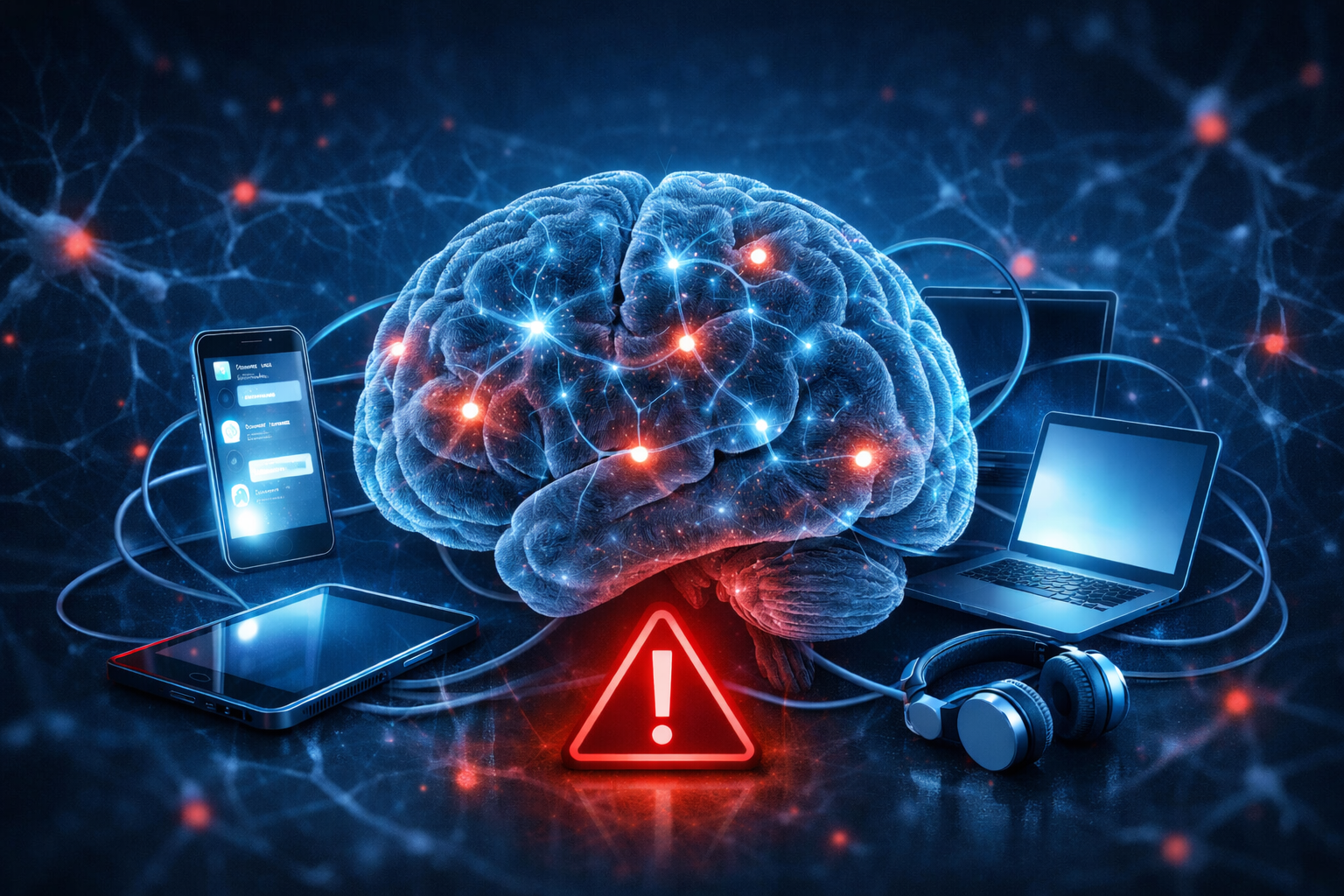
Can’t focus for 10 minutes? Always reaching for your phone? Your dopamine system is hijacked. And it’s getting worse.
You sit down to work. Within 2 minutes, you’re checking your phone. You open social media. 30 minutes gone.
You try to focus. Can’t. Your brain is screaming for stimulation. You feel restless. Bored. Anxious without your phone.
You think you just have poor discipline:
- “I need to try harder”
- “I’m just easily distracted”
- “Everyone else can focus fine”
- “I must have ADHD”
Wrong. Your dopamine system is dysregulated. Modern technology has hijacked your brain’s reward system. You’re neurologically addicted to digital stimulation. This isn’t a discipline problem. It’s a neurochemical problem.
Here’s what’s actually happening: Dopamine is your brain’s motivation and reward chemical. Every notification, like, scroll, and click gives you a small dopamine hit. Your brain adapts by requiring MORE stimulation for the SAME dopamine response. Natural rewards (work, reading, conversation) can’t compete with hyper-stimulating digital content. Your baseline dopamine drops. You become chronically understimulated, constantly seeking the next hit. Focus becomes impossible because your brain is chemically addicted to distraction.
In this comprehensive guide, I’ll explain how dopamine actually works (the mechanism most people misunderstand), reveal why modern technology is more addictive than cocaine (the neuroscience is alarming), show you the 7 signs your dopamine system is dysregulated (most people have 5+), provide the complete dopamine detox protocol (30-day reset), and explain how to rebuild sustainable focus (permanently fix your brain).
Whether you’re trying to be productive, achieve goals, or just want your attention span back, understanding dopamine is critical.
Let’s rescue your brain from the dopamine trap and restore your ability to focus.
TABLE OF CONTENTS
- Sign 1: Can't Focus on Single Task for More Than 10 Minutes
- Sign 2: Phantom Phone Notifications and Compulsive Checking
- Sign 3: Nothing Feels Satisfying or Rewarding
- Sign 4: Boredom Intolerance and Restlessness
- Sign 5: Sleep Disruption from Evening Screen Use
- Sign 6: Procrastination and Inability to Start Important Tasks
- Sign 7: Need for Constant Background Stimulation
- The Bottom Line: Your Brain Can Recover
What Is Dopamine and How Does It Work?
Understanding the motivation molecule.

Dopamine: The Anticipation Chemical
What it is:
- Neurotransmitter in brain
- Released by nucleus accumbens and ventral tegmental area (VTA)
- Part of reward pathway
- Motivates approach behavior
- The “wanting” chemical
What it does (and doesn’t do):
Common misconception:
- Dopamine = pleasure
- Released when you experience reward
- Wrong
Reality:
- Dopamine = motivation and anticipation
- Released BEFORE you get reward
- Drives you to pursue reward
- Actual pleasure is different chemicals (endorphins, serotonin)
- The “I want that” feeling
The mechanism:
Step 1: Prediction
- Brain predicts potential reward
- “This might feel good”
- Anticipation
Step 2: Dopamine release
- Dopamine surges in anticipation
- Creates desire and motivation
- Drives approach behavior
- “I want it” feeling
Step 3: Action
- You pursue the reward
- Dopamine remains elevated
- Sustains motivation
- Pursuit
Step 4: Reward obtained
- Get the reward
- Dopamine drops
- Other chemicals create pleasure (endorphins)
- Satisfaction
The key insight:
- Dopamine is about WANTING, not LIKING
- Drives pursuit, not enjoyment
- You can want something intensely but not enjoy it
- Motivation vs. pleasure
The Dopamine Baseline Concept
What baseline means:
- Your “normal” level of dopamine
- Tonic (background) level between peaks
- Determines your motivation and drive
- Neurochemical set point
Healthy baseline:
- Moderate tonic dopamine
- Normal activities satisfying
- Can focus on tasks
- Don’t need constant stimulation
- Balanced state
Low baseline (dysregulated):
- Low tonic dopamine
- Normal activities boring
- Can’t focus without stimulation
- Constantly seeking next hit
- Chronically understimulated
What affects baseline:
Downward pressure:
- Chronic overstimulation (constant dopamine spikes)
- Poor sleep (reduces dopamine receptors)
- Chronic stress (depletes dopamine)
- Substance use (drugs, alcohol)
- System exhaustion
Upward support:
- Adequate sleep (restores receptors)
- Exercise (increases baseline)
- Sunlight exposure (supports production)
- Balanced stimulation (moderate peaks)
- System restoration
The critical principle:
- High baseline = naturally motivated
- Low baseline = nothing feels rewarding
- Baseline determines everything
Dopamine Adaptation and Tolerance
The adaptation mechanism:
First exposure:
- Novel stimulus (social media, video game, porn)
- Large dopamine spike
- Feels amazing
- Brain remembers
- Peak response
Repeated exposure:
- Same stimulus
- Brain adapts (downregulates receptors)
- Smaller dopamine spike
- Less rewarding
- Tolerance building
Chronic exposure:
- Same stimulus barely produces dopamine
- Need MORE stimulation for SAME effect
- Baseline drops
- Normal life becomes boring
- Addiction pattern
The downward spiral:
- Overstimulation → receptor downregulation
- Fewer receptors → need more stimulation
- More stimulation → more downregulation
- Self-perpetuating
The research:
- Same mechanism as drug addiction
- Cocaine, heroin, meth downregulate dopamine receptors
- Digital stimulation uses same pathway
- Neurologically equivalent
Recovery potential:
- Receptors can upregulate (increase)
- Requires period of low stimulation
- Takes weeks to months
- Full recovery possible
- Reversible damage
How Modern Technology Hijacks Your Dopamine System
The neuroscience of digital addiction.

The Variable Reward Schedule
What it is:
- Unpredictable rewards
- Sometimes you get reward, sometimes not
- You never know when next reward comes
- Slot machine mechanism
Why it’s addictive:
- Predictable rewards: Dopamine spike decreases over time
- Variable rewards: Dopamine spike INCREASES over time
- Uncertainty keeps dopamine elevated
- Most addictive reward pattern
- Maximum addiction potential
Where you encounter it:
Social media:
- Scroll feed: Never know when interesting post appears
- Variable reward (sometimes good content, sometimes not)
- Keeps dopamine elevated
- Can’t stop scrolling
- Engineered addiction
Dating apps:
- Swipe: Never know when attractive match appears
- Variable reward (mostly no, occasionally yes)
- Dopamine sustained throughout
- Compulsive swiping
- Dating slot machine
Email/messaging:
- Check inbox: Never know what you’ll find
- Variable reward (sometimes important, mostly junk)
- Compulsive checking
- Communication gambling
Video games:
- Loot boxes, random drops, matchmaking
- Never know what you’ll get
- Variable reward throughout
- Designed for addiction
The consequence:
- Brain stuck in high-dopamine seeking mode
- Can’t settle into focused work
- Constantly checking for next reward
- Addiction by design
The Infinite Scroll Trap
The mechanism:
- Never-ending content
- No natural stopping point
- Always something new below
- Engineered endlessness
Why it’s destructive:
- Traditional media had natural endpoints (end of book, TV show, magazine)
- Endpoint allows dopamine to reset
- Infinite scroll prevents reset
- Dopamine remains elevated indefinitely
- No recovery period
The platforms using it:
- Social media feeds (Facebook, Instagram, Twitter/X, TikTok)
- YouTube recommendations
- Netflix autoplay
- Reddit endless feed
- Every major platform
The effect:
- Hours disappear
- “Just one more” becomes 100 more
- Time blindness
- Complete attention hijack
- Time vortex
The Notification Hijack
The mechanism:
- Unpredictable interruptions
- Unknown content (might be important)
- Dopamine spike from anticipation
- Must check to resolve uncertainty
- Pavlovian conditioning
The frequency:
- Average person: 96 notifications daily
- Every 10 minutes while awake
- Constant dopamine spikes
- Never allows baseline recovery
- Chronic overstimulation
The cost:
- 23 minutes to regain focus after interruption (research)
- 96 interruptions = impossible sustained focus
- Entire day fragmented
- Deep work impossible
- Attention destruction
The addiction:
- Brain conditioned: Notification = potential reward
- Anxiety when notifications disabled
- Phantom vibrations (feel phone buzz when it didn’t)
- Compulsive checking even without notifications
- Neurological dependence
The Comparison Trap
The mechanism:
- Social media shows curated highlight reels
- Others’ best moments vs. your daily reality
- Triggers comparison
- Dopamine crash (perceiving self as lacking)
- Scroll more seeking validation
- Negative feedback loop
The effect on dopamine:
- Seeing others’ success: Dopamine drop (you lack this)
- Seeking validation through likes: Dopamine spike anticipation
- Getting likes: Small dopamine spike
- Not getting enough likes: Dopamine crash
- Emotional rollercoaster
The research:
- Social media use correlates with depression
- Comparison is mechanism
- Dopamine dysregulation from constant up-down
- Mental health crisis
The Supernormal Stimulus Problem
What it means:
- Natural rewards: Food, sex, social connection
- Digital rewards: Hyper-exaggerated versions
- More intense than nature intended
- Evolutionary mismatch
Examples:
Natural: Face-to-face conversation (moderate dopamine) Digital: 1000 TikTok videos in hour (massive dopamine bombardment)
Natural: Real food (moderate dopamine) Digital: Hyperpalatable processed food (excessive dopamine)
Natural: Finding mate (significant dopamine) Digital: Infinite novel sexual content (dopamine overdrive)
Natural: Achievement in real life (satisfying dopamine) Digital: Video game achievements (constant dopamine)
The consequence:
- Natural rewards can’t compete
- Brain recalibrates to digital intensity
- Real life becomes understimulating
- Require digital stimulation to feel normal
- Reality becomes boring
The biological problem:
- Humans evolved for moderate, intermittent rewards
- Not designed for constant, intense stimulation
- System overwhelmed
- Neurological overload
The 7 Signs Your Dopamine System Is Dysregulated
How to know if you’re affected.

Sign 1: Can’t Focus on Single Task for More Than 10 Minutes
What it looks like:
- Start working on important task
- Within minutes, mind wanders
- Reach for phone unconsciously
- Check social media, email, messages
- 30 minutes gone, zero progress
- Attention fragmentation
Why it happens:
- Low dopamine baseline
- Focused work insufficient dopamine
- Brain seeks higher-dopamine activity
- Phone provides instant hits
- Dopamine-driven distraction
The test:
- Try to read book for 30 minutes, no phone
- If can’t, dopamine system dysregulated
- Self-assessment
Sign 2: Phantom Phone Notifications and Compulsive Checking
What it looks like:
- Feel phone vibrate (it didn’t)
- Hear notification sound (wasn’t real)
- Check phone 50+ times daily
- No real reason to check
- Anxiety when phone not accessible
- Phantom sensations
Why it happens:
- Brain conditioned: Phone = reward
- Anticipation creates dopamine
- Must check to resolve uncertainty
- Reinforces checking behavior
- Operant conditioning
The research:
- 89% of people experience phantom vibrations
- Indicates neurological dependence
- Widespread phenomenon
Sign 3: Nothing Feels Satisfying or Rewarding
What it looks like:
- Hobbies that used to be enjoyable now boring
- Reading feels like chore
- Conversations feel dull
- Exercise unenjoyable
- Only phone/screens feel good
- Anhedonia
Why it happens:
- Baseline dopamine suppressed
- Normal activities insufficient to trigger reward
- Only high-stimulation activities register
- Raised threshold
The mechanism:
- Like someone shouting in quiet room vs. loud concert
- Same stimulus (shouting) different impact
- Chronic high stimulation = everything else seems quiet
- Relative deprivation
Sign 4: Boredom Intolerance and Restlessness
What it looks like:
- Can’t sit still without doing something
- Waiting in line = immediately on phone
- Elevator ride = check phone
- Commercial break = reach for phone
- Any moment of nothing = intense discomfort
- Stimulation addiction
Why it happens:
- Low baseline dopamine
- Unstimulated state feels aversive
- Brain seeks to escape boredom
- Tolerance for boredom near zero
- Chronic understimulation
Historical perspective:
- Humans existed for millennia with significant boredom
- Boredom allowed reflection, creativity, rest
- Modern humans can’t tolerate 30 seconds
- Evolutionary novelty
Sign 5: Sleep Disruption from Evening Screen Use
What it looks like:
- Scroll social media until midnight
- “Just one more video” becomes 50 more
- Can’t fall asleep (mind racing)
- Wake up tired despite 7+ hours
- Repeat cycle daily
- Sleep-dopamine disruption
Why it happens:
- Evening screens elevate dopamine
- Dopamine suppresses melatonin
- Delays sleep onset
- Blue light worsens effect
- Circadian disruption
The double hit:
- Elevated dopamine prevents sleep
- Poor sleep reduces dopamine receptors
- Vicious cycle
- Compounding problem
Sign 6: Procrastination and Inability to Start Important Tasks
What it looks like:
- Know what you should do
- Can’t bring yourself to start
- Instead, scroll, browse, watch videos
- Hours pass, guilt increases
- Still can’t start
- Motivational paralysis
Why it happens:
- Important tasks: Low immediate dopamine
- Scrolling: High immediate dopamine
- Brain chooses high-dopamine activity
- Even though important task more valuable long-term
- Present bias
The mechanism:
- Dopamine drives approach behavior
- Low dopamine = no motivation to approach
- High-dopamine alternatives steal motivation
- Motivational hijacking
Sign 7: Need for Constant Background Stimulation
What it looks like:
- Can’t work without music/podcast/video playing
- Exercise only with entertainment
- Eating while watching something
- Showering while listening to something
- Every activity paired with stimulation
- Stimulation layering
Why it happens:
- Single activity insufficient dopamine
- Need multiple stimulation sources simultaneously
- Dopamine stacking
- Raised threshold
The progression:
- Used to: One activity satisfying
- Now: Need 2-3 simultaneous stimuli
- Future: Will need even more
- Accelerating tolerance
The Complete Dopamine Detox Protocol
30-day brain reset.

Understanding What “Detox” Means
What it is:
- Period of dramatically reduced stimulation
- Allows dopamine receptors to upregulate
- Baseline dopamine recovers
- Brain recalibrates to normal rewards
- Neurological reset
What it’s NOT:
- Not complete sensory deprivation
- Not meditation in cave for 30 days
- Not zero pleasure or enjoyment
- Sustainable intervention
The goal:
- Restore sensitivity to natural rewards
- Lower stimulation threshold
- Recover ability to focus
- Baseline restoration
Phase 1: The 7-Day Strict Reset (Days 1-7)
What to eliminate completely:
Digital:
- Social media (all platforms)
- YouTube (except educational, no browsing)
- Streaming services (Netflix, etc.)
- Video games
- News websites/apps
- Reddit, forums
- Dating apps
- All high-dopamine digital sources
Other:
- Junk food (hyperpalatable processed foods)
- Porn and sexual content
- Gambling (including stock trading for entertainment)
- Shopping/browsing (non-essential)
- All supernormal stimuli
What’s allowed:
Communication:
- Phone calls (actual conversations)
- Text messages (essential only, no browsing)
- Email (check 2x daily, scheduled)
- Functional communication only
Entertainment:
- Reading (books, long-form articles)
- Podcasts (educational, during commute only)
- Music (background, not primary activity)
- Social interaction (in-person)
- Low-stimulation activities
Activities:
- Exercise (without entertainment)
- Work/productive tasks
- Hobbies (creative, physical)
- Walking in nature
- Meditation
- Natural dopamine sources
Why 7 days strict:
- Breaks behavioral patterns
- Forces confrontation with understimulation
- Begins receptor upregulation
- Pattern interrupt
What to expect:
Days 1-2:
- Intense cravings
- Boredom
- Restlessness
- Frequent urges to check phone
- Withdrawal symptoms
Days 3-4:
- Cravings decrease slightly
- Boredom remains
- Irritability
- Time feels slow
- Difficult period
Days 5-7:
- Cravings manageable
- Boredom decreasing
- Starting to enjoy simple activities
- Brief moments of genuine focus
- Beginning adaptation
Phase 2: The Reintroduction Period (Days 8-21)
The approach:
- Gradually reintroduce some activities
- With strict boundaries
- Monitor effects
- Controlled reintegration
What to reintroduce (with limits):
Social media:
- 30 minutes daily maximum
- Scheduled time only (not scattered)
- No phone scrolling (desktop only)
- Specific purpose (no mindless browsing)
- Bounded usage
Entertainment:
- 1 hour streaming content daily
- Choose in advance (no browsing)
- Watch, then stop (no autoplay)
- Intentional consumption
News:
- 20 minutes daily maximum
- Scheduled time
- No throughout-day checking
- Batched information
What remains eliminated:
High-addiction risk:
- TikTok, Instagram Reels (infinite scroll)
- Video games with variable rewards
- Porn
- Gambling/day trading
- Maximum addiction sources
Why 14 days:
- Receptors continue upregulating
- Practice disciplined use
- Test self-regulation
- Consolidation period
Boundaries to maintain:
Time limits:
- Set timers
- Stop when timer ends
- No “just 5 more minutes”
- Strict enforcement
Device-free zones:
- Bedroom (no phone)
- Dining table (no phone)
- Bathroom (no phone)
- First hour after waking (no phone)
- Protected spaces
Implementation intentions:
- “If I reach for phone unconsciously, then I will put it in other room”
- “If timer ends, then I will close app immediately”
- Pre-planned responses
Phase 3: Sustainable Protocol (Day 22-30 and beyond)
The long-term approach:
- Maintain boundaries permanently
- Low-stimulation becomes default
- High-stimulation is occasional, controlled
- Lifestyle integration
Daily structure:
Morning (no phone):
- Wake → morning routine → exercise → breakfast
- First 2 hours: Zero digital stimulation
- Sets tone for day
- Protected morning
Work periods (deep focus):
- 90-minute blocks
- Phone in other room
- Website blockers active
- Single-task focus
- Deep work
Breaks (low stimulation):
- Walk outside
- Stretch
- Talk to person
- No scrolling
- Genuine rest
Evening (wind-down):
- No screens 2 hours before bed
- Reading
- Conversation
- Preparation for tomorrow
- Circadian support
Weekly allowances:
- 1-2 movies (chosen in advance)
- 3-4 hours social media total (scheduled)
- Gaming (if applicable): 2-3 hours (scheduled)
- Intentional indulgence
What’s permanently eliminated or minimized:
Infinite scroll:
- Delete TikTok, Instagram (or use desktop only with time limits)
- Never use Reels or Shorts
- Remove infinite scrolls
Notifications:
- All non-essential notifications OFF
- Check apps on YOUR schedule
- Not their schedule
- Reclaim attention
Background stimulation:
- Work in silence or music only
- Exercise without entertainment (sometimes)
- Meals without screens
- Single-stimulus activities
The Recovery Timeline
Week 1:
- Intense withdrawal
- Boredom difficult
- Frequent urges
- Minimal improvement
- Hardest week
Week 2:
- Withdrawal subsiding
- Boredom manageable
- Urges decreasing
- Starting to notice small improvements
- Turning point
Week 3-4:
- Significant improvement in focus
- Reading enjoyable again
- Conversations engaging
- Less phone obsession
- Noticeable recovery
Month 2:
- Focus significantly better
- Natural activities satisfying
- Phone less appealing
- Baseline restored substantially
- Major improvement
Month 3:
- Near-complete baseline restoration
- Sustained focus possible
- Life engaging without constant stimulation
- New normal established
- Full recovery
The maintenance:
- Must maintain boundaries forever
- One week of unrestricted use can undo progress
- Vigilance required
- Permanent lifestyle change
How to Rebuild Sustainable Focus
Training attention after detox.
Deep Work Practice
What it is:
- Extended periods (90+ minutes) of focused, uninterrupted work
- No multitasking
- No distractions
- Peak cognitive performance
- Flow state work
How to build capacity:
Week 1-2:
- 25-minute deep work sessions (Pomodoro)
- 5-minute break
- Repeat 2-3 times
- Starting capacity
Week 3-4:
- 45-minute deep work sessions
- 10-minute break
- Repeat 2 times
- Building endurance
Week 5-8:
- 90-minute deep work sessions
- 15-minute break
- Once or twice daily
- Peak capacity
The rules:
- Phone in other room (not just silent)
- Website blockers active
- Email closed
- Single task only
- Protected time
The benefit:
- Retrains sustained attention
- Strengthens prefrontal cortex
- Builds focus stamina
- Attention restoration
Meditation and Mindfulness
Why it helps:
- Trains attention control
- Increases awareness of distraction impulses
- Strengthens prefrontal cortex
- Reduces baseline anxiety
- Metacognitive training
The protocol:
Daily practice:
- 10-20 minutes
- Morning (after waking) or evening
- Focused attention meditation (breath focus)
- Notice distraction, return to breath
- Consistent practice
The mechanism:
- Each time notice distraction and return = mental rep
- Strengthens attention control
- Like lifting weights for focus
- Deliberate practice
The research:
- 8 weeks daily meditation increases gray matter in prefrontal cortex
- Improves sustained attention
- Reduces mind-wandering
- Proven benefits
Reading Physical Books
Why books specifically:
- Sustained linear attention required
- No hyperlinks to distract
- Can’t scroll to next thing
- Builds attention endurance
- Attention training
The practice:
- 30-60 minutes daily
- Physical book (not e-reader with other apps)
- No phone nearby
- Single book at a time (finish before starting next)
- Deep reading
The benefit:
- Retrains linear attention
- Builds patience
- Reduces need for constant stimulation
- Cognitive restoration
Starting difficulty:
- First weeks: Hard to focus, mind wanders
- Week 3-4: Becoming easier
- Month 2+: Genuinely enjoyable again
- Progressive improvement
Boredom Training
The concept:
- Intentionally do “boring” activities
- Sit with discomfort of unstimulation
- Train tolerance for boredom
- Exposure therapy for boredom
The practice:
Micro-boredom:
- Waiting in line: Don’t reach for phone
- Elevator ride: Do nothing
- Commercial break: Sit with it
- Small moments
Macro-boredom:
- 30-minute walk, no podcast/music
- Meal without entertainment
- Sitting in park, just observing
- Extended periods
Why it matters:
- Boredom is when creativity emerges
- Mind-wandering allows problem-solving
- Constant stimulation prevents reflection
- Necessary mental state
The adaptation:
- First times: Extremely uncomfortable
- Week 2-3: Less aversive
- Month 1+: Sometimes enjoyable
- Tolerance building
The Bottom Line: Your Brain Can Recover
After explaining everything:

The truth about dopamine and focus:
✅ Modern technology has hijacked your dopamine system (neurological addiction)
✅ Constant stimulation lowers your baseline dopamine (everything becomes boring)
✅ You’re not lazy or undisciplined your brain is chemically dysregulated (neurological problem)
✅ Recovery is possible but requires 30+ days of reduced stimulation (receptor upregulation)
✅ Permanent boundaries are necessary to maintain recovery (lifestyle change required)
Key takeaways:
How dopamine works:
- Motivation chemical (wanting, not liking)
- Released in anticipation of reward
- Baseline determines satisfaction with life
- Adapts to stimulation (builds tolerance)
- Understanding the mechanism
How technology hijacks dopamine:
- Variable reward schedules (slot machine design)
- Infinite scroll (no natural endpoint)
- Constant notifications (96 daily on average)
- Social comparison (dopamine rollercoaster)
- Supernormal stimuli (hyper-exaggerated rewards)
- Engineered addiction
The 7 signs of dysregulation:
- Can’t focus for 10 minutes (attention fragmentation)
- Phantom notifications and compulsive checking (neurological dependence)
- Nothing feels satisfying (raised threshold)
- Boredom intolerance (chronic understimulation)
- Sleep disruption from evening screens (circadian disruption)
- Procrastination on important tasks (motivational hijacking)
- Need constant background stimulation (dopamine stacking)
- Self-assessment
The 30-day detox protocol:
Phase 1 (Days 1-7):
- Eliminate: Social media, streaming, games, junk food, porn
- Allow: Reading, exercise, in-person social, essential communication
- Expect: Intense withdrawal, boredom, restlessness
- Strict reset
Phase 2 (Days 8-21):
- Reintroduce: Limited social media (30 min), streaming (1 hour)
- Maintain: Boundaries, time limits, scheduled use
- Eliminate permanently: Infinite scroll, high-addiction sources
- Controlled reintegration
Phase 3 (Day 22+):
- Sustainable: Morning no-phone, deep work blocks, evening wind-down
- Allowances: 3-4 hours social media weekly, 1-2 movies
- Permanent: Boundaries, device-free zones, single-stimulus activities
- Lifestyle integration
Recovery timeline:
- Week 1: Intense withdrawal (hardest week)
- Week 2: Subsiding, turning point
- Week 3-4: Noticeable improvement in focus
- Month 2: Significant recovery
- Month 3: Full baseline restoration
- Progressive improvement
How to rebuild focus:
- Deep work practice (25 min → 90 min sessions)
- Daily meditation (10-20 minutes)
- Reading physical books (30-60 min daily)
- Boredom training (tolerate unstimulation)
- Attention restoration
Permanent boundaries:
- Device-free zones (bedroom, table, bathroom)
- No phone first 2 hours after waking
- All non-essential notifications OFF
- Delete infinite scroll apps (TikTok, Instagram, or desktop-only)
- Deep work with phone in other room
- No screens 2 hours before bed
- Lifestyle structure
Why this matters:
- Can’t achieve goals without focus
- Can’t build deep relationships without presence
- Can’t find fulfillment with dysregulated dopamine
- Life passing by in scroll-induced haze
- Everything depends on this
Priority actions:
- Delete 3 most addictive apps right now (TikTok, Instagram, games)
- Turn off ALL non-essential notifications (today)
- Buy physical book to read (start tonight)
- Commit to 7-day strict detox (schedule start date)
- Phone in other room during sleep (tonight)
- Start immediately
The hard truth:
- Technology companies profit from your addiction
- Designed by neuroscientists to be maximally addictive
- Your attention is the product being sold
- You must actively defend your dopamine system
- You are being exploited
STOP SCROLLING. YOUR BRAIN IS BEING HIJACKED. DO THE 30-DAY DOPAMINE DETOX. REBUILD YOUR FOCUS. RECLAIM YOUR LIFE.
Ready to build a complete digital minimalism system with dopamine management protocols, attention restoration strategies, focus training techniques, and lifestyle boundaries that permanently protect your brain from exploitation while maximizing productivity and life satisfaction? Understanding dopamine is just the beginning. Get a comprehensive guide to reclaiming your attention, rebuilding deep focus, designing dopamine-protective environments, and thriving in the modern world without being enslaved by it. Stop being the product. Start protecting your brain.
REFERENCES
SECTION 1 — Dopamine mechanics: wanting vs. liking and reward anticipation
[1] Berridge KC — PubMed/Psychopharmacology, 2007 Comprehensive review of the debate over dopamine’s role in reward; dopamine mediates incentive salience (“wanting”) rather than hedonic impact (“liking”); opioid circuits, not dopamine, generate actual pleasure responses; in dopamine-depleted rats, hedonic “liking” reactions to sucrose were preserved while the motivation to pursue rewards was eliminated; drugs of addiction generate, hijack, and amplify dopamine reward signals, creating pathological wanting without corresponding liking; establishes the foundational neuroscientific basis for the article’s claim that dopamine is the “wanting not liking” chemical, and explains why addictive behaviors feel compulsive despite not producing genuine satisfaction https://pubmed.ncbi.nlm.nih.gov/17072591/
[2] Schultz W — PubMed/Dialogues in Clinical Neuroscience, 2016 Review of dopamine reward prediction error coding; dopamine neurons are activated by unpredicted rewards (positive prediction error), show no response to fully predicted rewards, and are suppressed by the omission of expected rewards (negative prediction error); drugs of addiction generate and amplify these dopamine prediction error signals, inducing exaggerated and uncontrolled dopaminergic effects on neuronal plasticity; the mechanism directly explains why variable/unpredictable rewards (social media, notifications) produce stronger dopaminergic activation than predictable rewards, which is the neurobiological engine of digital addiction https://pubmed.ncbi.nlm.nih.gov/27069377/
SECTION 2 — Variable reward schedules and digital addiction
[3] Andreassen CS et al. — PMC/Frontiers in Psychiatry, 2023 Narrative review of neurobiological risk factors for problematic social media use; internet addiction shares structural and functional brain features with chemical and behavioral addictions including impaired dopamine metabolism, reduced prefrontal cortex gray matter density, increased dopamine secretion with decreased receptor availability in the striatum, and compromised inhibitory control; dopamine receptor downregulation mirrors the tolerance and receptor adaptation described in substance addictions; social media creates intermittent reinforcement mechanisms through social feedback (likes, comments), and this unpredictable social reward may sustain addictive patterns even more effectively than monetary gambling rewards https://pmc.ncbi.nlm.nih.gov/articles/PMC10251362/
[4] Turel O et al. — PMC/Brain and Behavior, 2025 Review of social media algorithms and neurophysiological addiction mechanisms; AI-driven social media algorithms employ variable ratio reinforcement (intermittent unpredictable reward schedules similar to gambling); the unpredictability maximizes dopaminergic engagement because dopamine activity is greatest when reward size and timing are most variable; adolescents and heavy users develop a “dopamine cycle” of desire, anticipation, and reward that continuously reinstates seeking behavior; overactivation of the dopamine system causes reduced reward sensitivity to natural stimuli, a hallmark of addiction https://pmc.ncbi.nlm.nih.gov/articles/PMC11804976/
SECTION 3 — Interruptions, notifications, and the destruction of focus
[5] Mark G et al. — UCI/CHI Proceedings, 2008 Field and laboratory study on the cognitive cost of interrupted work; workers took an average of 23 minutes and 15 seconds to fully return to a task after an interruption; interrupted workers compensated by increasing work pace at a cost of significantly higher stress, frustration, and effort; attention is fragmented by each interruption and full cognitive recovery is required before deep work resumes; directly supports the article’s claim that notification-driven constant interruptions make sustained focus neurologically impossible, providing the empirical basis for the “96 notifications = impossible focus” framework https://ics.uci.edu/~gmark/chi08-mark.pdf
[6] Leroy S — Organizational Behavior and Human Decision Processes, 2009 Experimental research defining “attention residue”: the persistence of cognitive activity about a prior task while performing a new task; task-switching leaves a lingering cognitive trace that degrades performance on the subsequent task; the effect is strongest when prior tasks are unfinished or interrupted; each context switch reduces available cognitive resources for the current task; provides the neuropsychological mechanism explaining why chronic phone-checking and notification-driven multitasking progressively erodes the brain’s capacity for sustained focus https://www.sciencedirect.com/science/article/abs/pii/S0749597809000399
SECTION 4 — Meditation rebuilds prefrontal cortex and restores attention
[7] Holzel BK et al. — PMC/Psychiatry Research: Neuroimaging, 2011 Longitudinal controlled MRI study of 16 meditation-naive participants before and after the 8-week MBSR program; measurable increases in gray matter density were found in the hippocampus (learning and memory), posterior cingulate cortex, and temporo-parietal junction; decreased gray matter density in the amygdala correlated with participant-reported reductions in stress; the first longitudinal study demonstrating that mindfulness meditation produces structural brain changes over weeks in previously untrained adults; directly validates the article’s recommendation that daily meditation rebuilds prefrontal cortex function and attention capacity https://pmc.ncbi.nlm.nih.gov/articles/PMC3004979/





Leave a Reply
You must be logged in to post a comment.