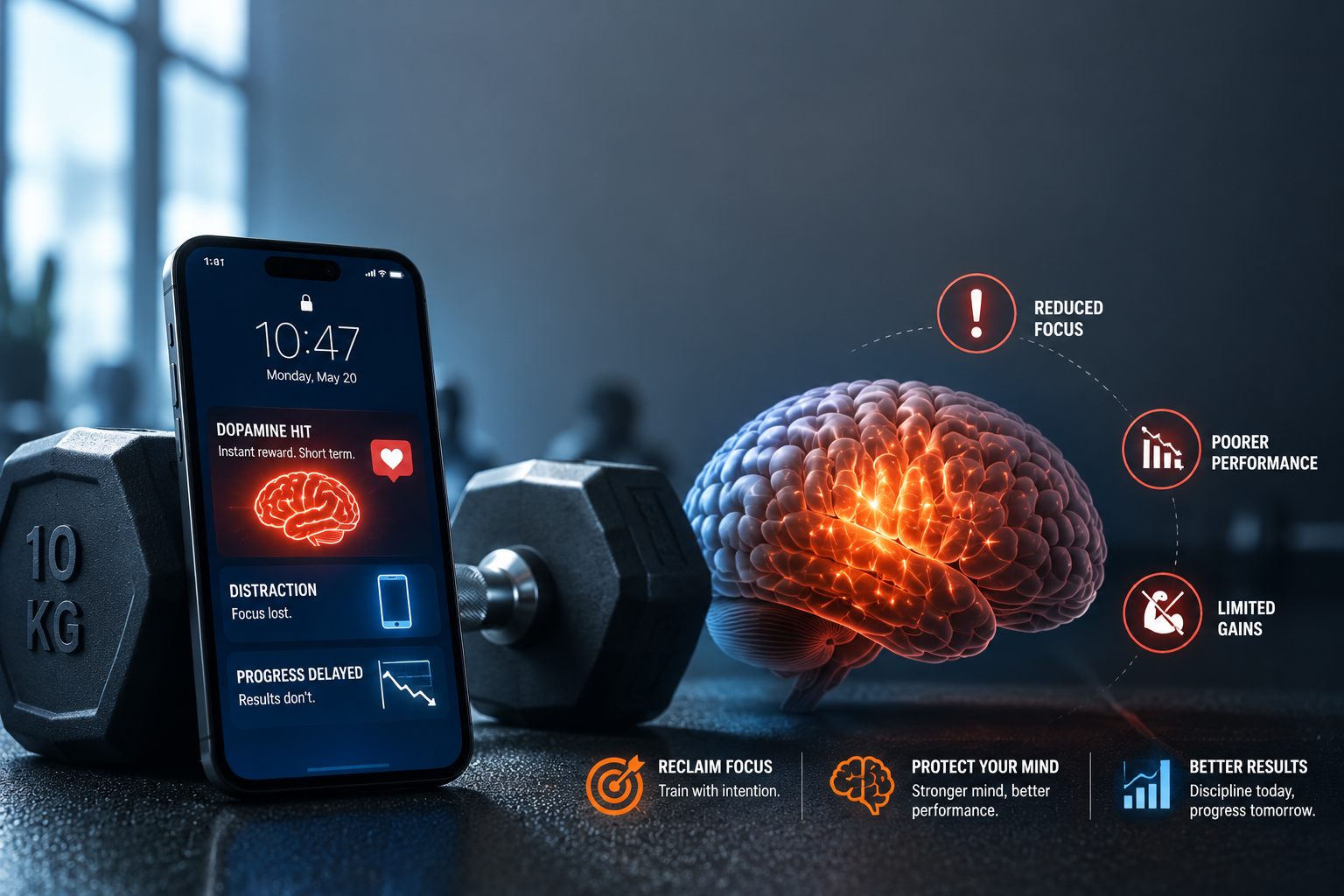
You’re between sets of heavy squats, heart rate elevated, legs shaking, and you pull out your phone. You scroll through Instagram for 90 seconds, watch half a TikTok, reply to a text, check a notification, then realize you’ve been “resting” for 4 minutes and have completely lost the intensity you built. You rack the bar for your next set, but something feels off. The weight feels heavier. Your focus is scattered. The mind muscle connection that was there during your first two sets has evaporated. You grind through a mediocre set, check your phone again, and the cycle repeats until your workout ends with a whimper instead of the intensity it deserved.
Now zoom out from the gym. You can’t sit through a meal without scrolling. You can’t watch a full TV episode without checking your phone. You can’t wait in line for 30 seconds without pulling up social media. You can’t fall asleep without a podcast or video playing. You can’t drive without music, a podcast, or a phone call filling every moment of silence. Your brain hasn’t experienced genuine boredom, silence, or unstimulated rest in months, maybe years.
This isn’t a productivity article about putting your phone down. This is about something much more important for anyone training to build muscle, lose fat, or improve performance: constant stimulation is fundamentally altering your brain’s reward system, your ability to tolerate discomfort, your recovery quality, your training intensity, and your capacity to stay consistent with difficult goals like dieting and progressive overload.
The connection between phone addiction, dopamine dysregulation, and gym performance is one of the most overlooked factors in modern fitness. Your grandparents didn’t need pre workout supplements to train hard because their baseline dopamine sensitivity was normal. Your brain, flooded with micro dopamine hits every 30 seconds from notifications, likes, and infinite scroll algorithms, needs increasingly intense stimulation just to feel engaged, and a set of squats can’t compete with that.
For people whose training intensity has mysteriously declined despite no changes in programming or nutrition, who find themselves unable to focus during workouts, who struggle with diet adherence despite knowing exactly what to eat, who feel restless and anxious whenever they’re not consuming content, or who have noticed their ability to tolerate discomfort decreasing over time, understanding how constant stimulation is sabotaging your results will change not just your training but your entire approach to building a physique.
In this comprehensive guide, I’ll explain the dopamine system and how constant stimulation hijacks the reward circuit that drives training motivation, how phone use between sets directly reduces muscle activation and training performance, the connection between stimulation addiction and inability to tolerate diet discomfort, why boredom is actually a performance enhancing state your brain desperately needs, how rest quality is destroyed by constant content consumption, practical protocols for reclaiming your focus and training intensity, and the counterintuitive reason why being bored makes you mentally stronger for hard training.
Whether you’re a serious lifter who has noticed declining workout quality, someone who can’t get through a training session without checking your phone 30 times, or a person who realizes their attention span has shortened dramatically and suspects it’s affecting their progress, this guide connects the dots between modern stimulation addiction and declining physical performance.
Let’s examine why your phone might be the biggest gains killer in your gym bag.
TABLE OF CONTENTS
The Dopamine System: Why Your Brain Is Hijacked
Before understanding why constant stimulation makes you weaker, you need to understand the brain system being exploited.
How Dopamine Actually Works
Dopamine is not the “pleasure chemical.” It’s the motivation and anticipation chemical.
The common misunderstanding:
- People think dopamine = feeling good
- Actually, dopamine = wanting, seeking, anticipating
- Dopamine drives you TOWARD rewards, not the enjoyment of them
- The feeling of satisfaction after achieving something is largely from other neurotransmitters (endorphins, serotonin)
- Dopamine is what makes you get off the couch and pursue the goal
Why this distinction matters for training:
Dopamine’s role in the gym:
- Motivates you to go to the gym (anticipation of progress)
- Drives you to add weight to the bar (pursuit of progressive overload)
- Keeps you pushing through hard sets (seeking the completion)
- Makes you stick to your diet (anticipation of physique results)
- Fuels the “one more rep” mentality (pursuit behavior)
Without adequate dopamine signaling:
- No motivation to train (can’t generate drive)
- No desire to push through discomfort (can’t sustain effort)
- No patience for long term goals (can’t delay gratification)
- Everything feels flat, boring, pointless
- This is what chronic overstimulation creates
The Dopamine Baseline Concept
Your brain has a dopamine baseline, a resting level that determines how motivated, focused, and driven you feel on a normal day.
How baseline works:
Healthy baseline (normal dopamine sensitivity):
- Regular activities feel rewarding (training, cooking, conversation)
- Moderate stimulation feels engaging
- Can sit with boredom without distress
- Training provides genuine satisfaction
- Diet adherence feels manageable
- Sleep comes naturally
- Focus sustained for extended periods
Depleted baseline (from chronic overstimulation):
- Regular activities feel boring and unrewarding
- Need increasingly intense stimulation to feel engaged
- Boredom feels physically uncomfortable, almost painful
- Training feels like a chore even if you love lifting
- Diet adherence feels impossible (brain demands dopamine from food)
- Sleep requires content playing (can’t tolerate silence)
- Focus shatters after 30 to 60 seconds
How baseline gets depleted:
The stimulation escalation:
Normal activity dopamine spikes (above baseline):
- Eating a meal: 50% above baseline
- Exercise: 75% above baseline
- Completing a task: 50% above baseline
- Social interaction: 50 to 100% above baseline
- Sex: 100% above baseline
Modern stimulation dopamine spikes:
- Social media scrolling: 50 to 100% above baseline (every few seconds)
- Video games: 75 to 200% above baseline (constant)
- Pornography: 200 to 300% above baseline
- Junk food: 50 to 100% above baseline
- Gambling: 200 to 400% above baseline
- Combination (eating while scrolling while watching TV): Compounding effect
The critical problem: frequency, not intensity.
A single Instagram scroll session:
- Open app: Small dopamine hit (anticipation)
- See first interesting post: Dopamine hit
- Scroll to next: Dopamine hit (novelty)
- See a like on your post: Dopamine hit (social validation)
- Watch a reel: Dopamine hit (entertainment)
- See something controversial: Dopamine hit (emotional stimulation)
- Repeat every 3 to 10 seconds for 20 minutes
- Total: 100 to 400 micro dopamine hits in one session
Contrast with training:
- Walk into gym: Small dopamine hit
- Complete warm up: Moderate dopamine
- Heavy set: Significant dopamine (effort, achievement)
- Rest period: Dopamine drops (waiting, boredom)
- Next set: Moderate dopamine
- Complete workout: Significant dopamine (accomplishment)
- Total: 15 to 30 dopamine events over 60 to 90 minutes
Your phone delivers 10 to 20x more dopamine events per hour than your training does. Over weeks and months of chronic phone use, your brain recalibrates what “normal stimulation” feels like. Training becomes boring by comparison, not because training changed, but because your brain’s expectations changed.
The Downregulation Spiral
When your brain receives too much dopamine too frequently, it protects itself by becoming less sensitive:
The mechanism:
Step 1: Chronic overstimulation
- Constant phone use, social media, content consumption
- Hundreds of dopamine hits daily
- Brain flooded with dopamine repeatedly
Step 2: Receptor downregulation
- Brain reduces number of dopamine receptors
- Remaining receptors become less sensitive
- Same stimulus now produces less response
- Need MORE stimulation to feel the SAME level of engagement
Step 3: Baseline drops
- Resting dopamine level decreases
- Without stimulation, you feel flat, bored, anxious
- Normal activities (training, cooking, reading) feel unsatisfying
- Crave constant stimulation to feel “normal”
Step 4: Tolerance develops
- Social media no longer satisfying (need more extreme content)
- Training feels increasingly boring (can’t compete with phone)
- Diet feels increasingly difficult (food becomes primary remaining dopamine source)
- Need pre workout stimulants just to feel motivated
- Need music, videos, or podcasts during every activity
Step 5: Withdrawal symptoms
- Without phone: Restlessness, anxiety, irritability
- Sounds dramatic, but brain scans show patterns similar to substance withdrawal
- Can’t tolerate 2 minutes of silence
- Reach for phone unconsciously dozens of times per hour
- Boredom feels genuinely painful
This is where most people reading this currently are. Not addicted to drugs. Addicted to stimulation. And it’s silently destroying their training results.
How Constant Stimulation Directly Weakens Your Training
Let’s connect the neuroscience to practical gym performance.
Problem 1: Phone Use Between Sets Destroys Muscle Activation
The most immediate and measurable impact: using your phone between sets significantly reduces performance on subsequent sets.
The neuromuscular mechanism:
What happens during a properly focused rest period:
- Central nervous system remains partially activated
- Motor cortex stays primed for the movement pattern
- Muscle recruitment pathways remain “warm”
- Mind muscle connection maintained
- Intensity and focus carry into next set
- Appropriate rest occurs (recovery) while readiness remains (activation)
What happens when you scroll your phone during rest:
- Attention shifts entirely to phone content
- Motor cortex disengages from training
- Muscle recruitment pathways cool down
- Mind muscle connection severed
- Emotional state shifts (anger from a comment, arousal from content, distraction from a conversation)
- Must rebuild focus from zero for next set
- Takes 1 to 2 reps of the next set just to re-engage neurologically
Research: Distraction and performance:
Study: Cell phone use between sets:
- Subjects performed resistance training exercises
- Group A: Rested normally between sets (quiet, focused)
- Group B: Used cell phones between sets (texting and social media)
- Result: Group B performed significantly fewer reps and reported lower perceived exertion
- Group B also had longer actual rest periods (got absorbed in phone)
- Training volume reduced substantially over the session
Study: Attentional focus and muscle activation:
- Internal focus (“squeeze the muscle”) produces greater muscle activation
- External focus (distraction, phone) reduces activation
- EMG studies show higher muscle fiber recruitment with internal focus
- Phone use eliminates internal focus entirely
The practical impact over a session:
Workout without phone (focused rest):
- Set 1: 225 lbs x 10 reps (focused, strong)
- Rest: 2 minutes, mentally rehearsing next set
- Set 2: 225 lbs x 9 reps (slight fatigue, still focused)
- Rest: 2 minutes, breathing, focused
- Set 3: 225 lbs x 8 reps (good effort, mind muscle connection strong)
- Set 4: 225 lbs x 7 reps (hard, grinded out with focus)
- Total volume: 7,650 lbs
Same workout with phone scrolling:
- Set 1: 225 lbs x 10 reps (decent, distracted between warm up sets)
- Rest: 3.5 minutes (lost track of time on phone)
- Set 2: 225 lbs x 8 reps (lost activation, first 2 reps felt unfocused)
- Rest: 4 minutes (watching a reel, forgot to start set)
- Set 3: 225 lbs x 7 reps (mind somewhere else, poor connection)
- Set 4: 225 lbs x 6 reps (going through motions, intensity gone)
- Total volume: 6,975 lbs
Difference: 675 lbs less volume per exercise. Over 5 exercises, that’s 3,375 lbs less total volume per workout. Over 200 workouts per year, that’s 675,000 lbs of lost volume.
675,000 lbs of annual training volume, lost to scrolling between sets. That’s the difference between building 2 lbs of muscle per year and building 4 lbs. At intermediate and advanced levels, that difference is enormous.
Problem 2: Inability to Tolerate Training Discomfort
A brain accustomed to constant stimulation has a dramatically reduced ability to tolerate discomfort, and hard training is inherently uncomfortable.
The discomfort tolerance mechanism:
What hard training requires:
- Sitting with burning muscles during high rep sets
- Pushing through the point where your brain screams “stop”
- Grinding through the last 2 to 3 reps that produce the most growth stimulus
- Maintaining focus during 60 to 90 minutes of physical stress
- Accepting that the process is sometimes monotonous
What constant stimulation trains your brain to do:
- Escape discomfort immediately (scroll to next video)
- Seek novelty every 3 to 10 seconds (infinite content)
- Avoid boredom at all costs (always have entertainment available)
- Switch attention constantly (app to app, video to video)
- Never sit with an unpleasant experience (always an escape in your pocket)
The conflict:
Your training requires: Sustained attention, discomfort tolerance, delayed gratification Your stimulation habits train: Scattered attention, discomfort avoidance, immediate gratification
These are directly opposing neural adaptations. Every hour spent training your brain to avoid discomfort through constant stimulation makes your brain less capable of tolerating the discomfort that hard training demands.
What this looks like in the gym:
Low discomfort tolerance lifter:
- Set of 12 on leg press
- Rep 1 to 6: Fine, manageable
- Rep 7 to 8: Starting to burn
- Rep 9: “This hurts, I should stop”
- Racks the weight at rep 9
- Could have done 12 (the growth was in reps 10, 11, 12)
- But brain can’t tolerate the discomfort
- Reps in reserve: 3 (left most productive reps on the table)
High discomfort tolerance lifter:
- Set of 12 on leg press
- Rep 1 to 6: Fine, manageable
- Rep 7 to 8: Starting to burn, acknowledges it, continues
- Rep 9 to 10: Significant discomfort, pushes through
- Rep 11: Very hard, grinds it out
- Rep 12: Near failure, completes with maximal effort
- Reps in reserve: 0 to 1 (captured all productive reps)
The difference: Rep 10, 11, and 12 produce more hypertrophic stimulus than reps 1 through 9 combined. The person who can’t tolerate discomfort never reaches the reps that matter most.
This isn’t about physical capacity. It’s about neural tolerance for discomfort. And constant stimulation systematically erodes that tolerance.
Problem 3: Diet Adherence Collapses
The same dopamine dysregulation that makes training feel boring makes dieting feel unbearable.
Why stimulation addicted brains can’t diet:
Normal dopamine sensitivity (diet is manageable):
- Food is satisfying but not the only dopamine source
- Can eat plain chicken and rice without craving more
- Moderate hunger is tolerable (not distressing)
- Can delay gratification (eat later, eat less now)
- Meal satisfaction lasts hours
Depleted dopamine sensitivity (diet feels impossible):
- Food becomes primary remaining dopamine source
- Brain demands hyper palatable food (sugar, fat, salt combinations)
- Even mild hunger feels unbearable (brain demands immediate relief)
- Cannot delay gratification (need food NOW)
- Meal satisfaction fades within minutes (need more stimulation)
The diet failure mechanism:
Step 1: Person with depleted dopamine tries to cut Step 2: Calorie restriction reduces one of the few remaining dopamine sources (food) Step 3: Brain panics (already low dopamine, now losing food pleasure too) Step 4: Cravings become overwhelming (brain’s survival response) Step 5: Willpower fails because the dopamine deficit is too large Step 6: Binge on highly palatable food (massive dopamine hit from sugar and fat) Step 7: Feel guilty, restrict harder next day Step 8: Cycle repeats
This person doesn’t lack discipline. Their dopamine system is so depleted from chronic overstimulation that removing food pleasure creates a neurological crisis. The binge isn’t weakness. It’s the brain desperately trying to restore dopamine to functional levels using the only tool it has left: food.
The solution isn’t more willpower. It’s restoring dopamine sensitivity by reducing other sources of chronic overstimulation (phone, social media, constant content). When baseline dopamine normalizes, diet adherence becomes dramatically easier because food no longer needs to carry the entire dopamine burden.
Problem 4: Recovery Quality Is Destroyed
Your body doesn’t recover during training. It recovers between sessions. And constant stimulation is destroying the quality of that recovery.
How stimulation affects recovery:
Sleep disruption:
- Blue light from screens suppresses melatonin production
- Stimulating content activates sympathetic nervous system (fight or flight)
- Scrolling before bed delays sleep onset by 30 to 60+ minutes
- Sleep quality decreases even when duration is adequate
- Social media content creates emotional arousal (anger, envy, excitement)
- Aroused brain takes longer to transition to deep sleep
- Deep sleep is when growth hormone peaks and muscles repair
- Less deep sleep = less recovery = less muscle growth
Sympathetic nervous system overactivation:
- Content consumption keeps you in a mildly stressed state
- News feeds, social comparison, controversial content
- Heart rate slightly elevated, cortisol slightly elevated
- Body stays in “alert” mode instead of transitioning to “recover” mode
- Recovery requires parasympathetic dominance (rest and digest)
- Constant stimulation prevents the shift to parasympathetic
- You’re “resting” physically but your nervous system is still working
Stress hormone accumulation:
- Social media triggers cortisol release (comparison, FOMO, conflict)
- Email and notifications maintain baseline stress
- Even “entertaining” content creates mild stress (emotional stimulation)
- Cumulative cortisol elevation throughout the day
- Cortisol is catabolic (breaks down muscle tissue)
- Chronic mild elevation impairs recovery
The practical impact:
Person A: Limited phone use, genuine rest periods:
- Phone in another room during evening
- 30 to 60 minutes of genuine boredom or low stimulation before bed
- Falls asleep in 10 to 15 minutes
- 8 hours sleep with normal deep sleep cycles
- Wakes refreshed
- Muscles recovered for next session
- Recovery quality: High
Person B: Constant stimulation until eyes close:
- Scrolling social media in bed
- Watching videos until too tired to keep eyes open
- Falls asleep in 30 to 45 minutes (brain still processing content)
- 8 hours sleep but reduced deep sleep (nervous system still active)
- Wakes groggy
- Muscles partially recovered
- Recovery quality: Poor despite same sleep duration
Same 8 hours in bed. Dramatically different recovery quality. Person B will see slower progress, more fatigue, and worse training performance despite identical sleep duration.
Why Boredom Is Actually a Performance Enhancing State
Now let’s flip the narrative. Instead of seeing boredom as something to avoid, understand why it’s something your brain desperately needs, especially for physique goals.
Boredom Resets Your Dopamine Baseline
The dopamine recovery process:
When you allow yourself to be bored (no phone, no content, no stimulation):
- Dopamine levels drop below baseline temporarily
- This feels uncomfortable (restless, antsy, irritable)
- Brain interprets this as “dopamine is too low”
- Response: Upregulate dopamine receptors (create more)
- Response: Increase receptor sensitivity (make existing ones more responsive)
- After sustained low stimulation periods: Baseline dopamine rises
- Normal activities become rewarding again
The neuroscience of “dopamine fasting”:
- Not about literally fasting from all dopamine (impossible)
- About reducing supranormal stimulation sources temporarily
- Allows receptor density and sensitivity to normalize
- Even partial reduction in stimulation helps
What happens when baseline normalizes:
Training becomes inherently motivating again:
- The “I don’t feel like going to the gym” feeling diminishes
- Sets feel engaging, not boring
- Progressive overload feels exciting, not tedious
- Post workout satisfaction is significant and lasting
Diet becomes tolerable:
- Plain foods satisfy again (don’t need hyper palatable constantly)
- Moderate hunger is manageable (not distressing)
- Can wait for meals without anxious food seeking
- Less craving for sugar, fat, and salt combinations
Recovery improves:
- Can actually rest (not just consume content while sitting)
- Sleep onset faster (brain transitions to rest mode)
- Deep sleep improved (parasympathetic dominance)
- Overall nervous system calmer
Boredom Builds Discomfort Tolerance
The ability to sit with boredom is identical to the ability to sit with training discomfort. They use the same neural circuitry.
The connection:
Boredom and pain share neural pathways:
- Both processed in anterior cingulate cortex
- Both create “I need to escape this” response
- Both require prefrontal cortex override to tolerate
- Practicing tolerance for one improves tolerance for the other
What practicing boredom develops:
- Ability to sit with unpleasant sensation without reacting
- Delayed response to discomfort impulse (“I want to stop” becomes something you notice but don’t obey)
- Extended attention span (can focus for longer periods)
- Reduced need for external stimulation to feel engaged
- All directly applicable to hard training
Practical application:
If you can sit in a quiet room for 20 minutes without reaching for your phone, you can push through 3 more reps on a hard set.
If you can wait in line without scrolling, you can tolerate being slightly hungry without snacking.
If you can drive in silence, you can maintain focus for an entire training session.
The skill is the same: tolerating discomfort without escaping. Phone addiction trains escape. Boredom tolerance trains endurance.
Boredom Enhances Mind Muscle Connection
Without external stimulation, your brain turns inward. This is where mind muscle connection lives.
The internal attention advantage:
Between sets without phone:
- Mind naturally reviews the previous set
- “That felt slightly off, I should adjust my grip”
- Mentally rehearses the next set
- Visualizes the movement pattern
- Feels the target muscle (even at rest)
- When the set starts, connection is immediate and strong
Between sets with phone:
- Mind is in a different world entirely
- Processing social content, emotional reactions
- Zero connection to the muscle or movement
- When the set starts, must rebuild connection from scratch
- First 2 to 3 reps are wasted (reconnecting)
The visualization research:
Study: Mental rehearsal and strength:
- Participants who mentally rehearsed exercises between sets
- Showed improved activation on subsequent sets
- Compared to distracted rest, mentally engaged rest produced better results
- Mind muscle connection is a trainable skill that requires attention
Boredom creates the space for this to happen naturally. When there’s nothing competing for your attention, your brain defaults to processing your physical state, which is exactly what you want between sets.
Practical Protocols: Reclaiming Your Focus and Performance
Understanding the problem is step one. Here are concrete, implementable strategies to fix it.
Protocol 1: The Training Phone Policy
The simplest, most impactful change you can make to your training quality:
Option A: Leave phone in locker or car
- Bring a notebook for tracking (pen and paper)
- Use a cheap watch for rest period timing
- Zero possibility of distraction
- Feels uncomfortable for 2 to 3 sessions, then becomes normal
- Training quality improves noticeably within 1 week
Option B: Phone on airplane mode in gym bag
- Available for emergencies (turn off airplane mode)
- No notifications, no temptation
- Can use for music if needed (but don’t unlock for anything else)
- Rule: Phone stays in bag between sets
Option C: Phone face down, notifications off (minimum approach)
- Least restrictive but requires discipline
- Turn off all notifications
- Place face down between sets
- No picking up during rest periods
- Music or podcast playing is acceptable (audio only, no visual scrolling)
The hierarchy of effectiveness: A is best, B is very good, C is the minimum that still helps.
What to do between sets instead of scrolling:
Option 1: Watch the gym
- Look around, observe other lifters
- Notice your own body (how do the muscles feel?)
- This is genuinely restful while maintaining gym engagement
Option 2: Focus on breathing
- 3 to 4 deep breaths
- Brings nervous system back to optimal state
- Enhances recovery between sets
- Costs zero effort
Option 3: Mental rehearsal
- Visualize the next set
- Feel the movement pattern mentally
- Imagine the target muscle contracting
- Sounds strange but research supports this
Option 4: Simply sit with the discomfort of doing nothing
- This is the hardest but most valuable option
- The boredom between sets is where discomfort tolerance is built
- Each moment of tolerated boredom makes you mentally stronger
- After 2 to 3 weeks, the discomfort of doing nothing disappears entirely
Protocol 2: The Pre Training Stimulation Fast
What you consume mentally in the 30 to 60 minutes before training significantly affects training quality.
The problem with pre training scrolling:
Driving to gym while scrolling at red lights:
- Brain enters scattered attention mode
- Multiple partial thoughts competing
- Emotional state shifted by random content
- Arrive at gym mentally fragmented
Scrolling in gym parking lot before going in:
- Delay training by 5 to 15 minutes
- Brain engaged in non training stimulation
- Must transition from phone mode to training mode
- Transition costs 5 to 10 minutes of suboptimal training
The protocol:
30 to 60 minutes before training:
- No social media
- No news
- No email (unless critical)
- Acceptable: Music (listening only), driving, walking, eating
- Let brain transition to “physical” mode
- Arrive at gym mentally ready, not fragmented
What this does:
- Allows dopamine to settle to baseline before training
- Training then provides a genuine dopamine elevation (feels rewarding)
- If you scroll right before training, baseline is already elevated, training can’t compete
- Pre training stimulation fast makes the workout feel more engaging and rewarding
Protocol 3: The Evening Stimulation Curfew
This directly impacts sleep quality, recovery, and next day training performance.
The protocol:
60 to 90 minutes before planned bedtime:
- Phone on charger IN ANOTHER ROOM
- Not next to bed (too accessible)
- Not face down on nightstand (too close)
- Physically in another room
What to do instead:
- Read a physical book (not an e-reader with backlight)
- Have a conversation with someone in your household
- Prepare meals or clothes for tomorrow
- Light stretching or foam rolling (not a workout, just gentle)
- Sit and think (actual boredom)
- Listen to calm music or audiobook at low volume
Why this works:
- Removes blue light exposure before sleep
- Allows melatonin production to begin naturally
- Nervous system transitions to parasympathetic mode
- Brain begins winding down instead of ramping up
- Sleep onset dramatically faster
- Sleep quality significantly improved
- Growth hormone release optimized during deep sleep
The first week is uncomfortable. You’ll feel restless, bored, anxious. You’ll reach for your phone and find it’s not there. This discomfort is the sound of your brain healing. By week 2 to 3, this period becomes genuinely relaxing instead of anxiety inducing. By week 4, you’ll wonder how you ever fell asleep with a phone in your hand.
Protocol 4: Scheduled Stimulation Windows
You don’t need to eliminate your phone entirely. You need to control WHEN you use it.
The scheduled approach:
Instead of: Using phone constantly throughout the day (200+ phone pickups daily for average person)
Try: Specific windows for phone and social media use
Example schedule:
- 7:00 to 7:15 AM: Check messages and notifications (one session)
- 12:00 to 12:30 PM: Social media, content consumption (lunch break)
- 6:00 to 6:15 PM: Check messages and notifications (one session)
- 8:00 to 8:30 PM: Social media, entertainment (evening wind down)
- Total: 75 minutes of scheduled phone use
Compare to: 3 to 7 hours of scattered, constant use (average for adults)
Why windows work better than “use less phone”:
“Use less phone” fails because:
- Vague (how much less?)
- No structure (when do I use it?)
- Requires constant willpower (must decide each time)
- Easy to justify “just one more check”
Scheduled windows work because:
- Specific (these exact times)
- Structured (clear boundaries)
- Requires one decision (set the schedule) instead of hundreds (resist each urge)
- Satisfies the need (you DO get to check, just at specific times)
- Knowing you’ll check at 12:00 makes it easier to resist at 10:30
Protocol 5: Boredom Practice (The Training You’re Missing)
Just as you train your muscles, you can train your boredom tolerance. And this is one of the highest return investments for training performance.
The boredom practice progression:
Week 1 to 2: Micro boredom exposures
- Wait in line without phone (2 to 5 minutes)
- Eat one meal without phone, TV, or reading (10 to 15 minutes)
- Drive short trips without music or podcast (5 to 10 minutes)
- Sit in waiting room without phone (5 to 10 minutes)
Week 3 to 4: Extended exposures
- Eat all meals without phone
- Drive all short trips without audio stimulation
- Spend 15 to 20 minutes in evening doing nothing (just sitting, thinking)
- Rest between ALL gym sets without phone
- Walk for 15 minutes without headphones
Week 5 to 8: Normal integration
- Boredom no longer feels uncomfortable (neural adaptation has occurred)
- Phone use is intentional, not compulsive
- Can sit in silence without anxiety
- Training focus dramatically improved
- Diet cravings reduced (dopamine baseline normalized)
- Sleep quality improved
What to expect:
Days 1 to 3: Intense restlessness, anxiety, constant urge to check phone Days 4 to 7: Restlessness decreasing, still uncomfortable but manageable Week 2: Noticeably calmer, boredom becoming tolerable Week 3: Periods of boredom start feeling neutral, not unpleasant Week 4: Baseline mood improving, training feels more engaging Week 6 to 8: New normal established, constant stimulation feels unnecessary
This timeline mirrors what recovering addicts experience. The initial period is uncomfortable. The middle period is adjustment. The end result is a fundamentally different relationship with stimulation that benefits every aspect of your life, especially training and dieting.
Protocol 6: Strategic Stimulation Use (Not Elimination)
The goal isn’t to become Amish. It’s to use stimulation intentionally instead of compulsively.
Stimulation that helps training:
Music during training:
- Can enhance performance (tempo matching, motivation)
- Preferable to podcasts (podcasts split attention, music enhances it)
- Use a pre made playlist (no scrolling during training)
- Volume moderate (can still hear body and breathing)
- This is a legitimate performance tool, not distraction
Training log review between sessions:
- Review previous workout to plan next one
- This is productive phone use (specific purpose, then put down)
- Set timer to prevent scrolling drift
Educational content in specific windows:
- Watching exercise technique videos AT HOME (learning)
- Reading training articles DURING PLANNED TIME (education)
- Not during training, not during rest periods
Stimulation that hurts training:
Social media scrolling between sets: Destroys focus, activation, intensity Texting during rest periods: Fragments attention Watching videos on the gym floor: Extends rest periods, reduces urgency Comparing yourself to social media physiques between sets: Increases cortisol, reduces motivation Taking and editing gym selfies during workout: Shifts focus from training to content creation
The distinction: Use technology to enhance training (music, logging). Don’t use technology to escape training (scrolling, texting, watching).
The Long Term Compound Effect
What 6 Months of Reduced Stimulation Does
The changes accumulate over time, creating a fundamentally different training experience:
Month 1:
- Training focus improved 20 to 30%
- Rest periods more consistent (not extending from phone use)
- Sleep onset faster by 15 to 30 minutes
- Mild improvement in diet adherence
Month 2:
- Training volume increasing (better focus = more productive sets)
- Mind muscle connection noticeably better
- Boredom tolerance dramatically improved
- Can sit through difficult sets more effectively
- Diet cravings decreasing
Month 3:
- Baseline mood and motivation improved
- Training feels genuinely rewarding again (not just “something I should do”)
- Can train for full session without wanting to check phone
- Sleep quality significantly better
- Diet adherence feels easier (not relying on food for dopamine)
Month 4 to 6:
- Training intensity at new personal level
- Progressive overload feels natural and exciting
- Diet is manageable (dopamine baseline normalized)
- Recovery optimized (sleep quality, stress reduction)
- Physique changes reflecting improved training quality
- Mental clarity and focus improved across all areas
- Relationship with phone is healthy (tool, not compulsion)
The Compound Effect on Physique
All of these improvements compound:
Better training focus = more effective sets = more growth stimulus Higher discomfort tolerance = harder training = more growth stimulus Better recovery = more adaptation from training = more growth Better diet adherence = more consistent nutrition = more growth Improved sleep = better hormonal profile = more growth
Each factor individually improves results by 5 to 15%. Combined over months, the compound effect is dramatic. You’re not making one change. You’re making five simultaneous improvements that all multiply each other.
This is why some people seem to make effortless progress. Their dopamine systems are regulated. Training feels rewarding. Diet feels manageable. Recovery is optimized. They’re not genetically gifted or more disciplined. They’re just not fighting against a dysregulated brain every single day.
THE BOTTOM LINE: CONSTANT STIMULATION AND YOUR PERFORMANCE
✅ Dopamine Dysregulation From Phone Use Directly Reduces Training Quality
✅ Phone Between Sets Measurably Reduces Volume And Activation
✅ Depleted Dopamine Baseline Makes Diet Adherence Nearly Impossible
✅ Constant Stimulation Destroys Discomfort Tolerance (Needed For Hard Training)
✅ Sleep And Recovery Severely Impacted By Pre Bed Screen Use
✅ Boredom Is A Performance Enhancing State Your Brain Desperately Needs
How Constant Stimulation Weakens You: • Phone Use Between Sets Reduces Training Volume By 5 to 15% Per Session • Dopamine Receptor Downregulation Makes Training Feel Boring And Unrewarding • Discomfort Avoidance Habit Prevents Pushing Through Growth Producing Reps • Food Becomes Primary Dopamine Source When Brain Is Depleted (Diet Fails) • Sleep Quality Destroyed By Pre Bed Stimulation (Recovery Impaired) • Attention Span Shortened To 30 to 60 Seconds (Can’t Focus Through Full Sets)
Why Boredom Makes You Stronger: • Resets Dopamine Baseline (Normal Activities Become Rewarding Again) • Builds Discomfort Tolerance (Same Neural Circuitry As Training Through Pain) • Enhances Mind Muscle Connection (Attention Turns Inward) • Improves Sleep Quality (Brain Transitions To Recovery Mode) • Reduces Food Cravings (Food No Longer Carrying Entire Dopamine Burden) • Increases Training Motivation (Gym Becomes Genuinely Rewarding)
The 6 Protocols:
- Training Phone Policy: • Leave phone in locker or car (best option) • Or airplane mode in gym bag • Zero scrolling between sets • Use notebook for training log
- Pre Training Stimulation Fast: • No social media 30 to 60 minutes before training • Let brain settle to baseline • Training provides genuine dopamine elevation • Arrive at gym mentally ready
- Evening Stimulation Curfew: • Phone in another room 60 to 90 minutes before bed • Read, talk, sit in silence, prepare for tomorrow • Melatonin production begins naturally • Sleep quality dramatically improves
- Scheduled Stimulation Windows: • Specific times for phone and social media (not constant) • 60 to 90 minutes total daily in planned sessions • Replaces 3 to 7 hours of scattered compulsive use • One scheduling decision replaces hundreds of resist decisions
- Boredom Practice: • Eat meals without phone • Wait in lines without scrolling • Drive short trips without audio • Sit in silence 15 to 20 minutes daily • Builds discomfort tolerance that transfers to training
- Strategic Stimulation Use: • Music during training (enhances performance) • Log review between sessions (productive) • Social media during planned windows only • Never scroll between sets
The Compound Effect Over 6 Months: • Training Focus Improved 20 to 30% • Training Volume Increased From Better Focus • Diet Adherence Dramatically Easier • Sleep Quality Significantly Better • Recovery Optimized • Baseline Motivation And Mood Improved • Physique Changes Reflecting All Improvements
STOP SCROLLING BETWEEN SETS. LEAVE YOUR PHONE IN THE LOCKER. EAT MEALS WITHOUT SCREENS. PUT YOUR PHONE AWAY 60 MINUTES BEFORE BED. PRACTICE BEING BORED. LET YOUR BRAIN HEAL. YOUR TRAINING INTENSITY, DIET ADHERENCE, RECOVERY QUALITY, AND RESULTS WILL IMPROVE MORE FROM THIS SINGLE CHANGE THAN FROM ANY NEW SUPPLEMENT, PROGRAM, OR DIET STRATEGY YOU COULD IMPLEMENT.
Ready To Build A Complete Training And Lifestyle System That Maximizes Focus, Recovery, And Long Term Progress? Understanding stimulation and dopamine is one piece of optimizing your entire approach to physique development. Get a comprehensive system covering training programs designed for maximum focus and progressive overload, nutrition protocols that are simple enough to follow without constant deliberation, recovery optimization strategies beyond just sleep, psychological frameworks for long term consistency and adherence, and how to structure your entire day around peak performance. Stop fighting your brain every day. Start working with it by creating the conditions where focus, motivation, and discipline happen naturally.
REFERENCES
SECTION 1 — Caffeine, adenosine antagonism, and tolerance via receptor adaptation
[1] Fredholm BB, Bättig K, Holmén J, Nehlig A, Zvartau EE — PubMed/Pharmacological Reviews, 1999 Comprehensive review of how caffeine acts in the brain through antagonism of adenosine receptors; chronic repeated stimulation of these pathways produces compensatory receptor adaptation (changes in receptor density and sensitivity) as the brain works to restore homeostasis; this adaptation is the mechanism underlying tolerance, whereby the same dose of a stimulus produces progressively less response over time, requiring greater stimulation for equivalent effect; the review establishes the receptor-adaptation framework that the article applies to chronic digital overstimulation and dopaminergic reward, explaining why constant high-frequency stimulation recalibrates the brain’s baseline and makes moderate rewards such as training feel less engaging by comparison https://pubmed.ncbi.nlm.nih.gov/10049999/
SECTION 2 — Attentional focus and muscle activation: internal focus and the mind-muscle connection
[2] Schoenfeld BJ, Vigotsky A, Contreras B, Golden S, Alto A, Larson R, Winkelman N, Paoli A — PubMed/European Journal of Sport Science, 2018 Randomized controlled trial in 30 men comparing an internal attentional focus (concentrating on contracting the target muscle) versus an external focus (concentrating on the outcome of the lift) across 8 weeks of resistance training; the internal-focus group achieved significantly greater elbow flexor muscle thickness gains (12.4% vs 6.9%), demonstrating that directing attention toward the working muscle enhances the hypertrophic response; the study confirms that the mind-muscle connection is a real, trainable variable affecting muscle activation and growth; provides the scientific basis for the article’s claim that phone use between sets severs internal attentional focus and that re-establishing it costs productive repetitions on subsequent sets https://pubmed.ncbi.nlm.nih.gov/29533715/
SECTION 3 — Adenosine, slow-wave sleep, and the recovery cost of pre-bed stimulation
[3] Bjorness TE & Greene RW — PubMed/Current Neuropharmacology, 2009 Review of the role of adenosine in sleep regulation; adenosine accumulates during waking and drives the homeostatic sleep response, regulating slow-wave activity expressed during slow-wave (deep) sleep; deep sleep is the period during which the central nervous system performs its primary restorative functions and during which growth hormone secretion peaks, supporting muscle repair and protein synthesis; pre-sleep stimulation that activates arousal systems and suppresses the transition to slow-wave sleep reduces the depth and quality of recovery sleep even when total time in bed is preserved; provides the neuroscientific basis for the article’s claim that screen use before bed impairs recovery quality and, through reduced deep sleep, limits the hormonal environment required for muscle growth https://pubmed.ncbi.nlm.nih.gov/20190965/
SECTION 4 — Stimulation tolerance time course: caffeine as a model of habituation
[4] Lara B, Ruiz-Moreno C, Salinero JJ, Del Coso J — PubMed/PLOS ONE, 2019 Double-blind, placebo-controlled crossover study in 11 active participants who ingested 3 mg/kg/day of caffeine for 20 consecutive days; the ergogenic effect on cycling peak power was greatest on the first day of ingestion (~4 to 5% above placebo) and then progressively diminished over the treatment period, demonstrating measurable tolerance developing with daily repeated exposure to the same stimulus; the study provides a clean human model of how a repeated reward or arousal stimulus produces progressive habituation, requiring escalating exposure for equivalent effect; the article applies this tolerance time-course model to chronic digital stimulation, where high-frequency novelty seeking habituates and demands more frequent or intense content for the same engagement https://pubmed.ncbi.nlm.nih.gov/30673725/





Leave a Reply
You must be logged in to post a comment.