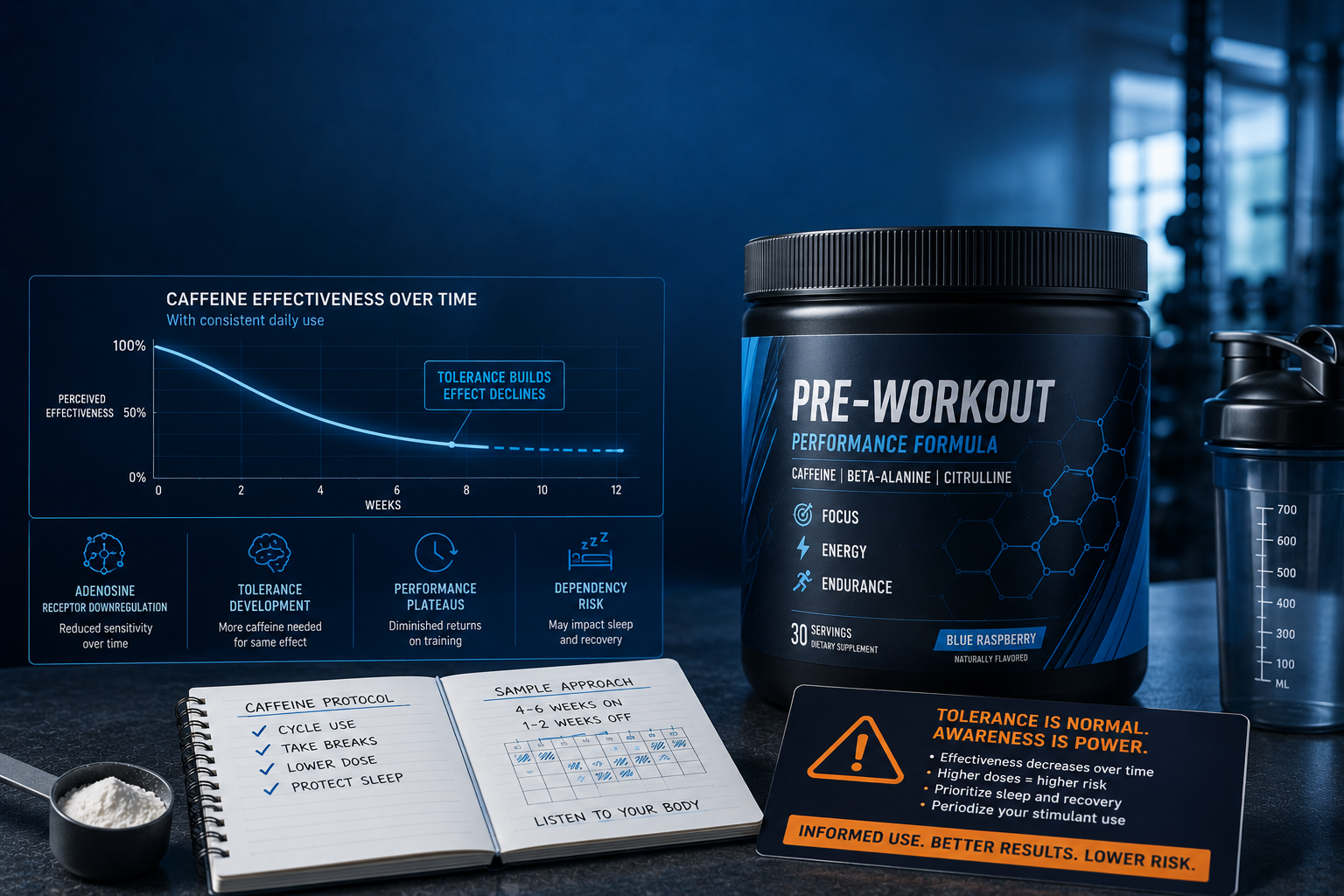
You’ve been taking pre-workout for a while, and something’s changed. Those first few weeks were amazing – incredible energy, laser focus, intense motivation to crush your training. But now? You barely feel anything. You’re taking the same dose, but it’s like drinking flavored water. Or maybe it’s your first time trying pre-workout, and you’re disappointed because you’re not experiencing the energy boost everyone raves about.
So why isn’t your pre-workout working anymore?
The main ingredient in pre-workout that provides noticeable energy increases is the stimulant in the formula – caffeine. The stimulating effects of pre-workout can diminish as you develop tolerance to caffeine and now require higher doses to feel the initial effects. However, it’s neither possible nor recommended to continuously increase your pre-workout dosage indefinitely.
For people who rely on pre-workout to power through tough training sessions, losing its effectiveness is frustrating and concerning. You’ve invested money in a supplement that’s supposed to give you an edge, and now it feels like a waste. Understanding why this happens and what you can do about it is crucial for getting the most from your supplementation.
In this comprehensive guide, I’ll explain the real reasons your pre-workout stopped working (or never worked in the first place), what’s happening in your body when tolerance develops, whether you can reverse tolerance and restore effectiveness, practical strategies to make your pre-workout work again, and how to use pre-workout strategically to maintain its benefits long-term.
Whether you’re experiencing diminishing returns from your current pre-workout or you’ve never felt the effects you expected, understanding the science behind caffeine tolerance and stimulant adaptation will help you optimize your supplementation strategy.
Let’s break down why your pre-workout isn’t delivering the results you want and what you can do about it.
TABLE OF CONTENTS
Why Your Pre-Workout Doesn’t Work (Anymore)
In practice, when we say a pre-workout “works” or “doesn’t work,” we’re generally referring to the effects of the stimulant in the formula, which is typically caffeine.
What “Working” Actually Means
After taking a dose of pre-workout containing caffeine, within the next 30 minutes you typically experience:
- Increased alertness (feeling “awake” and sharp)
- Enhanced motivation (actually wanting to train hard)
- Improved focus (mind-muscle connection, concentration on form)
- Surge of energy (feeling capable of intense effort)
- Reduced perceived exertion (the workout feels easier than it is)
All of these effects are primarily brought by caffeine’s action, and this is what most people, in practice, seek when taking pre-workout.
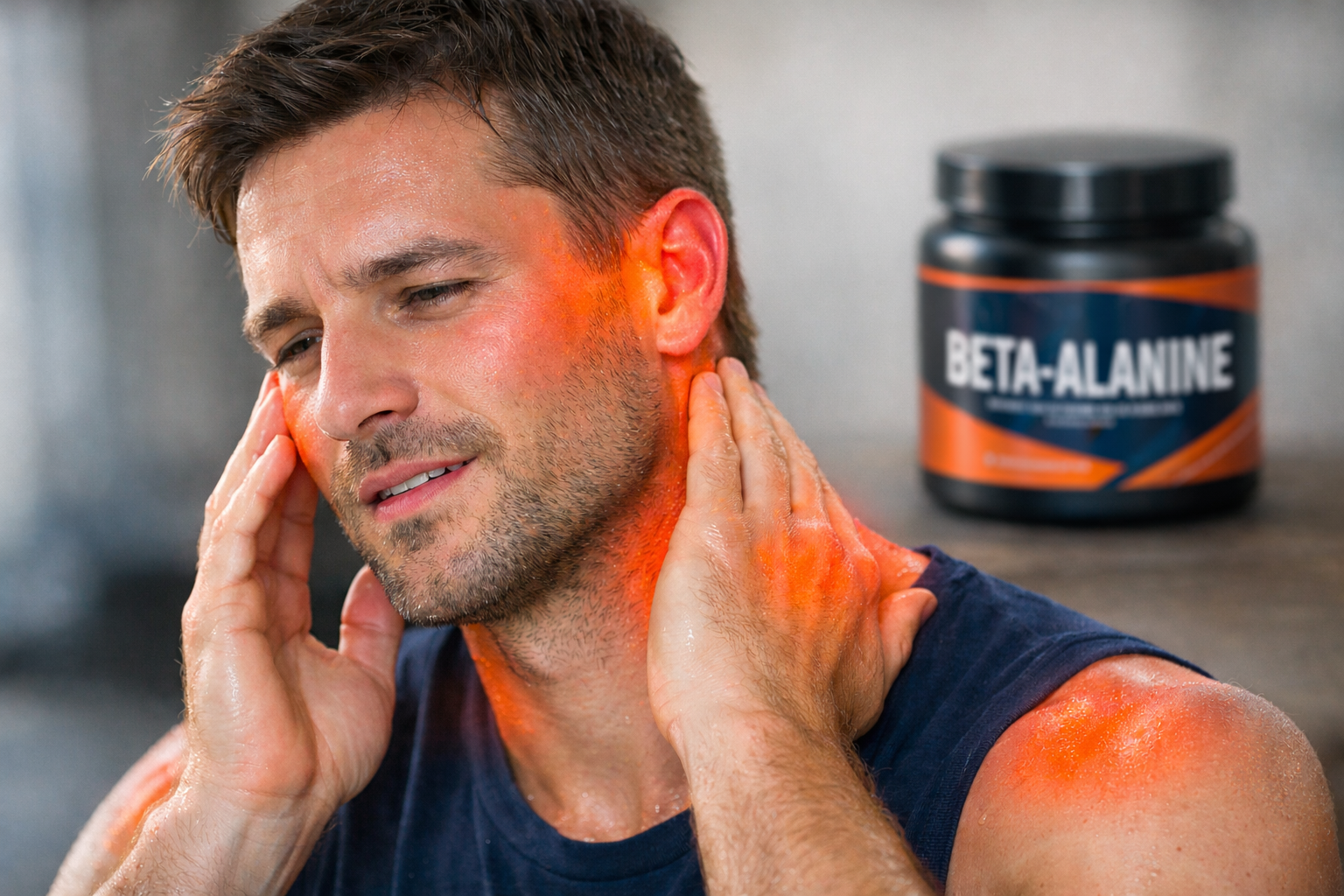
It’s not about beta-alanine tingles or citrulline pumps (though those are nice bonuses). It’s about that unmistakable feeling of “I’m ready to destroy this workout.”
However, over time, these effects tend to diminish or disappear completely, leaving you with a possibly expensive supplement that now serves more as kitchen decoration. What’s happening?
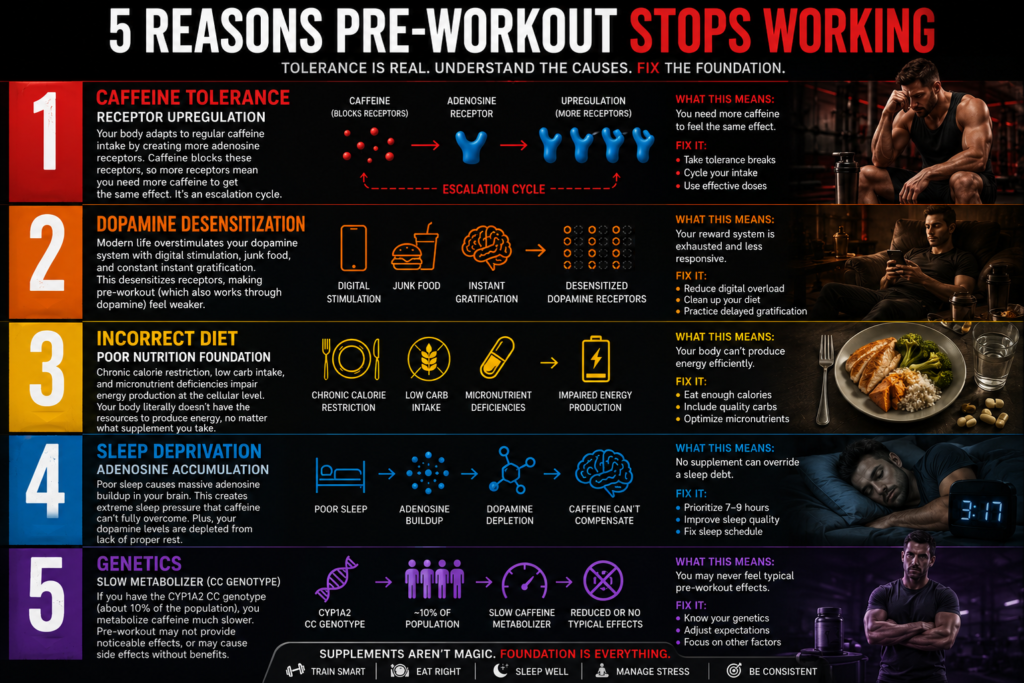
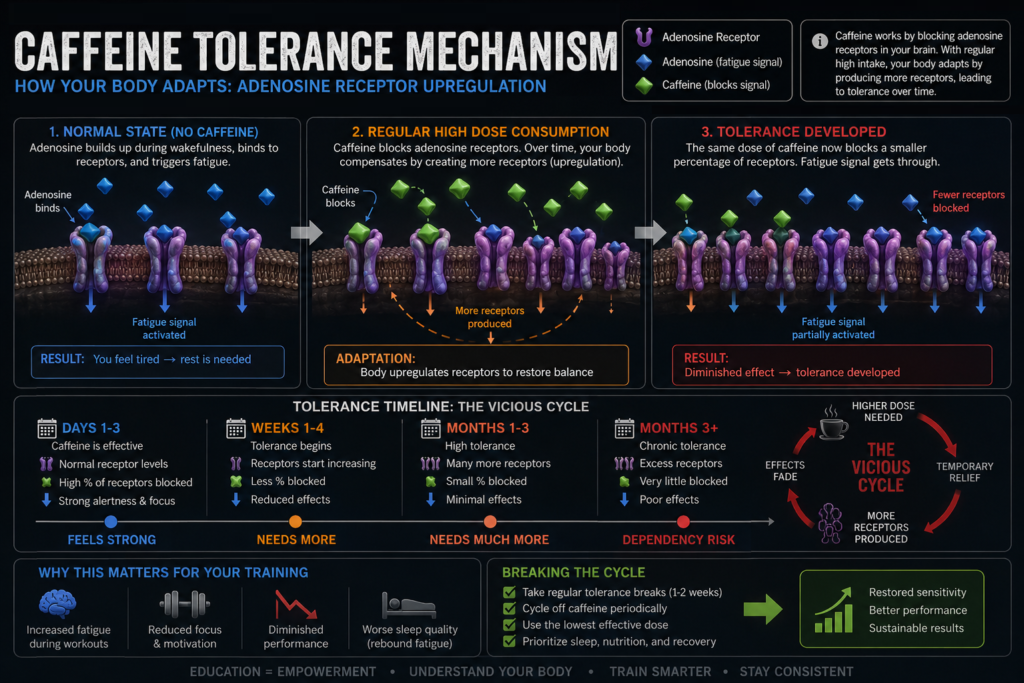
Reason 1: You’ve Developed Caffeine Tolerance
Your body can develop tolerance to caffeine over time. This is the single most common reason pre-workout stops working.
How caffeine normally works:
Caffeine primarily works by blocking receptors in your brain that signal fatigue. Here’s the simplified mechanism:
Step 1: Energy production creates adenosine
- When you exercise (or just live), your body breaks down ATP (adenosine triphosphate) for energy
- This process releases adenosine as a byproduct
- Adenosine accumulates throughout the day
Step 2: Adenosine signals fatigue
- Adenosine binds to adenosine receptors in your brain
- This binding tells your brain “you’re getting tired, slow down”
- The more adenosine that binds, the more fatigue you feel
Step 3: Caffeine blocks the fatigue signal
- Caffeine molecules are structurally similar to adenosine
- They can bind to adenosine receptors, blocking them
- With receptors blocked, adenosine can’t deliver its “tired” message
- Result: You don’t feel as fatigued even though adenosine is present
This is why caffeine makes you feel more awake and energetic – it’s not actually giving you energy; it’s blocking the signal that you’re tired.
But here’s the problem: Your body adapts
How tolerance develops:
If you consume caffeine regularly, especially in high doses, your body compensates by making more adenosine receptors. It’s like your body saying “if this substance is going to block my receptors, I’ll just make more receptors.”
The timeline of tolerance development:
Days 1-3 of regular caffeine use:
- Full effects experienced
- 200mg caffeine produces strong wakefulness and energy
Week 1-2:
- Slight adaptation beginning
- Same dose produces slightly less effect
- Most people don’t notice yet
Week 3-4:
- Noticeable tolerance developing
- 200mg now feels like maybe 150mg used to feel
- People start increasing their dose
Month 2-3:
- Significant tolerance established
- 200mg produces minimal effects
- Now need 300-400mg to feel original effect
- The escalation begins
Month 4+:
- Substantial tolerance
- Even high doses (400mg+) produce diminished effects
- Hitting the ceiling where more caffeine doesn’t help
- Dependency developed (feel terrible without caffeine)
The receptor upregulation problem:
Your brain has created so many adenosine receptors that:
- Even blocking many with caffeine, plenty remain unblocked
- Adenosine still binds to these extra receptors
- You still feel tired despite consuming caffeine
- The caffeine effect is “diluted” across more receptors
This is why your pre-workout stops working – you’ve developed tolerance through receptor adaptation.
Individual variation in tolerance development:
Some people develop tolerance faster than others due to:
- Genetic differences in caffeine metabolism
- Baseline adenosine receptor density
- Overall caffeine consumption from all sources (coffee, tea, energy drinks, etc.)
- Frequency of consumption
- Dose taken each time
Reason 2: You’re Abusing Dopamine
Beyond making you feel less tired through the adenosine mechanism, caffeine can increase the presence of a neurotransmitter in your brain called dopamine, which brings feelings of euphoria and motivation.
Dopamine’s role in pre-workout effects:
Dopamine is often called the “motivation molecule” or “reward neurotransmitter.” It’s involved in:
- Motivation and drive (the desire to do things)
- Pleasure and reward (feeling good when accomplishing tasks)
- Focus and attention (ability to concentrate)
- Movement and motor control
When caffeine increases dopamine, you experience:
- Intense motivation to train
- Pleasure from the workout itself
- Enhanced focus on each exercise
- That “euphoric” feeling people describe
This is the magic feeling people chase with pre-workout – not just energy, but genuine excitement to train.
But here are two potential problems with dopamine:
Problem 1: Dopamine receptor downregulation
Your brain perceives when there’s more dopamine than necessary and adapts by:
- Reducing the number of dopamine receptors (downregulation)
- Decreasing dopamine receptor sensitivity
- Lowering baseline dopamine production
The result:
- You need increasingly more dopamine to feel the same effects
- If you initially felt euphoria and intense motivation from pre-workout, this effect tends to diminish unless you increase the dose to compensate
- You’re chasing the dragon – trying to recapture that first amazing experience
Problem 2: Dopamine desensitization from other sources
Caffeine isn’t the only way to spike dopamine. Any activity that brings immediate pleasure can increase dopamine levels, and if you abuse these activities, your brain becomes desensitized.
Common dopamine-spiking activities:
Digital stimulation:
- Social media scrolling (instant feedback loops)
- Video games (reward systems designed to spike dopamine)
- Porn and internet browsing
- YouTube/TikTok/Instagram (endless novelty and stimulation)
Food-related:
- Junk food, fast food (hyperpalatable, engineered for dopamine response)
- Sugar consumption
- Eating for pleasure rather than hunger
Substance-related:
- Recreational drugs (legal and illegal)
- Alcohol
- Nicotine/vaping
- Excessive caffeine from multiple sources
Other:
- Gambling
- Excessive shopping
- Any compulsive behavior that provides instant gratification
If you’re constantly bombarding your brain with dopamine from these sources, by the time you take pre-workout, your brain is already desensitized. The dopamine increase from caffeine feels like nothing because your baseline tolerance is so high.
Example scenario:
Morning: Wake up, immediately check phone for 30 minutes (dopamine spike) Throughout day: Constantly checking social media, email, texts (repeated dopamine hits) Evening: Watch Netflix while scrolling phone (double dopamine) Before bed: More phone time (dopamine before sleep)
Then you take pre-workout expecting a huge motivation boost, but your dopamine system is exhausted and desensitized from hours of digital stimulation. The pre-workout effect is minimal.
The modern dopamine crisis:
We live in the most dopamine-stimulating environment in human history:
- Smartphones provide instant gratification 24/7
- Social media engineered for maximum engagement (dopamine loops)
- Entertainment on-demand (no delayed gratification)
- Hyperpalatable food everywhere (engineered to spike dopamine)
Our ancestors had to hunt for food, work hard for entertainment, and rarely experienced the dopamine spikes we get hundreds of times daily.
The result: Our dopamine systems are overwhelmed, tolerance is high, and supplements like pre-workout that used to feel amazing now barely register.
This is why some people never feel pre-workout effects – their dopamine system is already so desensitized from modern lifestyle that the relatively modest dopamine increase from caffeine doesn’t produce noticeable motivation or euphoria.
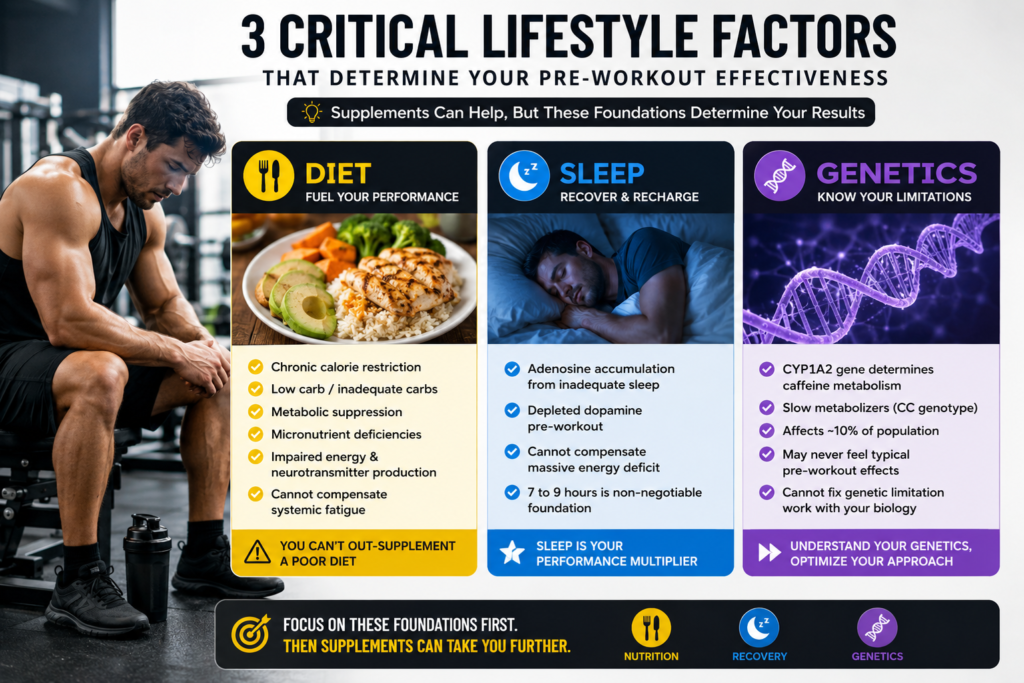
Reason 3: Incorrect Diet
Your nutrition can interfere with how pre-workout works in two significant ways:
Problem 1: Chronic calorie restriction and low-carb dieting
Training for a considerable time using a calorie-restricted diet (especially one that restricts carbohydrates) can make you feel chronically tired and change how your metabolism functions.
What happens during extended cutting:
Hormonal changes:
- Leptin decreases (satiety hormone, also regulates energy expenditure)
- Thyroid hormones (T3/T4) decrease (metabolic regulation)
- Testosterone decreases (energy, motivation, muscle maintenance)
- Cortisol often increases (stress, catabolism)
Metabolic adaptation:
- Overall metabolic rate slows down
- Non-exercise activity thermogenesis (NEAT) decreases unconsciously
- Energy conservation mode activated
- Chronic fatigue becomes the baseline state
Neurological changes:
- Neurotransmitter production affected (dopamine, serotonin require resources)
- Brain prioritizes survival over performance
- Perceived exertion increases (everything feels harder)
The pre-workout problem:
The positive effects of pre-workout cannot compensate for this type of chronic, metabolic-level fatigue. You might not feel the expected effects because:
- Your body is in deep energy conservation mode
- Hormones are suppressed across the board
- Neurotransmitter systems are compromised
- The caffeine “boost” is fighting against systemic fatigue
Example:
Person cutting aggressively for 12+ weeks:
- Eating 1200-1500 calories daily (500-800 below maintenance)
- Very low carb (<50g daily)
- Training 5-6 days weekly
- High daily activity (cardio, steps)
Takes 300mg caffeine pre-workout and feels… barely anything. Maybe slightly less terrible, but no energy surge, no motivation, no euphoria.
Why? Because they’re running on empty. Caffeine can’t create energy from nothing – it only helps you access and utilize the energy you have. When you have almost no energy reserves, caffeine has nothing to work with.
Problem 2: Micronutrient deficiencies
A diet poor in vitamins and minerals may fail to provide the necessary precursors for your body to produce energy and neurotransmitters.
Caffeine alone doesn’t make your body have more energy. That energy has to come from somewhere. In fact, caffeine stimulates a chain of reactions that result in more energy, and this chain depends on numerous nutrients to function properly.
The energy production pathway requires:
B vitamins (B1, B2, B3, B5, B6, B12):
- Essential for converting food into ATP (cellular energy)
- Involved in every energy-producing reaction in your body
- Deficiency = impaired energy production regardless of caffeine
Iron:
- Necessary for oxygen transport (hemoglobin)
- Required for mitochondrial energy production
- Deficiency = chronic fatigue, poor training performance
Magnesium:
- Cofactor in 300+ enzymatic reactions
- Required for ATP synthesis and utilization
- Deficiency = muscle weakness, fatigue, poor recovery
Vitamin D:
- Affects energy levels, muscle function, mood
- Deficiency associated with fatigue and poor performance
Electrolytes (sodium, potassium, calcium):
- Essential for muscle contraction
- Nerve signal transmission
- Fluid balance and hydration
Amino acids (from protein):
- Tyrosine: Precursor to dopamine
- Tryptophan: Precursor to serotonin
- Without adequate protein, neurotransmitter production suffers
The vicious cycle:
Poor diet → Micronutrient deficiencies → Impaired energy production and neurotransmitter synthesis → Chronic low energy and poor mood → Caffeine has limited effect because the underlying machinery is broken
If you have a diet poor in micronutrients, you can hardly take full advantage of your pre-workout because your body lacks the raw materials to respond to caffeine’s signals.
Example of micronutrient-poor diet:
Breakfast: White toast with butter Lunch: Pasta with basic sauce Dinner: Pizza Snacks: Chips, candy
This diet provides:
- Calories: Yes
- Protein: Minimal
- Vitamins and minerals: Almost none
- Result: Even with adequate calories, body can’t produce energy or neurotransmitters efficiently
Compare to micronutrient-rich diet:
Breakfast: Eggs, vegetables, whole grain toast, fruit Lunch: Chicken, rice, large salad, mixed vegetables Dinner: Salmon, sweet potato, broccoli Snacks: Greek yogurt, nuts, berries
This diet provides:
- Calories: Yes
- Protein: Abundant
- B vitamins: Abundant (from meat, eggs, whole grains)
- Iron: Abundant (from meat)
- Magnesium: Good (from vegetables, nuts)
- All amino acids: Complete (from varied protein sources)
- Result: Body has all resources needed to respond to caffeine effectively
Reason 4: Sleep Deprivation
If you could choose only one reason for your pre-workout to stop working, we’d be talking about sleep deprivation.
Just one poorly slept night can completely change how your brain functions day-to-day, especially regarding how your body uses adenosine and dopamine – two systems that caffeine influences.
How sleep deprivation ruins pre-workout effectiveness:
Effect 1: Massive adenosine accumulation
Sleeping fewer hours than recommended (less than 7-8 hours nightly) causes adenosine to accumulate beyond normal levels.
During sleep:
- Your brain clears adenosine that built up during the day
- Adenosine levels reset to low baseline
- You wake up refreshed (if sleep was adequate)
Without adequate sleep:
- Adenosine doesn’t fully clear
- You start the next day with elevated baseline adenosine
- Throughout the day, even more adenosine accumulates on top
- By evening, you have extremely high adenosine levels
The pre-workout problem:
Remember, caffeine works by blocking adenosine receptors. But when you’re sleep-deprived, you have:
- Way more adenosine than normal (maybe 2-3x normal levels)
- More adenosine receptors (from chronic caffeine use)
- Caffeine must block a much larger number of receptors to have an effect
It’s like bailing water from a boat with a massive hole – the caffeine is working, but it can’t keep up with the adenosine flood from sleep deprivation.
Effect 2: Depleted dopamine
Sleep deprivation significantly reduces dopamine availability and receptor sensitivity.
What happens without adequate sleep:
- Dopamine receptor sensitivity decreases
- Baseline dopamine production drops
- Dopamine signaling becomes impaired
- Motivation and drive plummet
The result:
- You feel unmotivated and low-energy
- Caffeine’s dopamine-boosting effect is blunted
- The “euphoria” and “motivation” from pre-workout disappears
- At best, you feel “slightly less terrible”
The energy deficit reality:
Here’s the crucial concept: Using pre-workout when you’re already sleep-deprived is like putting fuel in a tank that’s already empty.
In other words:
- Without sleep deprivation: Caffeine takes you from “normal energy” to “HIGH energy”
- With sleep deprivation: Caffeine takes you from “exhausted” to maybe “normal energy”
You’re using pre-workout to compensate for a massive energy deficit, not to enhance normal energy levels. At maximum, you’ll reach your normal baseline – not the enhanced state pre-workout is supposed to provide.
Basically, pre-workout cannot compensate for a poorly slept night (let alone multiple nights of poor sleep).
The compounding effect:
One bad night: Noticeable decrease in pre-workout effectiveness Multiple bad nights: Pre-workout feels almost completely ineffective Chronic sleep deprivation (weeks/months): Even high doses barely help
Example scenario:
Person A – Adequate sleep:
- Sleeps 8 hours nightly
- Wakes refreshed
- Takes 200mg caffeine pre-workout
- Experiences: Intense energy, strong motivation, excellent focus
- Great training session
Person B – Sleep deprived:
- Sleeps 5 hours nightly (chronic)
- Wakes exhausted
- Takes 300mg caffeine pre-workout (higher dose, trying to compensate)
- Experiences: Slightly less tired, minimal motivation, jittery but still fatigued
- Mediocre training session where everything feels hard
The harsh reality: Person B could take 500mg+ caffeine and still not feel as good as Person A on 200mg with adequate sleep.
Sleep is non-negotiable. It’s the foundation that makes all supplements work properly.
Reason 5: You Have a Gene That Metabolizes Caffeine Slowly
Finally, it’s possible that you have something called the CC genotype, an expression of a gene called CYP1A2. People with the CC genotype (about 10% of the population) metabolize caffeine very slowly and may not feel the expected effects of caffeine.
Understanding caffeine metabolism genetics:
The CYP1A2 gene codes for an enzyme in your liver that metabolizes (breaks down) caffeine.
There are three genotypes:
AA genotype (fast metabolizers – ~40% of population):
- Very efficient caffeine metabolism
- Caffeine is broken down quickly (half-life ~3 hours)
- Feel effects rapidly and intensely
- Effects wear off relatively quickly
- Can consume caffeine later in day with less sleep disruption
AC genotype (moderate metabolizers – ~50% of population):
- Average caffeine metabolism
- Moderate breakdown speed (half-life ~4-5 hours)
- Standard caffeine response
- Most people fall into this category
CC genotype (slow metabolizers – ~10% of population):
- Very slow caffeine metabolism
- Caffeine breakdown is sluggish (half-life ~6-8+ hours)
- May not feel typical caffeine effects
- When effects are felt, they’re very gradual
- Caffeine stays in system much longer
Unfortunately, if you have the CC genotype, increasing your pre-workout dose won’t help.
Why slow metabolism causes problems:
The dosing problem:
- Caffeine works gradually rather than creating the spike of energy and focus people expect
- By the time enough accumulates to produce effects, it’s so gradual you barely notice
- But it takes much longer to leave your system completely
The accumulation problem:
- If you take caffeine daily, it accumulates in your system
- Yesterday’s caffeine is still present when you take today’s dose
- Over time, this causes jitteriness, anxiety, and sleep disruption
- But never the “clean energy” feeling fast metabolizers get
The half-life explanation:
Caffeine half-life is how long it takes for half the caffeine to be eliminated from your system.
Fast metabolizer (AA) takes 200mg at 3 PM:
- 6 PM: 100mg remaining (half-life 3 hours)
- 9 PM: 50mg remaining
- Midnight: 25mg remaining
- Can sleep fine
Slow metabolizer (CC) takes 200mg at 3 PM:
- 9 PM: 100mg remaining (half-life 6 hours)
- 3 AM: 50mg remaining
- 9 AM next day: 25mg remaining
- Sleep is disrupted, still feeling effects the next morning
This is why some people, even without abusing caffeine or dopamine from other sources, will never feel the expected effects of pre-workout.
How to know if you’re a slow metabolizer:
Genetic testing:
- 23andMe or similar services can identify your CYP1A2 genotype
- Definitive answer about your caffeine metabolism
Experiential clues:
- Caffeine keeps you awake even if taken early afternoon
- Feel jittery or anxious rather than energized
- Effects are very subtle and gradual
- Caffeine affects your sleep even taken 8+ hours before bed
- You never feel the “rush” others describe
What to do if you’re a slow metabolizer:
Accept that traditional stimulant pre-workouts won’t work as expected:
- The dramatic energy surge won’t happen for you
- Focus on other pre-workout ingredients (beta-alanine, citrulline, etc.)
- Consider stimulant-free pre-workout options
Use other methods for energy:
- Optimize sleep (even more important for you)
- Time nutrition properly (adequate pre-workout carbs)
- Use music, mindset techniques, or training partners for motivation
Avoid high caffeine doses:
- Won’t make it work better
- Will cause sleep disruption and anxiety
- Keep doses low (<100mg) or avoid entirely
What to Do If Your Pre-Workout Doesn’t Work Anymore
First, an important clarification: just because you don’t feel a sudden surge of energy and euphoria from your pre-workout doesn’t necessarily mean it’s not working.
Many important ingredients in pre-workout don’t produce noticeable physical sensations but can still improve endurance, strength, and overall energy during training:
Beta-alanine:
- Causes tingling (paresthesia) which people notice
- But the performance benefit (buffering muscle acid) happens whether you feel tingles or not
- Works cumulatively over weeks
Citrulline:
- Improves blood flow and reduces fatigue
- You might get a “pump” feeling
- But the performance benefits exist even without noticeable pump
Creatine (if included):
- No acute feeling whatsoever
- But improves strength and power over time
- Works through cellular energy systems invisibly
Betaine, taurine, tyrosine:
- No noticeable sensations
- Performance benefits exist regardless
The point: Even if the stimulant effect has diminished, your pre-workout might still be improving your training objectively (more reps, more weight, less fatigue). Don’t judge effectiveness solely by how you “feel.”
That said, if you’re seeking to restore the feeling of euphoria, motivation, and heightened focus brought by pre-workout, then you can implement the following strategies:
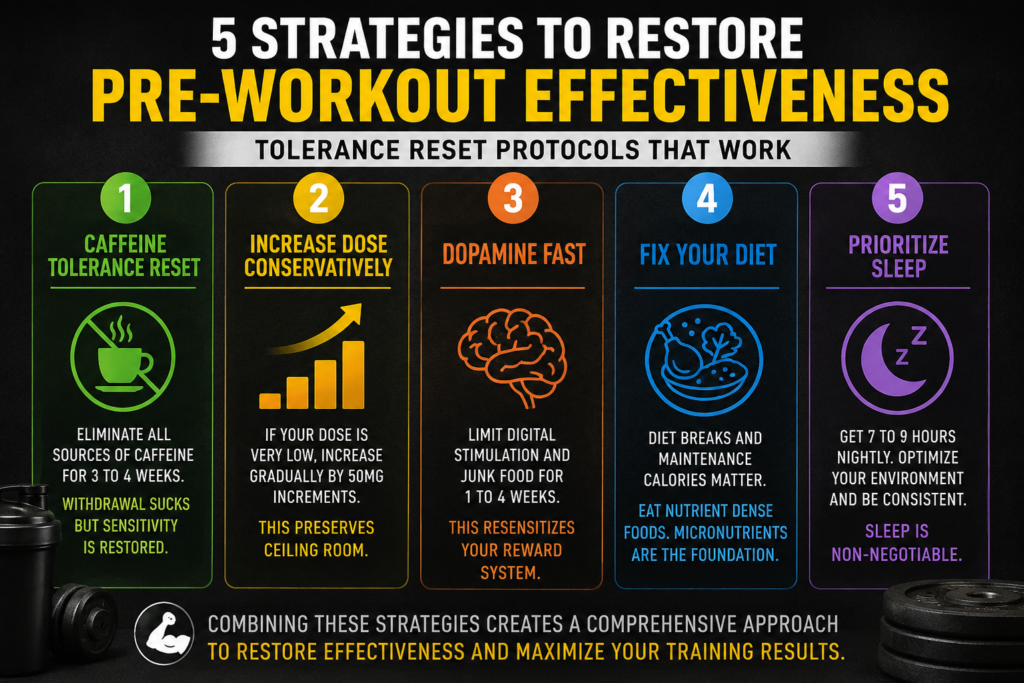
Strategy 1: Decrease Your Caffeine Tolerance (The Reset)
If you’ve acquired caffeine tolerance, unfortunately, increasing the dose is only a temporary solution that lasts just long enough for you to become even more tolerant and require very high doses of pre-workout.
The problem with continually increasing dose:
Financial problem:
- If you need double or triple the standard dose, your supplement runs out 2-3x faster
- Need to buy new containers much more frequently
- Dramatically affects cost-effectiveness
- An expensive supplement becomes extremely expensive
Safety problem:
- Many pre-workout ingredients have maximum safe dosages
- Example: Beta-alanine (safe up to ~5g), citrulline (safe up to ~10g)
- If you’re taking 2-3 servings to get enough caffeine, you might be exceeding safe limits of other ingredients
- Potential side effects and health risks
Tolerance problem:
- Increasing dose just accelerates tolerance development
- Soon you’re at maximum caffeine (400mg+) and still building tolerance
- Nowhere left to go
The solution: Caffeine reset (tolerance break)
Cut caffeine consumption for 3-4 weeks to resensitize your body to caffeine’s action.
Important note: It’s not enough to stop taking pre-workout if you’re abusing caffeine from other sources (through coffee, energy drinks, teas, and other caffeinated beverages).
You must eliminate ALL caffeine sources:
- No pre-workout (obviously)
- No coffee
- No energy drinks
- No caffeinated tea (green tea, black tea, etc.)
- No caffeine-containing sodas
- No caffeine pills or supplements
- Check medications (some contain caffeine)
The caffeine reset timeline:
Days 1-3 (The worst):
- Withdrawal symptoms peak
- Expect: Headaches, fatigue, irritability, difficulty concentrating, low motivation
- This is temporary but unpleasant
- Ibuprofen can help with headaches
- Extra sleep helps
Days 4-7:
- Withdrawal symptoms decrease
- Still feeling lower energy than normal
- Starting to stabilize
- Sleep quality often improves
Week 2:
- Withdrawal symptoms mostly gone
- Energy levels returning to natural baseline
- Adenosine receptors beginning to downregulate (fewer receptors)
- Starting to feel “normal” without caffeine
Week 3-4:
- Tolerance largely reset
- Natural energy and motivation restored
- Adenosine receptor density back to baseline
- Ready to reintroduce caffeine
How to maintain sensitivity after reset:
Use caffeine strategically, not habitually:
- Only before workouts (not daily morning coffee, afternoon pick-me-up, etc.)
- 3-4 days weekly maximum, not 7 days
- Take 1-2 complete caffeine-free days weekly
- This prevents rapid tolerance redevelopment
Cycle your caffeine:
- 6-8 weeks on (using pre-workout)
- 2-3 weeks off (caffeine reset)
- Repeat cycle
- Maintains sensitivity long-term
Start with lower doses after reset:
- If you were taking 400mg before, start with 200mg after reset
- You’ll feel the effects from lower dose (saves money, prevents rapid tolerance)
- Only increase if genuinely needed
The discipline required:
This is the hardest solution to implement because:
- You’ll feel worse before you feel better
- Temptation to use “just one coffee” during the break
- Social situations involving coffee
- Habit and ritual around morning coffee/pre-workout
But it’s the only real solution to tolerance. Anything else is just delaying the inevitable.
Strategy 2: Increase Pre-Workout Dose (If Initial Dose Was Very Low)
In some cases, a pre-workout may provide a relatively low dose of caffeine, and you still have the option to increase the dose, considering that the maximum recommended daily dose of caffeine is 400mg.
When this strategy makes sense:
Your current dose is under 200mg:
- Many pre-workouts provide 150-200mg per serving
- You have room to increase before hitting the 400mg ceiling
- Might restore effectiveness temporarily
You’re not a daily caffeine consumer from other sources:
- If you only get caffeine from pre-workout
- Not drinking coffee, energy drinks, etc. throughout the day
- Your total daily caffeine is just the pre-workout dose
You haven’t been using pre-workout long:
- Less than 4-6 weeks of consistent use
- Tolerance might not be fully developed
- Small increase might work
How to increase responsibly:
Conservative approach:
- Increase by 50mg at a time
- Wait 1-2 weeks before further increase
- Assess effectiveness at each level
- Stop increasing when effects are satisfactory
Example progression:
- Start: 150mg (one serving)
- Week 3-4: 200mg (1.33 servings or switch to higher-caffeine product)
- Week 6-8: 250mg (if needed)
- Week 10+: 300mg maximum (if necessary)
Check your pre-workout label:
- How much caffeine per serving?
- How many servings can you take before exceeding 400mg?
- What are the doses of other ingredients per serving?
Example:
Pre-workout provides per serving:
- 200mg caffeine
- 3g beta-alanine
- 6g citrulline
You could potentially take up to 2 servings (400mg caffeine) but that would give you:
- 400mg caffeine (at maximum safe daily limit)
- 6g beta-alanine (slightly high but generally safe)
- 12g citrulline (high but safe)
What NOT to do:
DON’T start with maximum dose (400mg):
- Some people think “I’ll get maximum benefits by starting at the maximum”
- Terrible strategy
- Your body will build tolerance just as fast
- When tolerance develops, you have nowhere to go
- Can’t exceed 400mg safely, and even 400mg loses effectiveness with tolerance
The ceiling effect:
Once you’re at 400mg and have tolerance, you’re stuck:
- Can’t safely go higher
- Tolerance continues developing
- Effects diminish
- Only option is tolerance reset (weeks off caffeine)
Better to start lower, increase gradually, and maintain room for adjustment.
Strategy 3: Implement a Dopamine Fast
Decreasing the amount of dopamine generated in your daily life can make your brain more sensitive to this neurotransmitter and make pre-workout “hit” harder.
What is a dopamine fast?
It’s not literally fasting from dopamine (impossible – dopamine is essential for survival). It’s about:
- Reducing artificially high dopamine spikes from modern stimuli
- Allowing your dopamine receptors to resensitize
- Restoring natural baseline dopamine function
To do this, you need to consciously avoid activities that bring immediate pleasure without effort:
Digital stimulation (biggest culprits):
- Limit social media to 30 minutes daily (or eliminate completely for 1-2 weeks)
- No mindless scrolling (Instagram, TikTok, Facebook, Reddit)
- Reduce video game time (or eliminate temporarily)
- Cut back on streaming services (binge-watching)
- Minimize YouTube rabbit holes
- Put phone away 1-2 hours before bed
Food-related:
- Avoid junk food and fast food (engineered for maximum dopamine)
- Eliminate added sugar (major dopamine trigger)
- No eating for pleasure when not hungry
- Focus on whole, unprocessed foods
- Make eating about nutrition, not entertainment
Substance-related:
- Abstain from recreational drugs and alcohol
- No nicotine/vaping
- Reduce caffeine to only pre-workout (not throughout day)
Other behavioral:
- Reduce or eliminate pornography and excessive masturbation
- Avoid compulsive shopping or spending
- Limit gambling or risk-taking behaviors
- Any activity you use for instant gratification
The dopamine fast protocol:
Duration: 1-4 weeks depending on severity of desensitization
Rules during fast:
- Engage in low-dopamine activities: reading, walking, meditation, socializing in person, creative work
- Embrace boredom (it’s okay to be bored – previous generations survived without constant stimulation)
- Focus on delayed gratification activities (long-term rewards)
- Practice mindfulness and presence
What people report after dopamine fasting:
Week 1:
- Boredom, restlessness, difficulty focusing
- Strong urges to check phone, eat junk, etc.
- Feels uncomfortable
- This is withdrawal from dopamine overload
Week 2:
- Urges decrease
- Starting to appreciate simple activities
- Better sleep quality
- More present and focused
Week 3-4:
- Dopamine sensitivity restored
- Activities that were “boring” now engaging
- Food tastes better
- Natural motivation increases
- Pre-workout effects dramatically improved
After dopamine reset + taking pre-workout:
- Caffeine’s dopamine boost feels significant again
- Motivation and euphoria return
- Focus and drive enhanced
- Pre-workout “works” like it used to
The modern challenge:
This is extremely difficult in 2024 because:
- Smartphones are ubiquitous
- Entertainment is on-demand 24/7
- Social pressure to be “connected”
- Work often requires digital devices
- Food is engineered for maximum pleasure
But that’s exactly why it’s necessary. The difficulty reveals how dependent we’ve become on artificial dopamine spikes.
Practical implementation:
Start small:
- Don’t try to eliminate everything at once
- Pick 2-3 major changes (example: no social media, no junk food, phone away after 8 PM)
- Build from there
Use tools:
- App blockers (Freedom, Cold Turkey)
- Phone in another room while working/sleeping
- Accountability partner
- Track progress
The long-term approach:
Don’t return to old habits immediately after reset:
- Maintain some restrictions permanently
- Use social media intentionally, not habitually
- Treat junk food as occasional, not regular
- Keep phone use reasonable
This restores and maintains dopamine sensitivity, making pre-workout and natural motivation work better long-term.
Strategy 4: Fix Your Diet
Address calorie restriction and low-carb issues:
If you’ve been cutting aggressively for extended periods:
Take a diet break:
- 1-2 weeks at maintenance calories
- Restore carbohydrate intake (at least 150-200g daily)
- Allow hormones to normalize
- Leptin increases, cortisol decreases, thyroid function improves
After diet break:
- Pre-workout effectiveness often dramatically improves
- Energy levels restored
- Training performance rebounds
- Can continue cutting with better results
Use more moderate deficits:
- 300-500 calorie deficit instead of 800-1000
- Slower fat loss but sustainable
- Better hormone health
- Pre-workout remains effective
Don’t restrict carbs excessively:
- Minimum 100-150g carbs daily even while cutting
- Time carbs around training
- Supports energy and performance
- Allows pre-workout to work properly
Address micronutrient deficiencies:
Eat nutrient-dense whole foods:
- Lean meats (B vitamins, iron)
- Fish (omega-3s, vitamin D)
- Eggs (choline, B vitamins)
- Vegetables (magnesium, vitamins A/C/K, fiber)
- Fruits (vitamin C, potassium, antioxidants)
- Whole grains (B vitamins, magnesium)
Consider supplementation:
- Quality multivitamin (insurance policy)
- Vitamin D (if deficient, very common)
- Magnesium (glycinate form, before bed)
- B-complex (if diet is lacking)
The restoration timeline:
Week 1-2: Begin addressing deficiencies, subtle improvements Week 3-4: Noticeable energy improvement, pre-workout more effective Week 6-8: Optimal energy and pre-workout response restored
Strategy 5: Prioritize Sleep
This is non-negotiable. If you fix nothing else, fix your sleep.
Target: 7-9 hours per night (most people need 8)
Sleep optimization strategies:
Consistency:
- Same bedtime and wake time daily (even weekends)
- Trains your circadian rhythm
- Improves sleep quality
Environment:
- Dark room (blackout curtains or sleep mask)
- Cool temperature (65-68°F optimal)
- Quiet (earplugs or white noise if needed)
- Comfortable mattress and pillows
Pre-sleep routine:
- No screens 1-2 hours before bed (blue light disrupts melatonin)
- No caffeine after 2 PM (even if you think it doesn’t affect you)
- No large meals within 2-3 hours of bed
- Light reading, stretching, or meditation before bed
Lifestyle factors:
- Regular exercise (but not within 2-3 hours of bedtime)
- Morning sunlight exposure (regulates circadian rhythm)
- Manage stress (meditation, journaling)
- Limit alcohol (disrupts sleep quality)
The sleep-pre-workout connection:
With poor sleep:
- 300mg caffeine feels like nothing
- Minimal motivation or energy
- Jittery but still tired
With adequate sleep:
- 200mg caffeine feels amazing
- Strong energy and motivation
- Clean, focused energy
Sleep makes or breaks every supplement. No amount of pre-workout can compensate for sleep deprivation.
THE BOTTOM LINE: RESTORING PRE-WORKOUT EFFECTIVENESS
After examining all reasons why pre-workout stops working and solutions to restore it, here’s what you need to understand:
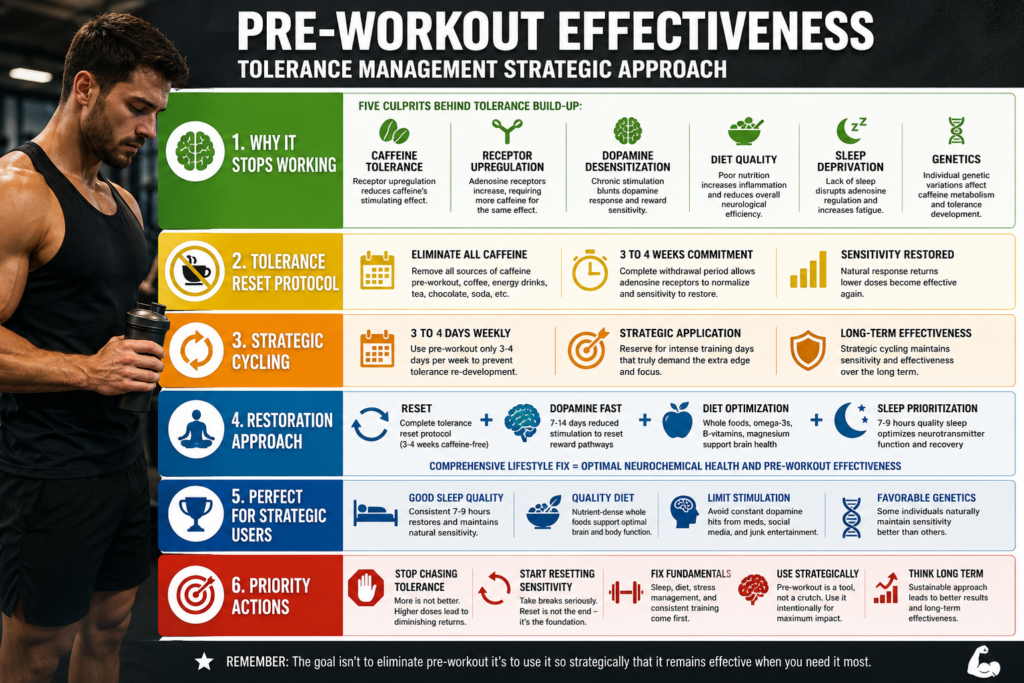
✅ Caffeine Tolerance Is The Primary Culprit (Receptor Upregulation Over Time)
✅ Dopamine Desensitization From Modern Life (Digital Overstimulation, Junk Food, Instant Gratification)
✅ Diet Quality Matters Significantly (Micronutrients, Adequate Calories, Carbohydrates)
✅ Sleep Is Absolutely Non-Negotiable (7-9 Hours Nightly)
✅ Genetic Factors Affect 10% Of Population (Slow Caffeine Metabolizers)
✅ Tolerance Reset Requires 3-4 Weeks Caffeine-Free (Complete Elimination From All Sources)
Perfect For Taking Pre-Workout:
- People Who Use Caffeine Strategically (3-4 Days Weekly, Not Daily)
- Those With Good Sleep Habits (7-9 Hours Nightly)
- Individuals With Quality Diets (Adequate Micronutrients)
- People Who Limit Dopamine Overstimulation (Moderate Digital Use)
- Fast Or Moderate Caffeine Metabolizers (AA Or AC Genotype)
Not Ideal For:
- Daily Caffeine Users From Multiple Sources (Coffee + Energy Drinks + Pre-Workout)
- Sleep-Deprived Individuals (< 7 Hours Nightly)
- Those On Very Low-Calorie Or Low-Carb Diets (Chronically Depleted)
- People With High Dopamine Tolerance (Excessive Digital Stimulation)
- Slow Caffeine Metabolizers (CC Genotype)
Why Your Pre-Workout Stopped Working:
Caffeine Tolerance (Most Common):
- Body created more adenosine receptors
- Same dose now blocks smaller percentage of receptors
- Need increasingly higher doses to feel same effects
- Solution: 3-4 week complete caffeine elimination
Dopamine Desensitization:
- Constant digital stimulation (social media, gaming, streaming)
- Junk food consumption
- Instant gratification lifestyle
- Solution: Dopamine fast for 1-4 weeks
Chronic Dieting:
- Extended calorie restriction
- Very low carbohydrate intake
- Metabolic and hormonal suppression
- Solution: Diet break, maintenance calories, increase carbs
Sleep Deprivation:
- Adenosine accumulation from inadequate sleep
- Depleted dopamine from poor sleep
- Pre-workout can’t compensate for massive energy deficit
- Solution: Prioritize 7-9 hours nightly
Slow Metabolism Genetics:
- CC genotype (10% of population)
- Caffeine metabolized very slowly
- Never feel typical caffeine rush
- Solution: Accept reality, use stimulant-free options
How To Restore Pre-Workout Effectiveness:
Tolerance Reset Protocol (Most Important):
- Eliminate all caffeine for 3-4 weeks
- Includes coffee, energy drinks, tea, soda, medications
- Expect withdrawal days 1-3 (headaches, fatigue)
- Sensitivity restored by week 3-4
- Reintroduce at lower dose (200mg instead of previous 400mg)
Strategic Cycling:
- Use pre-workout 3-4 days weekly, not 7
- Take 1-2 complete caffeine-free days weekly
- Every 6-8 weeks on, take 2-3 weeks off
- Maintains long-term sensitivity
Dopamine Reset:
- Limit social media to 30 minutes daily (or eliminate for 1-2 weeks)
- Eliminate junk food and added sugar
- Reduce video games, streaming, digital entertainment
- Embrace low-dopamine activities (reading, walking, meditation)
- Duration: 1-4 weeks depending on severity
Fix Your Diet:
- Take diet breaks if cutting aggressively (1-2 weeks maintenance)
- Maintain minimum 100-150g carbs daily even while cutting
- Eat nutrient-dense whole foods (meat, fish, eggs, vegetables, fruits)
- Consider multivitamin and vitamin D supplementation
Prioritize Sleep:
- Target 7-9 hours nightly (non-negotiable)
- Consistent sleep schedule (same time daily)
- Optimize environment (dark, cool, quiet)
- No screens 1-2 hours before bed
- No caffeine after 2 PM
STOP CHASING TOLERANCE WITH HIGHER DOSES. START RESETTING YOUR CAFFEINE SENSITIVITY. ELIMINATE ALL CAFFEINE FOR 3-4 WEEKS. FIX YOUR SLEEP AND DIET FUNDAMENTALS. USE PRE-WORKOUT STRATEGICALLY, NOT HABITUALLY. RESTORE THE EFFECTIVENESS YOU EXPERIENCED INITIALLY.
Ready To Build A Complete Pre-Workout Strategy That Maintains Long-Term Effectiveness Without Tolerance Buildup, While Optimizing Your Training Performance And Energy Levels? Understanding caffeine tolerance is just the beginning. Get a comprehensive supplementation and lifestyle system that includes personalized caffeine cycling protocols based on your training schedule, dopamine management strategies for modern life, sleep optimization techniques that restore natural energy, diet protocols that support supplement effectiveness, and evidence-based approaches to maintaining pre-workout sensitivity long-term. Stop wasting money on supplements that don’t work anymore. Start using science-based strategies that keep your pre-workout effective for years, not just weeks.
REFERENCES
SECTION 1 — Caffeine mechanism: adenosine receptor antagonism and tolerance via receptor upregulation
[1] Fredholm BB et al. — PMC/Pharmacological Reviews, 1999 Comprehensive review of adenosine pharmacology; caffeine acts as a non-selective adenosine receptor antagonist, blocking A1 and A2A receptor subtypes in the brain; A1 receptor blockade in the cortex and hippocampus produces arousal and reduced drowsiness, while A2A blockade in the striatum reduces fatigue and improves motivation; chronic caffeine administration produces upregulation of cortical A1 adenosine receptors, confirmed in multiple animal studies; this upregulation is the primary proposed mechanism of caffeine tolerance, as more receptors must be blocked to achieve the same functional effect; provides the foundational receptor pharmacology explaining why daily pre-workout use progressively loses effectiveness https://pubmed.ncbi.nlm.nih.gov/10541235/
[2] Lara B et al. — PMC/PLOS ONE, 2019 Crossover study in 18 recreational cyclists examining the time course of caffeine tolerance; participants consumed 3 mg/kg caffeine daily for 20 days; ergogenic effects on time trial performance were maximal on day 1 and significantly attenuated by day 15 and day 20 of daily consumption; resting heart rate and perceived exertion during exercise were not significantly affected by the 20-day period; individual variation in tolerance development was substantial; daily caffeine intake results in a higher likelihood of adenosine binding newly created receptors, progressively reducing the adenosine-blocking action of caffeine; the most controlled human study of the caffeine tolerance time course, directly validating the article’s tolerance development timeline https://pmc.ncbi.nlm.nih.gov/articles/PMC6343867/
SECTION 2 — CYP1A2 genetics: why some people never feel pre-workout effects
[3] Guest NS et al. — PMC/Journal of the International Society of Sports Nutrition, 2021 Position stand on caffeine and exercise performance from the ISSN; the CYP1A2 gene encodes the hepatic enzyme responsible for approximately 95% of caffeine metabolism; individuals with the CYP1A21F variant (CC genotype) are slow metabolizers with a caffeine half-life approximately twice that of fast metabolizers (AA genotype); caffeine half-life in fast metabolizers is approximately 2.5 to 3 hours, compared to 5 to 6 hours or more in slow metabolizers; slow metabolizers experience attenuated ergogenic performance benefits and greater cardiovascular side effects from the same dose; also establishes the safe upper limit for caffeine at 400 mg per day for healthy adults; provides the genetic framework for the article’s Reason 5 (CYP1A2 genotype) and the clinical rationale for recommending genetic testing for non-responders* https://pmc.ncbi.nlm.nih.gov/articles/PMC8002572/
SECTION 3 — Sleep and adenosine clearance: why sleep deprivation blunts caffeine
[4] Bjorness TE & Greene RW — PubMed/Current Biology, 2009 Review of the role of adenosine in sleep pressure and the function of sleep in adenosine clearance; adenosine accumulates as a byproduct of neural activity during wakefulness and is cleared primarily during sleep via a process dependent on the glymphatic system and astrocytic transporters; adenosine A1 receptors in the basal forebrain mediate the sleep pressure signal; when sleep is insufficient, adenosine clearance is incomplete, and individuals begin the next waking period with elevated baseline adenosine; this elevated baseline means caffeine must block substantially more receptor occupancy to suppress the fatigue signal, explaining why caffeine has diminished effectiveness in sleep-deprived individuals; provides the neurochemical mechanism underlying the article’s Reason 4 (sleep deprivation renders pre-workout ineffective) https://pubmed.ncbi.nlm.nih.gov/19913413/
SECTION 4 — Caffeine withdrawal: headaches, fatigue, and the reset timeline
[5] Juliano LM & Griffiths RR — PubMed/Psychopharmacology, 2004 Systematic review of 57 experimental and clinical studies on caffeine dependence and withdrawal; the caffeine withdrawal syndrome is characterized by headache, fatigue, irritability, difficulty concentrating, depressed mood, and flu-like symptoms; headache is the most common withdrawal symptom and is caused by cerebral vasodilation due to loss of adenosine receptor blockade; symptoms typically begin 12 to 24 hours after cessation, peak at 20 to 51 hours, and resolve within 2 to 9 days; substantial evidence supports caffeine dependence as a clinical entity; the paper documents that even moderate caffeine doses (100 mg per day) produce dependence; directly validates the article’s caffeine reset protocol by establishing the withdrawal symptom timeline and duration, reassuring readers that the 3 to 7 day withdrawal period is well-documented, predictable, and temporary https://pubmed.ncbi.nlm.nih.gov/15448977/

Leave a Reply
You must be logged in to post a comment.