
Doing the same workout every week and wondering why you’re not growing? You’re not progressive overloading. You’re just exercising.
You go to the gym. You lift weights. You work hard. But your body looks the same as 6 months ago.
You’re training consistently. Eating enough protein. Sleeping well. But nothing’s changing. Your strength is stuck. Your muscles aren’t growing.
You think the problem is:
- Not enough volume
- Wrong exercises
- Bad genetics
- Need better supplements
- Not training hard enough
Wrong. The problem is simple: you’re doing the same thing week after week. Your body adapted months ago. There’s no reason to grow. You need progressive overload the systematic increase of training stress over time. Without it, you’re just maintaining. With it, growth is inevitable.
Here’s what’s actually happening: Your body only adapts when forced to. If you lift the same weights for the same reps every week, your body has zero reason to build new muscle you’re already strong enough. Progressive overload means systematically increasing the demands: more weight, more reps, more sets, or better technique. This forces adaptation. Most people randomize workouts, chase the pump, or train by feel. They never progress. Elite lifters track everything and ensure weekly progress. That’s the difference.
In this comprehensive guide, I’ll explain what progressive overload actually is (the scientific mechanism), reveal why “muscle confusion” is bullshit (randomness doesn’t work), show you the 7 methods of progressive overload (multiple progression paths), provide the complete tracking system (how to measure progress), explain how to progress safely (avoiding injury and plateaus), and show you sample progression plans (exactly what to do).
Whether you’re beginner or advanced, if you’re not systematically progressing, you’re not growing.
Let’s fix your training with actual progressive overload.
TABLE OF CONTENTS
What Is Progressive Overload?
The fundamental principle of muscle growth.
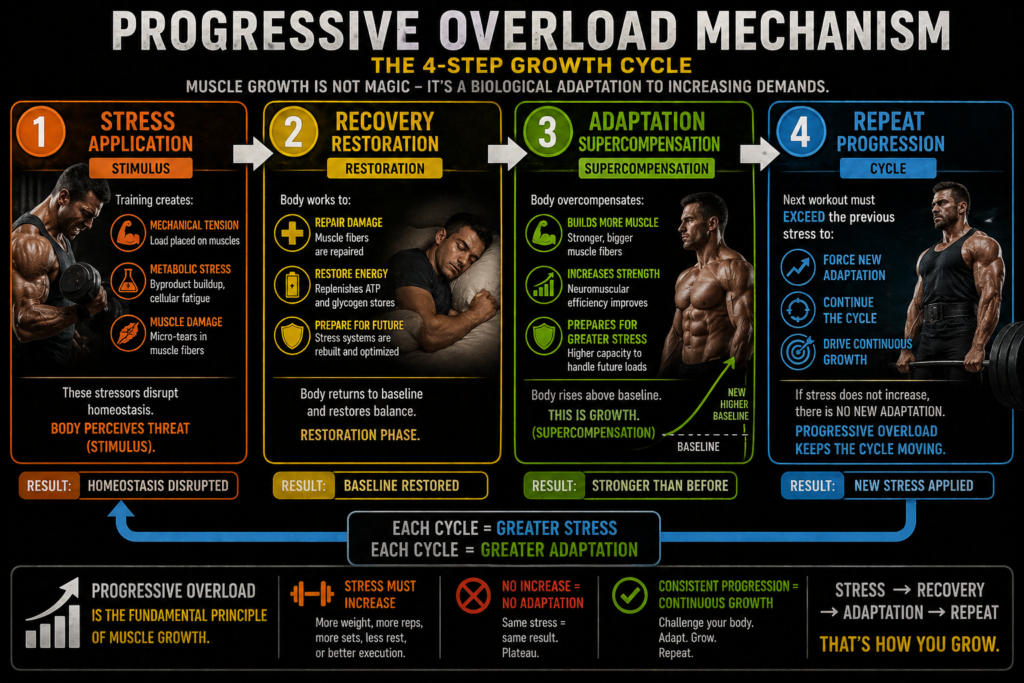
The Scientific Definition
What it is:
- Systematic increase in training stress over time
- Forces body to adapt
- Adaptation = bigger, stronger muscles
- The growth mechanism
The principle:
- Stress → Recovery → Adaptation → Repeat with greater stress
- Each cycle, stress must increase
- Otherwise, no new adaptation needed
- Progressive stimulus
The discovery:
- Milo of Croton (ancient Greece)
- Carried calf daily as it grew
- Progressive increase in load
- Built legendary strength
- Ancient principle
The modern research:
- Hans Selye’s General Adaptation Syndrome
- DeLorme’s progressive resistance exercise (1940s)
- Decades of subsequent research
- Scientific validation
The mechanism:
Step 1: Stress application
- Training creates mechanical tension, metabolic stress, muscle damage
- Disrupts homeostasis
- Body perceives as threat
- Stimulus
Step 2: Recovery
- Body repairs damage
- Restores energy systems
- Prepares for potential future stress
- Restoration
Step 3: Adaptation (supercompensation)
- Body overcompensates
- Builds slightly more muscle, strength
- Prepares for greater stress
- Growth
Step 4: Repeat with progression
- Next workout must exceed previous
- Forces new adaptation
- Continuous growth
- Progressive cycle
The necessity:
- Without progression, adaptation stops
- Body already adapted to current stimulus
- Maintenance, not growth
- Plateaus without progression
What Progressive Overload Is NOT
Misconception 1: Just adding weight
- Progressive overload often means more weight
- But not always
- Multiple progression methods
- Weight is one tool
Misconception 2: Linear progression forever
- Can’t add weight every session indefinitely
- Eventually requires periodization
- Strategic progression strategies
- Complexity increases
Misconception 3: More is always better
- Progression must be sustainable
- Too much too fast = injury
- Intelligent progression required
- Strategic, not reckless
Misconception 4: Random challenge
- Doing different workout each time
- “Muscle confusion”
- No systematic progression
- Doesn’t work
- Chaos ≠ progression
Misconception 5: Soreness equals progress
- DOMS (muscle soreness) not required
- Indicates unfamiliar stimulus
- Not indicator of growth
- Can progress without soreness
- Soreness is not the goal
Why “Muscle Confusion” and Random Workouts Don’t Work
The myth of constant variety.
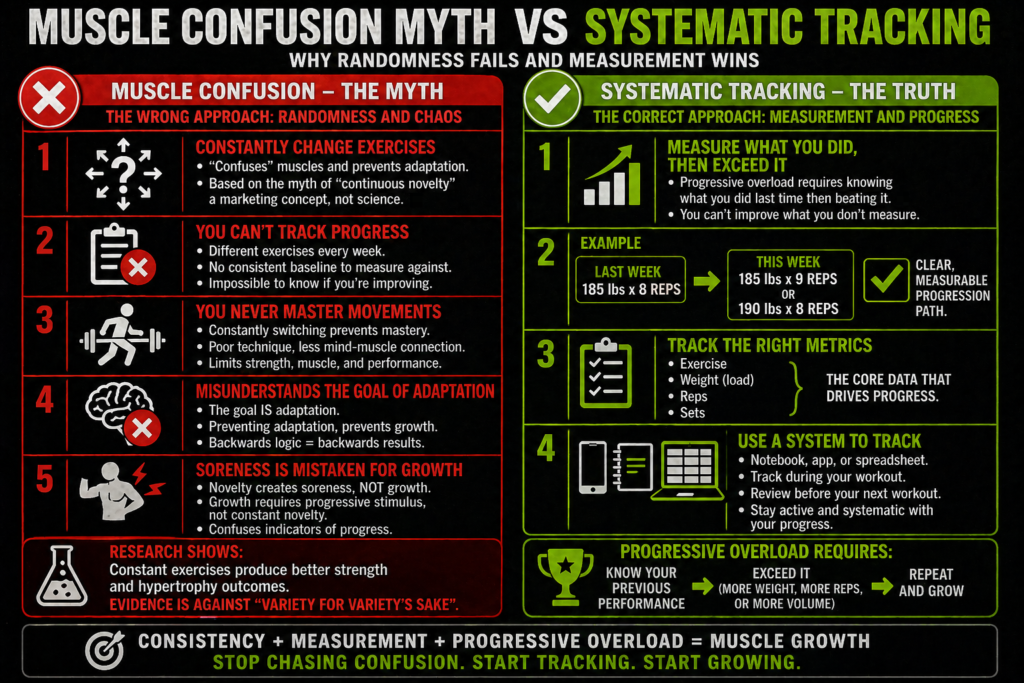
The Muscle Confusion Myth
What it claims:
- Must constantly change exercises
- “Confuse” muscles
- Prevents adaptation
- Continuous growth
- Marketing concept
Why it sounds logical:
- Body adapts to stimulus
- Different stimulus prevents full adaptation
- Continuous novelty
- Superficial logic
Why it’s wrong:
Reason 1: Can’t track progress
- Different exercises each week
- No baseline for comparison
- Can’t know if you’re stronger
- No measurement
Reason 2: Never master movements
- Takes weeks to learn proper form
- Constantly switching prevents mastery
- Poor technique limits load
- Skill interference
Reason 3: Misunderstands adaptation
- Goal IS adaptation (bigger muscles)
- Preventing adaptation prevents goal
- Want muscles to adapt
- Backwards logic
Reason 4: Soreness mistaken for growth
- Novel exercises create soreness
- Soreness feels like “working”
- But soreness ≠ growth
- Growth requires progressive stimulus
- Confusing indicators
The research:
- Studies comparing varied vs. constant exercises
- Constant exercises produce better strength and hypertrophy
- Skill development matters
- Evidence against variety
The exception:
- Some variation prevents boredom
- Addresses weaknesses
- But main exercises should be consistent
- Structured variation
Why Tracking Is Non-Negotiable
The principle:
- Can’t improve what you don’t measure
- Progressive overload requires knowing what you did
- Then exceeding it
- Measurement necessity
Without tracking:
- “I think I did 185 for 8 last week, or was it 10?”
- Guessing
- No systematic progression
- Randomness
With tracking:
- “Last week: 185 x 8”
- “This week: 185 x 9 or 190 x 8”
- Clear progression path
- Systematic progress
What to track:
Essential:
- Exercise
- Weight (load)
- Reps
- Sets
- Core metrics
Useful additions:
- Rest periods
- RPE (rate of perceived exertion)
- Notes (form, fatigue level)
- Context
The tool:
- Physical notebook (simple, reliable)
- Training app (convenient, graphs)
- Spreadsheet (customizable)
- Doesn’t matter which, just track
The 7 Methods of Progressive Overload
Multiple paths to progression.
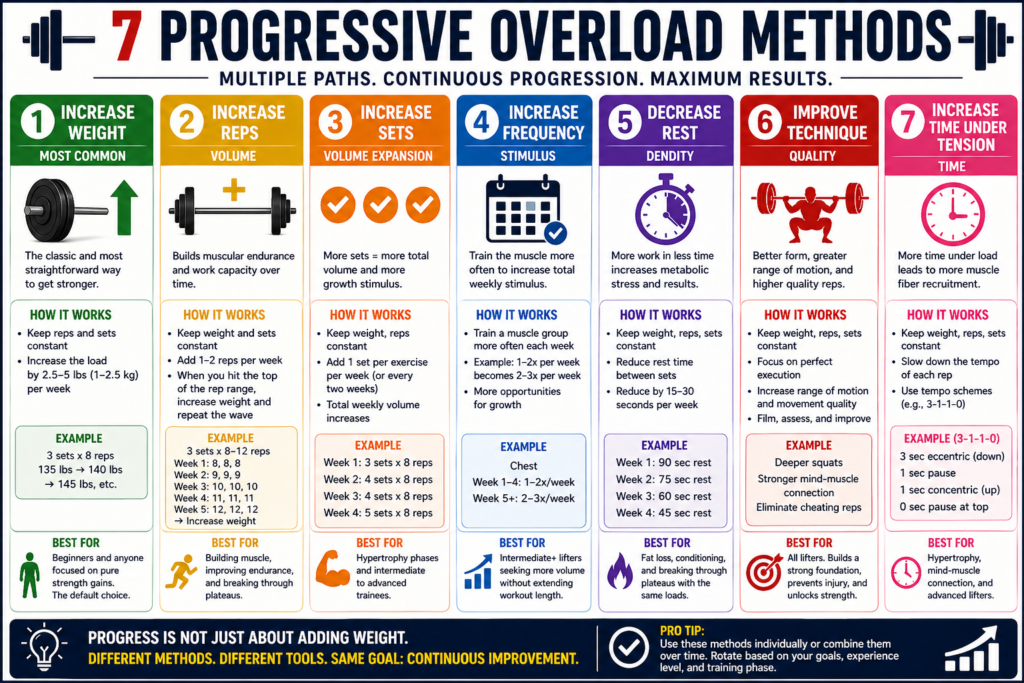
Method 1: Increase Weight (Most Common)
What it is:
- Keep reps/sets constant
- Increase load
- Most intuitive method
- Load progression
Example:
- Week 1: 100 lbs x 10 reps x 3 sets
- Week 2: 105 lbs x 10 reps x 3 sets
- Week 3: 110 lbs x 10 reps x 3 sets
- Linear weight increase
Pros:
- Simple and clear
- Easy to track
- Direct strength increase
- Straightforward
Cons:
- Can’t progress forever linearly
- Eventually stalls
- Not always possible (injury, technique breakdown)
- Limited longevity
Best for:
- Beginners
- Compound movements
- Lower rep ranges (3-8 reps)
- Foundation phase
Progression rate:
- Beginners: 2.5-5 lbs per week on compounds
- Intermediates: 2.5-5 lbs per 2-4 weeks
- Advanced: 2.5-5 lbs per month or longer
- Slows with experience
When to use:
- Primary method when possible
- Until you can’t add weight anymore
- Then switch to other methods
- Default approach
Method 2: Increase Reps
What it is:
- Keep weight constant
- Increase repetitions
- Build work capacity
- Volume progression
Example:
- Week 1: 200 lbs x 8 reps x 3 sets
- Week 2: 200 lbs x 9 reps x 3 sets
- Week 3: 200 lbs x 10 reps x 3 sets
- Week 4: Increase weight, drop back to 8 reps
- Rep accumulation
Pros:
- Safer than always adding weight
- Builds muscular endurance
- Prepares for weight jump
- Progressive preparation
Cons:
- High reps eventually less effective for strength
- Can take many weeks per weight increase
- Slower progression
Best for:
- Accessory movements
- Higher rep ranges (8-15)
- When weight jumps feel too big
- Hypertrophy focus
Progression rate:
- Add 1-2 reps per week
- Once you hit top of range, increase weight
- Gradual accumulation
The cycle:
- Start at bottom of rep range with new weight
- Progress reps each week
- Once top of range reached, add weight
- Repeat cycle
- Wave progression
Method 3: Increase Sets (Volume Progression)
What it is:
- Keep weight and reps constant
- Increase number of sets
- Total volume increases
- Set accumulation
Example:
- Week 1: 150 lbs x 10 reps x 3 sets = 4,500 lbs volume
- Week 2: 150 lbs x 10 reps x 4 sets = 6,000 lbs volume
- Week 3: 150 lbs x 10 reps x 5 sets = 7,500 lbs volume
- Volume increase
Pros:
- Effective for hypertrophy
- Total work increases
- Can be done when weight/reps stuck
- Volume driver
Cons:
- More time per workout
- Recovery demands increase
- Diminishing returns after ~10 sets per muscle per session
- Time and recovery cost
Best for:
- Hypertrophy phases
- When weight and reps can’t progress
- Building work capacity
- Volume prioritization
Progression rate:
- Add 1 set per week or per 2 weeks
- Maximum practical: 6-8 sets per exercise
- Gradual set addition
Important:
- Don’t add sets indefinitely
- Eventually switch to weight/rep progression
- Or introduce new exercise
- Strategic application
Method 4: Increase Frequency
What it is:
- Train muscle group more often
- More weekly stimulus
- Increased total volume
- Frequency increase
Example:
- Month 1: Train chest 1x per week
- Month 2: Train chest 2x per week
- Same volume per session, double weekly volume
- Doubled frequency
Pros:
- More opportunities to stimulate growth
- Better for skill development
- Faster progress potential
- Multiple stimulus events
Cons:
- Recovery must support
- Requires program restructuring
- More gym time
- Logistical complexity
Best for:
- Intermediate to advanced
- Lagging body parts
- When time permits
- Targeted development
Progression:
- Start 1-2x per week per muscle
- Progress to 2-3x per week
- Rarely need more than 3x
- Optimal frequency
Example split progression:
- Beginner: Full body 3x per week (3x frequency per muscle)
- Intermediate: Upper/Lower 4x per week (2x frequency)
- Advanced: Push/Pull/Legs 6x per week (2x frequency)
- Program evolution
Method 5: Decrease Rest Periods (Density)
What it is:
- Keep weight, reps, sets constant
- Reduce rest between sets
- More work in less time
- Work density increase
Example:
- Week 1: 185 lbs x 8 reps x 4 sets, 3 min rest = 12 min total
- Week 2: 185 lbs x 8 reps x 4 sets, 2.5 min rest = 10 min total
- Week 3: 185 lbs x 8 reps x 4 sets, 2 min rest = 8 min total
- Time compression
Pros:
- Increases metabolic stress (hypertrophy stimulus)
- Improves work capacity
- Saves time
- Efficiency gain
Cons:
- Performance may decrease initially
- Not ideal for pure strength
- Recovery between sets matters
- Trade-offs
Best for:
- Hypertrophy
- Conditioning
- Accessory work
- Metabolic emphasis
Limitations:
- Don’t reduce below what allows performance
- Compound lifts need adequate rest (2-5 min)
- Accessory work can use shorter rest (1-2 min)
- Movement-specific
Application:
- Reduce rest by 15-30 sec per week
- Stop when performance degrades
- Progressive reduction
Method 6: Improve Technique and Range of Motion
What it is:
- Keep weight, reps, sets constant
- Execute with better form
- Increase range of motion
- Quality progression
Examples:
Squat:
- Week 1: Squat to parallel
- Week 2: Squat slightly below parallel
- Week 3: Squat to full depth
- Same weight, better quality
- ROM increase
Bench press:
- Week 1: Touch chest, slight bounce
- Week 2: Touch chest, pause 1 second
- Week 3: Touch chest, pause 2 seconds
- Same weight, harder execution
- Tempo manipulation
Pros:
- Reduces injury risk (better form)
- More complete muscle development
- More difficult without adding weight
- Quality improvement
Cons:
- Subjective to measure
- Requires honest self-assessment
- May need coach feedback
- Assessment challenge
Best for:
- When form isn’t perfect yet
- Limited ROM due to mobility
- Making exercises harder without weight
- Skill development
Application:
- Film lifts regularly
- Identify technical flaws
- Systematically improve
- Progressive refinement
Method 7: Increase Time Under Tension (Tempo)
What it is:
- Keep weight, reps, sets constant
- Slow down movement
- More time muscle under load
- Tempo manipulation
Example:
- Week 1: Regular tempo (1 sec down, 1 sec up)
- Week 2: 3-1-1 tempo (3 sec down, 1 sec pause, 1 sec up)
- Week 3: 4-1-1 tempo (4 sec down, 1 sec pause, 1 sec up)
- Progressive tempo
Notation:
- 3-1-1-0 = 3 sec eccentric, 1 sec bottom, 1 sec concentric, 0 sec top
- Tempo notation
Pros:
- Increases time under tension (hypertrophy)
- Improves control
- Builds eccentric strength
- Quality emphasis
Cons:
- Less weight can be used
- Very fatiguing
- Not ideal for strength focus
- Hypertrophy tool
Best for:
- Hypertrophy phases
- Teaching control
- Rehabilitation
- Controlled emphasis
Application:
- Start with controlled tempo
- Progressively slow eccentric
- Add pauses
- Gradual tempo increase
How to Track and Measure Progress
The system for ensuring progression.
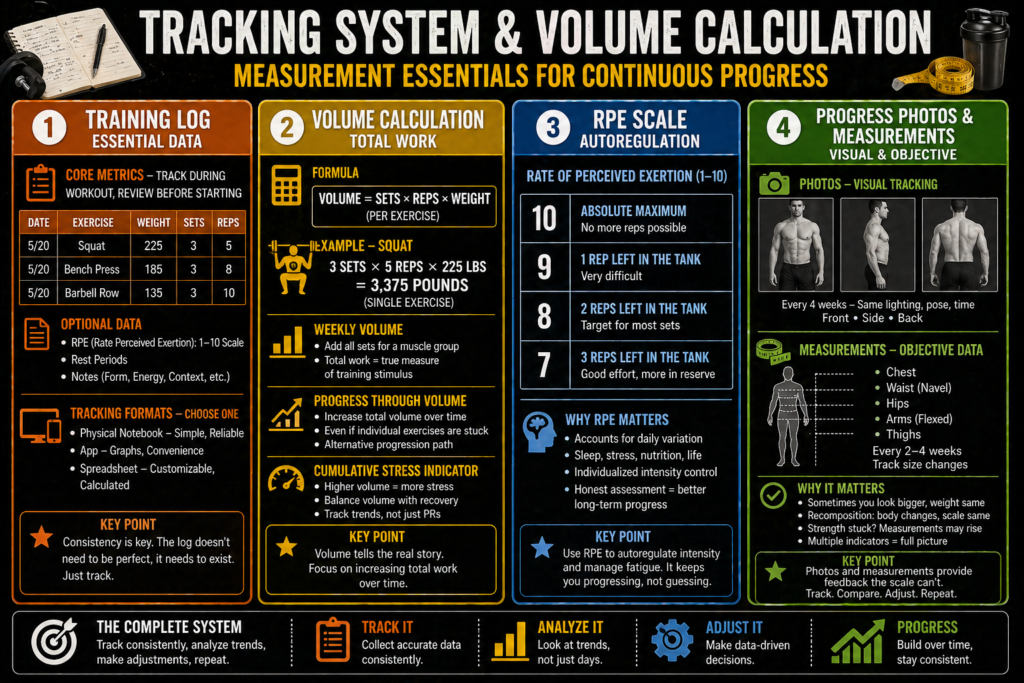
The Training Log
What to record:
Essential data:
- Date
- Exercise
- Weight
- Sets
- Reps
- Core metrics
Example entry:
Jan 15, 2026
Squat: 225 lbs x 5, 5, 5 (3 sets)
Bench: 185 lbs x 8, 7, 6 (3 sets)
Row: 135 lbs x 10, 10, 9 (3 sets)
Optional data:
- RPE (Rate of Perceived Exertion, 1-10 scale)
- Rest periods
- Notes (form, energy, sleep quality)
- Context
Example with RPE:
Squat: 225 lbs x 5, 5, 5 @ RPE 7
(Could have done 2-3 more reps)
The format:
Physical notebook:
- Pro: Simple, reliable, no battery
- Con: No automatic calculations
- Old school
Training app:
- Pro: Graphs, progress tracking, convenience
- Con: Requires phone, subscription sometimes
- Popular: Strong, Hevy, FitNotes
- Modern approach
Spreadsheet:
- Pro: Customizable, visual, calculated
- Con: Requires setup
- Middle ground
The habit:
- Log DURING workout (not after)
- Review previous session BEFORE starting
- Look for progression opportunity
- Active tracking
Calculating Total Volume
The formula:
- Volume = Sets x Reps x Weight
- Total work
Example:
- Squat: 3 sets x 5 reps x 225 lbs = 3,375 lbs
- Single exercise volume
Weekly volume:
- Add all sets for that muscle group
- Example: Chest
- Bench: 3 x 8 x 185 = 4,440 lbs
- Incline: 3 x 10 x 135 = 4,050 lbs
- Fly: 3 x 12 x 30 = 1,080 lbs
- Total chest volume: 9,570 lbs
- Weekly muscle group volume
Why track volume:
- Overall workload indicator
- Can progress volume even if individual exercises stuck
- Tracks cumulative stress
- Total work measure
Progression via volume:
- If can’t add weight or reps on individual exercise
- Can still increase weekly volume (add sets, exercises)
- Alternative progression path
Using RPE (Rate of Perceived Exertion)
The scale:
- RPE 10: Absolute maximum, no more reps possible
- RPE 9: 1 rep left in tank
- RPE 8: 2 reps left
- RPE 7: 3 reps left
- RPE 6: 4 reps left
- RPE 5 or below: Easy, many reps left
- Subjective difficulty
How to use:
- Record RPE with each set
- Adjust weight based on RPE
- Target RPE for most sets: 7-8
- Autoregulation
Progression with RPE:
- Week 1: 185 x 8 @ RPE 8
- Week 2: 185 x 8 @ RPE 7 (easier, got stronger)
- Week 3: 190 x 8 @ RPE 8 (increased weight, same difficulty)
- Progress indication
Benefits:
- Accounts for daily variation (sleep, stress, nutrition)
- More intuitive for beginners
- Prevents pushing too hard on bad days
- Individualized
Limitation:
- Subjective (requires honest assessment)
- Takes practice to calibrate
- Skill development
Progress Photos and Measurements
The visuals:
- Photos every 4 weeks
- Same lighting, same pose, same time of day
- Front, side, back
- Visual progress
Body measurements:
- Chest, waist, hips, arms, thighs
- Every 2-4 weeks
- Track size changes
- Objective dimensions
Why this matters:
- Sometimes look bigger but weight same (recomposition)
- Sometimes strength stuck but measurements increasing (hypertrophy)
- Multiple progress indicators
- Comprehensive assessment
The comparison:
- Don’t compare week to week (too variable)
- Compare month to month
- Look for trends
- Long-term view
Sample Progressive Overload Plans
Exactly what to do.
Beginner Linear Progression (Months 1-6)
The approach:
- Add weight every session when possible
- Simple and effective for beginners
- Rapid gains phase
Program example:
Day 1 (Monday):
- Squat: 3 x 5
- Bench Press: 3 x 5
- Row: 3 x 5
Day 2 (Wednesday):
- Squat: 3 x 5
- Overhead Press: 3 x 5
- Deadlift: 1 x 5
Day 3 (Friday):
- Squat: 3 x 5
- Bench Press: 3 x 5
- Row: 3 x 5
Progression:
- Every session: Add 5 lbs to squat, deadlift
- Every session: Add 2.5 lbs to bench, press, row
- Session-to-session progression
Example week 1-4:
Week 1, Day 1: Squat 135x5x3
Week 1, Day 2: Squat 140x5x3
Week 1, Day 3: Squat 145x5x3
Week 2, Day 1: Squat 150x5x3
Week 2, Day 2: Squat 155x5x3
...
When you fail:
- Miss target reps (e.g., get 5,4,3 instead of 5,5,5)
- Repeat same weight next session
- If fail again, deload 10% and build back up
- Reset and rebuild
Duration:
- Works for 3-6 months typically
- Eventually stalls
- Then move to intermediate approach
- Beginner phase
Intermediate Double Progression (Months 6-24)
The approach:
- Progress reps first, then weight
- Build up to top of rep range
- Increase weight, drop back to bottom of range
- Rep-weight cycles
Program example:
Day 1 (Monday):
- Squat: 3 x 6-8
- Bench: 3 x 8-10
- Row: 3 x 8-10
- Accessories: 3 x 12-15
Day 2 (Wednesday):
- Deadlift: 3 x 5-7
- Overhead Press: 3 x 8-10
- Chin-ups: 3 x 6-8
- Accessories: 3 x 12-15
Day 3 (Friday):
- Front Squat: 3 x 6-8
- Incline Bench: 3 x 8-10
- Face Pull: 3 x 12-15
- Accessories: 3 x 12-15
Progression example (Bench Press):
Week 1: 185 x 8, 8, 8
Week 2: 185 x 9, 8, 8
Week 3: 185 x 9, 9, 8
Week 4: 185 x 10, 9, 9
Week 5: 185 x 10, 10, 9
Week 6: 185 x 10, 10, 10 (top of range)
Week 7: 190 x 8, 8, 8 (increase weight, restart)
Volume progression:
- When weight/rep progression stalls
- Add set (3 sets → 4 sets)
- Or add exercise
- Volume manipulation
Duration:
- Works for 12-24 months
- Eventually requires more sophisticated programming
- Intermediate phase
Advanced Periodization (Year 2+)
The approach:
- Planned variation in intensity and volume
- Accumulation and intensification blocks
- Strategic deloads
- Structured complexity
Block 1: Accumulation (4-6 weeks):
- Higher volume, moderate intensity
- Goal: Build work capacity
- Example: 4 x 10 @ 70% 1RM
- Progressive overload via volume or reps
- Hypertrophy focus
Block 2: Intensification (3-4 weeks):
- Lower volume, high intensity
- Goal: Build strength
- Example: 5 x 3 @ 85% 1RM
- Progressive overload via weight
- Strength focus
Block 3: Realization (1-2 weeks):
- Very low volume, very high intensity
- Goal: Peak strength
- Example: Work up to 1-3RM
- Test maxes
- Performance peak
Block 4: Deload (1 week):
- 40-50% volume reduction
- Active recovery
- Fatigue dissipation
- Recovery
Repeat cycle:
- Each cycle, start slightly higher than previous
- Progressive overload across cycles
- Macro-progression
Why advanced need this:
- Can’t add weight every session anymore
- Need strategic variation
- Manage fatigue
- Complexity necessary
Common Progressive Overload Mistakes
What stops progress.
Mistake 1: Progressing Too Fast
What it looks like:
- Add 10+ lbs every session
- Jump from 135 to 225 in one month
- Ego-driven progression
- Unsustainable pace
Why it’s wrong:
- Form breaks down
- Injury risk skyrockets
- Can’t sustain
- Crash and burn
- Too aggressive
The consequence:
- Injury (major setback)
- Burnout
- Forced extended deload
- Regression
The fix:
- Smaller increments (2.5-5 lbs)
- Slower progression (sustainable)
- Patience
- Tortoise beats hare
Mistake 2: Changing Exercises Too Often
What it looks like:
- Different workout every session
- Constantly switching exercises
- “Muscle confusion”
- Excessive variety
Why it’s wrong:
- Can’t track progress (different baseline)
- Never master movements
- No progressive overload
- Random stimulus
The fix:
- Keep main exercises constant (3-6 months minimum)
- Track these consistently
- Progress systematically
- Variation only in accessories
- Structured consistency
Mistake 3: Not Tracking Anything
What it looks like:
- Train by feel
- Don’t write anything down
- “I think I used 185 last time”
- Memory-based training
Why it’s wrong:
- Can’t ensure progression
- No accountability
- Random workouts
- No systematic improvement
The fix:
- Start tracking TODAY
- Physical notebook or app
- Every single session
- Non-negotiable tracking
Mistake 4: Ignoring Recovery
What it looks like:
- Progress every session regardless
- Never deload
- Push through fatigue
- Recovery neglect
Why it’s wrong:
- Fatigue accumulates
- Performance decreases
- Injury risk increases
- Unsustainable
The fix:
- Scheduled deloads (every 4-8 weeks)
- Listen to body (some sessions maintain, not progress)
- Recovery is part of progress
- Strategic rest
Mistake 5: Only Focusing on Weight
What it looks like:
- Must add weight every time
- Sacrifice reps, sets, form for weight
- Ego lifting
- Single-dimension progression
Why it’s wrong:
- Eventually impossible (can’t add weight forever with good form)
- Ignores other progression methods
- Injury risk
- Limited approach
The fix:
- Use multiple progression methods
- When weight stalls, progress reps or sets
- When all stall, deload and build back
- Multi-faceted progression
The Bottom Line: Progress or Plateau
After explaining everything:
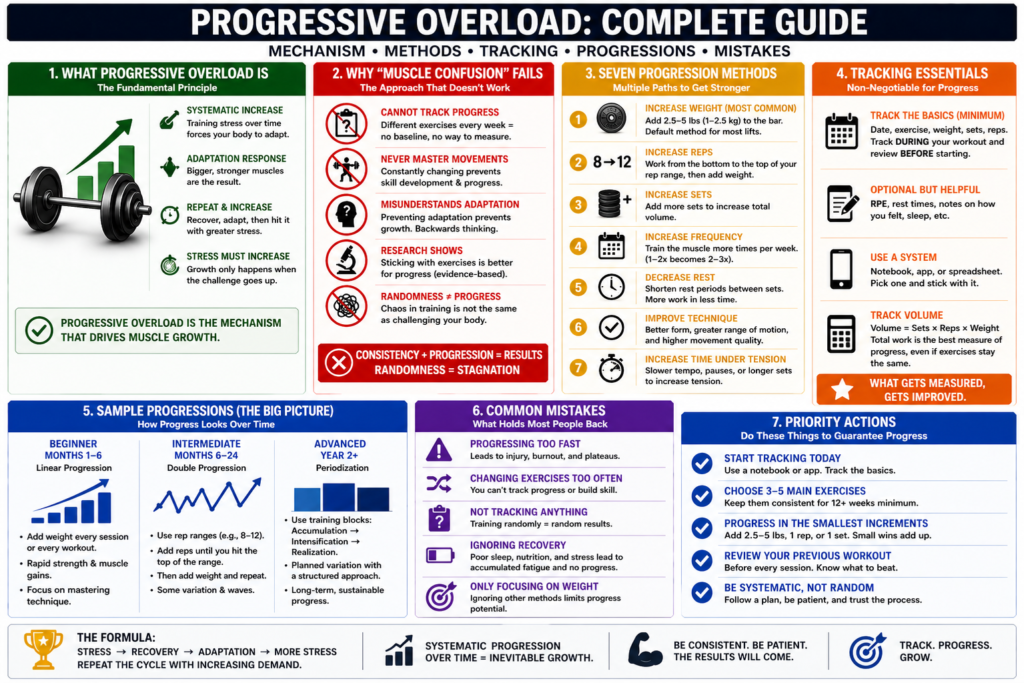
The truth about progressive overload:
✅ Progressive overload is the ONLY way to build muscle (fundamental principle)
✅ Without tracking, you’re not progressive overloading (measurement necessity)
✅ “Muscle confusion” and random workouts don’t work (chaos ≠ progress)
✅ Multiple progression methods exist beyond adding weight (7 different paths)
✅ Progression must be systematic and tracked (organized approach)
Key takeaways:
What progressive overload is:
- Systematic increase in training stress over time
- Forces body to adapt (bigger, stronger muscles)
- Stress → Recovery → Adaptation → Repeat with greater stress
- The growth mechanism
The mechanism:
- Apply stress (training)
- Body recovers
- Body adapts (supercompensation)
- Apply greater stress
- Repeat indefinitely
- Progressive cycle
Why muscle confusion fails:
- Can’t track progress (different exercises weekly)
- Never master movements (constant change)
- Misunderstands adaptation (preventing adaptation prevents growth)
- Soreness ≠ growth
- Research shows constant exercises better
- Evidence against randomness
The 7 progression methods:
Method 1: Increase weight (most common)
- Add 2.5-5 lbs when possible
- Default method
- Load progression
Method 2: Increase reps
- Progress from bottom to top of rep range
- Then add weight and repeat
- Rep accumulation
Method 3: Increase sets
- Add sets for more volume
- 1 set per week or two
- Volume expansion
Method 4: Increase frequency
- Train muscle more times per week
- 1-2x → 2-3x per week
- Frequency increase
Method 5: Decrease rest
- Reduce rest periods
- More work in less time
- Density progression
Method 6: Improve technique
- Better form, greater ROM
- Same weight, higher quality
- Quality improvement
Method 7: Increase time under tension
- Slower tempo, longer sets
- More time muscle loaded
- Tempo manipulation
Tracking essentials:
- Date, exercise, weight, sets, reps (minimum)
- Optional: RPE, rest, notes
- Physical notebook, app, or spreadsheet
- Track DURING workout
- Review previous session BEFORE starting
- Non-negotiable system
Volume calculation:
- Volume = Sets × Reps × Weight
- Track weekly volume per muscle group
- Progress total volume even if individual exercises stuck
- Total work measure
Sample progressions:
Beginner (months 1-6):
- Add weight every session (5 lbs compounds, 2.5 lbs accessories)
- Linear progression
- Rapid gains
Intermediate (months 6-24):
- Double progression (reps then weight)
- Example: 185×8,8,8 → 185×10,10,10 → 190×8,8,8
- Wave progression
Advanced (year 2+):
- Periodization (accumulation, intensification, realization blocks)
- Strategic deloads
- Macro-progression across cycles
- Structured complexity
Common mistakes:
- Progressing too fast (injury and burnout)
- Changing exercises too often (can’t track progress)
- Not tracking anything (random training)
- Ignoring recovery (accumulated fatigue)
- Only focusing on weight (limited approach)
- Pitfalls to avoid
Priority actions:
- Start tracking workouts TODAY (notebook or app)
- Choose 3-5 main exercises to keep consistent
- Progress via smallest increment possible (weight, reps, or sets)
- Review previous workout before each session
- Commit to same exercises for 12+ weeks minimum
- Begin systematic progression now
STOP DOING RANDOM WORKOUTS. START TRACKING EVERYTHING. PROGRESS SYSTEMATICALLY. GROWTH IS INEVITABLE WITH PROGRESSIVE OVERLOAD.
Ready to build a complete progressive overload system with detailed tracking protocols, multiple progression pathways, periodization strategies, and program designs that guarantee continuous muscle growth and strength gains? Understanding progressive overload is just the beginning. Get a comprehensive guide to implementing systematic progression, avoiding plateaus, programming intelligently, and achieving consistent results. Stop exercising randomly. Start progressing systematically.
REFERENCES
SECTION 1 — The foundational principle: progressive overload and the stress-adaptation model
[1] ACSM Position Stand — Medicine and Science in Sports and Exercise, 2009 Comprehensive position stand by the American College of Sports Medicine defining progressive overload as “the gradual increase in stress placed upon the body during exercise training” and establishing it as the essential driver of continued adaptation; guidelines distinguish novice, intermediate, and advanced trainees, each requiring systematically greater stimulus; for novice training the recommendation is 8 to 12 repetitions at 60 to 70% of 1RM with 2 to 3 sessions per week; advanced training requires periodized loading across multiple phases to continue forcing adaptation; the foundational clinical consensus document validating the article’s core premise that systematic progression, not random variation, is the mechanism of muscle growth https://pubmed.ncbi.nlm.nih.gov/19204579/
SECTION 2 — Volume as a driver of hypertrophy: the dose-response relationship
[2] Schoenfeld BJ, Ogborn D & Krieger JW — PubMed/Journal of Sports Science, 2017 Meta-regression of 15 studies (34 treatment groups) examining the effect of weekly resistance training volume on muscle hypertrophy; a graded dose-response relationship was found whereby higher weekly set volumes produced greater gains in muscle mass; training with more than 10 sets per muscle per week produced significantly greater hypertrophy than fewer sets; provides the empirical foundation for the article’s Method 3 (increase sets for volume progression) and validates the principle that systematically increasing total weekly training volume is a reliable progressive overload strategy producing measurable hypertrophic outcomes https://pubmed.ncbi.nlm.nih.gov/27433992/
SECTION 3 — Training frequency and hypertrophy: more weekly stimulus drives more growth
[3] Schoenfeld BJ et al. — PMC/Medicine and Science in Sports and Exercise, 2019 Randomized controlled trial (n=34) comparing resistance training volume in 1 versus 3 sets per exercise with volume equated across conditions; the higher-frequency, distributed volume condition produced significantly greater hypertrophy in the vastus lateralis (p=0.03); findings confirm that distributing the same volume across more sessions rather than concentrating it in fewer sessions enhances hypertrophic outcomes, likely due to repeated muscle protein synthesis stimulation events; validates the article’s Method 4 (increase frequency) as a legitimate and effective progressive overload strategy https://pmc.ncbi.nlm.nih.gov/articles/PMC6303131/
SECTION 4 — Practical application: periodization models and long-term progression
[4] Williams TD et al. — PMC/Sports, 2017 Systematic review comparing periodization models (linear, undulating, block) for strength and hypertrophy; periodized programs consistently produced greater strength and hypertrophy gains than non-periodized programs; linear periodization (simple weight increase over time) was most effective in novice trainees; undulating periodization (varying intensity and volume systematically) was superior in intermediate and advanced trainees, where simple linear progression plateaus; even in trained subjects, significant hypertrophic improvements were observed without complex periodization when adequate progressive overload was applied; directly validates the article’s tiered progression recommendations from beginner linear to intermediate double-progression to advanced periodization https://pmc.ncbi.nlm.nih.gov/articles/PMC5571788/
SECTION 5 — Time under tension and eccentric emphasis as progression methods
[5] Schoenfeld BJ & Grgic J — PubMed/Strength and Conditioning Journal, 2019 Review of the evidence on repetition tempo and time under tension (TUT) for muscle hypertrophy; both very slow (5 to 10 seconds per rep) and traditional tempos produce hypertrophy when sets are taken near failure; deliberately controlled eccentric (lowering) phases increase time under tension and mechanical load on muscle fibers; eccentric-focused training produces equal or greater hypertrophy compared to concentric-only training in most studies; provides the mechanistic basis for the article’s Method 7 (time under tension progression), showing that slowing the eccentric phase is a legitimate and quantifiable progressive overload tool independent of external load https://pubmed.ncbi.nlm.nih.gov/30401560/







Leave a Reply
You must be logged in to post a comment.