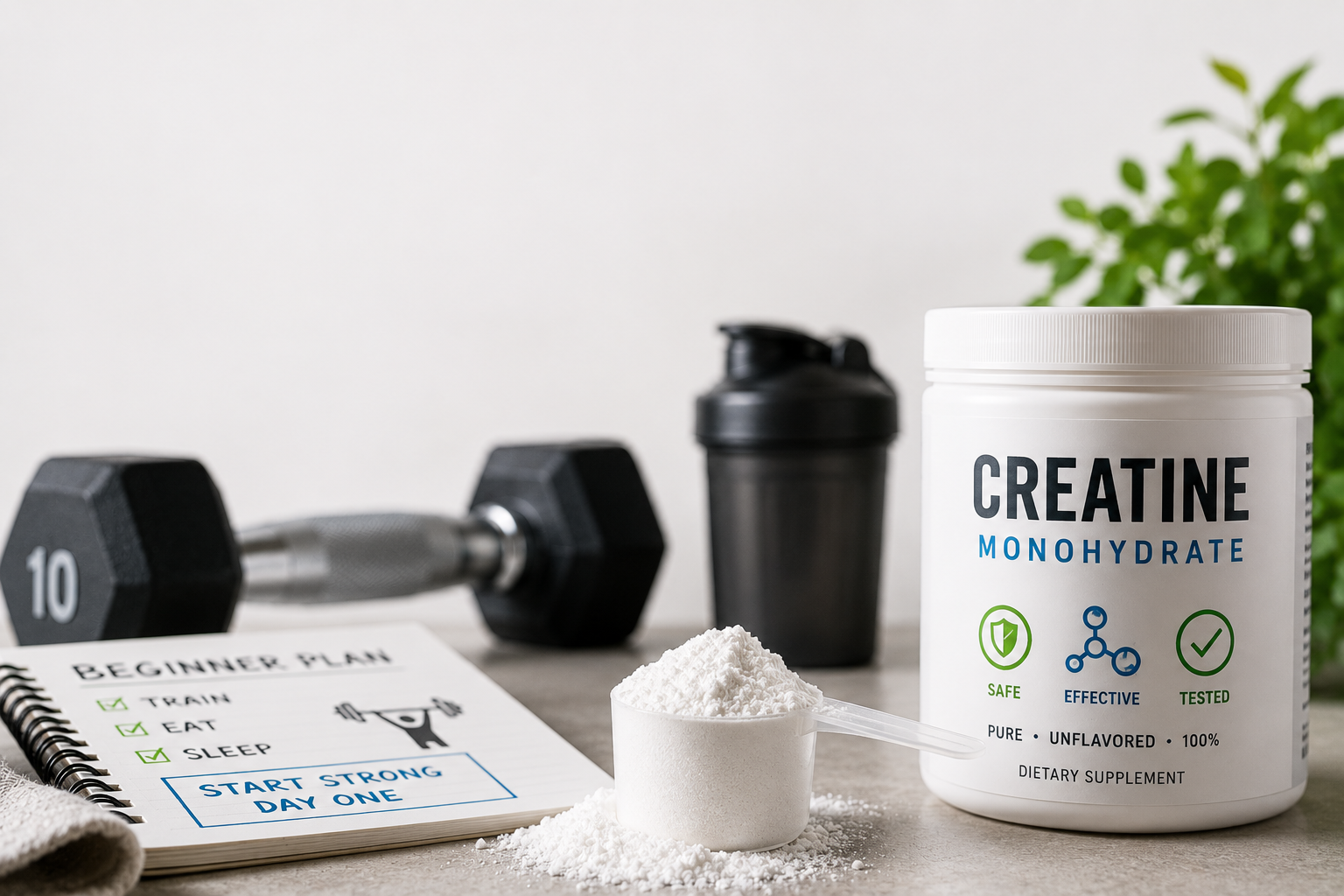
You just started going to the gym last month. You’re learning exercises, figuring out proper form, and trying to understand the basics of training and nutrition. Now you’re hearing about creatine from every direction: gym buddies, YouTube videos, fitness articles, supplement store employees. Everyone says it works. But you’re wondering: should you take creatine as a beginner, or should you wait until you’re more experienced? Is it safe for someone who just started? Will it even work if you don’t know how to train properly yet? Are you “wasting” it by taking it before you’ve built a foundation?
Creatine is one of the best supplements for muscle building. However, something that’s not always clear is whether a beginner can take creatine from day one of training and whether it’s worth it.
Can beginners take creatine? Yes, a beginner can take creatine, because the supplement will work regardless of your experience level in weight training. Creatine is the most studied dietary supplement in the world, has proven effectiveness, and is free of side effects (when used correctly).
However, to get the maximum benefit from creatine supplementation as a beginner, it’s important to know how creatine can improve your performance, which type to take, and how to take it.
For people who just started training and are confused about whether supplements are appropriate this early, who have heard mixed advice about “saving” creatine for when they’re more advanced, who are concerned about side effects from a supplement they’ve never taken, or who simply want to optimize their first year of training for maximum muscle and strength gains, understanding creatine for beginners will clarify one of the simplest decisions you’ll ever make about supplementation.
In this comprehensive guide, I’ll explain what creatine actually does in your body and how it improves training performance, three specific reasons why beginners should start creatine immediately, the safety profile of creatine backed by decades of research, why the “save it for later” advice is wrong and based on a misunderstanding, which type of creatine to buy (and why brand doesn’t matter much), exactly how beginners should take creatine including dosage and timing, the loading phase debate and whether beginners should bother, and realistic expectations for what creatine will and won’t do for a new lifter.
Whether you’re completely new to the gym and unsure about supplements, someone who has been training for a few weeks and is considering creatine, or a person who has been avoiding creatine because they thought they weren’t “ready,” this guide provides the complete answer with zero ambiguity.
Let’s examine why creatine is the first and possibly only supplement a beginner needs.
TABLE OF CONTENTS
What Creatine Actually Does (The Real Mechanism)
Before deciding whether to take creatine as a beginner, you need to understand what it actually does. Not the marketing claims. Not the gym bro science. The actual biochemistry.
The Phosphocreatine Energy System
Creatine is naturally present in your body and plays an important role in energy production, more specifically in the phosphocreatine system, which is the energy system responsible for short duration, high intensity activities like sprints, weight lifting, and throws.
How your muscles produce energy for lifting:
The ATP system (your muscle’s fuel):
- ATP (adenosine triphosphate) is the energy currency of every cell
- When you contract a muscle, ATP is broken down to release energy
- ATP becomes ADP (adenosine diphosphate) after releasing energy
- ADP is “spent” fuel, it can’t power muscle contractions
The phosphocreatine (PCr) system:
- Phosphocreatine is stored in muscle cells
- When ATP is used up, phosphocreatine donates its phosphate group to ADP
- This regenerates ADP back into ATP (fresh fuel)
- The recycled ATP can now power another muscle contraction
- This process happens in seconds (no oxygen needed)
- It’s the fastest energy system you have
The limitation:
- Your muscles store limited amounts of phosphocreatine
- During intense exercise, PCr depletes within 8 to 15 seconds
- Once PCr is depleted, this energy system can’t regenerate ATP as fast
- Your muscles fatigue, you can’t do more reps
- You have to rest while PCr is partially replenished between sets
When you’re doing a heavy set of a resistance exercise and the working muscle fatigues, in simplistic terms, one of the reasons this happens is because you’ve exhausted your creatine reserves.
What Creatine Supplementation Changes
By adding extra creatine to your muscles through supplementation, you increase your reserves and can now go further in the exercise before feeling fatigue.
The before and after comparison:
Without creatine supplementation:
- Muscle stores: Normal creatine levels
- PCr available: Baseline amount
- ATP recycling speed: Normal
- Sets fatigue at: Normal rep count
- Recovery between sets: Normal
With creatine supplementation (after saturation):
- Muscle stores: 20 to 40% more creatine
- PCr available: Significantly more
- ATP recycling speed: Faster (more PCr to donate phosphate)
- Sets fatigue at: 1 to 3 more reps before failure
- Recovery between sets: Slightly faster (PCr replenishment improved)
For example, if before taking creatine you could do bench press with 80kg for 8 repetitions, with creatine you might be able to do 12 repetitions or increase the load to 85kg for 8 repetitions.
Over time, since you’re training heavier, it’s expected that you also stimulate more muscle growth.
The mechanism is simple:
- Creatine supplementation increases phosphocreatine stores in muscles
- More phosphocreatine = more ATP regeneration during sets
- More ATP = more reps or more weight before fatigue
- More reps/weight = more training volume over time
- More training volume = more muscle growth stimulus
- More stimulus with adequate nutrition and recovery = more muscle built
This mechanism works regardless of training experience. A beginner’s muscles use the same ATP-PCr system as an advanced lifter’s muscles. Creatine doesn’t care how long you’ve been training. It enhances the same biochemical pathway in everyone.
What Creatine Does NOT Do
Clearing up misconceptions that might concern beginners:
Creatine is NOT a steroid:
- It’s a naturally occurring compound (found in meat and fish)
- Your body already produces 1 to 2g daily (liver, kidneys, pancreas)
- It’s classified as a dietary supplement, not a drug
- It doesn’t affect hormone levels (testosterone, estrogen, etc.)
- It has no relation to anabolic steroids whatsoever
Creatine does NOT work acutely:
- It’s not like caffeine (take it and feel it immediately)
- Takes 2 to 4 weeks to saturate muscle stores
- Benefits come from consistent daily use, not single doses
- Don’t expect to feel anything the first day you take it
Creatine does NOT build muscle directly:
- It doesn’t cause protein synthesis on its own
- It enhances your TRAINING by providing more energy
- The improved training creates the muscle building stimulus
- Without training, creatine does very little for muscle growth
- It’s a training enhancer, not a muscle builder
Creatine does NOT make you “big” overnight:
- Initial weight gain (1 to 3 kg) is water being pulled into muscle cells
- This is NOT fat gain and NOT actual muscle growth (yet)
- Muscles may look slightly fuller from the water
- Actual muscle building takes weeks to months of enhanced training
- The water weight is temporary and cosmetically neutral or positive
3 Reasons for a Beginner to Take Creatine
The most common reasoning for NOT taking creatine as a beginner is the idea that the supplement will be “wasted” at a time when the practitioner doesn’t yet have the experience to train correctly and won’t be able to extract the maximum from the substance.
However, creatine is a natural substance that can be used continuously. There is no need to plan a moment to use it.
Below we’ll see the most obvious reasons for a beginner to take creatine and why it’s still worthwhile.
Reason 1: Creatine Is Safe for Beginners
A recurring question regarding creatine use for beginners is about its “side effects.”
For someone not initiated in the world of bodybuilding, creatine can still be seen as an unknown and mysterious substance that may or may not be harmful.
However, taking creatine as a beginner is not a problem because there is a body of scientific evidence showing that the supplement, when used correctly, does not cause side effects in healthy individuals.
The safety evidence:
Decades of research confirming safety:
Kidney function:
- Multiple studies spanning up to 5 years of continuous use
- No adverse effects on kidney function in healthy individuals
- The “creatine damages kidneys” claim has been thoroughly debunked
- Creatinine levels rise (this is expected, not harmful)
- Actual kidney function markers (GFR, cystatin C) remain normal
Liver function:
- No evidence of liver damage from creatine supplementation
- Liver enzymes remain normal at recommended doses
- Safe even with prolonged use
Cardiovascular health:
- No negative effects on heart function
- Some evidence of potential benefits (blood pressure management)
- Safe for healthy hearts at recommended doses
General health markers:
- No negative effects on blood pressure in healthy individuals
- No negative effects on cholesterol in healthy individuals
- No dehydration risk (this myth has been disproven)
- No increased cramping risk (also disproven)
The research volume:
- Literally thousands of studies on creatine
- Hundreds of thousands of doses consumed across all studies
- One of the most extensively researched substances in sports nutrition
- Consistent finding: Safe for healthy individuals at recommended doses
When in doubt, if you have a suspicion or history of any chronic health problem, it’s always good to consult a doctor before starting to use any supplement.
Common beginner fears addressed:
“Will creatine damage my kidneys?”
- No, in healthy individuals. This myth comes from confusion between creatinine (a kidney marker that increases naturally with creatine use) and actual kidney damage. They’re not the same thing.
“Will creatine make me bloated?”
- Creatine pulls water INTO muscle cells, not under the skin. You may gain 1 to 3 kg of water weight, but you’ll look more muscular, not bloated. This is cosmetically neutral or positive.
“Will creatine cause hair loss?”
- One study showed creatine increased DHT (linked to hair loss in genetically predisposed individuals). This study has never been replicated. Evidence is very weak. If you’re genetically predisposed to hair loss, monitor and decide personally, but the evidence doesn’t support this concern strongly.
“Is creatine a drug or steroid?”
- Absolutely not. Creatine is found naturally in meat and fish. Your body makes its own creatine daily. It’s a dietary supplement, not a pharmaceutical or hormonal substance.
Reason 2: It Will Work Regardless of Experience Level
Some people argue that beginners shouldn’t take creatine until they’ve reached a level of training experience without it and results have stagnated. In other words, that creatine should only be used as a sort of “ace up your sleeve.”
However, this doesn’t make much sense because there are no disadvantages to supplementing with creatine.
The “save it for later” argument debunked:
The caffeine comparison (why “saving” creatine is wrong):
For example, if we were talking about caffeine, a substance the body acquires tolerance to and you need to ingest more to get the same effect over time, it makes sense to use it at the right moment.
But it’s not the same with creatine. There is no tolerance or window of opportunity to use creatine. In fact, you can use it continuously if you wish.
Why there’s no “right time” to start creatine:
No tolerance develops:
- Creatine works the same on day 1 as on day 1,000
- Your body doesn’t become “used to it” and require more
- The muscle stores stay saturated as long as you keep taking 5g daily
- No cycling needed, no tolerance management needed
No diminishing returns:
- The benefit is consistent and sustained
- You get the same 2 to 5% performance improvement year after year
- Unlike stimulants, the effect doesn’t wear off
- Your muscles will always use the extra phosphocreatine
No strategic timing needed:
- With caffeine: Using it too early means needing more later (tolerance)
- With creatine: Using it early means getting the benefit earlier (no cost)
- There is no scenario where starting creatine sooner is disadvantageous
- Every day without creatine is a day of slightly suboptimal training
In summary, if you start supplementing with creatine immediately, you’ll gain muscle and strength more efficiently than if you had waited. Simple as that.
The beginner gains amplifier:
Why creatine is arguably MORE valuable for beginners than advanced lifters:
Beginners make the fastest gains:
- First year of training: 15 to 25 lbs potential muscle gain
- This is the fastest growth rate you’ll ever experience
- Every rep, every set, every pound of progressive overload matters more during this period
- Creatine allows 1 to 3 extra reps per set
- Over hundreds of sets in your first year, those extra reps compound into significantly more muscle
Every advantage matters when growth is fastest:
- Advanced lifters gain 2 to 5 lbs of muscle per year
- Beginners gain 15 to 25 lbs per year
- The same 2 to 5% performance improvement from creatine
- Applied to the beginner’s faster growth rate
- Produces a larger absolute benefit for beginners
Analogy:
- 5% more interest on a $10,000 investment = $500 (beginner with rapid gains)
- 5% more interest on a $1,000 investment = $50 (advanced lifter with slow gains)
- The percentage is the same, but the beginner captures more absolute value because their growth rate is higher
Waiting to take creatine is like getting a raise but telling your employer to wait 2 years before paying you more. Why would you delay a benefit that has no downside?
Reason 3: May Reduce the Risk of Injuries
Another reason why creatine supplementation should be considered by beginners is that it may decrease the risk of injuries, precisely at a time when you may not yet be sure of what you’re doing.
Research shows that those who supplement with creatine have fewer injuries overall compared to those who train and don’t take creatine.
There are also studies showing that those who supplemented with creatine had fewer muscle cramps, strains, sprains, and total injuries than those who did not take creatine.
The injury prevention evidence:
Study: Creatine and injury rates in athletes:
- Athletes supplementing with creatine experienced fewer total injuries
- Fewer muscle cramps, fewer strains, fewer sprains
- The effect was observed across different sports and training modalities
- Potentially related to improved cellular hydration and energy availability
Why this matters specifically for beginners:
Beginners are most vulnerable to injuries because:
- Still learning proper exercise technique
- Haven’t developed mind muscle connection
- May use too much weight before ready
- Joint and connective tissue not yet adapted to training loads
- More likely to make form mistakes under fatigue
How creatine might help:
- Better cellular hydration in muscles (may protect against strains)
- More ATP available for muscle contraction (less fatigue, better form maintenance)
- Improved phosphocreatine recovery between sets (less accumulated fatigue)
- Potential connective tissue support (preliminary evidence)
It’s not clear why creatine can help avoid injuries and more research is needed before we can conclusively state that creatine supplementation decreases injury risk.
However, the preliminary results don’t lie and injury prevention is something of extreme importance for beginners who may end up getting hurt from not receiving proper instruction.
Even if the injury prevention benefit is modest, combined with the zero downside of creatine supplementation, it’s another reason to start from day one.
Which Creatine Is Best for Beginners?
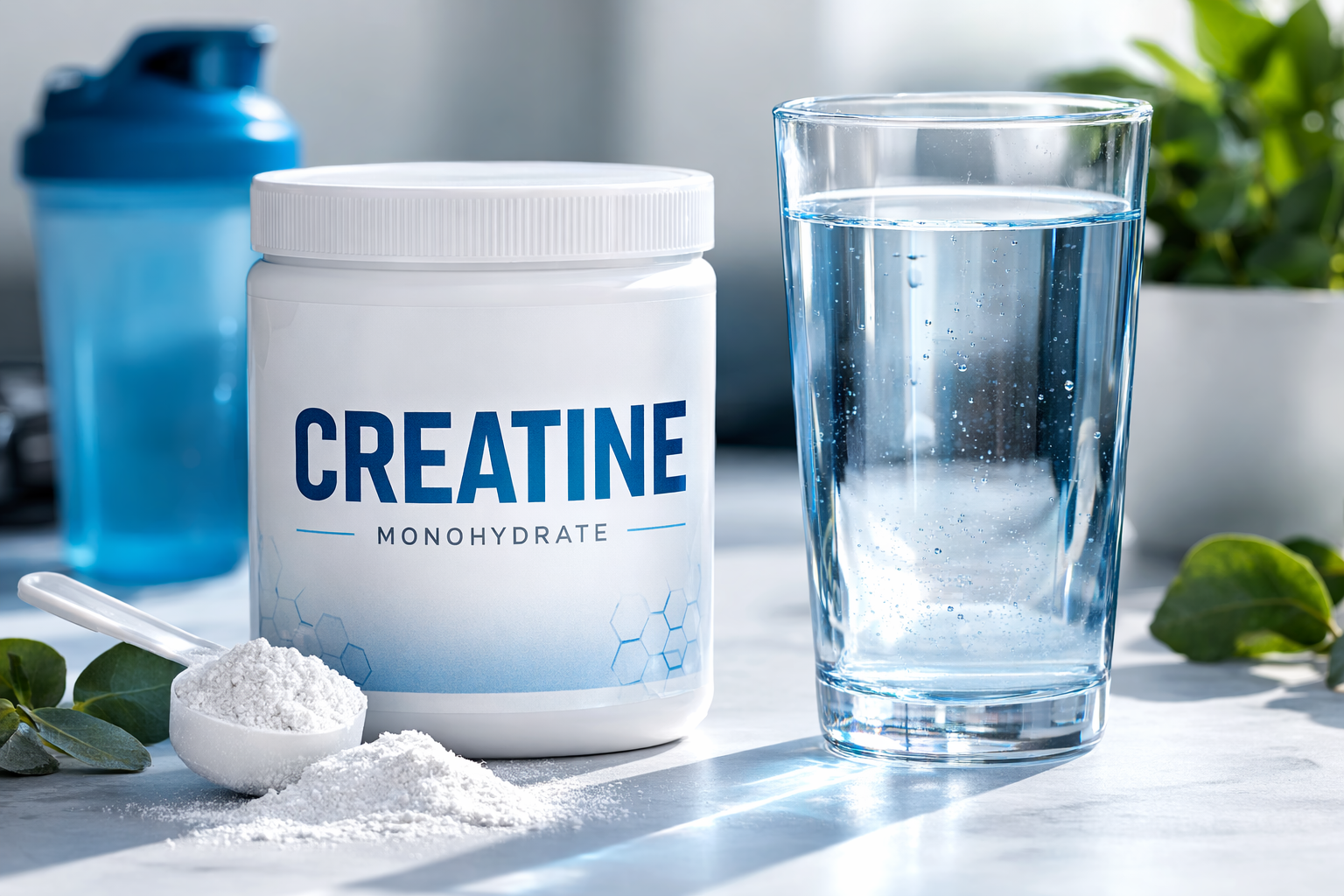
Although there are many different types of creatine on the market, creatine monohydrate has proven to be the most effective for muscle building, and this doesn’t change depending on the supplement brand. If we’re talking about real creatine, then it will work (regardless of the brand).
Why Creatine Monohydrate Is the Only Type You Need
There are claims that other types of creatine on the market are better than creatine monohydrate because they’re formulated in a way that makes them more soluble. However, there isn’t sufficient research to support that greater solubility improves the absorption or benefits of these other types of creatine.
Types of creatine on the market:
Creatine monohydrate (the gold standard):
- Most researched form (thousands of studies)
- Most evidence for effectiveness
- Cheapest per serving
- Proven to work consistently
- Available everywhere
- This is the only type you need
Creatine HCL (hydrochloride):
- Marketed as “more soluble” and “better absorbed”
- More expensive than monohydrate
- Less research supporting its effectiveness
- Solubility doesn’t equal better absorption
- No proven advantage over monohydrate
- Save your money
Creatine ethyl ester:
- Marketed as “better absorbed”
- Research actually shows it may be LESS effective than monohydrate
- Converts to creatinine (waste product) faster
- More expensive
- Worse than monohydrate by most measures
Buffered creatine (Kre-Alkalyn):
- Marketed as “pH buffered” and “no loading needed”
- Studies show no advantage over monohydrate
- Significantly more expensive
- Same results, higher price
- Not worth the premium
Micronized creatine monohydrate:
- Just monohydrate ground into finer particles
- Mixes slightly better in water (less gritty)
- Same effectiveness as regular monohydrate
- Slightly more expensive but not dramatically
- Fine if you prefer smoother mixing, but unnecessary
In other words, creatine monohydrate is the best for beginners and the best brand is the one that provides real creatine at the best price for your budget.
How to Choose a Creatine Product
Simple buying guide for beginners:
What to look for:
- Label says “creatine monohydrate” (not a blend or proprietary formula)
- 5g per serving (standard dose)
- No unnecessary additives (flavoring, coloring, other supplements mixed in)
- Reasonable price (creatine is cheap, don’t overpay for fancy packaging)
- From a recognizable brand (basic quality assurance)
What to avoid:
- Products that blend creatine with stimulants (separate your supplements)
- Proprietary blends that don’t disclose creatine amount
- Products that claim to be “10x more effective” (marketing, not science)
- Extremely cheap products from unknown brands (quality concerns)
- Products with 15 added ingredients (you want pure creatine, not a cocktail)
Price expectation:
- 500g of creatine monohydrate (100 servings): $15 to $25
- Lasts approximately 3.3 months at 5g daily
- Monthly cost: $5 to $8
- One of the cheapest supplements per serving available
- Cost should never be a barrier to creatine use
How Beginners Should Take Creatine
Beginners can choose to take creatine in capsule or powder form, based on personal preference, as there is no significant difference between the two delivery forms, as long as the type of creatine and dosage remain the same.
The Daily Dose
Beginners should take creatine daily to get the best results, and generally 5 grams per day is a sufficient dosage.
The dosing protocol:
Daily maintenance dose: 5 grams (1 teaspoon or 1 scoop)
- Take every day (training days AND rest days)
- Consistency matters more than timing
- Muscles need to stay saturated continuously
- Missing occasional days is fine (stores deplete slowly)
- Missing multiple days in a row reduces effectiveness
Why 5 grams is the standard:
- Research consistently shows 3 to 5g daily maintains saturation
- Below 3g may not fully maintain stores in larger individuals
- Above 5g provides no additional benefit (excess is excreted)
- 5g is the safe, effective dose that works for virtually everyone
- No need to adjust based on body weight for most people (though very large individuals 220+ lbs may benefit from 7 to 10g)
When to Take It
Timing is not critical for creatine:
Unlike pre workout stimulants, creatine doesn’t need to be timed precisely:
- It works through saturation (keeping muscle stores full over weeks)
- Taking it at 7 AM or 7 PM produces the same effect
- The time of day doesn’t change how much reaches your muscles
- Consistency of daily intake matters infinitely more than timing
Practical timing suggestions (for convenience, not effectiveness):
Option 1: With morning coffee or breakfast
- Mix into coffee, juice, or water
- Take alongside breakfast
- Easy to remember (part of morning routine)
- Habit stacking: “After I pour my coffee, I take my creatine”
Option 2: In your post workout shake
- Mix with protein shake after training
- Easy to remember (linked to training)
- Some evidence suggesting slightly better uptake with carbs and protein post workout
- But the difference is minimal
Option 3: Any consistent time
- Whatever time you’ll remember most reliably
- Consistency trumps timing every time
- Set a daily alarm if needed
- The best time to take creatine is the time you’ll actually take it
The Loading Phase Debate
As a beginner, you can choose to do a loading phase, where you take larger doses of creatine (20 grams per day) for 5 to 7 days to saturate your creatine reserves at a faster rate, but this doesn’t increase the effects of creatine, it only accelerates the appearance of benefits.
Loading vs no loading:
Loading phase (optional):
- 20g per day (split into 4 doses of 5g throughout the day)
- Duration: 5 to 7 days
- Then transition to 5g daily maintenance
- Saturates muscle stores in approximately 1 week
- Reaches full effectiveness faster
No loading (standard approach):
- 5g per day from day one
- Saturates muscle stores in approximately 3 to 4 weeks
- Same endpoint as loading, just takes longer
- Simpler, no complicated dosing schedule
- No GI discomfort from large doses
The comparison:
Week 1:
- Loading: Already saturated, beginning to feel benefits
- No loading: Partially saturated, building up
Week 4:
- Loading: Fully saturated (has been for 3 weeks)
- No loading: Fully saturated (just reached this point)
Week 5 onward:
- Both: Identical. Same saturation, same benefits, same performance.
The 3 week difference is the only trade off. Loading gets you there faster. Not loading gets you there with less hassle. Both arrive at the same destination.
Recommendation for beginners:
- Skip the loading phase
- Just take 5g daily from day one
- Simpler to follow
- No stomach discomfort from 20g doses
- You’ll be saturated within a month regardless
- One less thing to complicate your introduction to supplements
Powder vs Capsules
Both work identically. Choose based on preference:
Powder:
- Cheaper per serving (usually)
- Can mix into any liquid
- Requires measuring (scoop provided)
- Slightly less convenient for travel
- Available in unflavored (tasteless) or flavored versions
Capsules:
- Slightly more expensive
- More convenient (just swallow with water)
- Pre measured (no scooping needed)
- Easy for travel
- May need to take 3 to 5 capsules to reach 5g (depends on capsule size)
- Some people don’t like swallowing multiple capsules
For most beginners: Powder is the better value and most popular choice. Unflavored creatine monohydrate powder is virtually tasteless in water or other beverages.
What to Expect When You Start Taking Creatine
The First 2 Weeks
Week 1:
- Probably notice nothing performance wise (stores still building)
- May notice 0.5 to 1 kg weight gain (water being pulled into muscles)
- Don’t mistake water weight for fat gain (it’s not)
- Continue training normally
- Don’t expect to feel a “kick” like caffeine
Week 2:
- Stores continuing to build
- May notice muscles look slightly fuller (water in muscle cells)
- Perhaps starting to notice marginal performance improvement
- Still early, be patient
Weeks 3 to 4
When benefits become noticeable:
- Muscle stores approaching saturation
- May notice 1 to 2 extra reps on heavy sets
- May feel slightly stronger on compound lifts
- Recovery between sets may feel slightly faster
- Weight has stabilized (initial water gain leveled off)
- Training sessions may feel slightly more productive overall
Month 2 and Beyond
When the compound effect kicks in:
- Fully saturated, benefits consistent
- The 1 to 2 extra reps per set are compounding over weeks of training
- More total volume = more progressive overload
- More progressive overload = more muscle growth stimulus
- Starting to see measurable differences in strength and potentially size
- These improvements are FROM the enhanced training, not from creatine directly
Realistic Expectations
What creatine WILL do for a beginner:
- Increase training performance by 2 to 5% (consistent, modest improvement)
- Allow 1 to 3 extra reps per set on heavy exercises
- Improve recovery between sets slightly
- Increase total training volume over weeks and months
- Result in slightly more muscle gain over time compared to training without creatine
- Cause 1 to 3 kg of water weight gain (cosmetically neutral or positive)
What creatine will NOT do for a beginner:
- Transform your physique overnight
- Replace proper training (you still need to train hard and consistently)
- Replace proper nutrition (you still need adequate protein and calories)
- Make you look like a fitness model within weeks
- Cause dramatic, immediately visible muscle growth
- Work without consistent training (the benefit is THROUGH better training)
The honest perspective:
- Creatine is real and effective
- But it’s a 2 to 5% improvement, not a 50% improvement
- Over 12 months of consistent use with good training: Maybe 2 to 4 extra lbs of muscle compared to training without creatine
- That’s meaningful but not life changing from creatine alone
- The real results come from the training and nutrition. Creatine is the cherry on top.
Common Beginner Questions About Creatine
“Should I Take Creatine on Rest Days?”
Yes. Creatine works through maintaining saturated muscle stores, not through acute dosing. If you only take creatine on training days, your stores will fluctuate and never reach full saturation. Take 5g every day regardless of whether you train that day.
“Can I Mix Creatine With My Protein Shake?”
Yes. Creatine can be mixed with virtually anything: water, juice, protein shakes, coffee, smoothies, yogurt, oatmeal. It doesn’t interact negatively with any food or beverage. Choose whatever makes it easiest for you to take consistently.
“Do I Need to Drink More Water When Taking Creatine?”
Drinking adequate water is always important, but creatine doesn’t create a special hydration requirement. The old advice to “drink extra water with creatine to protect your kidneys” is based on debunked concerns. Just drink water normally throughout the day as you always should. 8 to 10 glasses daily is sufficient for most people. If you’re training intensely, you may need more, but that’s true regardless of creatine use.
“Will Creatine Make Me Look Bloated?”
No. Creatine pulls water into MUSCLE CELLS (intracellular), not under the skin (subcutaneous). If anything, this makes muscles look slightly fuller and more defined, not bloated. The 1 to 3 kg weight gain is water stored inside your muscles, which is cosmetically positive or neutral. You won’t look puffy or swollen.
“What Happens If I Stop Taking Creatine?”
Your muscle creatine stores will gradually return to baseline over 4 to 6 weeks. The performance benefit will slowly fade. The water weight will leave the muscles (you’ll lose 1 to 3 kg on the scale). But any MUSCLE you built through enhanced training will remain (as long as you keep training and eating properly). The muscle was built by your training, creatine just helped you train slightly better. The muscle doesn’t disappear because the creatine left.
“Can I Take Creatine With Other Supplements?”
Yes. Creatine doesn’t interact negatively with any common supplements. It’s safe to take alongside whey protein, multivitamins, omega-3, vitamin D, caffeine (despite one debunked myth about interaction), and any other standard supplement. No special timing or separation needed.
“Is Creatine Only for Men?”
No. Creatine works identically in women. The phosphocreatine energy system is the same regardless of sex. Women benefit from the same 2 to 5% performance improvement. The water weight gain may be slightly less in women (lower muscle mass = less total water stored). Creatine is safe and effective for both men and women.
Conclusion
There is no plausible reason for beginners to avoid creatine. Using creatine sooner will bring results sooner than expected. Simple as that.
The only caveat is understanding that using creatine is not mandatory. You can simply choose not to use creatine, which is an individual choice and won’t make an ocean of difference in your results.
The decision simplified:
Take creatine if:
- You want to optimize your training performance from day one
- You’re comfortable with a safe, well researched supplement
- You can afford $5 to $8 per month
- You want every available advantage during your fastest growth period
Don’t take creatine if:
- You prefer not to take any supplements (personal choice, valid)
- You have a medical condition affecting kidneys (consult doctor first)
- The cost is genuinely problematic for your budget (prioritize food instead)
- You simply don’t want to (no one is forcing you)
If you decide to take it:
- Buy creatine monohydrate (cheapest, most effective)
- Take 5g daily (every day, training and rest days)
- Mix with whatever you want (water, shake, coffee)
- Be consistent (daily, not occasionally)
- Be patient (full benefits in 3 to 4 weeks)
- Continue indefinitely (no cycling needed)
- That’s the entire protocol. It’s that simple.
THE BOTTOM LINE: CREATINE FOR BEGINNERS
✅ Beginners Can And Should Take Creatine From Day One (It Works Regardless Of Experience Level)
✅ Creatine Is The Most Studied Supplement In The World (Proven Safe And Effective)
✅ No Need To “Save It For Later” (No Tolerance, No Diminishing Returns, No Strategic Timing)
✅ Creatine Monohydrate Is The Only Type You Need (Cheapest And Most Researched)
✅ 5 Grams Daily Is The Complete Protocol (No Loading Required, Any Time Of Day)
✅ May Reduce Injury Risk (Especially Valuable For Beginners Still Learning Form)
3 Reasons Beginners Should Take Creatine:
- It’s Safe: • Thousands of studies confirming safety • No kidney damage in healthy individuals • No liver damage at recommended doses • No side effects when used correctly (5g daily) • Debunked myths: No dehydration, no cramping, no bloating
- It Works Regardless Of Experience: • The phosphocreatine system works the same in beginners and advanced lifters • No tolerance develops (works the same on day 1 and day 1,000) • No reason to wait (every day without creatine is slightly suboptimal training) • Beginner gains are fastest, so every advantage matters MORE during this period • Starting sooner means more total benefit captured over your training career
- May Reduce Injury Risk: • Research shows fewer total injuries in creatine users • Fewer cramps, strains, and sprains • Especially valuable when still learning proper form • Mechanism not fully understood but evidence is promising • Zero downside combined with potential injury prevention
Practical Guide:
What To Buy: • Creatine monohydrate (any reputable brand) • Powder or capsules (your preference) • Don’t overpay for fancy types (HCL, ethyl ester, buffered) • Budget: $15 to $25 for 100 servings (3+ months supply)
How To Take It: • 5 grams daily (every day, including rest days) • Mix with any liquid (water, juice, shake, coffee) • Take at any consistent time (timing doesn’t matter) • No loading phase needed (just start with 5g daily) • Continue indefinitely (no cycling, no breaks needed)
What To Expect: • Week 1 to 2: 1 to 3 kg water weight gain, minimal performance change • Week 3 to 4: Benefits becoming noticeable (1 to 2 extra reps per set) • Month 2+: Consistent performance enhancement, training volume accumulating • Long term: 2 to 5% better training performance, translating to more muscle over months and years
What NOT To Expect: • Overnight transformation (not how it works) • Dramatic immediate strength gains (it’s a 2 to 5% improvement, not 50%) • Muscle growth without training (creatine enhances training, doesn’t replace it) • Results without proper nutrition (still need adequate protein and calories)
CREATINE IS THE SINGLE BEST SUPPLEMENT A BEGINNER CAN TAKE. IT’S SAFE. IT’S EFFECTIVE. IT’S CHEAP. IT WORKS FROM DAY ONE REGARDLESS OF YOUR EXPERIENCE LEVEL. THERE IS NO REASON TO WAIT AND NO ADVANTAGE TO DELAYING. BUY CREATINE MONOHYDRATE. TAKE 5 GRAMS DAILY. TRAIN CONSISTENTLY. EAT ENOUGH PROTEIN. THE REST TAKES CARE OF ITSELF.
Ready To Build A Complete Supplementation And Training System For Your First Year In The Gym? Understanding creatine is one piece of setting yourself up for maximum beginner gains. Get a comprehensive system covering the only supplements worth your money as a beginner (hint: the list is very short), training programs designed specifically for new lifters to maximize beginner gains, nutrition fundamentals that don’t require a degree in dietetics, progressive overload strategies that work from day one, and realistic timelines for what to expect in your first 12 months. Stop overthinking your start. The best time to begin was yesterday. The second best time is today. Take the creatine, follow the program, eat the protein, and watch what happens.


Leave a Reply
You must be logged in to post a comment.