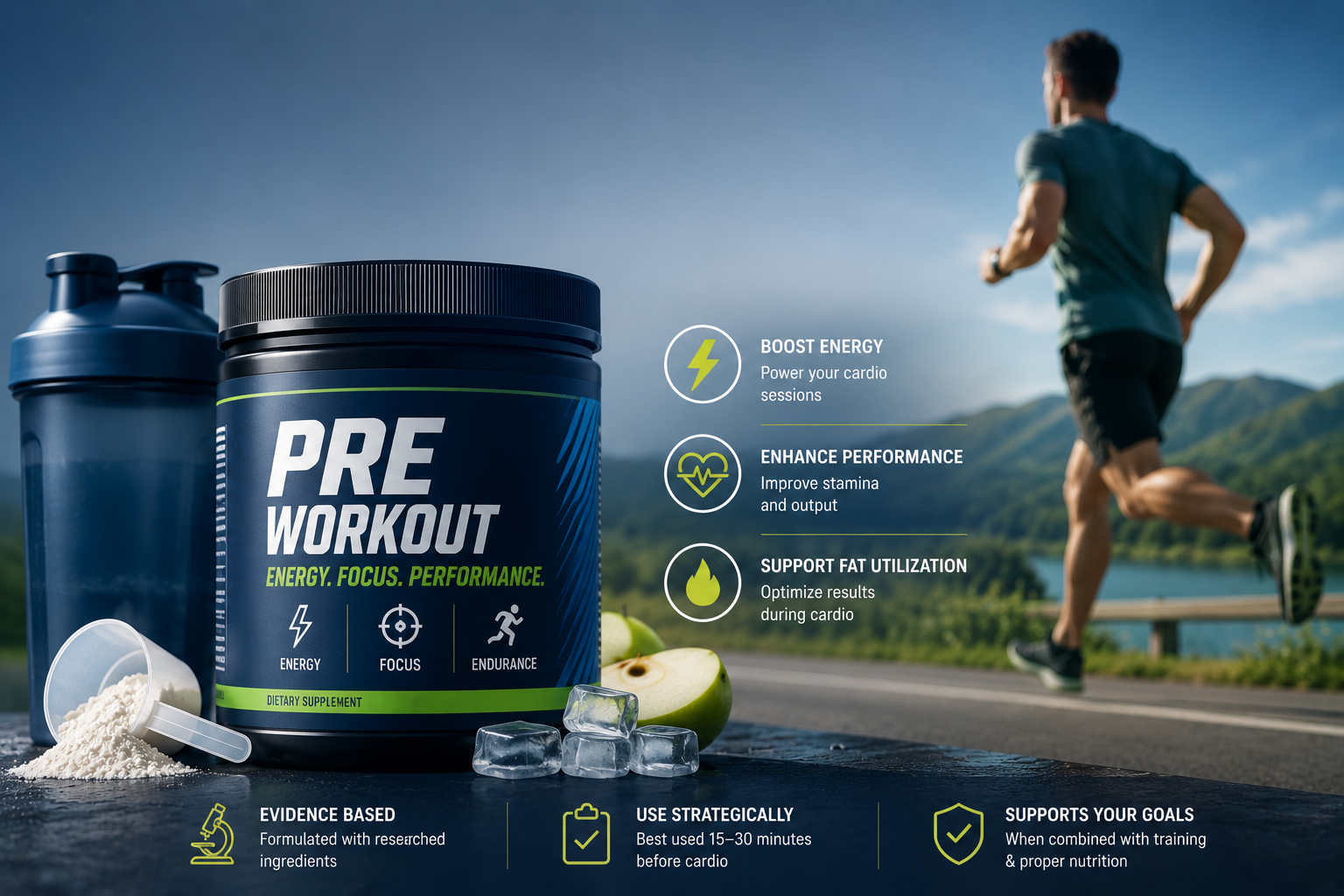
You’re standing in your kitchen at 5:30 AM, staring at your pre-workout container. You have a 45-minute HIIT session or a 5-mile run planned, and you’re wondering: is pre-workout just for lifting weights, or will it actually help with cardio? Will the energy boost translate to better running performance, or are you just wasting money and risking jitters during your workout?
Pre-workouts are popular for a good reason they work. Pre-workouts provide a push to train harder and longer. However, you might be surprised to discover that using pre-workout for cardio can be useful for bringing better results.
So, can you use pre-workout for cardio? Yes, using pre-workout for cardio can increase your energy levels, resistance to fatigue, and even facilitate the use of fat as an energy source.
For people doing both resistance training and cardio, or athletes focused primarily on endurance activities, understanding how pre-workout supplements affect aerobic performance can unlock better training sessions, faster fat loss, and improved cardiovascular adaptations. Many athletes assume pre-workout is only beneficial for lifting heavy weights when research clearly shows advantages for cardio as well.
In this comprehensive guide, I’ll explain what pre-workout supplements actually do and how they work, whether it’s worth taking pre-workout before cardio (and what the research says), how to properly take pre-workout before different types of cardio, the specific benefits for fat burning and endurance, potential side effects and who should avoid pre-workout for cardio, and optimal dosing strategies to maximize benefits while minimizing tolerance.
Whether you’re doing HIIT workouts, long-distance running, cycling, sports training, or any aerobic activity, understanding how to leverage pre-workout supplements can significantly enhance your performance and results.
Let’s examine everything you need to know about pre-workout and cardio.
Key Points to Understand First
Before diving into the details, here are the fundamental truths about pre-workout for cardio:
Pre-workouts are designed to be taken before training and “training” is not synonymous with weightlifting only. Basically, any physical activity that requires training can benefit from pre-workout use.
Yes, it’s worth using pre-workout for cardio, whether for running, sports with aerobic nature, or HIIT training sessions. The energy-boosting and fatigue-reducing properties transfer directly to aerobic activities.
Since pre-workouts increase energy levels, among other benefits, there’s no reason these characteristics wouldn’t transfer to aerobic activities. In fact, research supports pre-workout use for cardio.
Some pre-workout ingredients, like caffeine, can facilitate the use of fat as an energy source, increasing your potential to burn fat during cardio even if this isn’t your primary goal.
Most traditional pre-workouts containing caffeine should be taken at least 30-60 minutes before activity, regardless of whether it’s resistance training or cardio, to allow proper absorption.
Side effects are generally mild and mainly related to the stimulant added to the formula (usually caffeine), depending on individual sensitivity.
Now let’s examine each aspect in detail.
What Is Pre-Workout Actually For? (Understanding the Supplement)
A pre-workout supplement is exactly what the name suggests a supplement designed to be taken before training. The thing is, “training” is not synonymous with bodybuilding. Basically, any physical activity that requires training can benefit from pre-workout use.
Common Pre-Workout Ingredients and Their Functions
Pre-workouts typically contain ingredients like caffeine, arginine, creatine, and beta-alanine that increase energy and focus, improve muscular power and strength, and help reduce fatigue.
Let’s break down what each common ingredient actually does:
Caffeine (100-400mg per serving):
Primary function: Central nervous system stimulant
What it does:
- Blocks adenosine receptors (adenosine causes drowsiness)
- Increases dopamine and norepinephrine (alertness, focus)
- Enhances fat oxidation (mobilizes fatty acids for energy)
- Reduces perceived exertion (exercise feels easier)
- Improves muscular endurance
Effective dose: 3-6mg per kg body weight (200-400mg for most people)
Why it’s in almost every pre-workout: Most evidence-based, reliable performance enhancer. Works for both resistance training and cardio.
Beta-Alanine (2-5g per serving):
Primary function: Intramuscular buffer (reduces acid buildup)
What it does:
- Converts to carnosine in muscles
- Carnosine buffers hydrogen ions (reduces “burn” during exercise)
- Delays muscular fatigue
- Most beneficial for activities lasting 1-4 minutes
- Particularly effective for HIIT and interval training
Effective dose: 3-6g daily (can be taken anytime, works through loading)
Side effect: Harmless tingling sensation (paresthesia) at doses above 2g
Why it helps cardio: Delays fatigue during high-intensity intervals, allows pushing harder during sprints or hill work.
Citrulline Malate (6-8g per serving):
Primary function: Nitric oxide precursor (vasodilation)
What it does:
- Converts to arginine in body (more effective than taking arginine directly)
- Increases nitric oxide production
- Improves blood flow to muscles
- Enhances nutrient and oxygen delivery
- Reduces ammonia buildup (waste product that causes fatigue)
- Improves endurance
Effective dose: 6-8g citrulline malate or 3-4g pure L-citrulline
Why it helps cardio: Better oxygen delivery to working muscles, reduced fatigue during sustained efforts.
Creatine Monohydrate (3-5g per serving):
Primary function: Increases phosphocreatine stores (rapid energy)
What it does:
- Regenerates ATP (cellular energy currency)
- Most effective for short, explosive efforts (sprints, jumps)
- Less relevant for steady-state endurance
- Requires loading (20g daily for 5 days, or 5g daily for 3-4 weeks)
- Works through saturation, not acute dosing
Effective dose: 5g daily (timing doesn’t matter much)
Why it’s in pre-workout: Convenient to take with other supplements, supports explosive efforts during HIIT.
L-Theanine (100-200mg per serving):
Primary function: Calming agent (balances caffeine stimulation)
What it does:
- Promotes alpha brain wave activity (relaxed alertness)
- Reduces jitteriness from caffeine
- Improves focus without sedation
- Creates “smooth” energy instead of jittery stimulation
Effective dose: 100-200mg (often paired with 100-200mg caffeine in 1:1 ratio)
Why it improves pre-workout: Makes high caffeine doses more tolerable, reduces anxiety.
Tyrosine (500-2000mg per serving):
Primary function: Dopamine and norepinephrine precursor
What it does:
- Supports neurotransmitter production during stress
- May improve focus during demanding exercise
- Reduces performance decline in heat or sleep-deprived conditions
- Mixed evidence for exercised individuals
Effective dose: 500-2000mg pre-exercise
Taurine (1-2g per serving):
Primary function: Cell volumizer and antioxidant
What it does:
- May improve endurance
- Reduces oxidative stress
- Supports hydration
- Evidence is mixed but generally safe
Effective dose: 1-2g
B-Vitamins (various amounts):
Primary function: Energy metabolism cofactors
What they do:
- Support energy production pathways
- Most useful if deficient (which is rare with normal diet)
- Provide little acute benefit if already adequate
- Often added to make ingredient list look more impressive
The reality: Unless deficient, probably not contributing much to pre-workout effect.
How Pre-Workouts Work Synergistically
The magic of pre-workouts isn’t just individual ingredients it’s how they work together:
Caffeine + L-Theanine:
- Caffeine provides energy and alertness
- Theanine smooths out jitters and anxiety
- Result: Clean, focused energy instead of jittery overstimulation
Beta-Alanine + Citrulline:
- Beta-alanine buffers acid inside muscle cells
- Citrulline delivers more oxygen and nutrients to muscles
- Result: Can push harder and longer before fatigue
Caffeine + Tyrosine:
- Both support focus and mental drive
- Caffeine through adenosine blockade
- Tyrosine through dopamine support
- Result: Strong mental focus throughout workout
Almost all pre-workouts contain caffeine as the primary ingredient, and amounts vary from 100mg to 400mg per serving.
The caffeine content spectrum:
Low caffeine (100-150mg):
- Equivalent to 1 cup of coffee
- Mild energy boost
- Good for caffeine-sensitive individuals
- Good for afternoon/evening workouts (less sleep disruption)
Moderate caffeine (200-250mg):
- Equivalent to 2 cups of coffee
- Noticeable energy and focus boost
- Sweet spot for most people
- Standard “effective dose”
High caffeine (300-400mg):
- Equivalent to 3-4 cups of coffee
- Very strong stimulation
- Risk of jitters, anxiety, rapid heart rate
- Only for high-tolerance individuals
- Morning workouts only (will disrupt sleep if taken later)
Excessive caffeine (400mg+):
- Exceeds daily recommended maximum (400mg)
- Significantly increased side effect risk
- Diminishing returns on performance
- Not recommended
The Bottom Line on Pre-Workout Function
Pre-workouts are multi-ingredient formulas designed to:
- Increase energy and alertness (primarily through caffeine)
- Improve muscular endurance (beta-alanine, citrulline)
- Enhance focus and motivation (caffeine, tyrosine, theanine)
- Delay fatigue (multiple mechanisms)
- Support performance across various training modalities
These benefits apply to ALL types of training not just weightlifting. Let’s explore how they specifically help cardio.
Is It Worth Taking Pre-Workout Before Cardio?
There’s a preconception that pre-workouts are exclusively made to be used before resistance training. While studies support pre-workout use in these contexts with great benefits, recent research suggests pre-workout can be useful during cardio as well.
Therefore, yes, in summary, it’s worth using pre-workout for cardio, whether for running, sports with aerobic nature, or HIIT training sessions.
The Research on Pre-Workout and Cardio Performance
Let’s examine what the scientific literature actually shows about pre-workout supplements and aerobic exercise:
Study 1 – Caffeine and Running Performance:
Research design:
- Trained distance runners
- Given caffeine (5mg per kg body weight) or placebo
- Performed 5K time trial
Results:
- Caffeine group: 1.1% faster completion time
- Perceived exertion: Lower in caffeine group
- No difference in heart rate or lactate
- Caffeine made the same effort feel easier
Interpretation: For a 20-minute 5K, that’s 13 seconds faster. In competitive running, that’s significant. For recreational runners, it means running the same pace feels less difficult.
Study 2 – Multi-Ingredient Pre-Workout and HIIT:
Research design:
- Active individuals
- Consumed pre-workout (caffeine + beta-alanine + citrulline + others) or placebo
- Performed repeated sprint intervals on bike
Results:
- Pre-workout group: 5.7% more total work completed
- Maintained power output longer
- Faster recovery between intervals
- Reduced perceived exertion
Interpretation: Pre-workout allowed subjects to sustain higher intensity for longer during interval training exactly what you want from HIIT.
Study 3 – Caffeine and Cycling Endurance:
Research design:
- Cyclists
- Given caffeine (6mg per kg) or placebo
- Cycled to exhaustion at moderate-high intensity
Results:
- Caffeine group: 19% longer time to exhaustion
- Same perceived exertion despite cycling longer
- Enhanced fat oxidation (more fat burned as fuel)
Interpretation: Caffeine allowed cyclists to push significantly longer at the same perceived effort level. This is massive for endurance performance.
Study 4 – Beta-Alanine and High-Intensity Interval Training:
Research design:
- Subjects supplemented with beta-alanine (6.4g daily) for 4 weeks
- Performed high-intensity cycling intervals
Results:
- Beta-alanine group: Improved total work capacity
- Delayed time to exhaustion
- Particularly effective for intervals lasting 60-240 seconds
- Benefits accumulated over the 4-week loading period
Interpretation: Beta-alanine needs to be loaded but provides real benefits for HIIT and interval training specifically.
Study 5 – Citrulline and Aerobic Performance:
Research design:
- Cyclists given citrulline malate (8g) or placebo
- Performed cycling time trial
Results:
- Citrulline group: 1.5% improvement in time trial performance
- Reduced muscle soreness post-exercise
- Lower perceived exertion
- Enhanced blood flow markers
Interpretation: While 1.5% seems small, in competitive endurance sports this is meaningful. For recreational athletes, it means better performance with less fatigue.
How Pre-Workout Benefits Transfer to Cardio
Since pre-workouts increase energy levels, among other benefits, there’s no reason these characteristics wouldn’t transfer to aerobic activities.
In resistance training, the extra energy is directed toward training heavier whether using more load, doing more reps, or adding exercises.
During cardio, the extra energy serves to reduce perception of fatigue and allows you to extract more from the aerobic activity.
How this manifests differently across cardio types:
Steady-State Moderate Intensity Cardio (Zone 2-3):
Examples: Easy jogging, moderate cycling, elliptical at conversational pace
Without pre-workout:
- Manageable but can feel monotonous
- Focus may drift
- Last 10-15 minutes can drag
- Moderate perceived exertion
With pre-workout:
- Session feels more engaging
- Mental focus stays sharper
- Time seems to pass faster
- Same pace feels slightly easier
- May naturally push pace slightly higher
The effect may not be dramatically noticeable during moderate steady-state cardio, but you’ll definitely notice it if you do HIIT or any high-intensity activity.
High-Intensity Interval Training (HIIT):
Examples: Sprint intervals, bike sprints, rowing intervals, hill repeats
Without pre-workout:
- Initial intervals feel good
- Middle and late intervals become very difficult
- Power output drops significantly in later intervals
- Recovery between intervals feels inadequate
- Mental drive to push hard decreases
With pre-workout:
- All intervals feel more achievable
- Power output maintained better throughout session
- Recovery between intervals feels faster
- Mental drive stays strong
- Can complete more intervals or higher intensity
The difference is dramatic and highly noticeable with HIIT. This is where pre-workout shines for cardio.
Long-Duration Endurance (60+ minutes):
Examples: Long runs, cycling, swimming, sports practices
Without pre-workout:
- Early portion feels fine
- Middle portion becomes challenging
- Final portion requires significant mental effort
- Fatigue accumulates progressively
- Pace naturally slows in final third
With pre-workout (if timed correctly):
- Sustained energy throughout longer duration
- Fatigue delayed
- Mental focus maintained better
- Can maintain target pace more consistently
- “Hitting the wall” delayed or avoided
However, timing matters more for long endurance caffeine peaks at 45-60 minutes and fades by 3-4 hours. For very long efforts (90+ minutes), you may need mid-session caffeine or strategy.
Sports Performance (soccer, basketball, tennis, etc.):
Without pre-workout:
- Energy fluctuates throughout match/game
- Later quarters or halves show performance decline
- Mental sharpness decreases
- Reaction time slows
With pre-workout:
- More consistent energy levels
- Better maintained performance in later stages
- Improved decision-making and reaction times
- Reduced perceived fatigue
Pre-workout is working regardless of the cardio category you do it’s just more obviously felt in higher-intensity activities.
The Fat Burning Advantage
Additionally, some pre-workout ingredients, like caffeine, can facilitate the use of fat as an energy source, increasing your potential to burn fat during cardio even if this isn’t your primary goal.
How caffeine enhances fat oxidation:
Mechanism 1: Increases epinephrine (adrenaline)
- Caffeine stimulates release of epinephrine
- Epinephrine signals fat cells to break down triglycerides
- Fatty acids released into bloodstream
- Available to be burned for energy
Mechanism 2: Enhances lipase enzyme activity
- Lipase is the enzyme that breaks down fat
- Caffeine increases its activity
- More fat is mobilized from storage
Mechanism 3: Shifts fuel utilization
- Caffeine causes muscles to preferentially use fat for fuel
- Spares glycogen (carbohydrate stores)
- Particularly effective during moderate-intensity cardio (Zone 2)
The research on caffeine and fat burning:
Study – Caffeine and fat oxidation during exercise:
- Subjects consumed caffeine (5mg per kg) before moderate cycling
- Fat oxidation measured via respiratory exchange ratio
- Caffeine group: 25% increase in fat burning during exercise
- Effect most pronounced at moderate intensity (65-75% max HR)
- Glycogen sparing effect also observed
What this means practically:
During 45-minute moderate-intensity cardio session:
Without caffeine:
- Burn 300 calories total
- 150 calories from fat (50%)
- 150 calories from carbs (50%)
With caffeine (from pre-workout):
- Burn 300 calories total (same effort level)
- 180-200 calories from fat (60-65%)
- 100-120 calories from carbs (35-40%)
- Extra 30-50 calories from fat instead of carbs
Over time, this adds up:
- 4 cardio sessions weekly = 120-200 extra fat calories burned weekly
- Over 12 weeks = 1,440-2,400 extra fat calories
- That’s approximately 0.4-0.7 lbs additional fat loss
- Modest but meaningful when combined with calorie deficit
Important caveats:
Fat burning doesn’t equal fat loss automatically:
- Total calorie deficit still determines fat loss
- Enhanced fat oxidation during exercise is beneficial
- But must be combined with proper nutrition
- Not a magic solution, but a helpful optimization
The effect diminishes with caffeine tolerance:
- Regular caffeine users have reduced response
- Fat oxidation boost smaller in habitual consumers
- Cycling caffeine intake may preserve this benefit
- Non-regular users see largest effect
Optimal intensity for fat oxidation:
- Moderate intensity (60-70% max HR) shows largest % increase
- High intensity burns more calories total but lower % from fat
- For fat loss, total energy expenditure > substrate utilization
The verdict: Pre-workout (specifically caffeine) does enhance fat burning during cardio, which is a nice bonus whether or not fat loss is your primary goal.
How to Take Pre-Workout Before Cardio (The Optimal Protocol)
The methodology for using pre-workout doesn’t change for cardio. In other words, most traditional pre-workouts containing caffeine should be taken at least 30-60 minutes before physical activity, regardless of what activity it is.
Optimal Timing for Different Cardio Types
This time is more than sufficient for ingredients to be properly absorbed by your body and take effect during training.
The absorption and peak timeline for common ingredients:
Caffeine:
- Absorption begins: 15-20 minutes
- Peak blood levels: 45-60 minutes
- Noticeable effects: 30-45 minutes
- Duration of effects: 3-6 hours (half-life ~5 hours)
- Optimal timing: 30-60 minutes pre-cardio
Beta-Alanine:
- Works through muscle loading, not acute dosing
- Acute paresthesia (tingling): 15-30 minutes
- Actual performance benefit: Requires weeks of daily use
- Timing less critical (works through saturation)
Citrulline:
- Absorption and conversion to arginine: 30-60 minutes
- Peak nitric oxide effects: 60-90 minutes
- Optimal timing: 45-60 minutes pre-cardio
Practical timing strategies:
For morning cardio (6 AM workout):
- 5:15-5:30 AM: Take pre-workout
- 5:30-6:00 AM: Get dressed, drive to gym, warm up
- 6:00 AM: Start main cardio workout
- Peak effects hit during workout
- Perfect timing
For afternoon cardio (5 PM workout):
- 4:15-4:30 PM: Take pre-workout
- 4:30-5:00 PM: Change, commute, prepare
- 5:00 PM: Start cardio
- Works well
For evening cardio (7 PM workout):
- 6:15-6:30 PM: Take pre-workout
- CAUTION: May interfere with sleep if going to bed before 11 PM
- See sleep disruption section below
Adjusting Timing for Workout Duration
Short cardio sessions (20-30 minutes HIIT):
- Standard 30-45 minute pre-timing works perfectly
- Peak effects coincide with entire workout
- No mid-session energy dip
Medium cardio sessions (45-60 minutes):
- Standard 30-60 minute pre-timing works well
- Slight energy decline toward end possible
- Still effective throughout
Long cardio sessions (90+ minutes):
- Standard pre-timing means effects fade in final 30-45 minutes
- Options:
- Take pre-workout 45 minutes before (later peak)
- Add mid-session caffeine (gum, gel, or drink)
- Accept some fade (still better than nothing)
Example for long run:
- Running for 2 hours
- Take pre-workout 45 min before start
- Peak effects: 30-75 minutes into run (covers middle portion)
- Consider caffeine gel at 90 minutes for final push
- Staggered caffeine strategy
The Sleep Disruption Issue
Remember that the most evident effects of pre-workouts can last several hours (4-6 hours) after reaching their peak, and it may be interesting not to take pre-workout if you plan to sleep shortly after physical activity.
Caffeine half-life and sleep:
Understanding half-life:
- Caffeine half-life: ~5 hours (varies by individual)
- This means after 5 hours, 50% still in your system
- After 10 hours, 25% still in your system
- After 15 hours, 12.5% still in your system
Why this matters for sleep:
- Even small amounts of caffeine can disrupt sleep quality
- May fall asleep but sleep is lighter, less restorative
- REM sleep particularly affected
- Deep sleep reduced
Practical guidelines:
If bedtime is 10 PM:
- Latest pre-workout (300mg caffeine): 2 PM
- Latest moderate pre-workout (200mg): 3-4 PM
- Latest low pre-workout (100mg): 5-6 PM
- Individual variation is huge
If bedtime is 11 PM:
- Latest high pre-workout: 3 PM
- Latest moderate pre-workout: 4-5 PM
- Latest low pre-workout: 6-7 PM
If bedtime is midnight:
- Latest high pre-workout: 4 PM
- Latest moderate pre-workout: 5-6 PM
- Latest low pre-workout: 7-8 PM
- More flexibility for evening workouts
Individual differences in caffeine metabolism:
Fast metabolizers (CYP1A2 gene variant):
- Clear caffeine quickly (3-4 hour half-life)
- Can take pre-workout closer to bedtime
- Less sleep disruption
Slow metabolizers:
- Clear caffeine slowly (6-8 hour half-life)
- Must take pre-workout much earlier
- More susceptible to sleep disruption
- May need stimulant-free options for evening
Signs you’re a slow metabolizer:
- Coffee in afternoon keeps you up at night
- Feel “wired” for many hours after caffeine
- Caffeine makes you anxious easily
- Small doses have big effects
Alternative for evening cardio:
- Use stimulant-free pre-workout (beta-alanine, citrulline, creatine only)
- Or skip pre-workout entirely
- Or use very low dose (50-100mg caffeine)
- Or do cardio earlier in day
Dosage Guidelines
There’s no way to suggest a universal dosage for pre-workouts since each product has a unique formulation.
As a general rule, keep in mind that the maximum daily caffeine dosage is 400mg. This is the dosage considered “safe,” so you can use it as a baseline to know if you’re taking too high a dose of pre-workout.
Caffeine dosing strategies:
Conservative approach (good for beginners):
- Start with 100-150mg caffeine (half serving of most pre-workouts)
- Assess tolerance and effects
- Gradually increase if needed
- Stay below 300mg for cardio (lower than resistance training needs)
Moderate approach (most people):
- 200-250mg caffeine
- Sweet spot for performance benefits
- Manageable side effects for most
- Standard one-scoop serving of most products
Aggressive approach (high-tolerance only):
- 300-400mg caffeine
- Only for those with established tolerance
- Significant side effect risk
- Not necessary for cardio (moderate doses equally effective)
Per-kilogram dosing (research-based):
- 3-6mg per kg body weight
- 70kg (154 lb) person: 210-420mg
- 80kg (176 lb) person: 240-480mg
- 3-4mg per kg is optimal balance for most
Important reminder: The ideal is always to try to get maximum benefits using minimum caffeine, then increase dose if needed, to avoid building tolerance.
Tolerance prevention strategies:
Strategy 1: Cycle pre-workout use
- Use pre-workout 3-4 days per week (not daily)
- On other days: Use low-dose or no pre-workout
- Prevents rapid tolerance development
- Maintains effectiveness longer
Strategy 2: Take tolerance breaks
- Every 8-12 weeks, take 1-2 weeks completely off caffeine
- Allows receptors to reset
- Restores sensitivity
- Next cycle, same dose feels much stronger
Strategy 3: Vary dosage
- Monday: Full dose (250mg)
- Wednesday: Half dose (125mg)
- Friday: Full dose (250mg)
- Sunday: Half dose (125mg)
- Prevents adaptation to single dose
Strategy 4: Use minimum effective dose
- Don’t automatically take full serving
- Use smallest amount that provides benefit
- Reserve higher doses for important training days
- Preserves response
Pre-Workout Formulations for Different Cardio Goals
For HIIT and interval training:
Ideal ingredients:
- Caffeine: 200-300mg (energy, power output)
- Beta-alanine: 3-5g (buffering for repeated efforts)
- Citrulline: 6-8g (blood flow, recovery between intervals)
- Tyrosine: 1-2g (focus during hard efforts)
Example products: Most standard pre-workouts work well
For steady-state endurance (60-90+ minutes):
Ideal ingredients:
- Caffeine: 150-250mg (sustained energy without crash)
- Citrulline: 6-8g (endurance, blood flow)
- Electrolytes: Sodium, potassium, magnesium (hydration for longer efforts)
- Beta-alanine: Less critical for steady-state
Example products: Endurance-specific pre-workouts or standard pre-workout + electrolyte tablet
For fat loss focused cardio:
Ideal ingredients:
- Caffeine: 200-300mg (fat oxidation, energy)
- L-carnitine: 2-3g (fatty acid transport, some evidence for fat oxidation)
- Green tea extract: 400-500mg EGCG (modest fat oxidation boost)
- Yohimbine: 2.5-10mg (alpha-2 receptor blocker, mobilizes stubborn fat) – caution, can cause anxiety
Example products: “Fat burner” pre-workouts, though standard pre-workout provides most benefits
For morning fasted cardio:
Ideal ingredients:
- Caffeine: 150-250mg (energy in fasted state)
- BCAAs: 5-10g (prevent muscle breakdown during fasted training)
- Tyrosine: 1-2g (focus when blood sugar is low)
- Citrulline: 6-8g (blood flow)
Example products: Fasted cardio specific formulas or standard pre-workout + BCAAs
The Specific Benefits of Pre-Workout for Cardio
Let’s examine in detail how pre-workout supplements enhance different aspects of cardiovascular training.
Benefit 1: Increased Energy and Reduced Perceived Exertion
The primary benefit and what most people notice immediately is increased energy levels.
How this manifests during cardio:
Subjective energy boost:
- Feel more “ready” to train
- Less mental resistance to starting workout
- Higher motivation to push hard
- Reduced “I don’t feel like it” thoughts
Reduced rating of perceived exertion (RPE):
- Same workload feels easier
- Can push harder at same perceived effort
- Critical for performance improvements
Research example:
Study had cyclists perform time trial at maximum effort:
- Without caffeine: Completed in 20:15, average RPE: 18/20
- With caffeine: Completed in 19:52 (23 seconds faster), average RPE: 17/20
- Went faster while feeling it was slightly less hard
This is the magic of pre-workout for cardio: better performance with less suffering.
Benefit 2: Delayed Fatigue and Improved Endurance
Pre-workout ingredients delay the onset of fatigue through multiple mechanisms:
Mechanism 1: Reduced adenosine signaling (caffeine)
- Adenosine accumulates during exercise
- Signals fatigue to brain
- Caffeine blocks adenosine receptors
- Fatigue signal delayed
Mechanism 2: Buffering acid buildup (beta-alanine)
- High-intensity exercise produces hydrogen ions
- Creates “burn” sensation
- Carnosine (from beta-alanine) buffers these ions
- Can maintain intensity longer
Mechanism 3: Enhanced oxygen delivery (citrulline)
- Increases nitric oxide production
- Vasodilation (blood vessels expand)
- More oxygen to working muscles
- Delays aerobic fatigue
Practical outcome:
- Run an extra 0.5-1 mile before hitting fatigue
- Complete 2-3 more sprint intervals before form breaks down
- Maintain target pace for entire planned duration
- Recover faster between high-intensity efforts
Benefit 3: Enhanced Fat Oxidation
We covered this earlier, but it’s worth emphasizing as a distinct benefit.
The fat-burning effect is particularly valuable for:
Those cutting fat:
- Every bit of additional fat oxidation helps
- Compounds over weeks and months
- Works synergistically with calorie deficit
Endurance athletes:
- Sparing glycogen by burning more fat
- Delays “bonking” or “hitting the wall”
- Can maintain intensity longer before glycogen depletion
Fasted cardio practitioners:
- Amplifies fat oxidation when glycogen already low
- May enhance “fasted cardio” benefits (if they exist)
- Provides energy despite no food
Benefit 4: Improved Mental Focus and Motivation
Cardio can be mentally challenging especially long, monotonous sessions or brutal HIIT workouts.
How pre-workout helps mentally:
Increased dopamine and norepinephrine:
- Improved motivation and drive
- Enhanced ability to push through discomfort
- Reduced mental fatigue
Better maintained attention:
- Stay focused on form and pacing
- Don’t mentally check out mid-session
- More engaged with the workout
Reduced boredom:
- Time seems to pass faster
- More “in the zone” feeling
- Less awareness of discomfort
This is particularly valuable for:
- Early morning cardio (when you’d rather be sleeping)
- Long steady-state sessions (when mind wanders)
- End of training week (when mentally fatigued)
Benefit 5: Increased Power Output in HIIT
For high-intensity interval training specifically, pre-workout provides substantial benefits:
Research on pre-workout and HIIT:
Study – Multi-ingredient pre-workout and sprint intervals:
- Subjects performed 6 x 30-second all-out sprints on bike
- Pre-workout group maintained higher power output across all sprints
- Placebo group showed 15-20% decline by sprint 6
- Pre-workout group showed only 8-10% decline
- Pre-workout preserved power output during repeated high-intensity efforts
Why this matters:
- Higher power output = better training stimulus
- More work performed = better adaptations
- Maintained intensity = superior results
For athletes doing HIIT or sprint work, pre-workout is particularly valuable.
Side Effects of Using Pre-Workout for Cardio
Pre-workout use is not free of side effects, but they’re mild, mainly related to the stimulant added to the formula (usually caffeine), and depend on individual sensitivity.
Regardless of what physical activity you’re doing in conjunction with pre-workout use, you may notice the following side effects:
Common Side Effects (Mild, Manageable)
Increased heart rate:
- Expected response to stimulants
- Heart rate elevated 5-15 beats per minute at rest
- During cardio: May push into higher HR zones than usual
- Not dangerous for healthy individuals
- May feel uncomfortable if not used to it
Possible increase in blood pressure:
- Caffeine can raise BP 5-10 mmHg temporarily
- Effect diminishes with regular use (tolerance)
- Healthy individuals: No concern
- Those with hypertension: Caution needed (see below)
Increased sweating:
- Thermogenic effect of caffeine
- Body temperature regulation affected
- May sweat more than usual during cardio
- Ensure adequate hydration
- Not harmful, just uncomfortable
Jitteriness/tremors:
- Common with high caffeine doses
- Shaky hands, restless feeling
- Particularly noticeable at rest, less during exercise
- Reduce dose if bothersome
- Can be minimized with L-theanine
Anxiety/nervousness:
- Some people experience heightened anxiety
- Racing thoughts, feeling “on edge”
- More common in anxiety-prone individuals
- Worse on empty stomach
- Lower dose or avoid if severe
Insomnia:
- If taken too close to bedtime
- Even if you fall asleep, sleep quality reduced
- Follow timing guidelines earlier
- Effect lasts 4-6+ hours
Headaches:
- Caffeine withdrawal if regular user misses dose
- Dehydration (caffeine is mild diuretic)
- Vasoconstriction/vasodilation effects
- Usually preventable with proper hydration
Beta-alanine paresthesia (tingling):
- Harmless tingling sensation, usually in face, hands
- Occurs 15-30 minutes after consuming 2g+ beta-alanine
- Not dangerous, just weird feeling
- Fades after 60-90 minutes
- Reduce dose or switch to sustained-release form if bothersome
Cardio-Specific Considerations
When it comes to side effects of pre-workouts specifically for those doing cardio, it’s necessary to understand that stimulants like caffeine increase heart rate and possibly blood pressure.
Why this matters more for cardio than resistance training:
Heart rate considerations:
During resistance training:
- Heart rate elevated during sets
- Returns to near-baseline between sets
- Average heart rate across workout: Moderate
- Intermittent elevation
During cardio:
- Heart rate sustained at elevated level for entire duration
- No rest periods for recovery
- Average heart rate across workout: Much higher
- Continuous elevation
The combination (pre-workout + cardio):
- Caffeine-induced HR increase: +10-15 bpm
- Plus cardio-induced HR increase: +60-120 bpm (depending on intensity)
- Total: May reach higher zones than expected
Example:
- Resting HR: 60 bpm
- Target cardio HR (moderate pace): 140 bpm (Zone 3)
- With pre-workout: May hit 150-155 bpm (Zone 4)
- Feels harder than intended, may need to slow pace
This isn’t necessarily dangerous but can be uncomfortable and may push you into a higher training zone than desired.
Blood pressure considerations:
Healthy individuals:
- Transient BP elevation not concerning
- Body handles it fine
- No long-term consequences
- Monitor how you feel but generally safe
Individuals with prehypertension or hypertension:
- Pre-workout + intense cardio = significant BP spike
- Could reach concerning levels (180+ mmHg systolic)
- Risk of cardiovascular events (very rare but possible)
- Should consult doctor before using stimulant pre-workouts
Healthy people will rarely have problems because of this, but someone who is overweight or already has elevated blood pressure could have problems using pre-workout for cardio.
Who Should Avoid or Use Caution With Pre-Workout for Cardio
Absolutely avoid pre-workout if you have:
- Diagnosed heart arrhythmias
- Severe hypertension (BP consistently >160/100 despite medication)
- History of heart attack or stroke
- Diagnosed cardiovascular disease
- Doctor has advised against stimulants
Use caution and consult doctor if you have:
- Mild to moderate hypertension (BP 130-160/85-100)
- Family history of early cardiovascular disease
- Overweight or obese (increased cardiovascular strain)
- Anxiety disorders (stimulants may worsen)
- Hyperthyroidism (already elevated metabolism)
- Taking medications that interact with stimulants
Consider stimulant-free pre-workout if:
- Very sensitive to caffeine
- Training in evening (sleep concerns)
- Already consuming lots of caffeine (coffee, tea, etc.)
- Pregnant or breastfeeding
- Teenager (developing cardiovascular system)
When in doubt, consult a doctor before using any supplement, especially if you have any health problems or family history of cardiovascular issues.
Managing and Minimizing Side Effects
If you experience side effects but want to use pre-workout:
Strategy 1: Reduce the dose
- Start with half serving
- Assess tolerance
- Increase gradually only if needed
- Many people don’t need full serving
Strategy 2: Take with food
- Empty stomach: Rapid absorption, more side effects
- With small meal: Slower absorption, gentler effects
- Reduces jitters and anxiety significantly
Strategy 3: Ensure proper hydration
- Drink 16-20 oz water with pre-workout
- Continue hydrating before and during cardio
- Reduces headaches and manages sweating
Strategy 4: Choose lower-stim formulas
- Products with 100-150mg caffeine instead of 300mg+
- Still provides benefits with fewer side effects
- Better for cardio than lifting anyway
Strategy 5: Add L-theanine
- 100-200mg theanine with caffeine dose
- Smooths out stimulant effects
- Reduces jitters and anxiety
- Maintains energy and focus
Strategy 6: Cycle usage
- Don’t use daily
- 3-4 times per week maximum
- Prevents tolerance and dependence
- Reduces cumulative side effects
Strategy 7: Switch to stimulant-free
- Products with only beta-alanine, citrulline, creatine
- No caffeine or other stimulants
- Still provides performance benefits
- Zero stimulant-related side effects
Frequently Asked Questions
Can You Use Pre-Workout Before Running?
Yes, you can use pre-workout before running. The ingredients in most pre-workouts are geared toward increasing energy and focus, both definitely useful for running.
Specific benefits for runners:
Sprint training and intervals:
- Beta-alanine buffers acid during hard efforts
- Caffeine improves power output
- Reduced perceived exertion allows pushing harder
- Highly beneficial
Tempo runs and threshold work:
- Caffeine delays fatigue at sustained hard efforts
- Mental focus helps maintain target pace
- Citrulline improves oxygen delivery
- Very beneficial
Long slow distance (easy runs):
- Energy boost helps with motivation
- Enhanced fat burning (preserves glycogen)
- Mental focus prevents zoning out
- Moderately beneficial
Race day:
- Caffeine shown to improve race times 1-3%
- Reduced perceived exertion critical for pushing limits
- Timing crucial (45-60 min before gun)
- Highly beneficial if practiced in training first
For long-distance running or marathons, a pre-workout containing electrolytes can help even more with endurance and fluid retention in muscles. This is because electrolytes are typically lost through sweat and need to be replaced after an hour or more.
However, looking for a pre-workout that has electrolytes as the main feature isn’t necessary and will usually cost much more than obtaining them separately.
Better approach for long runs:
- Standard pre-workout 45-60 min before
- Separate electrolyte tablets or drink during run
- Much more cost-effective
- Greater flexibility in electrolyte dosing
Does Using Pre-Workout Before Cardio Cause Harm?
In normal situations and in healthy people, taking pre-workout before cardio does not cause harm.
The safety evidence:
- Thousands of studies on caffeine and exercise
- No adverse events in healthy populations
- Benefits far outweigh risks for most people
- When used as directed, very safe
However, people sensitive to stimulants like caffeine will have to control the initial dose to avoid side effects.
Sensitivity factors:
- Genetic variation (CYP1A2 gene)
- Body weight (smaller people more affected)
- Tolerance level (regular vs. non-users)
- Time of day (empty stomach vs. fed)
Start conservatively if you’re:
- New to pre-workout supplements
- Sensitive to coffee or caffeine
- Under 150 lbs
- Not a regular caffeine consumer
Begin with half serving and assess response before increasing.
When Should You NOT Use Pre-Workout Before Cardio?
You should not use pre-workout before cardio if:
Medical contraindications:
- Sensitive to caffeine (severe anxiety, palpitations from small amounts)
- Have any chronic health problem, especially heart-related or blood pressure issues
- Taking medications that interact with stimulants (MAO inhibitors, some antidepressants)
- Pregnant or breastfeeding
- Under 18 years old (developing cardiovascular system)
Practical situations:
- Evening workout close to bedtime (will disrupt sleep)
- Already consumed 300mg+ caffeine earlier in day (approaching 400mg limit)
- Feeling unwell or fighting infection (added stress on system)
- Very hot/humid conditions (increased cardiovascular strain)
- Dehydrated (stimulants + dehydration = increased side effects)
Personal preference:
- Simply don’t want to use supplements
- Prefer training without stimulants
- Doing very low-intensity cardio (unnecessary)
- Concerned about dependency
Alternative approaches exist for all these situations pre-workout is a tool, not a requirement.
THE BOTTOM LINE: PRE-WORKOUT FOR CARDIO
✅ Pre-Workout Works For Cardio (Not Just For Weightlifting)
✅ Increases Energy, Reduces Fatigue (Particularly Noticeable During HIIT)
✅ Enhances Fat Burning (Caffeine Mobilizes Fatty Acids, Spares Glycogen)
✅ Improves Endurance Performance (Research Shows 1-19% Performance Gains)
✅ Optimal Timing: 30-60 Minutes Before Cardio (Peak Effects During Workout)
✅ Side Effects Generally Mild (Increased HR, Sweating, Jitters – Manageable)
✅ Not Suitable For Everyone (Avoid If Heart Issues, Hypertension, or Stimulant Sensitivity)
Perfect For Using Pre-Workout Before Cardio: • HIIT And Interval Training (Biggest Performance Boost) • Early Morning Cardio (Energy Boost When Groggy) • Cutting While Doing Cardio (Enhanced Fat Burning + Preserved Energy) • Competitive Endurance Events (Race Day Performance Edge) • Long Cardio Sessions (Delayed Fatigue, Sustained Energy)
Can Skip Pre-Workout For Cardio When: • Very Low-Intensity Activity (Walking, Easy Recovery Sessions) • Evening Workouts Close To Bedtime (Sleep Disruption Risk) • Already High Daily Caffeine Intake (Approaching 400mg Limit) • Medical Contraindications (Heart Issues, Hypertension) • Personal Preference (Don’t Want Stimulants)
Key Research-Supported Benefits:
Energy And Performance: • 1-3% improvement in endurance performance (race times) • 5-19% increase in time to exhaustion (can go longer) • Maintained power output during repeated intervals • Reduced rating of perceived exertion (same pace feels easier)
Fat Burning Enhancement: • 25% increase in fat oxidation during moderate-intensity cardio • Glycogen sparing effect (preserves carbohydrate stores) • Enhanced fatty acid mobilization from adipose tissue • Modest but meaningful contribution to fat loss over time
Mental Benefits: • Improved focus and concentration during long sessions • Reduced boredom and increased engagement • Enhanced motivation and drive • Better maintained effort in late stages of workout
Optimal Pre-Workout Protocol For Cardio:
Timing: • 30-60 minutes before cardio start • Caffeine peaks at 45-60 minutes • Plan workout to coincide with peak effects • Adjust for sleep (6+ hours before bed minimum)
Dosing: • Caffeine: 200-250mg for most people (3-4mg per kg body weight) • Start with half dose if new to pre-workout • Stay under 400mg daily caffeine total • Cycle usage to prevent tolerance (use 3-4 days weekly, not daily)
Formulation For Cardio: • Caffeine (energy, fat burning, endurance) • Beta-alanine (buffering for HIIT and intervals) • Citrulline (blood flow, oxygen delivery) • Optional: Electrolytes for sessions 90+ minutes
Different Cardio Types Benefit Differently:
HIIT/Intervals (Highest Benefit): • Maintained power across repeated efforts • Delayed fatigue during hard intervals • Faster recovery between efforts • Enhanced lactate buffering
Steady-State Moderate (Moderate Benefit): • Reduced perceived exertion • Enhanced fat oxidation • Maintained focus and motivation • May not feel dramatically different but measurable improvements
Long Endurance (High Benefit): • Delayed “hitting the wall” • Sustained energy over long duration • Glycogen sparing • Improved mental focus throughout
Side Effect Management:
Common Effects: • Increased heart rate (+10-15 bpm resting, higher during cardio) • More sweating (thermogenic effect) • Possible jitters (dose-dependent) • Tingling from beta-alanine (harmless paresthesia)
Prevention: • Start with lower dose (half serving) • Take with small amount of food • Stay well hydrated (16-20 oz water with pre-workout) • Avoid evening use if sleep-sensitive • Add L-theanine to reduce jitters (100-200mg)
Who Should Avoid: • Heart conditions or arrhythmias • Uncontrolled hypertension (BP >160/100) • Pregnant/breastfeeding • Under 18 years old • Severe anxiety disorders • On medications that interact with stimulants
Tolerance Prevention:
Strategy 1 – Cycling: • Use pre-workout 3-4 days per week maximum • Not daily • Preserves effectiveness long-term
Strategy 2 – Periodic Breaks: • Every 8-12 weeks, take 1-2 weeks completely off caffeine • Resets receptor sensitivity • Restores full effects
Strategy 3 – Minimum Effective Dose: • Don’t automatically use full serving • Find smallest amount that provides benefit • Prevents unnecessary tolerance buildup
Alternatives To Pre-Workout:
Stimulant-Free Pre-Workout: • Beta-alanine, citrulline, creatine (no caffeine) • Still provides buffering and blood flow benefits • Zero stimulant-related side effects • Good for evening training
Coffee: • 1-2 cups provides 100-200mg caffeine • Much cheaper than pre-workout
- Missing other beneficial ingredients (beta-alanine, citrulline) • Simple, effective option
Individual Ingredients: • Caffeine pills (200mg) • Plus beta-alanine powder (3-5g) • Plus citrulline powder (6-8g) • Most cost-effective approach • Maximum control over dosing
STOP ASSUMING PRE-WORKOUT IS ONLY FOR WEIGHTLIFTING. START USING IT STRATEGICALLY FOR CARDIO. TIME IT PROPERLY. DOSE CONSERVATIVELY. PREVENT TOLERANCE. ENHANCE PERFORMANCE, REDUCE FATIGUE, AND BURN MORE FAT DURING EVERY CARDIO SESSION.
Ready To Build A Complete Supplementation And Training Strategy That Optimizes Both Cardio Performance And Fat Loss While Preserving Muscle Mass? Understanding pre-workout for cardio is just one piece. Get a comprehensive system that includes evidence-based supplement protocols for different training goals, periodized cardio programming that maximizes fat loss without interference with muscle building, strategic nutrition timing around cardio and resistance training, pre-workout formulation guidance to match your specific needs and budget, and integrated training plans that balance cardio, resistance work, and recovery. Stop guessing about supplementation. Start with a science-based approach that delivers measurable improvements in performance, body composition, and results.
REFERENCES
SECTION 1 — Caffeine improves endurance performance and time-to-exhaustion
[1] Ganio MS et al. — PubMed/International Journal of Sport Nutrition and Exercise Metabolism, 2009 Systematic review and meta-analysis of 21 studies examining caffeine and endurance exercise performance; caffeine produced a mean improvement in performance of 3.2% across time trial and time-to-exhaustion protocols; the benefit was seen across running, cycling, and rowing modalities; caffeine reduces rating of perceived exertion (RPE) by approximately 5.6% at the same absolute workload, explaining how athletes can sustain greater power or pace at the same subjective effort; effects are most consistent at doses of 3 to 6 mg per kg body weight consumed 60 minutes before exercise; provides the primary meta-analytic evidence for the article’s claims that pre-workout caffeine improves endurance cardio performance by 1 to 19% and reduces perceived exertion https://pubmed.ncbi.nlm.nih.gov/19398834/
SECTION 2 — Multi-ingredient pre-workout and high-intensity interval performance
[2] Smith AE et al. — PubMed/Journal of the International Society of Sports Nutrition, 2010 Double-blind placebo-controlled crossover study in 13 trained men examining a multi-ingredient pre-workout supplement (caffeine, arginine, creatine, beta-alanine) versus placebo on cycling performance; subjects consuming the supplement showed significantly greater peak and mean power output during Wingate tests, sustained higher power across repeated sprint intervals, and displayed reduced performance decrements from interval 1 to interval 6; total work performed was significantly greater in the supplement condition; provides the controlled trial evidence for the article’s claim that multi-ingredient pre-workouts produce meaningful performance improvements specifically in HIIT and interval training https://pubmed.ncbi.nlm.nih.gov/20156347/
SECTION 3 — Beta-alanine improves high-intensity exercise capacity through carnosine buffering
[3] Hobson RM et al. — PMC/Amino Acids, 2012 Meta-analysis of 15 studies examining beta-alanine supplementation and exercise performance; beta-alanine increased muscle carnosine content, which serves as a buffer against hydrogen ion accumulation during high-intensity exercise; performance improvements were statistically significant for exercise lasting 1 to 4 minutes, the duration most characteristic of HIIT intervals; longer supplementation periods (4 weeks or more of daily intake) produced greater performance benefits than shorter loading; provides the meta-analytic basis for the article’s description of beta-alanine as a key HIIT-specific ingredient that requires loading for full effectiveness, distinct from the acute effects of caffeine https://pmc.ncbi.nlm.nih.gov/articles/PMC3374095/
SECTION 4 — Caffeine enhances fat oxidation during moderate-intensity exercise
[4] Collado-Mateo D et al. — PMC/Nutrients, 2020 Meta-analysis of 19 studies examining caffeine supplementation and fat oxidation during exercise; caffeine significantly increased fat oxidation rates during aerobic exercise; the effect was largest at moderate exercise intensities (60 to 75% VO2max), corresponding to Zone 2 to 3 cardio; the proposed mechanisms include elevated catecholamine levels (epinephrine and norepinephrine) stimulating lipolysis, increased free fatty acid availability, and a glycogen-sparing effect; the fat oxidation benefit was present across resting, fasted, and fed conditions; provides the meta-analytic evidence for the article’s description of caffeine enhancing fat burning during cardio, validating the claim that pre-workout caffeine contributes modestly but meaningfully to fat loss outcomes over time https://pmc.ncbi.nlm.nih.gov/articles/PMC7146537/
Leave a Reply
You must be logged in to post a comment.