
You’re struggling to hit your protein targets. Between work, training, and life, you don’t always have time to prepare protein-rich meals. So you’re wondering: can I just take whey protein shakes multiple times throughout the day to meet my needs? Is three shakes a day too much?
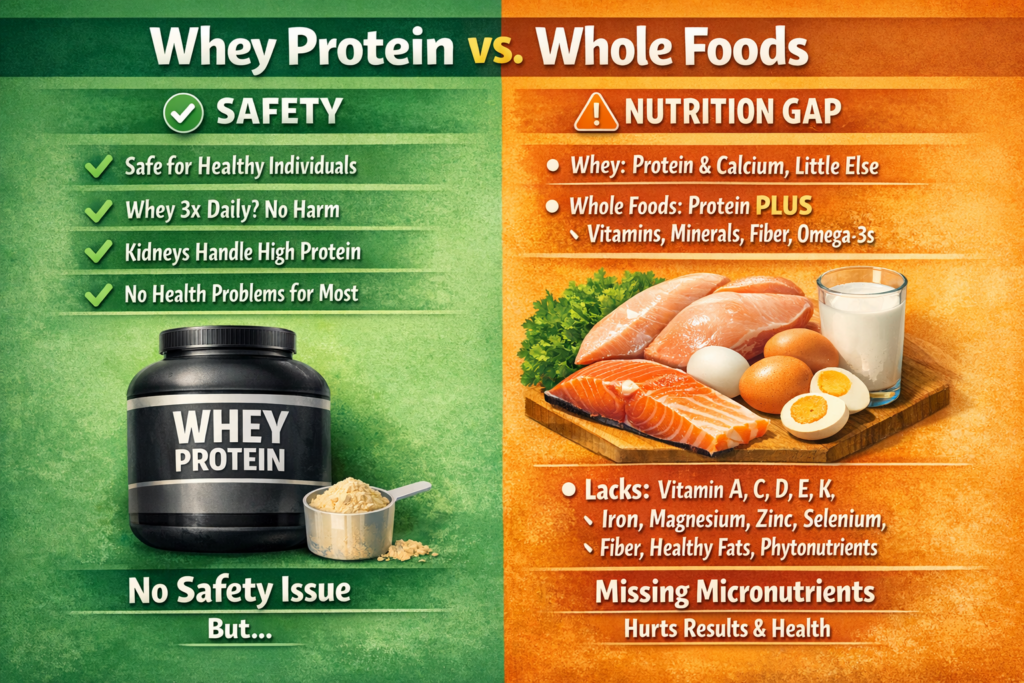
In terms of safety, yes, if you’re healthy, you can take whey protein three times daily without harm. However, in terms of sustainability, cost-effectiveness, and maintaining a nutritious diet, this strategy may not be optimal. While whey protein is safe and convenient, relying on it as your primary protein source means you’re missing out on the vitamins, minerals, and other nutrients that whole food protein sources provide.
For people trying to optimize their nutrition for muscle building, understanding when and how often to use whey protein makes a significant difference. Whey is an incredibly useful tool, but like any tool, it works best when used appropriately, not as a complete replacement for whole foods.
In this comprehensive guide, I’ll explain whether taking whey protein multiple times daily causes any health problems, how many times you should actually take whey each day for best results, specific scenarios where taking whey 3+ times daily makes sense, the pros and cons of frequent whey consumption, and how to balance whey supplementation with whole food protein sources.
Whether you’re a busy professional struggling to eat enough protein, an athlete with very high protein requirements, or someone cutting calories while trying to preserve muscle, understanding the optimal frequency of whey protein consumption will help you make informed decisions about your supplementation strategy.
Let’s examine the science and practicality of taking whey protein multiple times daily.
TABLE OF CONTENTS
Does Taking Whey Protein 3 Times a Day Cause Any Harm?
If you don’t have chronic health conditions that require strict control of protein intake or food sensitivities, taking whey protein three times daily is unlikely to cause problems.
What Whey Protein Actually Is
The basic facts:
Whey is nothing more than milk serum – a natural food that’s been processed to filter out components we don’t want (lactose, fat, etc.) and retain primarily protein. At the end of the day, it’s still food, just in powder form.
The processing:
- Starts with liquid whey (byproduct of cheese production)
- Undergoes filtration to remove lactose and fat
- Concentrated to increase protein content
- Spray-dried into powder form
- Result: 70-90%+ protein by weight (depending on type)
In this sense (regarding safety), questioning whether you can take whey two, three, or more times daily is similar to asking whether you can eat eggs or meat multiple times per day.
The answer in both cases is: yes, for healthy individuals, there’s no inherent harm.
When High Protein Intake Becomes a Concern
This would only be truly important if you were consuming excess protein through your diet AND using multiple whey protein shakes on top of that.
And even this is debatable. There isn’t much evidence in the scientific literature showing any relevant link between high protein consumption and health problems in healthy individuals.
What the research actually shows:
Study 1 – High protein and kidney function:
- Examined healthy individuals consuming 2.2g protein per kg body weight (very high intake)
- No adverse effects on kidney function
- Kidneys of healthy people can handle high protein loads
Study 2 – Long-term high protein consumption:
- Meta-analysis of multiple studies
- No evidence of harm from high protein intake in people with healthy kidneys
- Concerns about protein and kidney damage apply primarily to those with pre-existing kidney disease
Study 3 – Bone health and protein:
- Old myth: High protein causes calcium loss and weakens bones
- Modern research: Actually, adequate protein supports bone health
- Higher protein intake associated with better bone density in most studies
The reality about protein overconsumption:
In practice, protein is the most difficult and “expensive” (in every sense) macronutrient to consume, and this naturally limits intake.
You can easily find people overeating carbohydrates and fats:
- Pizza, pasta, bread, cookies, chips, ice cream
- These foods are hyperpalatable and easy to overeat
- Calorie-dense and not very satiating
But protein? Difficult:
- Highly satiating (fills you up)
- Requires more effort to prepare (cooking chicken, eggs, etc.)
- More expensive than carbs or fats
- High thermic effect (30% of protein calories burned during digestion)
Not only is overconsumption rare, but consuming enough protein is the actual problem most people need to solve.
In fact, most people use whey protein precisely because they can’t consume sufficient protein through whole foods.
The Real Issue with Taking Too Much Whey Protein
At the end of the day, regarding safety and health, the only real problem with taking too much whey protein to the point where it becomes your primary protein source is the lack of micronutrients and fiber.
When compared to whole food protein sources:
Chicken breast provides:
- Protein (obviously)
- B vitamins (B6, B12, niacin)
- Selenium
- Phosphorus
- Small amounts of iron and zinc
Eggs provide:
- Protein
- Vitamins A, D, E, B12, folate
- Choline (brain health)
- Selenium, iodine
- Healthy fats
- Lutein and zeaxanthin (eye health)
Salmon provides:
- Protein
- Omega-3 fatty acids (EPA and DHA)
- Vitamin D
- B vitamins
- Selenium
- Potassium
Whole milk provides:
- Protein (casein and whey naturally)
- Calcium
- Vitamin D (if fortified)
- B vitamins
- Phosphorus
- Potassium
- Fat-soluble vitamins
Whey protein powder provides:
- Protein (excellent quality and complete amino acid profile)
- Small amounts of calcium (from milk origin)
- Minimal amounts of B vitamins
- Almost nothing else
The nutritional gap is significant. Whey is nutritionally poor compared to whole food protein sources.
Can You Work Around This Nutritional Deficiency?
Theoretically, yes. There are ways to compensate by:
- Supplementing with multivitamins
- Taking mineral supplements
- Adding fiber supplements or fiber-rich foods
- Ensuring adequate vegetable and fruit intake
But practically speaking, for the sake of convenience and sustainability of your meal plan, it’s better to keep whole food proteins as your primary protein source and use whey for its original purpose: being a supplement (something that complements, not replaces).
The Short Version
Taking whey protein up to three times daily doesn’t harm healthy people. However, if whey becomes your primary protein source, you’re probably not getting various vitamins and minerals that real food provides, which can indirectly and directly affect your results in the gym and overall health.
Who needs to be more careful:
People with kidney disease:
- Should monitor protein intake carefully
- Consult nephrologist before high protein consumption
- Whey concentrates protein, making it easy to overconsume
Those with dairy allergies or severe lactose intolerance:
- Even whey isolate (99% lactose-free) may cause issues for some
- Whey concentrate contains more lactose
- May need plant-based protein alternatives
Individuals with digestive sensitivities:
- Some people experience bloating, gas, or digestive discomfort
- Multiple daily servings can amplify these issues
- May need to reduce frequency or switch protein types
People taking certain medications:
- Some medications interact with high calcium intake (whey contains calcium)
- Levodopa (Parkinson’s medication) absorption affected by protein timing
- Consult pharmacist about potential interactions
For everyone else, safety isn’t the concern – optimization is.
So How Many Times Should You Take Whey Protein Per Day?
Going straight to the point: You can take whey protein as many times as necessary to reach your daily protein requirements, as long as this doesn’t make the supplement your primary protein source.
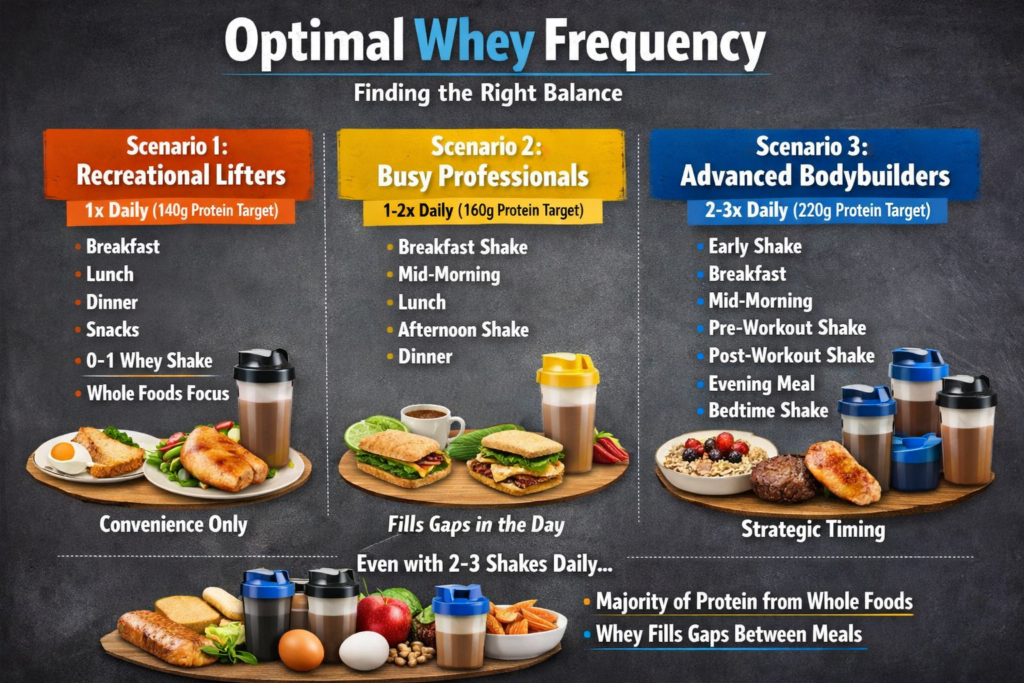
In normal situations, for most people and in most cases, the goal should be to consume the majority of dietary protein from whole foods and use whey protein as a complement at times where a shake would be convenient.
The Practical Reality
In practice, translating this to the real world, in most cases taking whey once or twice is more than sufficient.
Scenario 1: Most recreational lifters (1x daily)
Daily protein target: 140g (for a 180 lb person at 0.8g per pound)
Whole food protein sources throughout the day:
- Breakfast: 3 eggs + 2 slices toast = 20g protein
- Lunch: 6 oz chicken breast + rice + vegetables = 50g protein
- Snack: Greek yogurt = 15g protein
- Dinner: 8 oz steak + potato = 55g protein
- Total from whole foods: 140g
Whey needed: 0 servings (met target with food)
Alternative if lunch/dinner portions smaller:
- Same breakfast and snack = 35g
- Smaller lunch (4 oz chicken) = 30g
- Smaller dinner (6 oz steak) = 40g
- Total from whole foods: 105g
- Whey post-workout: 1 scoop = 25g
- Total: 130g (close enough to target)
Scenario 2: Busy professionals (1-2x daily)
Daily protein target: 160g (for a 200 lb person)
Realistic eating pattern:
- Breakfast: Protein shake on the way to work = 25g
- Mid-morning: Protein bar = 20g
- Lunch: Chipotle bowl with chicken = 40g
- Afternoon: Second protein shake = 25g
- Dinner: Home-cooked meal with fish = 50g
- Total: 160g (2 shakes, rest whole foods)
Scenario 3: Hardcore bodybuilder (2-3x daily)
Daily protein target: 220g (for a 220 lb advanced bodybuilder)
Typical day:
- Early morning shake (fasted cardio): 25g
- Breakfast: 6 eggs = 36g
- Mid-morning: Chicken and rice = 45g
- Pre-workout shake: 25g
- Post-workout: Chicken and pasta = 50g
- Evening: Steak and potatoes = 50g
- Before bed: Casein shake or cottage cheese = 30g
- Total: 261g (3 whey servings, majority still whole foods)
The pattern you should notice:
Even with 2-3 whey servings daily, the majority of protein is still coming from whole foods. The whey fills gaps at convenient times:
- First thing in the morning (when you don’t want to cook)
- Pre/post-workout (for convenience and fast absorption)
- Between meals (when solid food isn’t practical)
- Before bed (casein form for slow release)
The Distribution Strategy
How to distribute protein throughout the day:
Muscle protein synthesis (MPS) research suggests:
- 3-5 protein feedings daily optimizes muscle growth
- Each feeding should contain 25-40g protein (or 0.25-0.4g per kg body weight)
- Spacing feedings 3-5 hours apart maintains elevated MPS
- More frequent feeding doesn’t necessarily mean more growth (diminishing returns)
Example 4-feeding schedule for 160g daily target:
- Feeding 1 (8 AM): Whole food breakfast, 35g protein
- Feeding 2 (12 PM): Whole food lunch, 45g protein
- Feeding 3 (4 PM): Whey shake, 25g protein
- Feeding 4 (8 PM): Whole food dinner, 55g protein
- Total: 160g (1 whey serving)
Example 5-feeding schedule for 200g daily target:
- Feeding 1 (7 AM): Whey shake, 25g protein
- Feeding 2 (10:30 AM): Whole food snack, 30g protein
- Feeding 3 (2 PM): Whole food lunch, 50g protein
- Feeding 4 (5:30 PM): Whey shake (pre-workout), 25g protein
- Feeding 5 (9 PM): Whole food dinner, 70g protein
- Total: 200g (2 whey servings)
The key principle: Use whey to fill gaps between whole food meals, not replace them entirely.
How to Determine YOUR Optimal Frequency
Ask yourself these questions:
1. What’s my daily protein target?
- Generally 0.7-1g per pound of body weight for muscle building
- Higher end (1g) if cutting or very lean
- Lower end (0.7-0.8g) if maintaining or bulking
2. How much protein am I realistically getting from whole foods?
- Track for 2-3 days to see actual intake
- Count protein from all sources (meat, eggs, dairy, grains, vegetables)
- Be honest about portion sizes
3. What’s the gap between target and whole food intake?
- Target 180g, getting 130g from food = 50g gap
- 50g gap = 2 servings of whey (25g each)
4. Can I reasonably eat more whole foods instead?
- Is the gap because I’m not eating enough at meals (small portions)?
- Or because I genuinely don’t have time/access to prepare more food?
- If small portions, increase meal sizes rather than adding shakes
- If time/convenience, whey is the solution
5. What times during the day would a shake be most convenient?
- Common convenient times:
- First thing in the morning (don’t want to cook)
- Pre-workout (quick fuel without feeling full)
- Post-workout (fast absorption when appetite low)
- Between meals (portable, no cooking required)
- Before bed (casein for overnight protein supply)
The decision tree:
If getting adequate protein from whole foods → 0-1 whey servings for convenience
If struggling to hit target by 25-50g → 1-2 whey servings to fill gap
If struggling to hit target by 50-75g+ → 2-3 whey servings, but examine why you can’t eat more whole foods (appetite issue? Time management? Food preferences?)
When It’s Worth Taking Whey Protein 3 Times a Day (Being Specific)
Let’s imagine a scenario where you have the availability and means to use whey 3+ times daily. Below we’ll examine situations where this actually makes sense.
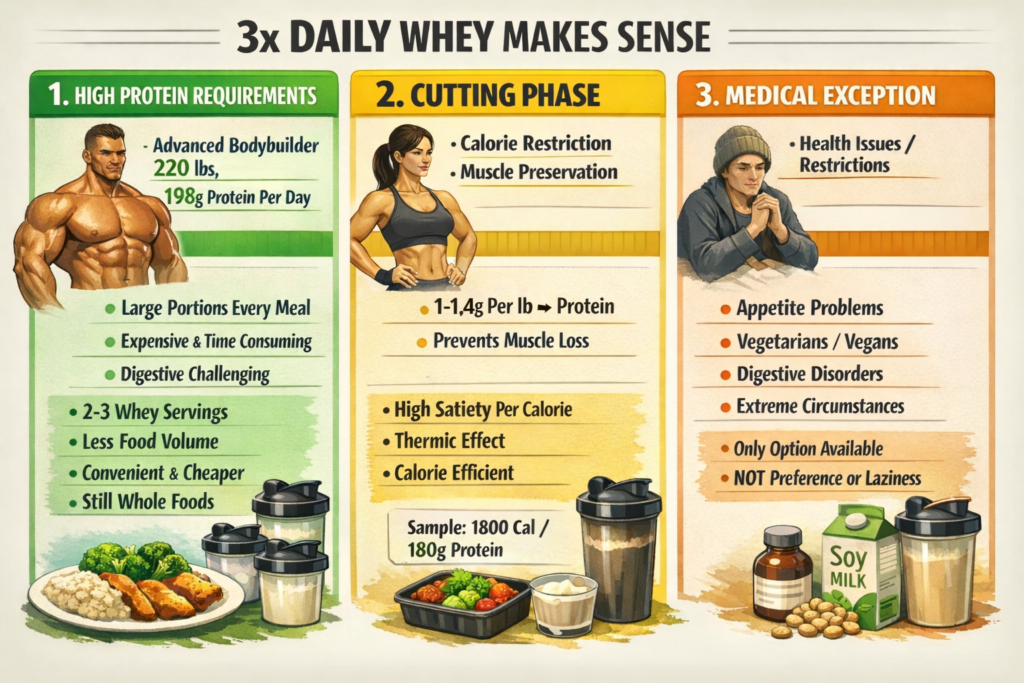
Situation 1: Your Protein Requirement Is Above Average
The more muscle mass (and body weight) you have, the greater your protein requirement.
The scaling reality:
Small individual (140 lbs):
- Protein target at 0.8g per pound: 112g daily
- Achievable with 3 moderate meals and snacks
- Example: 25g breakfast, 35g lunch, 40g dinner, 12g snacks = 112g
- Can easily meet target without whey
Average individual (180 lbs):
- Protein target at 0.8g per pound: 144g daily
- Requires attention but manageable with whole foods
- May benefit from 1 whey serving for convenience
- Example: 30g breakfast, 45g lunch, 50g dinner, 20g snacks = 145g
Large advanced lifter (220 lbs with significant muscle mass):
- Protein target at 0.9g per pound: 198g daily
- Difficult to achieve with whole foods alone
- Example attempting whole foods only:
- Breakfast: 6 eggs = 36g
- Snack: Greek yogurt = 20g
- Lunch: 8 oz chicken = 56g
- Snack: Cottage cheese = 25g
- Dinner: 10 oz steak = 70g
- Total: 207g
This requires eating large portions at every meal, which can be:
- Expensive (meat is costly)
- Time-consuming (meal prep burden)
- Digestively challenging (some people struggle with large meat portions)
- Inconvenient (need refrigeration, cooking facilities)
With 2-3 whey servings:
- Breakfast: Whey shake = 25g
- Mid-morning: 4 oz chicken = 28g
- Lunch: Whey shake + meal = 25g + 35g = 60g
- Pre-workout: Whey shake = 25g
- Dinner: 8 oz steak = 56g
- Total: 194g
Advantages:
- Less total food volume (easier on digestion)
- More convenient (shakes require no cooking)
- Often less expensive (whey cost per gram protein < premium meat)
- Still plenty of whole food (chicken, steak for micronutrients)
Who this applies to:
Advanced bodybuilders:
- 200+ pounds with low body fat
- High muscle mass requiring 180-250g+ protein daily
- Training 5-6 days weekly with high volume
Strength athletes:
- Powerlifters, strongmen in heavier weight classes
- 220-300+ pounds bodyweight
- Extremely high protein requirements (200-300g+)
Emphasizing: This is obviously a specific case, and the minority of people who train have this elevated protein need. Most recreational lifters don’t fall into this category.
Situation 2: You’re in a Cutting Phase
Taking whey protein three times daily during a cutting phase – when the goal is reducing body fat while maintaining muscle mass – can be advantageous, especially if you know what you’re doing.
Why whey works particularly well during cuts:
Benefit 1: Muscle preservation under calorie restriction
During cutting, your body is energy-deprived (calorie deficit), which increases the risk of muscle loss. Your body needs energy and will get it from somewhere – ideally fat, but muscle is also on the table.
Protein helps protect muscles against catabolism, especially important when:
- Calories are restricted
- Training continues intensely (creating muscle damage)
- Glycogen stores are lower (from reduced carb intake)
- Recovery is impaired (from calorie deficit)
High protein intake (2.2-3g per kg or 1-1.4g per lb) during cutting:
- Significantly reduces muscle loss
- Some studies show almost complete muscle preservation with adequate protein
- Lower protein while cutting = substantial muscle loss alongside fat loss
Benefit 2: High satiety per calorie
Whey protein is incredibly satiating relative to its calorie content.
The satiety comparison:
- 1 scoop whey (25g protein, 120 calories): Very filling for 2-3 hours
- 120 calories of bread (2 slices): Minimal satiety, hungry in 30-60 minutes
- 120 calories of candy: Zero satiety, might increase hunger
During a cut when hunger is constant, strategically placed whey shakes can make adherence much easier:
- Morning shake: Suppresses hunger until lunch
- Afternoon shake: Prevents snacking before dinner
- Evening shake: Reduces nighttime cravings
Benefit 3: Higher thermic effect
Protein has the highest thermic effect of all macronutrients – meaning your body burns more calories digesting protein than it does carbs or fats.
The numbers:
- Protein: 20-30% of calories burned during digestion
- Carbohydrates: 5-10% burned
- Fats: 0-3% burned
Example:
- 100 calories from protein: Net 70-80 calories (20-30 burned digesting)
- 100 calories from carbs: Net 90-95 calories (5-10 burned)
- 100 calories from fats: Net 97-100 calories (0-3 burned)
Over a full day at high protein intake (200g = 800 calories), you’re burning an extra 160-240 calories just from the thermic effect compared to an equal calorie amount from fats.
This adds up over weeks: An extra 200 calories burned daily = 1,400 weekly = potential extra 0.4 lbs fat loss weekly
Benefit 4: Calorie-efficient protein source
When cutting, every calorie counts. You want maximum protein with minimum calories.
Whey protein concentrate:
- 120 calories
- 24g protein
- 3g carbs
- 2g fat
Whey protein isolate:
- 110 calories
- 25g protein
- 1g carbs
- 0g fat
Compare to whole food protein:
- 6 oz chicken breast: 180 calories, 54g protein (excellent ratio, but you can’t eat chicken 5x daily)
- 6 oz 85% lean ground beef: 310 calories, 46g protein (fattier, more calories)
- 6 oz salmon: 350 calories, 42g protein (healthy fats but calorie-dense)
When you only have 1,800 calories to work with during a cut, whey gives you protein without “wasting” calories on fats and carbs you may need to limit.
Sample cutting day with 3 whey servings (1,800 calorie target, 180g protein):
- Meal 1 (7 AM): Whey shake + banana = 230 calories, 27g protein
- Meal 2 (11 AM): 5 oz chicken breast + large salad = 260 calories, 43g protein
- Meal 3 (3 PM): Whey shake + apple = 230 calories, 27g protein
- Meal 4 (6 PM): 6 oz fish + vegetables + small portion rice = 380 calories, 48g protein
- Meal 5 (9 PM): Whey shake (casein) + handful almonds = 280 calories, 32g protein
- Snacks: Vegetables, diet soda, coffee = 50 calories, 3g protein
- Total: 1,430 calories, 180g protein
Notice: Still eating whole foods (chicken, fish, vegetables, fruit), but whey allows hitting high protein target within calorie restrictions.
Situation 3: For Some Reason, You Can’t Consume All the Protein You Need from Food
Taking whey protein three times daily can be an effective solution for people who have difficulties meeting their daily protein needs through solid foods.
Who falls into this category:
Medical situations requiring dietary restrictions:
- Medically supervised very low-calorie diets (VLCD)
- Post-bariatric surgery patients (small stomach capacity)
- Certain medical conditions requiring protein supplementation
- Recovery from illness or surgery (poor appetite, high protein needs)
Appetite issues:
- Naturally low appetite (can’t force down large meals)
- Medications that suppress appetite (ADHD meds, certain antidepressants)
- Eating disorders recovery (working on normalizing intake)
- Elderly individuals with reduced appetite
Extreme life circumstances:
- Working 60-80+ hour weeks (no time to cook or eat)
- Caring for newborns or sick family members (meals constantly interrupted)
- Traveling extensively for work (limited food access)
- Students during exam periods (prioritizing study over meal prep)
Vegetarians/vegans with limited options:
- Plant protein sources are less protein-dense
- May struggle to eat enough legumes, tofu, tempeh to hit targets
- Protein powder becomes necessary supplement
People with digestive issues:
- Difficulty digesting large amounts of solid protein (meat, eggs)
- IBS or IBD requiring easily-digestible protein
- Whey isolate easier on stomach than whole foods for some
However, it’s important to emphasize that this scenario should be seen as an exception to the rule. We’re referring to people who genuinely have no other option.
For everyone else, the issue isn’t “I can’t eat enough protein,” it’s usually:
- I don’t want to meal prep (laziness, not inability)
- I don’t like protein-rich foods (preference, not restriction)
- I haven’t learned to cook efficiently (skill issue)
These are solvable problems that don’t require taking whey 3x daily.
Pros and Cons of Taking Whey Multiple Times Daily
Let’s examine both sides objectively so you can make an informed decision for your situation.
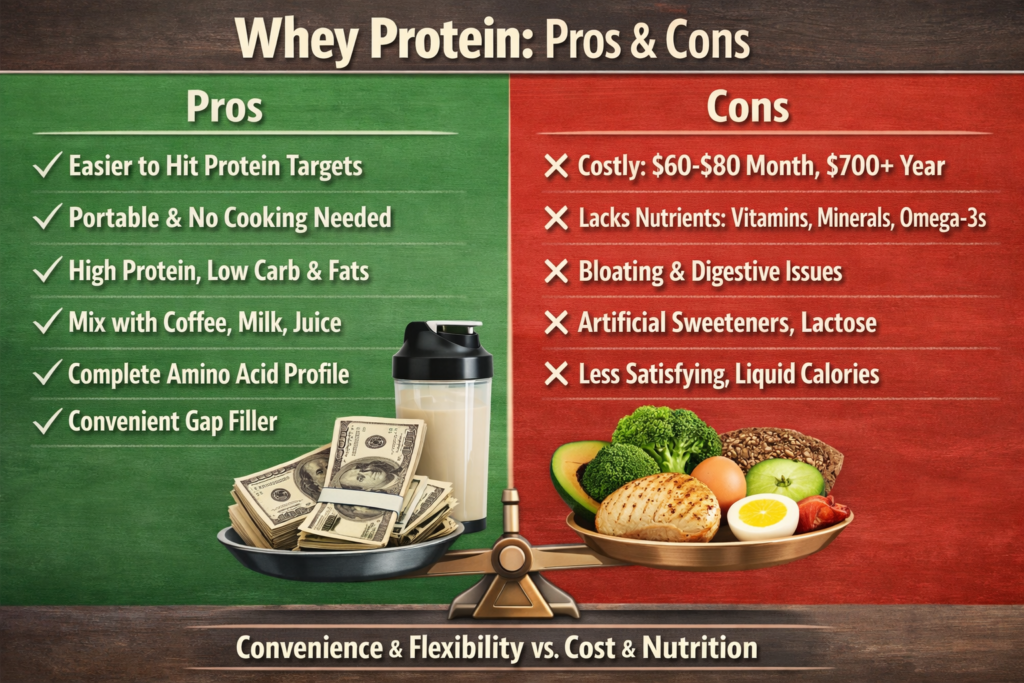
The Pros (Advantages of Frequent Whey Consumption)
1. Easier to hit your protein targets
Why this matters:
- Portable (take powder anywhere)
- No cooking required (just add liquid and shake)
- Fast to consume (drink in 60 seconds vs. 15 minutes eating a meal)
- Easy digestion (liquid form, no chewing)
- No refrigeration needed for powder (convenient for travel, work)
Real-world example:
- 3 PM at office, need 30g protein
- Option A: Whey shake mixed with water at desk = 2 minutes
- Option B: Go to cafeteria, find protein source, wait in line, eat = 30+ minutes
For busy people, this convenience is invaluable.
2. High protein content with low carbs and fats
Why this matters:
- Easy way to increase protein macros without adding unwanted carbs or fats
- Critical during cutting when calories are limited
- Allows flexible use of carbs and fats elsewhere in diet
The macro comparison (per 25g protein):
Whey isolate:
- Protein: 25g
- Carbs: 1g
- Fat: 0g
- Calories: 105
Chicken breast:
- Protein: 25g (4 oz)
- Carbs: 0g
- Fat: 2g
- Calories: 130
85% lean ground beef:
- Protein: 25g (4 oz)
- Carbs: 0g
- Fat: 12g
- Calories: 210
Whole eggs:
- Protein: 25g (4 large eggs)
- Carbs: 2g
- Fat: 20g
- Calories: 280
2% milk:
- Protein: 25g (3 cups)
- Carbs: 36g
- Fat: 15g
- Calories: 375
When you need “pure” protein without additional macros, whey is unmatched.
3. Can be mixed with a variety of liquids
Beyond just water:
Milk (dairy or plant-based):
- Creamier texture
- Additional protein (if dairy milk)
- More calories (useful if bulking)
- Better flavor
Coffee:
- Creates protein coffee (great morning option)
- Caffeine + protein combo
- Works well with chocolate or vanilla whey
- Iced or hot
Juice:
- Fruit flavor complement (orange juice + vanilla whey)
- Additional carbs (useful post-workout)
- Kids often prefer this
Almond/oat/coconut milk:
- Lower calorie than dairy milk
- Lactose-free
- Different flavor profiles
In recipes:
- Protein pancakes
- Protein oatmeal
- Protein ice cream
- Baked goods
The versatility prevents flavor fatigue when consuming multiple servings daily.
4. Excellent amino acid profile
Whey protein is “complete”:
- Contains all 9 essential amino acids (EAAs) your body can’t produce
- Optimal ratios for muscle protein synthesis
- High leucine content (key trigger for MPS)
The leucine advantage:
- Whey contains ~2.5-3g leucine per 25g protein
- Leucine is primary signal for muscle protein synthesis
- Threshold for MPS: ~2-3g leucine per meal
- Whey hits this threshold perfectly
Compared to plant proteins:
- Many plant proteins are incomplete (missing or low in certain EAAs)
- Lower leucine content (need more total protein to hit threshold)
- Whey is superior for muscle building (though plant proteins work when combined properly)
5. Most whey powders already contain BCAAs
What are BCAAs:
- Branched-chain amino acids: leucine, isoleucine, valine
- Marketed as separate supplements
- Claimed to boost muscle growth and reduce soreness
The truth:
- Any complete protein source contains BCAAs
- Whey is approximately 25% BCAAs by weight
- 25g whey protein = ~6g BCAAs
- Separate BCAA supplements are unnecessary if consuming adequate whey/protein
Money-saving realization:
- If consuming 2-3 whey servings daily = 12-18g BCAAs already
- No need to spend $30-50 on separate BCAA supplements
- Marketing successfully sells redundant products
The Cons (Disadvantages of Frequent Whey Consumption)
1. Terrible cost-effectiveness
Let’s do the math:
Whey protein cost:
- Average quality whey: $50 for 5 lbs (71 servings of 25g protein)
- Cost per serving: $0.70
- Cost per 25g protein: $0.70
Whole food protein costs (per 25g protein):
Eggs:
- 4 large eggs = 25g protein
- Cost: $0.40-0.60
- Cheaper than whey
Chicken breast:
- 4 oz = 25g protein
- Cost: $0.75-1.50 (depending on sales)
- Comparable to whey
Ground beef (when on sale):
- 3 oz 90% lean = 25g protein
- Cost: $0.60-1.20
- Comparable to whey
Canned tuna:
- 1 can (5 oz) = 30g protein
- Cost: $1.00-1.50
- Slightly more expensive per gram
Greek yogurt:
- 1 cup Kirkland Greek yogurt = 23g protein
- Cost: $0.80-1.00
- Comparable to whey
BUT the real cost issue is taking whey 3x daily:
- 3 servings × $0.70 = $2.10 daily
- × 30 days = $63 monthly
- × 12 months = $756 yearly
That’s $756/year on just protein powder (not counting other food). For many people, this is a significant expense.
Compare to getting those 75g from whole foods:
- 10 eggs daily: $0.50
- Or 12 oz chicken: $2.25
- Mix of both: $1.40
- × 30 days = $42 monthly = $504 yearly
Saving $250+ annually by prioritizing whole foods.
2. Lacks variety of micronutrients
What whey protein provides (per serving):
- Protein: ✓✓✓ (excellent)
- Calcium: ~150mg (15% DV) – moderate
- Sodium: ~50mg – minimal
- Potassium: ~200mg – minimal
- B vitamins: trace amounts
- Everything else: essentially nothing
What whey protein lacks:
- Vitamin A, C, D, E, K: none
- Iron, magnesium, zinc, selenium: minimal to none
- Fiber: zero
- Phytonutrients, antioxidants: none
- Healthy fats (omega-3s, etc.): none
What you miss by replacing whole foods with whey:
Replacing chicken breast with whey:
- Miss out on: B6, B12, niacin, selenium, phosphorus
Replacing eggs with whey:
- Miss out on: Vitamins A, D, E, B12, folate, choline, lutein, zeaxanthin, healthy fats
Replacing fish with whey:
- Miss out on: Omega-3s (critical for health), vitamin D, selenium, iodine
The cumulative effect: If 60-70% of your protein comes from whey (3 servings of 75g total = 75/140 = 54%), you’re missing substantial micronutrients that should come from protein-rich whole foods.
Over weeks and months, micronutrient deficiencies can cause:
- Impaired recovery (many vitamins/minerals involved in muscle repair)
- Reduced immune function (more sick days = missed training)
- Lower energy levels (B vitamins, iron, etc.)
- Poor performance (numerous minerals involved in muscle contraction)
- Long-term health issues
Can you supplement vitamins/minerals separately? Yes, but:
- Adds more cost
- Whole food nutrients are better absorbed
- Synergistic effects of nutrients in food (not replicated in pills)
- You miss out on yet-undiscovered beneficial compounds in whole foods
3. Can cause bloating and digestive discomfort
Not everyone tolerates whey protein well, and consuming it multiple times daily can amplify issues.
Common digestive problems:
Lactose intolerance:
- Whey concentrate: 3-5% lactose (can cause issues)
- Whey isolate: <1% lactose (better tolerated)
- 3 servings of concentrate daily = significant lactose intake
- Symptoms: Gas, bloating, diarrhea, cramping
Protein overload:
- Digestive system can struggle with multiple high-protein liquid meals
- Some people report constipation from excessive protein without adequate fiber
- Others experience loose stools
- Individual tolerance varies widely
Sweeteners and additives:
- Many whey powders contain sugar alcohols (maltitol, erythritol, xylitol)
- These can cause severe GI distress in some people
- Artificial sweeteners (sucralose, aspartame) bother some individuals
- Gums and thickeners (xanthan gum, guar gum) cause bloating for some
The “dairy sensitivity” issue:
- Some people react to dairy proteins beyond just lactose
- May experience inflammation, acne, digestive upset
- If this is you, plant-based proteins are better option
Who’s most affected:
- People with IBS (irritable bowel syndrome)
- Those with dairy sensitivities
- Individuals with generally sensitive digestion
- Anyone not drinking enough water with protein powder
How to minimize digestive issues:
- Choose whey isolate over concentrate (less lactose)
- Drink plenty of water throughout the day
- Don’t take all servings close together (space them out)
- Start with 1 serving daily, gradually increase to assess tolerance
- Choose unflavored or minimally processed options
- Consider digestive enzymes (lactase if lactose is the issue)
- Increase fiber intake from vegetables and fruits
THE BOTTOM LINE: WHEY PROTEIN FREQUENCY
After examining all aspects of taking whey protein multiple times daily, here’s what you need to understand:
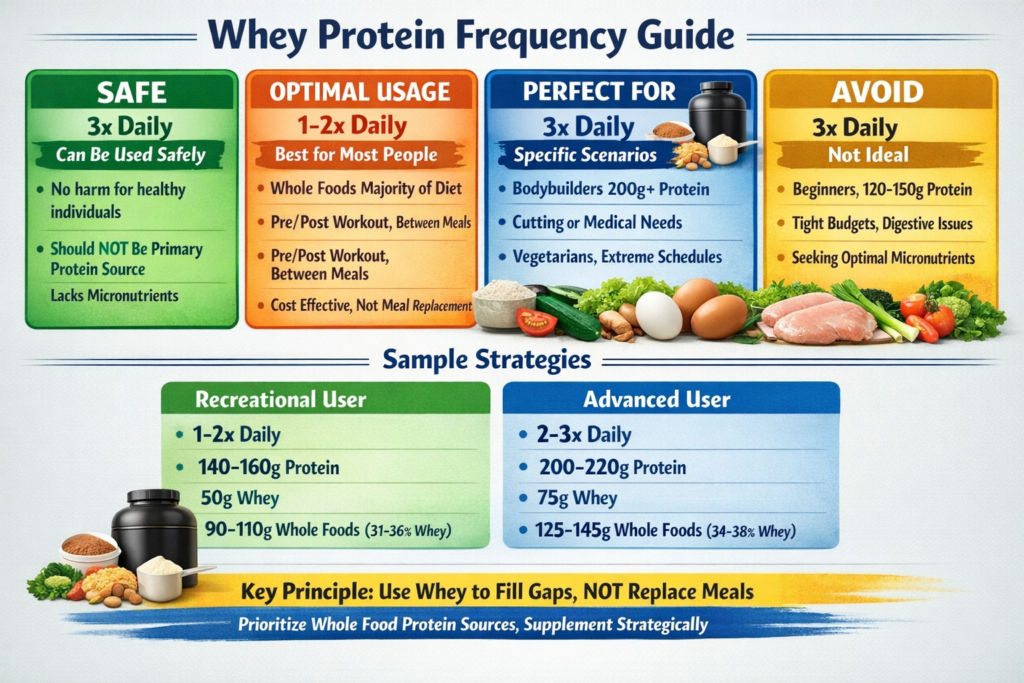
✅ Safe To Take 3x Daily For Healthy Individuals (No Safety Concerns)
✅ Should Not Become Primary Protein Source (Lacks Micronutrients From Whole Foods)
✅ Most People Need Only 1-2 Servings Daily (Whole Foods Should Provide Majority)
✅ Useful As Convenient Protein Top-Up (Not Meal Replacement)
✅ Cost-Effectiveness Decreases With Frequency (Expensive Compared To Whole Foods)
✅ Quality Whole Foods Provide Superior Nutrition (Vitamins, Minerals, Fiber)
Perfect For Taking 3x Daily:
- Advanced Bodybuilders With Very High Protein Needs (200+ Grams Daily)
- Athletes During Cutting Phases (High Protein, Low Calories Required)
- People With Medical Reasons Limiting Whole Food Intake
- Vegetarians/Vegans Struggling To Hit Protein Targets
- Individuals With Temporarily Extreme Schedules (Exams, Work Crunch)
Not Ideal For Taking 3x Daily:
- Beginners With Normal Protein Needs (120-150g Manageable With Food)
- Those On Tight Budgets (Whole Foods More Cost-Effective)
- People With Digestive Sensitivities (Multiple Daily Servings Amplify Issues)
- Anyone Wanting Optimal Micronutrient Intake (Whole Foods Superior)
Optimal Whey Protein Usage Strategy:
For Most People (1-2 Servings Daily):
- Breakfast: Whole food meal (eggs, oats) – no whey
- Mid-morning: Snack if needed – no whey
- Lunch: Whole food meal (chicken, rice, vegetables) – no whey
- Pre-workout: Whey shake (25g protein) – convenient, fast-digesting
- Dinner: Whole food meal (fish, potatoes, salad) – no whey
- Evening: Optional second whey or casein if protein target not met
Total Daily: 140-160g protein (50g from whey, 90-110g from whole foods) Whey percentage: 31-36% of total protein (acceptable ratio)
For Advanced Athletes (2-3 Servings Daily):
- Morning: Whey shake (fasted cardio or convenience)
- Mid-morning: Whole food meal
- Pre-workout: Whey shake
- Post-workout: Whole food meal (high protein)
- Evening: Whole food meal
- Before bed: Casein shake or cottage cheese
Total Daily: 200-220g protein (75g from whey, 125-145g from whole foods) Whey percentage: 34-38% of total protein (still acceptable)
Pros Of Multiple Daily Servings:
Convenience:
- No cooking required
- Portable and shelf-stable
- Fast to consume
- Easy to hit protein targets
Macro Control:
- Pure protein without unwanted carbs/fats
- Precise macro tracking
- Flexible diet design
Complete Amino Acid Profile:
- All essential amino acids
- High leucine for muscle protein synthesis
- Built-in BCAAs (no need for separate supplement)
Versatility:
- Mix with various liquids
- Use in recipes
- Different flavors prevent boredom
Cons Of Multiple Daily Servings:
Expensive:
- $60-80 monthly for 3 servings daily
- $700+ annually
- Whole foods often cheaper per gram protein
Micronutrient Deficiency Risk:
- Missing vitamins from meat (B12, B6, niacin)
- Missing minerals from eggs (choline, selenium)
- Missing omega-3s from fish
- Zero fiber
- Long-term health impacts
Digestive Issues:
- Bloating, gas, discomfort
- Lactose intolerance problems with concentrate
- Some people don’t tolerate multiple liquid protein meals
- May need isolate (more expensive)
Less Satisfying:
- Liquid calories less satiating than solid food
- May lead to snacking
- Missing chewing satisfaction
- Doesn’t feel like “real eating”
STOP REPLACING MEALS WITH PROTEIN POWDER. START USING WHEY STRATEGICALLY. PRIORITIZE WHOLE FOOD PROTEIN SOURCES. SUPPLEMENT GAPS WITH WHEY SHAKES. MAXIMIZE NUTRITION WHILE HITTING PROTEIN TARGETS EFFICIENTLY.
Ready To Build A Complete Nutrition Strategy That Optimizes Protein Intake From Both Whole Foods And Supplements, Without Overspending Or Missing Essential Nutrients? Understanding whey protein frequency is just one piece. Get a comprehensive nutrition system that includes personalized protein target calculations based on your goals and body composition, whole food meal planning that provides complete nutrition, strategic supplement timing for maximum absorption and results, budget-friendly protein strategies that maximize value, and micronutrient optimization to support training and recovery. Stop guessing about protein intake and supplement frequency. Start following a science-based nutrition plan that delivers results while supporting long-term health.
REFERENCES
SECTION 1 — High protein intake is safe for healthy individuals: kidney and health evidence
[1] Antonio J et al. — PMC/Journal of Nutrition and Metabolism, 2016 One-year randomized crossover study in 14 resistance-trained men comparing their habitual diet (mean 2.51 g/kg/day protein) to a high protein phase (mean 3.32 g/kg/day); after one year, no harmful effects were found on blood lipids, liver function, or kidney function; subjects also did not experience an increase in fat mass despite the higher caloric intake during the high protein phase; one of the longest controlled trials of high protein intake in resistance-trained individuals, directly addressing concerns about whether multiple daily whey servings producing intakes above 2 g/kg/day cause health problems in healthy people; provides the primary evidence base for the article’s reassurance that frequent whey use is safe for healthy individuals with intact kidney function https://pmc.ncbi.nlm.nih.gov/articles/PMC5078648/
[2] Martin WF et al. — PMC/Nutrition and Metabolism, 2005 Comprehensive review of the available evidence examining dietary protein intake and renal function; the concern that high protein causes kidney damage via increased glomerular pressure and hyperfiltration is assessed; evidence for this mechanism was derived primarily from animal models and patients with pre-existing renal disease; no significant evidence was found for a detrimental effect of high protein intake on kidney function in healthy individuals; protein-induced increases in glomerular filtration rate are described as a normal adaptive mechanism within the functional limits of a healthy kidney; directly refutes the common belief that taking whey protein multiple times daily damages kidneys in healthy people, and clarifies that the restriction applies only to those with existing kidney disease https://pmc.ncbi.nlm.nih.gov/articles/PMC1262767/
SECTION 2 — Protein distribution and optimal per-meal doses for muscle protein synthesis
[3] Schoenfeld BJ & Aragon AA — PMC/Journal of the International Society of Sports Nutrition, 2018 Review and synthesis of the literature on per-meal protein thresholds for muscle building; the commonly cited figure of 20 to 25g as the maximum useful dose per meal was derived from fast-digesting isolated proteins without other macronutrients; with slower proteins and mixed meals, absorption is delayed and the body utilizes a greater amount over a longer period; Morton et al.’s synthesis was used to propose that 0.4 g/kg/meal represents the optimal per-meal dose (approximately 32g for an 80 kg person), with the authors concluding that up to 0.55 g/kg per meal may be beneficial; this review underpins the article’s recommendation of 25 to 40g protein per feeding and the 3 to 5 daily feedings strategy https://pmc.ncbi.nlm.nih.gov/articles/PMC5828430/
[4] Areta JL et al. — PubMed/Journal of Physiology, 2013 RCT in which 80g of whey protein was distributed across three different patterns over a 12-hour post-exercise recovery window: 8 servings of 10g every 1.5 hours, 4 servings of 20g every 3 hours, or 2 servings of 40g every 6 hours; muscle protein synthesis was greatest with the 4-serving pattern (20g every 3 hours); the bolus condition (40g twice) and the pulse condition (10g frequently) were both inferior; the paper demonstrates that both the dose per feeding and the spacing between feedings matter for maximizing MPS; provides the mechanistic foundation for the article’s recommendation to space protein feedings 3 to 5 hours apart with 25g portions, and explains why distributing whey across multiple daily servings is preferable to single large servings https://pubmed.ncbi.nlm.nih.gov/23459753/
SECTION 3 — Total protein intake for muscle mass: the evidence base for daily targets
[5] Morton RW et al. — PMC/British Journal of Sports Medicine, 2018 Meta-analysis of 49 RCTs (1,863 participants) examining protein supplementation during resistance training; protein supplementation significantly increased fat-free mass and strength gains; gains in fat-free mass plateaued at approximately 1.62 g/kg/day total protein; total daily protein intake was the strongest predictor of hypertrophic outcomes; training experience moderated the benefit from supplemental protein; the most comprehensive dataset establishing the protein targets used in the article’s calculations, and the justification for why meeting daily protein needs through whey supplementation when whole food intake is insufficient is a valid strategy https://pmc.ncbi.nlm.nih.gov/articles/PMC5867436/





Leave a Reply
You must be logged in to post a comment.