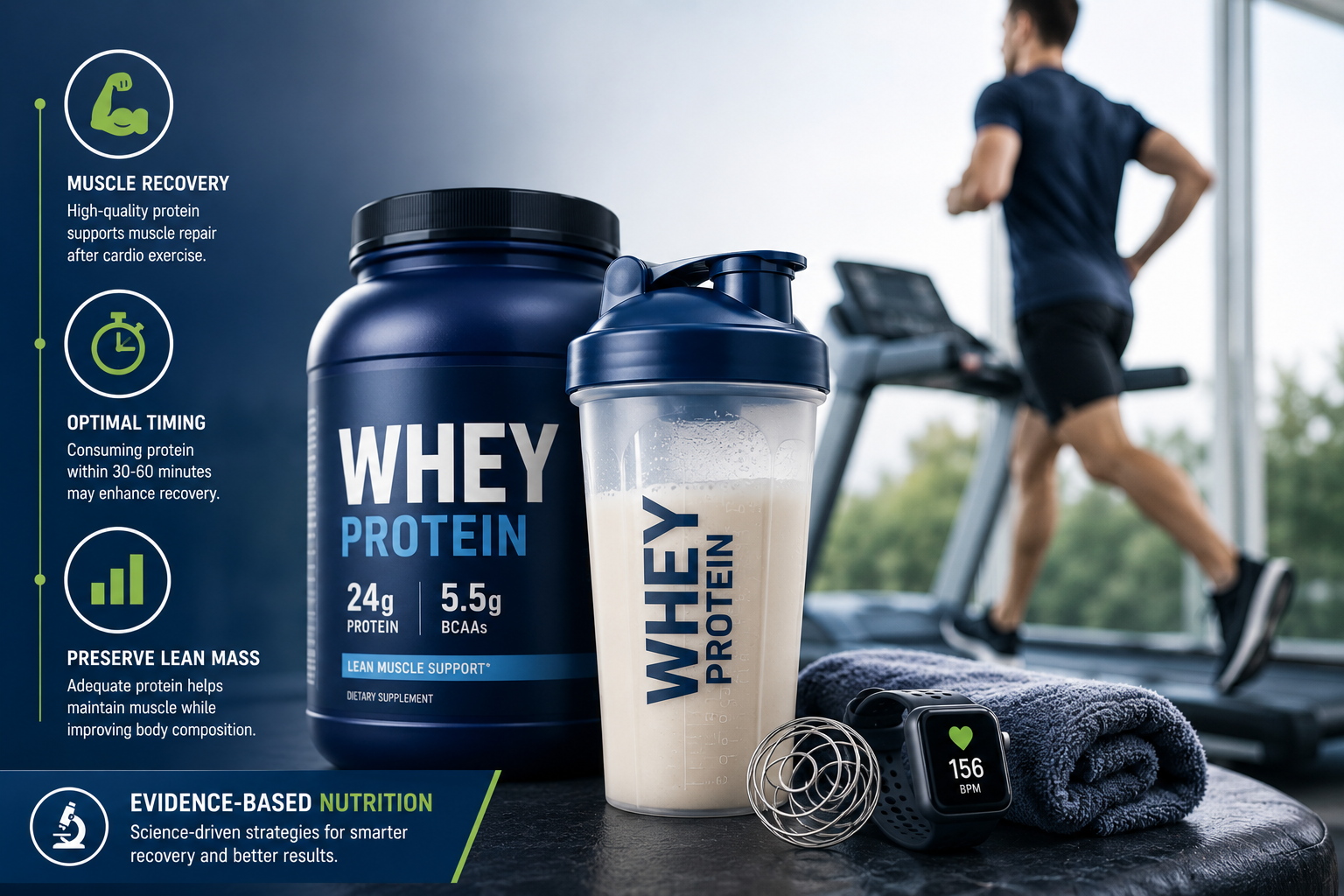
You just finished a brutal 45-minute HIIT session or a long steady-state run, and you’re standing in the gym locker room wondering: should I drink a whey protein shake right now? Or is protein only necessary after weight training? Will taking whey after cardio help with recovery, or is it just wasting money on unnecessary supplementation?
A frequent question in the bodybuilding and fitness world is whether to take whey after doing cardio, whether this is recommended, or if it’s better to save whey only for resistance training sessions.
So, can you take whey protein after doing cardio? Yes, you can take whey protein after doing cardio. But this isn’t a mandatory requirement and depends on your personal preference. Total daily protein intake is more important than consuming protein at specific times (like immediately after cardio).
For people doing both cardio and resistance training, understanding when protein supplementation actually matters can save money, reduce unnecessary complications, and help optimize both recovery and body composition goals. Many athletes overthink post-cardio nutrition or follow outdated “anabolic window” myths when simpler, more flexible approaches would work better.
In this comprehensive guide, I’ll explain the actual advantages of taking whey protein after cardio (backed by research), what your post-cardio shake should contain for optimal recovery, how long after cardio you should take whey (spoiler: timing is very flexible), whether the protein needs to be whey specifically or if other sources work equally well, potential disadvantages of post-cardio whey supplementation, and when post-cardio protein actually matters vs. when it’s unnecessary.
Whether you’re a physique athlete doing cardio while cutting, an endurance athlete trying to preserve muscle mass, or someone combining cardio and resistance training for overall fitness, understanding post-cardio protein needs will help you make informed, evidence-based decisions.
Let’s examine everything you need to know about whey protein and cardio.
Key Points to Understand First
Before diving into the details, here are the fundamental truths about whey protein and cardio:
There is no mandatory requirement, written in stone, to take whey after cardio. Your total daily protein intake is far more important than consuming protein only at specific times.
Taking whey after cardio offers some advantages including enhanced muscle recovery, muscle mass retention during cutting phases, and pure convenience when solid food isn’t practical.
The optimal post-cardio shake contains both protein and carbohydrates in a ratio of 1:2 to 1:3 (protein to carbs) to repair muscle damage and replenish energy stores.
You don’t need to rush to consume protein immediately after cardio. The “60-minute anabolic window” theory is exaggerated. Total daily protein matters more than precise timing.
The protein doesn’t need to be whey specifically. Any quality protein source providing 20-25g protein will work effectively for post-cardio recovery.
Some people may experience gastrointestinal symptoms when taking whey immediately after long or high-intensity cardio sessions due to blood flow redistribution during exercise.
Now let’s examine each aspect in detail.
The 3 Main Advantages of Taking Whey Protein After Cardio
To avoid extremism, it’s necessary to make clear that there is no mandatory requirement to take whey after cardio. In fact, your total daily protein intake is much more important than consuming protein only at specific times.
But this doesn’t mean there aren’t some advantages to taking a protein shake after cardio. Let’s examine what they are.
Advantage 1: Enhanced Muscle Recovery
Taking whey protein after physical activity (any physical activity) has been shown in studies to improve muscle recovery in both trained athletes and beginners, which includes aerobic activity.
What happens to muscles during cardio:
When you exercise, micro-damage to muscle tissue is expected to occur. More intense cardio sessions (higher intensity or prolonged duration) will definitely create micro-damage in the muscles most used to perform the activity.
The muscle damage reality of cardio:
Low-intensity steady-state cardio (walking, easy cycling):
- Minimal muscle damage
- Mostly uses aerobic energy systems
- Very little structural muscle stress
- Recovery is quick and easy
Moderate-intensity cardio (jogging, moderate cycling):
- Some muscle damage, especially in untrained individuals
- Eccentric contractions during running create micro-tears
- Impact forces stress muscle fibers
- Recovery needed but not extensive
High-intensity cardio (HIIT, sprints, hill running):
- Significant muscle damage
- Explosive contractions create substantial micro-tears
- Comparable to resistance training in some muscles
- Requires serious recovery
Long-duration endurance cardio (long runs, cycling 90+ minutes):
- Cumulative damage over time
- Glycogen depletion stresses muscle fibers
- Late-stage form breakdown increases damage
- Extended recovery period needed
This is why doing too much cardio can hinder your muscle recovery from resistance training – it’s not possible to use muscles significantly without them taking some damage, even if the activity doesn’t involve weights.
The interference effect (cardio interfering with muscle growth):
Excessive cardio volume impacts muscle building through:
- Depleting recovery resources (energy, amino acids)
- Creating additional muscle damage that must be repaired
- Competing for adaptation signals (AMPK vs. mTOR)
- Reducing available calories for muscle growth
Research on cardio and muscle damage:
Studies measuring muscle damage markers (creatine kinase, myoglobin, muscle soreness) after different types of cardio show:
Study 1 – Running and muscle damage:
- Downhill running: Massive CK elevation (500-1000% above baseline)
- Flat running: Moderate CK elevation (200-300% above baseline)
- Cycling: Minimal CK elevation (50-100% above baseline)
- Running creates more damage than cycling due to impact forces
Study 2 – HIIT and muscle damage:
- Sprint intervals: Elevated muscle damage markers
- Comparable to resistance training in some cases
- Delayed onset muscle soreness (DOMS) common
- HIIT is closer to resistance training than steady cardio
Study 3 – Endurance cardio and damage:
- Marathon runners: Severe muscle damage post-race
- Recovery can take 1-2 weeks for full restoration
- Protein and carbs accelerate recovery significantly
- Long endurance sessions require substantial recovery
Therefore, it’s no surprise that taking whey after doing cardio has benefits in terms of improving muscle recovery.
How Protein Aids Cardio Recovery
Protein provides amino acids for muscle repair:
- Whey contains all essential amino acids
- BCAAs (leucine, isoleucine, valine) particularly important
- Rapidly absorbed and delivered to damaged muscles
- Stimulates muscle protein synthesis (MPS)
The recovery timeline with and without post-cardio protein:
Without post-cardio protein:
- Muscle damage persists longer
- Soreness more severe and prolonged
- Strength and performance take longer to recover
- Risk of accumulated damage from frequent training
With post-cardio protein (20-30g):
- Faster initiation of repair processes
- Reduced severity of muscle soreness
- Quicker return to baseline performance
- Better preparedness for next training session
Research on post-cardio protein and recovery:
Study – Protein after endurance exercise:
- Cyclists given protein vs. carbs-only after training
- Protein group: 25% faster recovery of muscle function
- Protein group: Reduced muscle soreness at 24 and 48 hours
- Conclusion: Protein accelerates recovery from cardio
Practical example:
You run 5 miles on Monday. Your quads and calves have micro-damage. You have a leg workout scheduled for Wednesday.
Scenario A – No post-run protein:
- Still sore Tuesday evening
- Leg workout Wednesday compromised
- Can’t lift as heavy or perform as many reps
- Suboptimal resistance training session
Scenario B – Post-run protein shake:
- Less sore Tuesday evening
- Leg workout Wednesday goes well
- Able to lift normal weights with good form
- Optimal resistance training session
The protein helped you recover faster, allowing better performance in your primary training (resistance work).
Advantage 2: Muscle Mass Retention During Cutting Phases
If you’re doing cardio and are in a cutting phase (consuming fewer calories than your body needs to burn fat), there’s a greater potential for you to lose both fat and muscle mass.
Why cutting increases muscle loss risk:
Calorie deficit creates catabolic environment:
- Body needs energy but food intake is restricted
- Can break down muscle for amino acids (gluconeogenesis)
- Muscle protein breakdown (MPB) increases
- Muscle protein synthesis (MPS) decreases
- Net result: Potential muscle loss
Cardio compounds the challenge:
- Burns additional calories (deepens deficit)
- Creates muscle damage requiring repair
- Uses amino acids for energy during prolonged sessions
- Increases cortisol (catabolic hormone)
The combination (cutting + cardio) is particularly risky:
- Limited calories for recovery
- Increased recovery demands from cardio
- Muscle is vulnerable to breakdown
- Protein becomes even more critical
Preventing muscle loss should be your top priority, since muscle loss directly affects your training performance, aesthetics, and the very ability to burn fat (the less muscle you have, the fewer calories you burn daily).
The metabolic consequences of muscle loss during cutting:
Lost muscle reduces metabolic rate:
- Muscle tissue burns 6-10 calories per pound daily at rest
- Lose 10 lbs muscle = lose 60-100 calories daily from BMR
- Makes further fat loss harder (lower TDEE)
- Can lead to plateau or rebound weight gain
Lost muscle reduces training performance:
- Weaker in gym (lift less weight)
- Fewer calories burned during training
- Lower quality training stimulus
- Reduced muscle growth potential
Lost muscle reduces aesthetics:
- “Skinny fat” appearance instead of lean and muscular
- Less definition even at low body fat
- Smaller, flatter muscles
- Defeating the purpose of cutting
Taking whey protein after cardio, in addition to contributing to your total daily protein intake, “protects,” so to speak, your muscle mass from the catabolic effects of physical activity itself.
How Post-Cardio Protein Preserves Muscle While Cutting
Mechanism 1: Stimulates muscle protein synthesis
- Whey rapidly elevates blood amino acids
- Leucine triggers mTOR pathway
- MPS increases for 3-5 hours post-consumption
- Shifts muscle from catabolic to anabolic state
Mechanism 2: Reduces muscle protein breakdown
- Amino acid availability signals body not to break down muscle
- Insulin response (from protein + carbs) suppresses MPB
- Net protein balance becomes positive
- Muscle is preserved despite calorie deficit
Mechanism 3: Provides building blocks for repair
- Cardio creates muscle damage
- Damage must be repaired even during cutting
- Without adequate protein, body may cannibalize other muscle
- Whey provides amino acids specifically for repair
Research on protein and muscle retention during cutting:
Study 1 – High protein during calorie deficit:
- Subjects in 30% calorie deficit for 12 weeks
- Group A: 1.2g protein per kg (0.55g per lb)
- Group B: 2.4g protein per kg (1.1g per lb)
- Both groups lost similar fat
- Group B retained significantly more muscle mass
Study 2 – Protein timing during fat loss:
- Athletes in calorie deficit doing cardio and resistance training
- Compared protein throughout day vs. concentrated at certain times
- Total daily protein matched between groups
- Both groups retained muscle equally well
- Timing less important than total intake
Study 3 – Post-cardio protein during cutting:
- Endurance athletes in moderate deficit
- Group with post-cardio protein: Better muscle retention
- Group without: More muscle loss over 8 weeks
- Post-cardio protein beneficial but total daily intake still most important
The key takeaway: Post-cardio protein helps preserve muscle during cutting, but it’s one piece of the puzzle. Total daily protein (0.8-1g per lb body weight minimum when cutting) matters most.
Practical cutting scenario:
Your stats:
- 180 lbs body weight
- Cutting on 2,000 calories daily
- Protein target: 180g daily (1g per lb)
- Doing cardio 4x weekly (30-45 min sessions)
Without post-cardio protein:
- Miss post-cardio feeding opportunity
- May struggle to hit 180g total daily
- End day at 150-160g protein
- Suboptimal for muscle retention
With post-cardio protein (25g whey):
- Immediately address recovery needs
- Easier to hit 180g total daily
- Consistent protein distribution across day
- Optimal for muscle retention
The post-cardio shake isn’t magic, but it helps you maintain the high protein intake essential for preserving muscle while losing fat.
Advantage 3: Pure Convenience
Although it’s possible to obtain all your protein needs through solid foods, protein shakes increase diet adherence by making your life easier.
Why convenience matters for long-term success:
Consistency beats perfection:
- Perfect diet you can’t sustain = failure
- Good diet you can maintain = success
- Convenience supports consistency
- Protein shakes remove friction
Modern life is busy:
- Not always time to cook chicken breast
- Can’t always sit down for full meal
- Sometimes need nutrition on the go
- Shakes provide fast, portable option
Post-workout appetite is often suppressed:
- Intense exercise suppresses hunger hormones
- May not want solid food for 1-2 hours
- Liquid nutrition easier to consume
- Doesn’t require chewing or full digestion
Protein shakes are convenient and portable, providing a high-quality option when your routine doesn’t allow you to have a solid meal.
Moreover, some people don’t have appetite for a solid meal immediately after physical activity, but the same doesn’t occur with a liquid meal, like a whey protein shake.
The appetite suppression phenomenon after cardio:
Why intense cardio kills appetite:
- Core body temperature elevated (thermogenesis)
- Blood diverted away from digestive system
- Stress hormones (cortisol, adrenaline) suppress hunger
- Dehydration creates mild nausea
- Takes 30-90 minutes for normal hunger signals to return
This creates a nutrition problem:
- Need protein for recovery
- Don’t want to eat solid food
- Forcing yourself to eat feels awful
- Risk skipping post-cardio nutrition entirely
The liquid meal solution:
Benefits of liquid protein:
- No chewing required (less effort)
- Easier to digest (faster gastric emptying)
- Can drink even without appetite
- Doesn’t create fullness/nausea like solid food
- Hydrates while providing nutrition
Comparison of post-cardio options:
Option A – Solid meal (6 oz chicken, rice, vegetables):
- High quality nutrition
- Requires cooking (time)
- Requires eating when not hungry (difficult)
- May cause nausea if consumed too soon
- 30-45 minutes to prepare and eat
Option B – Whey shake:
- Good nutrition (protein covered, can add carbs)
- Takes 2 minutes to prepare
- Easy to consume even without appetite
- No nausea risk
- Done in 5 minutes total
For many people, the convenience of Option B means they actually do it consistently, whereas Option A would be skipped 50% of the time.
Real-world convenience scenarios:
Scenario 1 – Early morning cardio before work:
- 6 AM: Cardio session
- 6:45 AM: Need to shower and leave for work
- No time to cook breakfast
- Whey shake in car on way to work = protein needs met
Scenario 2 – Lunch break cardio:
- 12:00 PM: 30-minute run
- 12:30 PM: Back at desk for afternoon
- Can’t cook meal at office
- Whey shake at desk = recovery covered, back to work
Scenario 3 – Evening cardio:
- 7 PM: HIIT class
- 8 PM: Get home, need to cook dinner for family
- Dinner won’t be ready for 45 minutes
- Whey shake immediately = prevents going too long without protein
In all these scenarios, solid food would be impractical or impossible. The convenience of whey protein makes post-cardio nutrition actually happen.
What Should Your Post-Cardio Whey Shake Contain?
After cardio, especially a high-intensity cardio session, if you choose to take whey, it’s better to combine whey with a carbohydrate source to repair muscle damage and replenish your energy stores.
The Optimal Protein-to-Carbohydrate Ratio
The appropriate protein-to-carbohydrate ratio for a post-workout shake is 1:2 to 1:3.
Why this ratio works:
The 1:2 ratio (moderate carbs):
- Example: 25g protein, 50g carbs
- Suitable for moderate-intensity cardio
- Balanced recovery without excessive calories
- Good for those watching calorie intake
The 1:3 ratio (higher carbs):
- Example: 25g protein, 75g carbs
- Suitable for high-intensity or long-duration cardio
- Maximizes glycogen replenishment
- Better for athletes doing multiple sessions daily
For example, if you’re using a whey concentrate scoop, which typically has 25g of protein, then you’d need to add 50 to 75g of carbohydrates to have a good ratio between protein and carbohydrates.
How to Achieve This Ratio Practically
Method 1: Carbohydrate powder supplements
This can be achieved by mixing your protein powder with a carbohydrate powder supplement, like maltodextrin or dextrose, for convenience.
Carbohydrate supplement options:
Maltodextrin:
- Rapidly absorbed
- Minimal taste (slightly sweet)
- Cost-effective
- 25g carbs per 25g powder
- Mix easily with whey
Dextrose (glucose):
- Extremely rapid absorption
- Very sweet taste
- Spikes insulin effectively
- 25g carbs per 25g powder
- May be too sweet for some
Cluster dextrin (highly branched cyclic dextrin):
- Fast absorption with less GI distress
- Minimal sweetness
- More expensive
- Mixes very smoothly
- Premium option
Waxy maize:
- Moderate absorption speed
- Minimal taste
- Middle-ground option
- 25g carbs per 25g powder
Example shake with carb powder:
- 1 scoop whey protein (25g protein)
- 50-75g maltodextrin (50-75g carbs)
- 300-400ml water
- Mix and drink
- Total: 25g protein, 50-75g carbs, 200-300 calories
Method 2: Fruit sources (whole food approach)
Or use fruit to make a smoothie. Using fruit instead of some carbohydrate powder will still be quite effective for recovery.
Fruit-based carbohydrate options:
Banana (medium, 120g):
- 27g carbs
- Natural sugars
- Potassium for electrolytes
- Creamy texture in shake
- Excellent post-cardio option
Blueberries (1 cup, 150g):
- 21g carbs
- Antioxidants for recovery
- Less sweet than banana
- Berry flavor
Strawberries (1 cup, 150g):
- 12g carbs
- Lower carb option
- Vitamin C
- Lighter flavor
Mango (1 cup, 165g):
- 25g carbs
- Tropical flavor
- Good vitamin content
- Blends smoothly
Dates (3-4 dates, 70g):
- 55g carbs
- Very sweet
- Caramel-like flavor
- Natural energy source
Apple (medium, 180g):
- 25g carbs
- Fiber content
- Refreshing flavor
- Blends well
Example fruit-based shake (1:3 ratio):
- 1 scoop whey protein (25g protein)
- 1 large banana (30g carbs)
- 1 cup blueberries (21g carbs)
- 1 tbsp honey (17g carbs)
- 200ml whole milk or plant milk (6g carbs if milk)
- Total: ~25g protein, ~74g carbs, ~400 calories
The advantages of fruit over powder:
- Whole food nutrition (vitamins, minerals, fiber)
- More satisfying and enjoyable
- Antioxidants aid recovery
- Tastes better than plain carb powder
The advantages of powder over fruit:
- Precise carb control
- Lower cost per gram carbs
- Longer shelf life
- No blender required
The Complete Meal Approach
Additionally, you don’t need to be “surgical” with your post-cardio shake. You have total freedom to make a shake that has protein, carbohydrates, and other things to make a complete liquid meal.
For example, you can use a shake similar to this and will have all the benefits mentioned in the text:
Complete post-cardio shake recipe:
- 1 scoop whey protein (20-25g protein)
- 1 large banana
- 1 cup blueberries
- 1 tablespoon honey
- 200ml whole milk or plant milk
This shake provides:
- Protein: ~30g (whey + milk)
- Carbs: ~80g (fruit + honey + milk)
- Fats: ~8g (if using whole milk)
- Calories: ~480
- Ratio: approximately 1:2.7 (protein to carbs) – perfect
Optional additions for enhanced recovery:
Creatine (5g):
- Supports ATP regeneration
- Aids recovery
- Convenient time to take it
- No taste impact
Electrolyte powder:
- Replaces sodium, potassium lost in sweat
- Especially important after long or hot cardio
- Improves hydration
- Minimal calories
Omega-3 fish oil:
- Anti-inflammatory properties
- Aids recovery
- Can mix into shake or take separately
- Supports overall health
Greens powder:
- Micronutrient insurance
- Alkalizing effect
- May aid recovery
- Taste varies by brand
Peanut butter or almond butter (1-2 tbsp):
- Adds healthy fats
- Increases satiety
- Makes shake more meal-like
- Adds 100-200 calories
- Good for those not in aggressive cut
The principle: You can customize your post-cardio shake to your specific needs, preferences, and goals. There’s no single perfect recipe.
In summary, a post-cardio shake containing protein and carbohydrates is most beneficial, especially when consumed in a 1:2 to 1:3 ratio of protein to carbohydrates.
Shake Composition for Different Cardio Types
Low-intensity steady state (walking, easy cycling 30-60 min):
- Minimal glycogen depletion
- Lower protein needs
- Recommended: 20g protein, 30-40g carbs
- Example: Whey + 1 banana + water
Moderate-intensity cardio (jogging, moderate cycling 45-60 min):
- Moderate glycogen use
- Some muscle damage
- Recommended: 25g protein, 50-60g carbs
- Example: Whey + 1 banana + 1 cup berries + honey
High-intensity intervals (HIIT, sprint work 20-30 min):
- Significant glycogen depletion
- Substantial muscle damage
- Recommended: 25-30g protein, 60-75g carbs
- Example: Whey + fruit + maltodextrin
Long endurance (running/cycling 90+ minutes):
- Severe glycogen depletion
- Accumulated muscle damage
- Recommended: 30-40g protein, 80-100g carbs
- Example: Whey + multiple fruits + honey + oats blended in
Match your shake to your cardio session intensity and duration for optimal recovery.
How Long After Cardio Should You Take Whey?
When reading about the advantages of taking whey after cardio, it’s common to think you need to rush to consume protein as soon as possible after training.
Exaggeration is not necessary. Much less immediate urgency.
The Truth About the “Anabolic Window”
Most studies on the subject show that the total amount of protein consumed throughout the day is more important than consuming protein at a specific time of day.
The “60-minute anabolic window” theory, within which protein needed to be consumed or all is lost, is at minimum exaggerated.
What the “anabolic window” myth claimed:
The old belief:
- Must consume protein within 30-60 minutes post-exercise
- Otherwise muscle protein synthesis (MPS) won’t be maximized
- Miss the window = wasted workout
- Creates anxiety and urgency around timing
Why this belief became popular:
- Early studies showed short-term MPS elevation post-exercise
- Supplement companies marketed urgency (sell more product)
- Bodybuilding culture embraced it
- Became “common knowledge” without critical examination
What modern research actually shows:
Study 1 – Extended anabolic window:
- MPS remains elevated for 24-48 hours after resistance training
- Similar elevation after intense cardio
- Protein consumed anytime during this window is beneficial
- The “window” is more like a “garage door” – open for hours, not minutes
Study 2 – Timing vs. total daily protein:
- Compared immediate post-workout protein vs. 3 hours delayed
- Total daily protein matched between groups
- After 12 weeks: No difference in muscle growth or recovery
- Conclusion: Total daily protein matters more than precise timing
Study 3 – Pre-workout protein effect:
- Protein consumed before training elevates amino acids during and after
- Reduces need for immediate post-workout protein
- If you ate protein 2-3 hours before cardio, still have elevated amino acids post-cardio
- Pre-workout nutrition extends your flexibility post-workout
The nuanced reality:
Post-exercise protein is beneficial, but timing flexibility is huge:
- 0-2 hours post-cardio: Optimal (if convenient)
- 2-4 hours post-cardio: Still excellent
- 4-6 hours post-cardio: Still beneficial
- What matters: Consistent protein intake across the day (every 3-5 hours)
You can take whey after cardio when it’s most convenient, without forcing any urgency.
Practical Timing Recommendations
Ideal timing (if convenient):
- Within 30-90 minutes post-cardio
- Not because of a magic window
- But because it’s practical and builds good habits
- Helps ensure you don’t skip post-cardio nutrition entirely
Acceptable timing (still effective):
- 2-3 hours post-cardio
- If you’re eating regular meals
- As long as total daily protein is adequate
- No meaningful difference in outcomes
When timing matters more:
Scenario 1 – Training fasted:
- Did cardio first thing in morning without eating
- Haven’t had protein in 10-12 hours (overnight fast)
- Body is in catabolic state
- Earlier post-cardio protein is more beneficial
Scenario 2 – Multiple daily sessions:
- Cardio in morning, resistance training in evening
- Need recovery from first session to perform well in second
- Limited time between sessions
- Earlier post-cardio protein helps recovery for second session
Scenario 3 – Very long or intense cardio:
- 90+ minute run or 2-hour cycling
- Severe glycogen depletion
- Significant muscle damage
- Earlier protein + carbs accelerates recovery initiation
When timing matters less:
Scenario 1 – Regular meal schedule:
- Ate protein-rich meal 2 hours before cardio
- Will eat another meal 2-3 hours after
- Amino acids circulating from pre-cardio meal
- Exact post-cardio timing less critical
Scenario 2 – Low-intensity cardio:
- Easy 30-minute walk
- Minimal muscle damage
- Minor glycogen use
- Timing very flexible, total daily protein matters most
Scenario 3 – Well-fed throughout day:
- Eating 4-5 protein-rich meals daily
- Never going more than 4 hours without protein
- Consistent nutrient intake
- Missing one specific post-cardio feeding won’t matter much
Real-World Timing Examples
Example 1 – Morning cardio, flexible timing:
- 6:00 AM: Cardio session (fasted)
- 7:00 AM: Shower, get ready
- 7:30 AM: Whey shake (90 minutes post-cardio)
- 10:00 AM: Breakfast
- Works perfectly fine
Example 2 – Evening cardio, even more flexible:
- 6:00 PM: Cardio session
- 6:30 PM: Drive home
- 7:00 PM: Cook dinner
- 7:30 PM: Eat dinner with protein (90 minutes post-cardio)
- No separate shake needed, dinner provides protein
Example 3 – Multiple sessions, timing matters more:
- 7:00 AM: Cardio session
- 7:30 AM: Whey shake immediately (30 minutes post-cardio)
- 10:00 AM: Breakfast
- 1:00 PM: Lunch
- 5:00 PM: Resistance training session
- Early post-cardio protein supports recovery for evening training
The key principle: Don’t stress about perfect timing. Focus on total daily protein intake and regular feeding frequency (every 3-5 hours). Post-cardio protein helps, but it’s not make-or-break.
Does the Protein Need to Be Whey?
No. You can use whatever protein powder you desire.
For example, instead of whey, you can use egg white protein (albumin), casein, beef protein isolate, soy protein isolate, and so on.
It’s only recommended to try to consume about 20-25g of protein after cardio.
Alternative Protein Powder Options
Egg white protein (albumin):
- Protein per serving: 24g
- Absorption speed: Medium (slower than whey, faster than casein)
- Pros: Complete amino acid profile, no dairy, excellent quality
- Cons: Can be foamy when mixed, more expensive than whey
- Best for: Those avoiding dairy, want high-quality alternative
Casein protein:
- Protein per serving: 24g
- Absorption speed: Slow (3-4 hours)
- Pros: Sustained amino acid release, very filling
- Cons: Slower absorption may be less ideal immediately post-cardio
- Best for: Those mixing post-cardio shake with later meal, or taking before bed
Beef protein isolate:
- Protein per serving: 23g
- Absorption speed: Medium-fast
- Pros: No dairy, complete protein, creatine naturally present
- Cons: Expensive, taste can be off-putting for some
- Best for: Dairy-free athletes, carnivore diet enthusiasts
Soy protein isolate:
- Protein per serving: 25g
- Absorption speed: Fast (comparable to whey)
- Pros: Complete protein, fast absorption, affordable, vegan
- Cons: Concerns about phytoestrogens (largely debunked), digestive issues for some
- Best for: Vegans, vegetarians, budget-conscious
Pea protein isolate:
- Protein per serving: 20-24g
- Absorption speed: Medium
- Pros: Vegan, hypoallergenic, environmentally sustainable
- Cons: Not complete protein alone (low methionine), earthy taste
- Best for: Vegans, those with multiple allergies
- Tip: Combine with rice protein for complete amino acid profile
Rice protein:
- Protein per serving: 22-24g
- Absorption speed: Medium
- Pros: Hypoallergenic, vegan, gentle on stomach
- Cons: Low in lysine (incomplete alone), grainy texture
- Best for: Combining with pea protein, very sensitive stomachs
Hemp protein:
- Protein per serving: 15-20g (lower than others)
- Absorption speed: Medium-slow
- Pros: Omega-3 fats, fiber, complete protein, vegan
- Cons: Lower protein density, earthy taste, expensive
- Best for: Whole food enthusiasts, omega-3 supplementation
Blended plant proteins:
- Protein per serving: 20-25g
- Absorption speed: Medium
- Pros: Complete amino acid profile, often better taste, vegan
- Cons: More ingredients, higher cost
- Best for: Vegans wanting optimal amino acid profile
- Examples: Pea + rice, pea + hemp + rice combinations
Which Protein Type Is Best Post-Cardio?
The research consensus:
Whey protein advantages:
- Fastest absorption (peaks at 60-90 minutes)
- Highest leucine content (key for MPS)
- Most studied for post-exercise recovery
- Slight edge for immediate post-cardio, but difference is minor
All quality proteins work well:
- As long as you’re getting 20-25g protein
- Total daily protein matters far more
- Individual preference and tolerance matter
- Use what fits your diet, budget, and values
Study – Whey vs. soy vs. casein post-exercise:
- All three types consumed post-resistance exercise
- 12-week training program
- Results: No significant difference in muscle growth or recovery
- Conclusion: Protein source matters less than total amount
Study – Plant vs. animal protein for athletes:
- Matched total protein intake
- Compared muscle building and recovery
- Both groups: Similar outcomes when protein quantity matched
- Conclusion: Quality protein from any source works
Whole Food Protein Sources (No Powder Needed)
You don’t need protein powder at all. Whole food protein sources work equally well if you can consume them post-cardio:
Greek yogurt (170g serving):
- 17g protein
- Add fruit and honey for carbs
- Easy to consume, portable
- Probiotics for gut health
Cottage cheese (1 cup):
- 28g protein
- Can mix with fruit
- Slow-digesting (casein)
- Very filling
Hard-boiled eggs (3 large):
- 18g protein
- Can prepare in advance
- Portable
- Complete amino acid profile
Turkey or chicken breast (100g):
- 30g protein
- Requires cooking
- Less convenient post-cardio
- Excellent protein quality
Canned tuna (1 can, 140g):
- 30g protein
- Very portable
- No cooking needed
- Omega-3 fats (if not drained)
Chocolate milk (500ml):
- 16g protein
- 60g carbs
- Classic post-exercise recovery drink
- Convenient, tasty, research-supported
The principle: Any quality protein source providing 20-25g protein will work effectively post-cardio. Whey is convenient and effective, but not mandatory.
Are There Any Disadvantages to Taking Whey After Cardio?
Some people may experience gastrointestinal symptoms when taking whey protein immediately after a long or high-intensity cardio session. This would be the only real disadvantage to using whey at this time.
Understanding Exercise-Induced GI Distress
One of the main reasons this happens is the redistribution of blood flow from the gastrointestinal tract organs to the active muscles during heavy aerobic exercise.
How exercise affects digestion:
During intense exercise:
- Blood is shunted away from digestive organs (stomach, intestines)
- 60-80% reduction in splanchnic blood flow
- Blood redirected to working muscles (need oxygen and nutrients)
- Digestive system becomes temporarily less functional
The timeline:
- During exercise: Minimal digestive capacity
- 0-15 minutes post-exercise: Still reduced capacity
- 15-30 minutes post-exercise: Beginning to normalize
- 30-60 minutes post-exercise: Mostly back to normal
- 60+ minutes post-exercise: Fully normal
What happens when you consume whey immediately post-intense cardio:
- Large bolus of liquid and protein enters stomach
- Digestive system still in “exercise mode” (reduced blood flow)
- Difficulty processing and absorbing the protein
- Results in GI symptoms
Although this phenomenon, known as “exercise-induced gastrointestinal syndrome,” is more relevant for long-distance runners, any intense physical activity redistributes blood to skeletal muscles and can set the stage for having gastrointestinal symptoms when using whey immediately after activity.
Specific GI Symptoms and Causes
Common symptoms when taking whey too soon after intense cardio:
Nausea:
- Most common complaint
- Stomach feels unsettled
- Liquid sloshing sensation
- Caused by delayed gastric emptying
Bloating and fullness:
- Uncomfortable abdominal distension
- Feeling overly full from small volume
- Gas accumulation
- Stomach isn’t processing contents normally
Cramping:
- Abdominal pain or discomfort
- Intestinal spasms
- Caused by rapid movement of contents through compromised GI tract
Diarrhea:
- Loose or urgent bowel movements
- Happens 30-90 minutes after consuming shake
- Caused by rapid transit through intestines
- Osmotic effect of undigested protein/carbs
Acid reflux:
- Burning sensation in chest
- Stomach acid coming up esophagus
- Lying down or bending over makes it worse
- Lower esophageal sphincter may be relaxed post-exercise
Who is most susceptible:
Long-distance runners:
- Most affected group
- Vertical impact forces compound issue
- Jostling of GI contents during running
- Often called “runner’s trots”
HIIT and sprint athletes:
- High intensity = more blood shunting
- Breathing pattern affects GI system
- Sympathetic nervous system activation
Those with sensitive stomachs:
- IBS or other digestive conditions
- Lactose intolerance (if using whey concentrate)
- General food sensitivities
Those who are dehydrated:
- Dehydration reduces GI function
- Concentrated shake harder to process
- Compounds the problem
How to Prevent Post-Cardio GI Issues
Strategy 1: Wait 15-30 minutes before consuming shake
- Allow blood flow to return to digestive system
- Let heart rate come down
- Cool down properly
- Then consume shake
Strategy 2: Start with smaller serving
- Half scoop instead of full scoop
- Less volume to process
- Gradually increase as tolerated
- Your tolerance may improve over time
Strategy 3: Dilute the shake more
- Use 400-500ml water instead of 250-300ml
- Thinner consistency easier to digest
- Reduces osmotic load
- Gentler on stomach
Strategy 4: Sip slowly instead of chugging
- Take 10-15 minutes to drink shake
- Gradual entry into stomach
- Less overwhelming for GI system
- Better tolerance
Strategy 5: Use whey isolate instead of concentrate
- Lower lactose content
- Easier to digest for many people
- Worth trying if concentrate causes issues
- Slightly more expensive but may be worth it
Strategy 6: Switch to different protein source
- Egg white protein often better tolerated
- Soy or pea protein for dairy-sensitive
- Whole food sources (Greek yogurt, chocolate milk)
- Individual tolerance varies
Strategy 7: Ensure adequate hydration
- Drink water during cardio
- Rehydrate immediately post-cardio
- Then consume protein shake 15-30 min later
- Proper hydration improves GI function
Strategy 8: Consume shake earlier (pre-cardio instead)
- 60-90 minutes before cardio
- Fully digested by end of session
- Amino acids available post-cardio
- Avoids post-cardio GI issues entirely
Strategy 9: Skip the shake, use whole food meal
- Wait 45-60 minutes post-cardio
- Eat solid food protein meal
- May be better tolerated for some
- Less convenient but more comfortable
When GI Issues Are NOT Normal
Occasional mild discomfort is normal. Severe or persistent symptoms are not and may indicate:
Lactose intolerance:
- Severe cramping, gas, diarrhea every time
- Specifically with dairy-based protein
- Switch to whey isolate or non-dairy protein
- Symptoms resolve = lactose was the issue
Protein allergy:
- Nausea, vomiting, hives, difficulty breathing
- Immune reaction to specific protein
- More serious than intolerance
- Requires avoiding that protein source entirely
Underlying GI condition:
- IBS, Crohn’s, ulcerative colitis
- Symptoms happen with many foods, not just post-cardio whey
- Need medical evaluation
- May need to avoid protein shakes entirely
Contaminated or spoiled product:
- Symptoms only with specific tub of protein
- Other people also affected
- Protein smells or tastes off
- Discard product immediately
If you consistently experience severe GI symptoms from post-cardio whey, consult with a healthcare provider or registered dietitian. The issue may be solvable with simple changes or may indicate something requiring attention.
The Bottom Line on GI Issues
For most people:
- Waiting 15-30 minutes before shake = no issues
- Proper hydration helps significantly
- Starting with smaller servings allows adaptation
- GI tolerance often improves over time
For sensitive individuals:
- May need to wait 45-60 minutes
- Or skip shake and use whole food protein
- Or switch to different protein source
- Individual experimentation required
The disadvantage is manageable and doesn’t outweigh the benefits for most people.
THE BOTTOM LINE: WHEY PROTEIN AFTER CARDIO
✅ Can Take Whey After Cardio (Safe, Beneficial, But Not Mandatory)
✅ Total Daily Protein Matters Most (Timing Is Secondary To Total Intake)
✅ Three Main Advantages (Recovery, Muscle Retention When Cutting, Convenience)
✅ Optimal Post-Cardio Shake Contains Protein + Carbs (1:2 to 1:3 Ratio)
✅ Timing Is Very Flexible (0-3 Hours Post-Cardio All Work Well)
✅ Any Quality Protein Source Works (Whey, Casein, Plant Proteins, Whole Foods)
✅ Some May Experience GI Issues (Manageable With Simple Strategies)
Perfect For Taking Whey Post-Cardio: • Those Doing Intense Or Long-Duration Cardio (Significant Recovery Needs) • Athletes Cutting While Trying To Preserve Muscle (Protein Protects Muscle) • People Training Fasted (Need Post-Cardio Nutrition More Urgently) • Those Without Appetite For Solid Food Post-Exercise (Liquid Easier) • Anyone Doing Multiple Daily Training Sessions (Recovery For Next Session)
Can Skip Post-Cardio Whey When: • Doing Low-Intensity Cardio Only (Walking, Easy Cycling – Minimal Recovery Needs) • Eating Regular Protein-Rich Meals Throughout Day (Already Meeting Protein Needs) • Not In Calorie Deficit (Muscle Retention Less Critical) • Experiencing GI Issues Despite Modifications (Individual Tolerance) • Prefer Using Whey At Other Times (Pre-Bed, Between Meals, Etc.)
Key Research-Backed Principles:
Enhanced Recovery: • Cardio creates muscle damage (especially HIIT and long-duration) • Post-cardio protein accelerates repair • 20-25g protein optimal per serving • Reduces soreness and speeds return to performance
Muscle Retention During Cutting: • Calorie deficit + cardio = higher muscle loss risk • Post-cardio protein helps preserve muscle • Must be combined with adequate total daily protein (0.8-1g per lb) • Whey alone won’t prevent muscle loss if total protein too low
Convenience Factor: • Post-cardio appetite often suppressed • Liquid nutrition easier to consume • Portable and fast to prepare • Supports dietary consistency
Optimal Post-Cardio Shake Composition:
Basic Shake (Moderate Intensity): • 1 scoop whey protein (25g protein) • 1 large banana (27g carbs) • 1 cup berries (21g carbs) • 1 tbsp honey (17g carbs) • 300ml water or milk • Total: ~25g protein, ~65g carbs, ~360 calories
Enhanced Shake (High Intensity/Long Duration): • 1 scoop whey protein (25g protein) • 50-75g maltodextrin or dextrose (rapid carbs) • 1 banana (additional carbs) • 5g creatine (optional) • Electrolytes (if sweating heavily) • Total: ~25g protein, ~80-100g carbs, ~450-550 calories
Minimal Shake (Low Intensity): • 1 scoop whey (25g protein) • 1 banana (27g carbs) • Water • Total: ~25g protein, ~27g carbs, ~220 calories
Timing Guidelines:
Anabolic Window Reality: • Old myth: Must consume within 30-60 minutes or gains lost • Research shows: MPS elevated for 24-48 hours post-exercise • Truth: 0-3 hours post-cardio all effective • Most important: Total daily protein intake
When Timing Matters More: • Fasted cardio (no protein in 8-12 hours) • Multiple daily sessions (need recovery for next) • Very long/intense cardio (severe depletion) • Earlier consumption beneficial in these cases
When Timing Matters Less: • Ate protein 2-3 hours pre-cardio • Eating regular protein meals throughout day • Low-intensity cardio only • Flexible window of several hours
Alternative Protein Sources:
Animal-Based: • Whey isolate or concentrate (fastest absorption) • Casein (slower, sustained release) • Egg white protein (medium speed, dairy-free) • Beef protein isolate (medium-fast, dairy-free)
Plant-Based: • Soy protein isolate (fast, complete protein) • Pea + rice protein blend (complete when combined) • Hemp protein (omega-3s, fiber, whole food) • Blended plant proteins (optimized amino acid profile)
Whole Foods: • Greek yogurt (17g per 170g serving) • Cottage cheese (28g per cup) • Chocolate milk (classic recovery drink) • Eggs, chicken, tuna (if able to eat solid food)
Managing GI Issues:
Prevention Strategies: • Wait 15-30 minutes before consuming shake • Dilute shake with more liquid • Sip slowly over 10-15 minutes • Use whey isolate instead of concentrate • Ensure proper hydration first • Try different protein sources
If Issues Persist: • Wait 45-60 minutes before shake • Switch to whole food protein • Consume shake pre-cardio instead (60-90 min before) • May indicate lactose intolerance or other sensitivity • Consult healthcare provider if severe
STOP OVERTHINKING POST-CARDIO NUTRITION. START FOCUSING ON TOTAL DAILY PROTEIN INTAKE. TAKE WHEY AFTER CARDIO IF CONVENIENT. OR DON’T IF IT’S NOT. EITHER WAY, HIT YOUR DAILY PROTEIN TARGET. THAT’S WHAT ACTUALLY MATTERS FOR RECOVERY AND MUSCLE RETENTION.
Ready To Build A Complete Nutrition And Training Strategy That Optimizes Both Cardio Performance And Muscle Building Goals Simultaneously? Understanding post-cardio protein is just one piece. Get a comprehensive system that includes personalized daily protein targets based on your body weight and goals, strategic meal timing protocols that support both cardio and resistance training, evidence-based supplementation guidance on what works (and what’s marketing hype), macro-balanced meal plans for cutting, maintaining, and building, and training programs that optimize the cardio-strength training balance for your specific goals. Stop following contradictory advice from different sources. Start with a unified, science-based approach that delivers results in both performance and physique.
REFERENCES
SECTION 1 — Cardio creates muscle damage requiring protein for recovery
[1] Damas F et al. — PubMed/European Journal of Applied Physiology, 2019 Review of exercise-induced muscle damage across different exercise types; eccentric muscle actions during running produce the greatest structural damage, including Z-disc disruption, sarcomere disruption, and elevated creatine kinase, particularly with downhill or high-impact modalities; HIIT produces muscle damage comparable to moderate resistance training, while cycling produces substantially less; muscle protein synthesis is elevated after damaging cardio and protein intake accelerates repair; endurance exercise alone without protein results in slower recovery and greater performance decrements compared to carbohydrate-protein co-ingestion; provides the mechanistic basis for the article’s Advantage 1, establishing that cardio creates genuine muscle damage requiring protein-supported recovery, not just resistance training https://pubmed.ncbi.nlm.nih.gov/30847616/
SECTION 2 — The post-exercise anabolic window: timing is flexible, total intake is primary
[2] Aragon AA & Schoenfeld BJ — PMC/Journal of the International Society of Sports Nutrition, 2013 Systematic review of nutrient timing and the post-exercise anabolic window; muscle protein synthesis remains elevated for 24 to 48 hours following resistance and intense aerobic exercise; when a pre-exercise meal is consumed, blood amino acid concentrations remain elevated through and after training, substantially extending the practical post-exercise protein timing window to 4 to 6 hours; studies directly comparing immediate versus delayed post-exercise protein (up to 3 hours) find minimal differences in muscle hypertrophy and recovery outcomes when total daily protein is equated; the “anabolic window” is more accurately described as a broad opportunity spanning hours rather than a narrow 30-minute window; provides the scientific basis for the article’s guidance that post-cardio protein timing is flexible and total daily protein intake is the primary variable https://pmc.ncbi.nlm.nih.gov/articles/PMC3577439/
SECTION 3 — Exercise-induced gastrointestinal syndrome during and after intense cardio
[3] Costa RJS et al. — PMC/Alimentary Pharmacology and Therapeutics, 2017 Systematic review of exercise-induced gastrointestinal syndrome; intense endurance exercise redistributes up to 80% of splanchnic blood flow to working muscles, reducing GI perfusion and compromising mucosal integrity; this produces gastrointestinal symptoms including nausea, cramping, bloating, and diarrhea in a substantial proportion of athletes; symptom prevalence increases with exercise intensity and duration, with runners more affected than cyclists due to vertical impact forces jostling GI contents; nutritional intake immediately during or after maximal exercise is a precipitating factor for GI symptoms; the review directly validates the article’s description of exercise-induced GI distress as the primary disadvantage of consuming whey protein immediately after intense cardio sessions https://pmc.ncbi.nlm.nih.gov/articles/PMC5467063/
SECTION 4 — Protein plus carbohydrate co-ingestion optimizes post-exercise recovery
[4] Ferguson-Stegall L et al. — PubMed/Journal of Strength and Conditioning Research, 2011 Crossover study in cyclists completing exhaustive exercise followed by 4 hours of recovery; consuming a carbohydrate-protein supplement (1:3 ratio) during recovery produced significantly greater muscle glycogen synthesis and lower muscle damage markers (creatine kinase and myoglobin) compared to a carbohydrate-only supplement; exercise performance in a subsequent bout was also superior in the carbohydrate-protein group; the results support co-ingesting protein and carbohydrates in a 1:3 ratio after endurance exercise rather than carbohydrates alone; provides the direct evidence base for the article’s recommendation that the optimal post-cardio shake contains both protein and carbohydrates in a 1:2 to 1:3 ratio https://pubmed.ncbi.nlm.nih.gov/21116187/


Leave a Reply
You must be logged in to post a comment.