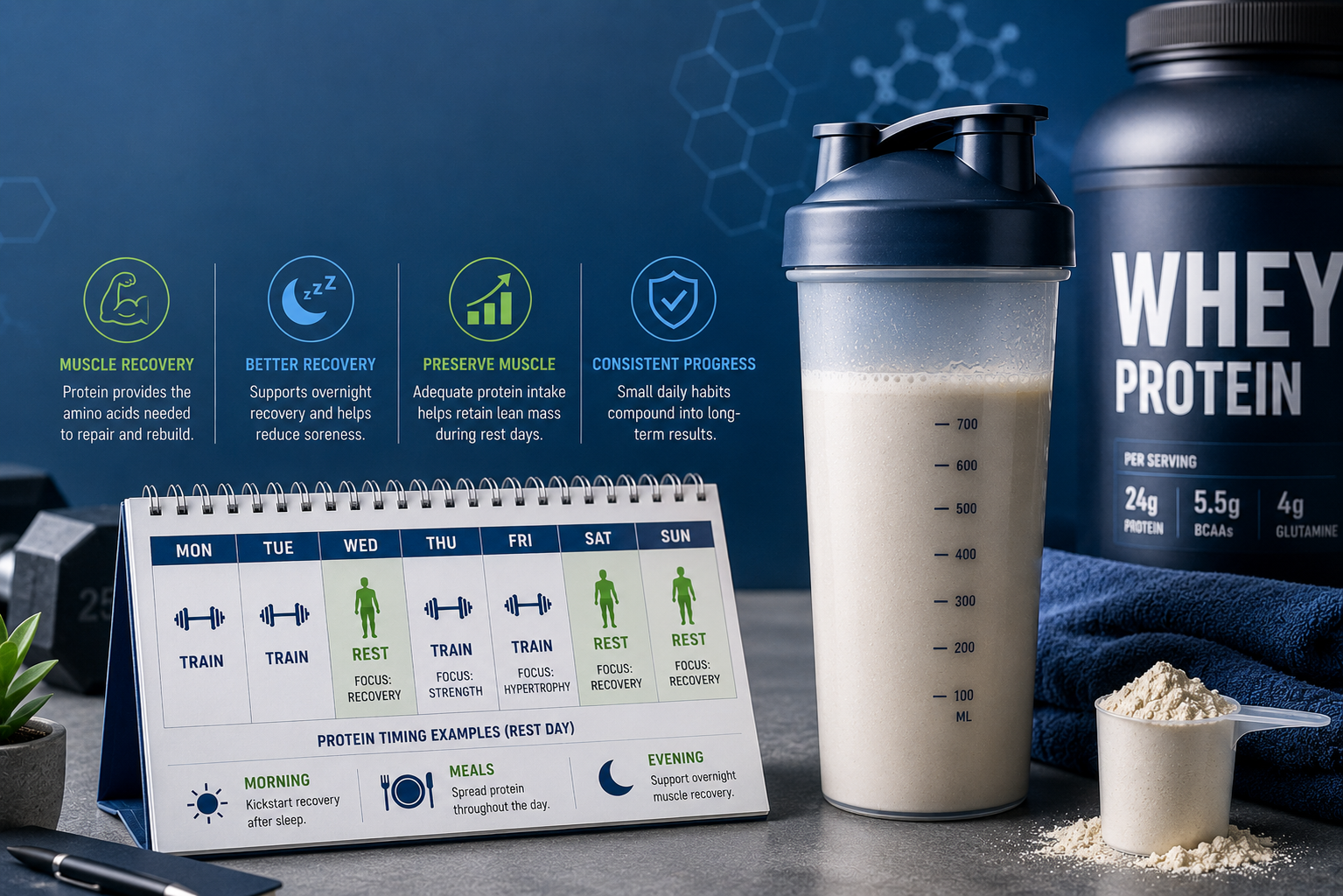
You’re committed to your training program and you take your whey protein shake religiously after every workout. But then rest day comes, and you’re standing in your kitchen wondering: should I still take whey protein today? I’m not training, so do I even need it?
If you train for body composition goals, you’ve probably heard that it’s best to take whey after training. However, what about taking whey protein on rest days? After all, you need quality protein when you’re recovering too.
So, can you take whey protein on rest days? Yes, whey protein can be used on any day and at any time where a protein-rich meal would be beneficial, which includes rest days. Your muscles don’t stop needing protein just because you’re not in the gym. In fact, rest days are when most of your muscle recovery and growth actually occurs, making protein intake just as important – if not more important – than training days.
For people serious about building muscle or improving their physique, understanding how to optimize protein intake across the entire week (not just training days) is crucial. Many people make the mistake of prioritizing protein only around workouts while neglecting rest days, potentially leaving significant gains on the table.
In this comprehensive guide, I’ll explain whether you actually need to take whey on rest days (spoiler: it depends on your total protein intake), when the best times are to take whey on rest days if you choose to use it, how much whey you should consume on rest days, the science behind protein needs during recovery, and how to decide if whey on rest days makes sense for your specific situation.
Whether you’re trying to maximize muscle growth, preserve muscle while cutting, or simply optimize your nutrition strategy, understanding protein requirements on rest days will help you make informed decisions about your supplementation.
Let’s examine what happens in your body on rest days and how whey protein fits into optimal recovery.
TABLE OF CONTENTS
Do You Actually NEED to Take Whey Protein on Rest Days?
While you certainly can take whey on rest days to supplement your protein intake, let’s be clear: you don’t need to do this as an obligation or requirement for results.
Some people might read this article and think they’ve discovered a new mandatory rule for achieving good results. That’s not the case with whey on rest days.
Understanding Protein Needs on Rest Days
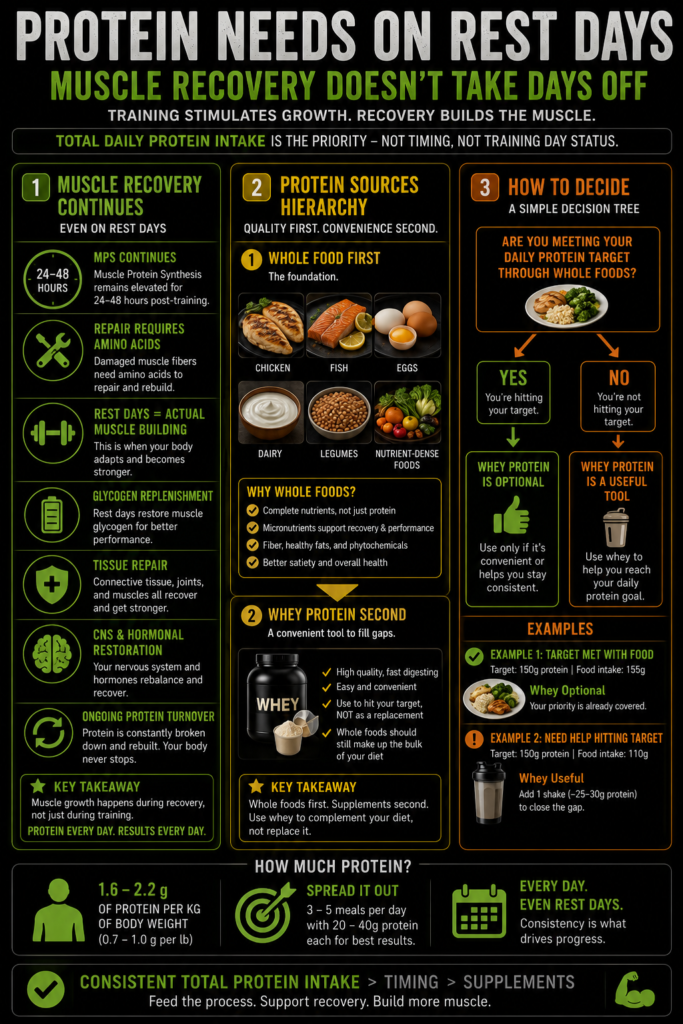
It’s essential to consume sufficient protein both on training days and rest days. Protein is vital for recovery and muscle building, which occurs primarily when you’re resting, not when you’re training.
What happens on rest days:
Muscle protein synthesis (MPS) continues:
- Training damages muscle fibers (micro-tears)
- Repair occurs in the hours and days after training
- This repair process requires amino acids (from protein)
- MPS remains elevated for 24-48 hours after training
- Rest days are when actual muscle building happens
Recovery processes are active:
- Glycogen replenishment in muscles
- Repair of connective tissue, tendons, ligaments
- Central nervous system recovery
- Hormonal restoration (testosterone, growth hormone)
- All of these require protein and other nutrients
Muscle protein breakdown (MPB) is ongoing:
- Your body constantly breaks down and rebuilds muscle protein
- Even at rest, this turnover continues
- Need adequate protein to maintain positive protein balance
- Without enough protein, you can lose muscle even on rest days
The fundamental truth: Your body doesn’t take a day off from needing protein just because you didn’t train.
But Here’s the Important Qualifier
However, if you’re already consuming sufficient protein through whole foods, there’s no obligation to supplement with protein shakes on rest days.
The hierarchy of protein sources:
First priority: Whole food protein
- Chicken, turkey, fish, beef, pork
- Eggs and dairy products
- Legumes for plant-based eaters
- These provide protein PLUS micronutrients, minerals, and other beneficial compounds
- Always prefer whole foods when possible
Second priority: Protein supplementation
- Whey protein, casein, plant-based proteins
- Used to fill gaps when whole foods aren’t practical or sufficient
- Convenience tool, not a replacement for real food
The decision tree for rest days:
Question 1: Are you meeting your daily protein target through whole foods?
- If YES → Whey protein on rest days is optional (for convenience only)
- If NO → Whey protein on rest days is a useful tool to hit your target
Question 2: How much protein do you need daily?
- Generally 0.7-1g per pound of body weight for muscle building
- Example: 180 lb person needs 126-180g protein daily
- This target is the same on training and rest days
Question 3: How much protein are you getting from food?
- Track for a few days to see actual intake
- Count all protein sources (meat, eggs, dairy, grains, vegetables)
- Find the gap between target and actual intake
Question 4: Is that gap best filled with whey or more whole food?
- Gap of 20-30g: Could easily add an extra chicken breast, eggs, or Greek yogurt
- Gap of 40-60g: Might be more practical to use 1-2 whey shakes
- Gap of 80g+: Combination of more whole foods AND whey
Example Scenarios
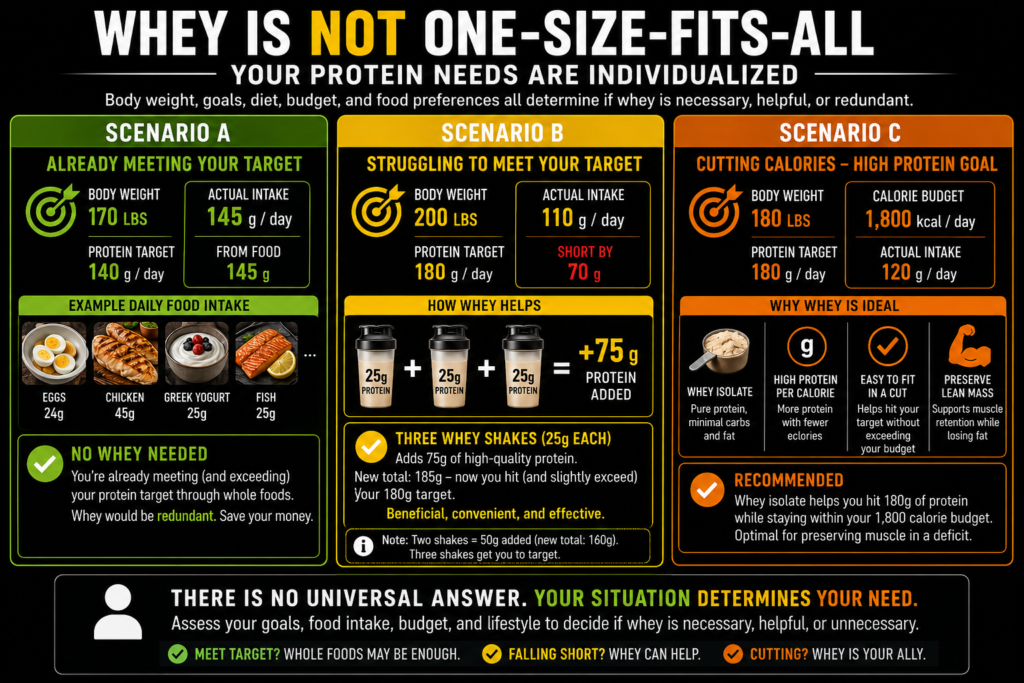
Scenario A: Person already meeting protein needs
Profile:
- 170 lb individual
- Protein target: 140g daily
- Current intake from food: 145g daily
Breakdown:
- Breakfast: 4 eggs = 24g
- Lunch: 6 oz chicken + rice + vegetables = 50g
- Snack: Greek yogurt = 20g
- Dinner: 8 oz fish + potato = 51g
- Total: 145g
Should they take whey on rest days?
- Absolutely not necessary
- Already exceeding target with whole foods
- Whey would be redundant (and extra calories if cutting)
- Save your money
Scenario B: Person struggling to meet protein needs
Profile:
- 200 lb individual
- Protein target: 180g daily
- Current intake from food: 110g daily
Breakdown:
- Breakfast: Oatmeal + banana = 8g
- Lunch: Sandwich with 3 oz deli meat = 25g
- Snack: Handful of nuts = 7g
- Dinner: 6 oz chicken + vegetables = 52g
- Evening: Protein bar = 18g
- Total: 110g (70g short of target)
Should they take whey on rest days?
- Yes, very beneficial
- 2 whey shakes (50g protein) gets them to 160g (much closer)
- Alternative: Significantly increase portion sizes at meals
- Whey is often more convenient and cost-effective
Scenario C: Person cutting calories
Profile:
- 180 lb individual trying to lose fat
- Protein target: 180g daily (high protein helps preserve muscle during cut)
- Calorie budget: 1800 daily
- Current intake from food: 120g
Challenge:
- Need high protein but limited calories
- Whole foods provide protein + calories from fats/carbs
- Whey isolate provides pure protein with minimal extra calories
Should they take whey on rest days?
- Highly recommended
- 2 scoops whey isolate = 50g protein, only 220 calories
- Same protein from chicken = 50g protein, 275 calories (still good)
- Same protein from nuts = 50g protein, 900+ calories (terrible for cutting)
- Whey helps hit protein target without exceeding calorie budget
The Bottom Line on “Needing” Whey on Rest Days
You need adequate protein on rest days – that’s non-negotiable for muscle building and recovery.
You don’t need whey specifically – it’s just one convenient tool for getting that protein.
If whole foods provide all your protein, skip the whey and save your money. If you’re struggling to hit your target from food alone, whey on rest days is a smart strategy.
When Should You Take Whey on Rest Days?
Unlike some supplements that need to be taken at specific times to serve their purpose (like pre-workout before training), you can take whey protein at any time and receive all its benefits.
Your Body Doesn’t Care About Timing (Much)
The fundamental truth:
Your body doesn’t know where the protein you eat or drink comes from. It only knows that you’ve just provided what it needs for muscle building.
When your body breaks down digested protein into amino acids and they enter your bloodstream, they simply do their job. It doesn’t matter if those amino acids came from an egg, chicken breast, or whey protein.
The amino acid pool concept:
Think of your body as having an “amino acid pool” – a reservoir of available amino acids from all protein sources consumed throughout the day:
- Eat chicken: Amino acids added to the pool
- Drink whey shake: More amino acids added to the pool
- Your muscles draw from this pool as needed for protein synthesis
- The pool is replenished with each protein feeding
What this means practically:
There’s no “magic window” on rest days where whey works better or worse. The total amount of protein you consume throughout the day matters far more than the specific timing.
Strategic Times to Use Whey on Rest Days
That said, certain times might be more convenient or practical for consuming whey on rest days:
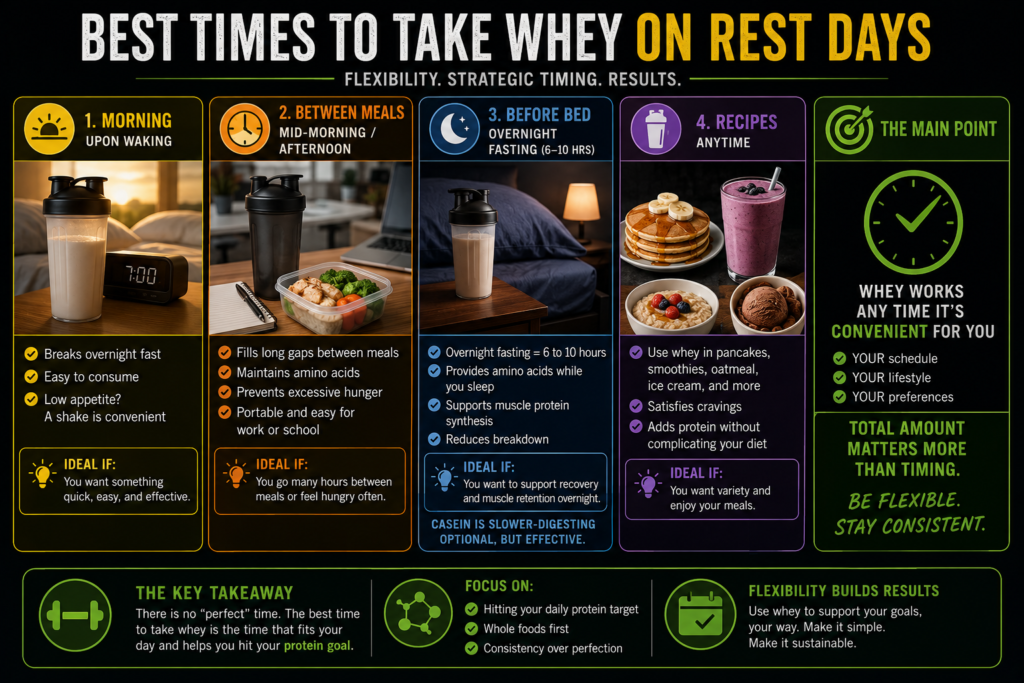
Morning (Upon Waking)
Why this timing works well:
Some people don’t feel hungry in the morning:
- The thought of eating solid food is unappealing
- But you’ve been fasting overnight (8+ hours without protein)
- A shake containing whey + a carbohydrate source (like a banana or oats) goes down easily
- Provides protein to start the day
Example morning shake:
- 1 scoop whey protein (25g)
- 1 banana (1g protein, 27g carbs)
- 1 cup almond milk (1g protein)
- Optional: 1 tbsp peanut butter (4g protein, healthy fats)
- Total: ~30g protein, easy to consume
Post-breakfast supplement:
- If you eat a low-protein breakfast (toast, cereal, oatmeal)
- Add a whey shake to boost total protein
- Brings the meal up to adequate protein levels
Between Meals (Mid-Morning or Afternoon)
Why this timing works well:
Long gaps between meals:
- If you eat breakfast at 8 AM and lunch at 1 PM (5-hour gap)
- Adding protein mid-morning maintains amino acid availability
- Supports continuous muscle protein synthesis
- Prevents excessive hunger at lunch
Low-protein meal supplementation:
- When a solid meal is inherently low in protein
- Example: Pasta-heavy lunch with minimal meat
- Add a shake to complement the meal
- Brings total protein up to target
Convenience factor:
- At work or school where cooking isn’t possible
- Shake is portable, requires no refrigeration (powder form)
- Mix with water in a shaker bottle
- 60-second protein intake
Before Bed
Why this timing works well:
Overnight fasting period:
- You’ll go 6-10 hours without eating (while sleeping)
- Provides amino acids during this fasting period
- May support overnight muscle protein synthesis
- Reduces muscle protein breakdown
Appetite management:
- Maybe you don’t feel very hungry before bed
- But you haven’t consumed all the protein you need for the day
- A shake is easier to consume than a full meal
- Whey before bed works very well for this purpose
The casein consideration:
Some people prefer casein protein before bed:
- Casein digests more slowly than whey
- Provides gradual amino acid release throughout the night
- May be theoretically superior for overnight muscle protein synthesis
- But whey still works fine if that’s what you have
Research shows the difference is marginal – total daily protein matters more than whey vs. casein timing.
As Part of Recipes (Anytime)
Why this approach works well:
Satisfies sweet cravings:
- Most whey proteins have sweet flavors (vanilla, chocolate, strawberry, etc.)
- Can be incorporated into recipes
- Helps during restrictive diets where cravings are common
- Provides protein while satisfying desire for treats
Example whey protein recipes:
Protein pancakes:
- Mix whey with eggs, banana, oats
- Creates high-protein breakfast
- Satisfying and nutritious
Protein ice cream:
- Blend whey with frozen banana, ice, almond milk
- Creates dessert-like treat
- High protein, relatively low calorie
Protein oatmeal:
- Cook oats, stir in whey protein after cooking
- Boosts protein content of standard oatmeal
- Adds flavor without extra preparation
Protein smoothies:
- Whey + fruits + vegetables + liquid
- Complete meal replacement
- Easy to consume, nutrient-dense
The Main Point About Timing
You can take whey protein at any time on rest days:
- Morning when you wake up
- Before going to bed
- With or between meals
- Whenever it’s convenient for YOUR schedule
The most important thing about protein consumption on rest days is the total amount you consume, not the timing.
The frequency consideration:
Some research suggests spreading protein intake across 3-5 meals/feedings optimizes muscle protein synthesis:
- Each feeding should contain 20-40g protein
- Spaced 3-5 hours apart
- This pattern may be slightly superior to 1-2 large protein meals
- But total daily protein still matters most
Example distribution on rest day:
Option A – 4 protein feedings (optimal):
- Meal 1 (8 AM): 35g protein from eggs and toast
- Meal 2 (12 PM): 45g protein from chicken and rice
- Meal 3 (4 PM): Whey shake 25g protein
- Meal 4 (8 PM): 55g protein from steak and vegetables
- Total: 160g protein
Option B – 3 protein feedings (still good):
- Meal 1 (9 AM): Whey shake + oatmeal 30g protein
- Meal 2 (2 PM): 60g protein from large chicken meal
- Meal 3 (8 PM): 70g protein from large fish meal
- Total: 160g protein
Both approaches provide the same total protein. Option A with more frequent feedings may be marginally better, but the difference is small.
Beyond Whey: Real Food Works Just as Well
Also important to remember: Protein from “real food” will work just as well at any of the times mentioned above.
A protein shake is simply a convenience to make your life easier when you need it.
If you have access to whole foods and prefer them, there’s no reason to force yourself to use whey protein. Examples:
Instead of morning whey shake:
- 4 eggs scrambled with vegetables (24g protein)
- Greek yogurt with berries (20-25g protein)
- Cottage cheese with fruit (25-30g protein)
Instead of between-meal whey shake:
- Handful of beef jerky (20g protein)
- Can of tuna (30g protein)
- Protein bar (20g protein, though these are processed)
Instead of before-bed whey shake:
- Cottage cheese (28g protein per cup, slow-digesting like casein)
- Hard-boiled eggs (12g protein for 2 eggs)
- Leftover chicken from dinner (25g protein for 4 oz)
Whey protein is a tool for convenience and filling gaps, not a mandatory requirement.
Whey Protein Dosage on Rest Days
If you choose to take whey on rest days through a shake, it’s important to use the correct amount. Take too little, and you won’t adequately stimulate muscle protein synthesis. Take too much, and you’re wasting money.
The Optimal Dose Per Serving
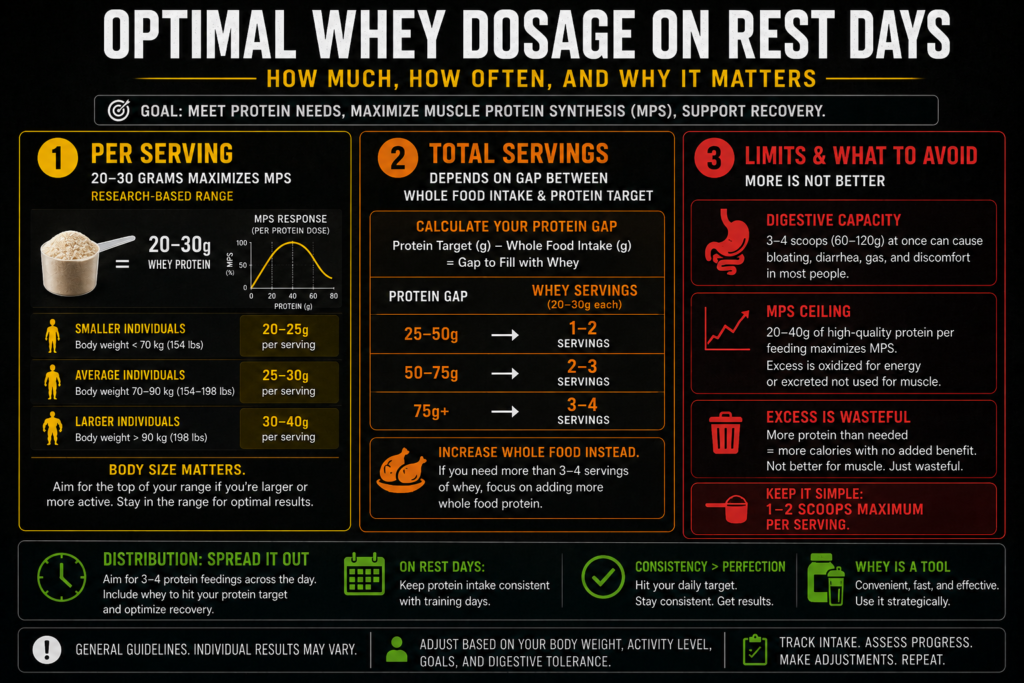
Generally, you should consume 20-30 grams of protein per serving. This amount maximizes muscle protein synthesis, at least when using a high-quality source like whey.
The research behind this recommendation:
Study 1 – Dose-response:
- Examined muscle protein synthesis response to various protein doses
- 20g protein: Near-maximal MPS stimulation
- 40g protein: Marginal additional benefit (maybe 5-10% more MPS)
- 60g protein: No additional benefit over 40g
- Excess amino acids oxidized (burned) rather than used for muscle building
Study 2 – Optimal dose varies by body size:
- Smaller individuals (130-150 lbs): 20-25g sufficient
- Average individuals (160-180 lbs): 25-30g optimal
- Larger individuals (200+ lbs): 30-40g may be beneficial
The practical guideline:
0.25-0.4g protein per kg body weight per meal optimizes muscle protein synthesis.
Examples:
- 150 lb (68 kg) person: 17-27g per serving → 20-25g practical target
- 180 lb (82 kg) person: 20-33g per serving → 25-30g practical target
- 220 lb (100 kg) person: 25-40g per serving → 30-40g practical target
Practical Whey Protein Serving Sizes
For most people and for the sake of simplicity, one scoop of whey protein concentrate containing about 24g of protein is sufficient for use in a protein shake.
Checking your specific whey protein:
Different brands and types vary:
Whey concentrate:
- Typically 70-80% protein by weight
- One scoop (30-35g powder) = 21-28g protein
- Usually 120-140 calories per scoop
Whey isolate:
- Typically 90%+ protein by weight
- One scoop (30g powder) = 25-28g protein
- Usually 100-110 calories per scoop
Whey hydrolysate:
- Similar to isolate in protein content
- Pre-digested for faster absorption
- One scoop (30g powder) = 24-27g protein
Check your label:
- Look at “protein per serving”
- Serving size might be 1 scoop or 2 scoops depending on brand
- Adjust your intake based on the actual protein content
How Many Servings on Rest Days?
This depends entirely on your total daily protein target and how much you’re getting from whole foods.
Example calculation:
Person: 180 lbs, targeting 1g protein per pound = 180g daily
Whole food intake on rest day:
- Breakfast: 2 eggs + toast = 14g
- Lunch: 5 oz chicken + rice = 40g
- Dinner: 6 oz fish + vegetables = 45g
- Total from whole foods: 99g
Gap to fill: 180g target – 99g from food = 81g needed
Whey servings needed: 81g ÷ 25g per scoop = ~3 scoops (or 3 separate shakes throughout the day)
Distribution on this rest day:
- Mid-morning: 1 scoop whey shake (25g)
- Afternoon: 1 scoop whey shake (25g)
- Before bed: 1 scoop whey shake (25g)
- Plus whole foods = 174g total (close to 180g target)
Different example with better whole food intake:
Person: Same 180 lbs, same 180g target
Whole food intake on rest day:
- Breakfast: 4 eggs + Greek yogurt = 40g
- Lunch: 8 oz chicken + rice = 60g
- Snack: Cottage cheese = 25g
- Dinner: 8 oz steak + potato = 56g
- Total from whole foods: 181g
Gap to fill: Already at target!
Whey servings needed: 0 (no whey needed at all on this day)
The principle: Use as much or as little whey as needed to reach your daily protein target. No more, no less.
Can You Take Too Much Whey at Once?
Yes, there are practical limits:
Digestive capacity:
- Taking 3-4 scoops (75-100g protein) in one shake can cause:
- Bloating and discomfort
- Diarrhea
- Gas
- Nausea
- Most people tolerate 1-2 scoops per shake comfortably
Protein synthesis ceiling:
- As mentioned, muscle protein synthesis maxes out around 20-40g per feeding
- 75g protein in one shake doesn’t build more muscle than 30g
- Excess is oxidized (used for energy) or excreted
- Economically wasteful
Calorie consideration:
- If cutting, high-dose whey uses up calorie budget
- 4 scoops = ~400-500 calories
- That’s 25-30% of a 1800-calorie cutting diet
- Leaves less room for whole foods with micronutrients
The recommendation:
Keep individual whey servings to 1-2 scoops (25-50g protein) maximum. If you need more total protein, space out multiple smaller servings throughout the day rather than mega-dosing once.
Quality Over Quantity
Focus on hitting your total daily target with high-quality protein sources (whey qualifies), not on consuming excessive amounts in hopes of better results.
The hierarchy:
Priority 1: Hit your daily protein target (0.7-1g per lb) Priority 2: Distribute protein across 3-5 meals/servings Priority 3: Use appropriate serving sizes (20-40g per feeding)
Everything else is minor details that don’t significantly impact results.
THE BOTTOM LINE: WHEY PROTEIN ON REST DAYS
After examining all aspects of using whey protein on rest days, here’s what you need to understand:
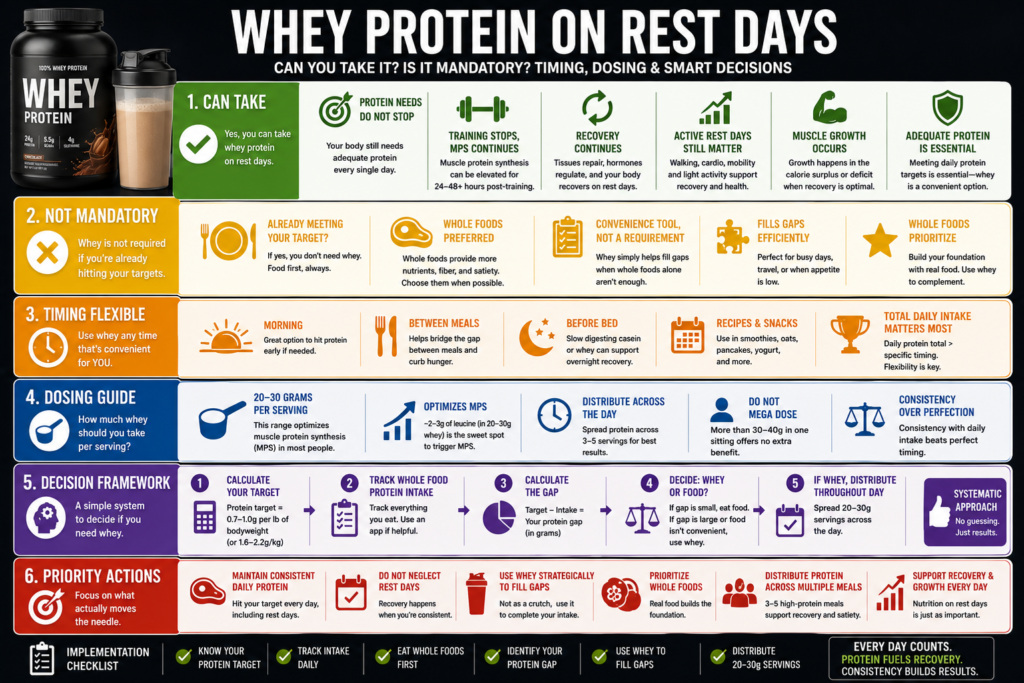
✅ Can Absolutely Take Whey On Rest Days (Protein Needs Don’t Stop When Training Stops)
✅ Not Mandatory If Already Meeting Protein Needs (Whole Foods Preferred When Possible)
✅ Timing Matters Less Than Total Daily Intake (Flexibility In When You Consume It)
✅ 20-30g Per Serving Optimizes Muscle Protein Synthesis (More Isn’t Better)
✅ Use As Needed To Fill Protein Gaps (Convenience Tool, Not Requirement)
✅ Rest Days Are When Muscle Growth Actually Occurs (Recovery Requires Adequate Protein)
Perfect For Using Whey On Rest Days:
- People Struggling To Hit Protein Targets From Food Alone
- Those With Low Appetites In Morning (Shakes Easier Than Solid Food)
- Individuals Cutting Calories (Need High Protein, Limited Calories)
- Busy Professionals Without Time For Frequent Meals
- Anyone Who Finds Whey More Convenient Than Cooking
Not Necessary For:
- Those Already Meeting Protein Targets With Whole Foods
- People Who Prefer Real Food Over Supplements
- Anyone On Tight Budget (Whole Foods Often Cheaper Per Gram Protein)
- Individuals With Adequate Time For Meal Preparation
Why Rest Days Still Require Adequate Protein:
Muscle Protein Synthesis Continues:
- Training damages muscle fibers
- Repair occurs 24-48 hours post-training
- MPS elevated through rest days
- Requires continuous amino acid supply
Recovery Processes Active:
- Glycogen replenishment
- Connective tissue repair
- Central nervous system recovery
- Hormonal restoration
- All require protein and nutrients
Muscle Protein Breakdown Ongoing:
- Constant protein turnover even at rest
- Need adequate protein to maintain positive balance
- Without sufficient protein, can lose muscle on rest days
How Much Protein On Rest Days:
Same As Training Days:
- 0.7-1g per pound of body weight
- Example: 180 lb person needs 126-180g daily
- No reduction on rest days
- Consistency is key
Distribution Across Day:
- 3-5 protein-containing meals/servings
- 20-40g protein per serving
- Spaced 3-5 hours apart
- Maintains elevated muscle protein synthesis
When To Take Whey On Rest Days:
Morning (Upon Waking):
- Easy to consume when appetite is low
- Breaks overnight fast
- Example: Whey + banana + almond milk
Between Meals:
- Fills long gaps between solid meals
- Maintains amino acid availability
- Portable and convenient
Before Bed:
- Provides protein during overnight fast
- Supports overnight recovery
- Whey or casein both work
With Low-Protein Meals:
- Supplements meals naturally low in protein
- Example: Pasta dish + whey shake
- Brings total protein up to target
In Recipes:
- Protein pancakes, smoothies, oatmeal
- Satisfies sweet cravings
- Adds protein to standard meals
Whey Protein Dosage On Rest Days:
Per Serving:
- 20-30g for most people
- Smaller individuals (130-150 lbs): 20-25g
- Average individuals (160-180 lbs): 25-30g
- Larger individuals (200+ lbs): 30-40g
Total Daily Servings:
- Depends on gap between whole food intake and target
- Gap of 25-50g: 1-2 servings whey
- Gap of 50-75g: 2-3 servings whey
- Gap of 75g+: 3-4 servings (but increase whole food intake instead if possible)
Timing Distribution:
- Spread servings throughout day
- Don’t consume all at once
- Example: Morning, afternoon, evening
- Maintains continuous amino acid availability
Decision Framework For Rest Days:
Step 1: Calculate your daily protein target (0.7-1g per lb bodyweight)
Step 2: Track whole food protein intake for a typical rest day
Step 3: Calculate gap between target and actual intake
Step 4: Decide if gap is better filled with whey or more whole food
Step 5: If using whey, distribute servings throughout the day
Common Mistakes To Avoid:
Skipping Protein On Rest Days:
- Myth: Only need protein on training days
- Reality: Rest days are when muscle grows
- Solution: Maintain consistent daily protein intake
Mega-Dosing Whey Once Daily:
- Taking 75-100g protein in one shake
- Exceeds MPS capacity, wastes protein
- Solution: Spread across 3-4 smaller servings
Relying Solely On Whey:
- Using whey for all protein needs
- Missing micronutrients from whole foods
- Solution: Prioritize whole foods, supplement with whey
Assuming Timing Is Critical:
- Obsessing over “perfect” timing
- Creates unnecessary stress and rigidity
- Solution: Focus on total daily intake, timing is secondary
STOP NEGLECTING PROTEIN ON REST DAYS. START MAINTAINING CONSISTENT DAILY PROTEIN INTAKE. USE WHEY STRATEGICALLY TO FILL GAPS. PRIORITIZE WHOLE FOOD PROTEIN SOURCES. DISTRIBUTE PROTEIN ACROSS MULTIPLE MEALS. SUPPORT RECOVERY AND MUSCLE GROWTH EVERY DAY OF THE WEEK.
Ready To Build A Complete Protein Strategy That Optimizes Muscle Recovery And Growth Across Training And Rest Days, Without Overspending On Unnecessary Supplementation? Understanding whey protein on rest days is just one piece. Get a comprehensive nutrition system that includes personalized daily protein targets based on your body composition and goals, meal planning strategies that prioritize whole food protein sources, strategic whey supplementation protocols that fill gaps efficiently, distribution timing for optimal muscle protein synthesis throughout the day, and budget-friendly protein strategies that maximize results per dollar spent. Stop guessing about protein intake and supplement timing. Start following a science-based nutrition plan that supports consistent muscle growth and recovery every single day.
REFERENCES
SECTION 1 — Muscle protein synthesis remains elevated 24-48 hours post-exercise
[1] Phillips SM et al. — PubMed/American Journal of Physiology, 1997 Foundational study measuring mixed muscle protein synthesis (MPS) and breakdown in 8 resistance-trained men at rest, 3 hours, and 24 hours after a single bout of heavy resistance exercise; MPS was elevated by 112% at 3 hours post-exercise and remained significantly elevated at 24 hours post-exercise (65% above baseline); muscle protein breakdown was also elevated at 3 hours but to a lesser degree; the net protein balance remained negative until amino acids were provided; demonstrates that the anabolic response to a training session extends well into the rest period, directly supporting the article’s argument that rest days are when muscle repair and growth occur and why protein intake remains equally important on non-training days https://pubmed.ncbi.nlm.nih.gov/9176786/
SECTION 2 — Per-meal protein dose: 20-40g maximizes muscle protein synthesis
[2] Witard OC et al. — PubMed/American Journal of Clinical Nutrition, 2014 Dose-response study in 48 resistance-trained young men examining MPS rates following ingestion of 0g, 10g, 20g, or 40g whey protein at rest and after resistance exercise; MPS was maximal with 20g post-exercise and only marginally increased (approximately 10-12%) with 40g; excess leucine and amino acid oxidation increased substantially with 40g, indicating that the surplus beyond 20-40g is burned for energy rather than used for muscle building; provides the mechanistic dose-response evidence for the article’s recommendation of 20 to 30g per serving for most people, establishing that mega-dosing a single shake does not proportionally increase muscle building https://pubmed.ncbi.nlm.nih.gov/24257722/
SECTION 3 — Protein distribution across multiple meals outperforms bolus feeding
[3] Areta JL et al. — PubMed/Journal of Physiology, 2013 RCT distributing 80g of whey protein across three patterns during a 12-hour post-exercise window: 8 × 10g every 1.5 hours, 4 × 20g every 3 hours, or 2 × 40g every 6 hours; muscle protein synthesis was greatest with the 4-serving pattern (20g every 3 hours); the bolus condition (40g twice) and the pulse condition (10g frequently) were both inferior; directly supports the article’s recommendation to spread whey intake across 3 to 5 daily servings rather than consuming all protein in one or two large doses, and validates the practical guidance to space protein feedings 3 to 5 hours apart on rest days https://pubmed.ncbi.nlm.nih.gov/23459753/
SECTION 4 — Total daily protein intake is the primary driver of muscle mass gains
[4] Morton RW et al. — PMC/British Journal of Sports Medicine, 2018 Meta-analysis of 49 RCTs (1,863 participants) examining protein supplementation during resistance training; total daily protein intake was the strongest predictor of hypertrophic outcomes; gains in fat-free mass plateaued at approximately 1.62 g/kg/day total protein; neither specific protein sources nor timing were independent significant predictors of outcomes when total protein was accounted for; the most comprehensive dataset establishing that what matters most for muscle building is consistently meeting the daily protein target regardless of which day of the week it is, directly supporting the article’s core argument that rest-day protein intake is equally important as training-day intake https://pmc.ncbi.nlm.nih.gov/articles/PMC5867436/



Leave a Reply
You must be logged in to post a comment.