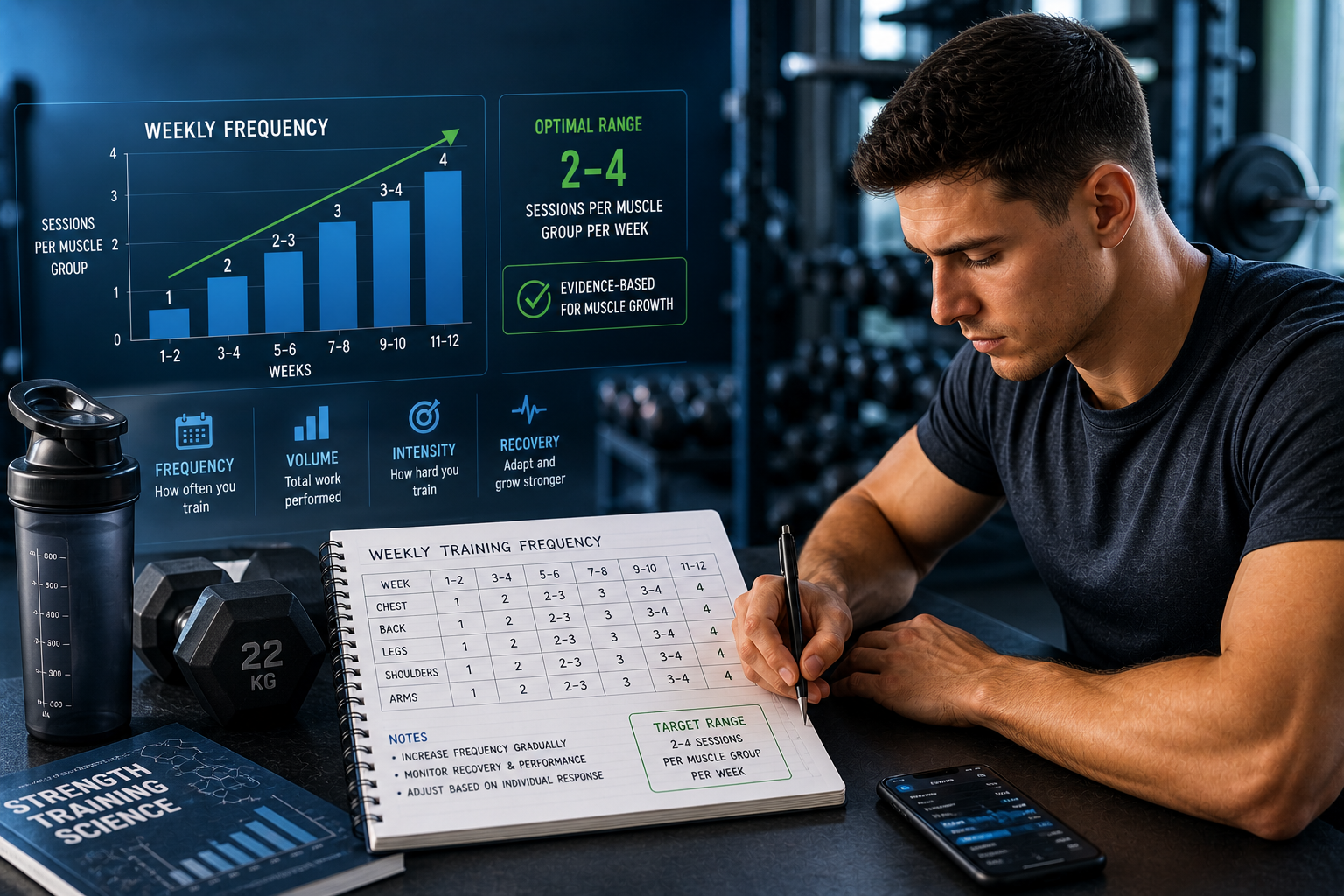
Training each muscle once per week? You’re leaving gains on the table. Here’s what the science actually shows.
You do chest on Monday. Next chest session is the following Monday. Seven days between sessions.
You think this is optimal. “Muscles need a full week to recover.” But you’re wrong.
You believe:
- Once per week is enough
- More frequency means overtraining
- Muscles need 7 days to recover fully
- Bodybuilder splits are optimal
All wrong. The research is clear: Training each muscle 2-3 times per week produces significantly more growth than once per week. Protein synthesis returns to baseline 48-72 hours after training. Waiting 7 days means 4-5 days with no growth stimulus. Higher frequency allows more total weekly volume (the primary growth driver) while maintaining quality per session. The evidence overwhelmingly favors 2-3x per muscle weekly over 1x.
In this comprehensive guide, I’ll explain the muscle protein synthesis timeline (why frequency matters biologically), reveal what the research shows (frequency comparison studies), show you the optimal frequencies by training status (beginner vs. advanced), provide sample splits for each frequency (practical programs), explain how to manage fatigue with higher frequency (the recovery factor), and address the volume-frequency relationship (how they interact).
Whether you’re stuck on a bro-split or trying to optimize your program, understanding training frequency is critical.
Let’s determine your optimal training frequency based on science.
TABLE OF CONTENTS
The Biology of Training Frequency
Why frequency matters physiologically.
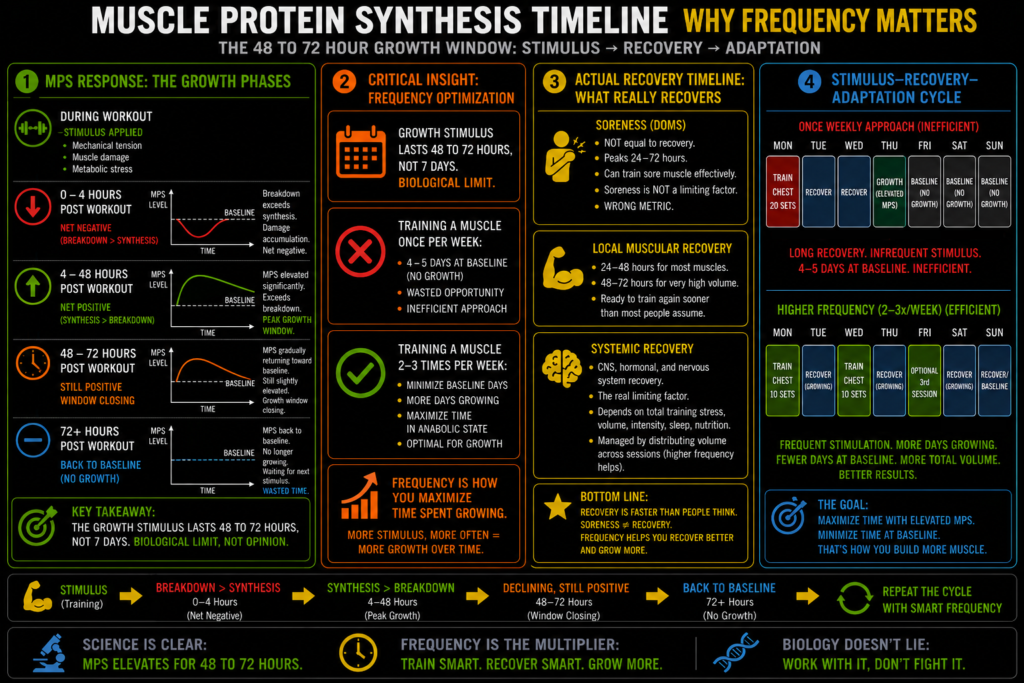
The Muscle Protein Synthesis (MPS) Response
What happens when you train:
During workout:
- Mechanical tension on muscle fibers
- Muscle damage (micro-tears)
- Metabolic stress accumulation
- Stimulus applied
0-4 hours post-workout:
- Muscle protein breakdown exceeds synthesis
- Net negative protein balance
- Damage accumulation phase
- Breakdown period
4-48 hours post-workout:
- Muscle protein synthesis elevated significantly
- Exceeds breakdown
- Net positive protein balance
- Peak growth window
48-72 hours post-workout:
- MPS gradually returning to baseline
- Still slightly elevated
- Growth window closing
- Declining stimulus
72+ hours post-workout:
- MPS back to baseline
- No longer growing from that session
- Waiting for next stimulus
- Baseline state
The critical insight:
- Growth stimulus lasts 48-72 hours, not 7 days
- Training muscle once weekly = 4-5 days at baseline (no growth)
- Training muscle 2-3x weekly = minimize baseline days (more growth)
- Frequency optimization
The Recovery Timeline
The misconception:
- “Muscles need 7 days to fully recover”
- Based on soreness duration
- Wrong metric
The reality:
- Soreness ≠ recovery
- DOMS (delayed onset muscle soreness) peaks 24-72 hours
- But can train sore muscle effectively
- Soreness not limiting factor
Actual recovery timeline:
Local muscular recovery:
- 24-48 hours for most muscles
- 48-72 hours for very high volume sessions
- Ready to train again sooner than you think
- Faster than assumed
Systemic recovery (CNS, hormonal):
- Can be limiting factor
- Depends on total training stress
- Managed by distributing volume across sessions
- Frequency helps here too
The principle:
- Can recover from moderate session in 24-48 hours
- Can’t recover from massive session in 7 days
- Better to split volume across multiple sessions
- Distributed load
The Stimulus-Recovery-Adaptation Cycle
Traditional once-weekly approach:
- Monday: Train chest (massive 20-set session)
- Tuesday-Sunday: Recover
- Next Monday: Repeat
- Long recovery, infrequent stimulus
The problems:
- Tuesday-Thursday: Growth occurring
- Friday-Sunday: Baseline (no growth, just waiting)
- 4 days wasted per week
- Inefficient
Higher frequency approach (2-3x weekly):
- Monday: Train chest (10 sets)
- Tuesday: Recovering and growing
- Wednesday: Baseline reached, train chest again (10 sets)
- Thursday: Recovering and growing
- Friday: Baseline reached, train chest again (optional third session)
- Frequent stimulation
The benefit:
- More days spent growing
- Fewer days at baseline
- More total weekly volume possible
- Optimized growth
What the Research Shows
The evidence base.
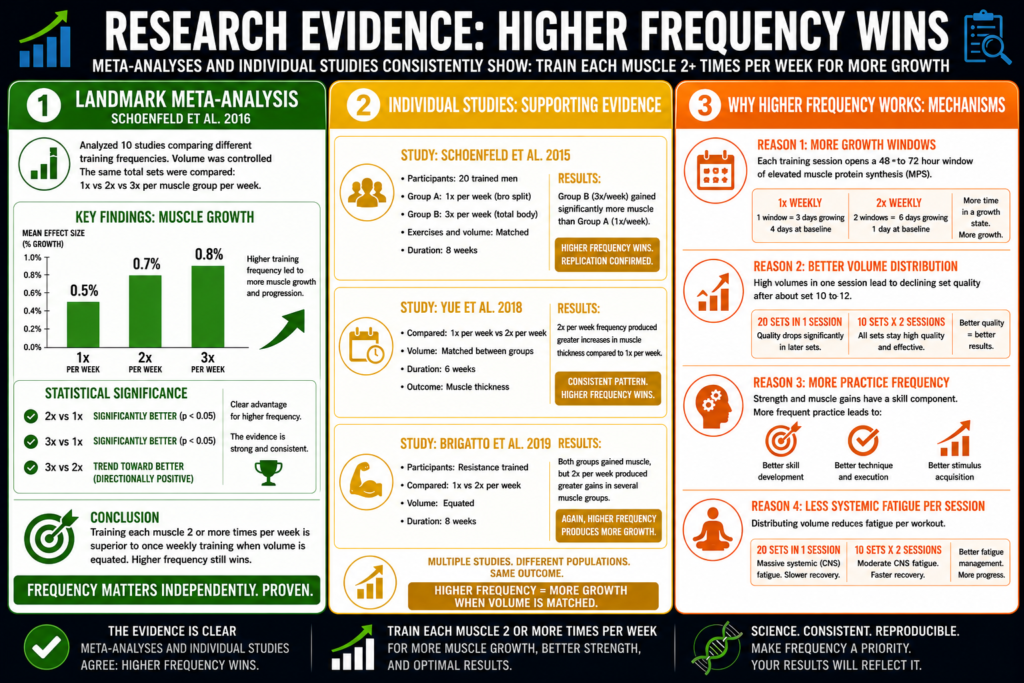
The Landmark Meta-Analysis (Schoenfeld et al., 2016)
The study:
- Analyzed 10 studies comparing training frequencies
- Controlled for volume (same total sets per week)
- Compared 1x vs. 2x vs. 3x per muscle weekly
- Comprehensive analysis
Key findings:
Muscle growth results:
- 1x per week: 0.5% growth per week
- 2x per week: 0.7% growth per week
- 3x per week: 0.8% growth per week
- Higher frequency = more growth
Statistical significance:
- 2x vs. 1x: Significantly better (p < 0.05)
- 3x vs. 1x: Significantly better (p < 0.05)
- 3x vs. 2x: Trend toward better (not statistically significant, but directionally positive)
- Clear advantage to higher frequency
The conclusion:
- Training each muscle 2+ times per week superior to once weekly
- When volume equated, higher frequency still wins
- Frequency matters independently
Individual Studies Supporting Higher Frequency
Study 1 (Schoenfeld et al., 2015):
- 20 trained men
- Group A: 1x per week (bro-split)
- Group B: 3x per week (total body)
- Same exercises, same total volume
- Duration: 8 weeks
- Results: Group B (3x) gained significantly more muscle
- Higher frequency wins
Study 2 (Yue et al., 2018):
- Compared 1x vs. 2x frequency
- Matched volume
- Duration: 6 weeks
- Results: 2x frequency produced greater increases in muscle thickness
- Replication of findings
Study 3 (Brigatto et al., 2019):
- Resistance-trained men
- 1x vs. 2x per muscle weekly
- Volume equated
- Duration: 8 weeks
- Results: Both groups gained muscle, but 2x had greater gains in several muscle groups
- Consistent pattern
The Mechanism Explained
Why does higher frequency work better?
Reason 1: More growth windows
- Each training session opens 48-72 hour growth window
- 1x weekly: One growth window (3 days growing, 4 days baseline)
- 2x weekly: Two growth windows (6 days growing, 1 day baseline)
- More time spent growing
Reason 2: Better volume distribution
- 20 sets in one session: Quality declines after set 10-12
- 10 sets x 2 sessions: All sets high quality
- More effective total volume
- Quality per set maintained
Reason 3: More practice frequency
- Strength has skill component
- More frequent practice = better skill development
- Better technique = better stimulus
- Skill acquisition
Reason 4: Less systemic fatigue per session
- 20-set chest session: Massive CNS fatigue
- 10-set chest session: Moderate CNS fatigue
- Faster recovery between sessions
- Fatigue management
Optimal Frequency by Training Status
Different needs for different levels.
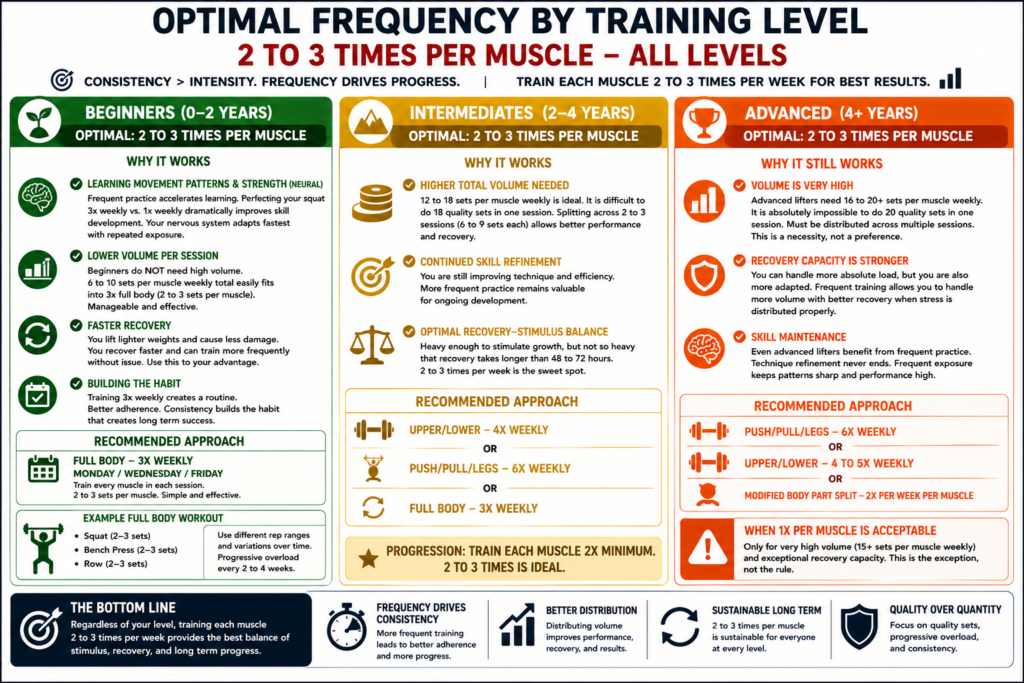
Beginners (0-2 Years Training)
Optimal frequency: 2-3x per muscle weekly
Why this works for beginners:
Reason 1: Learning movement patterns
- Strength is neural in beginners
- Frequent practice accelerates learning
- Perfect squat form faster with 3x weekly vs. 1x
- Skill development priority
Reason 2: Lower volume per session
- Beginners don’t need high volume (6-10 sets per muscle weekly total)
- Can easily fit into 3x weekly full-body
- 2-3 sets per muscle per session
- Manageable sessions
Reason 3: Faster recovery
- Beginners lift lighter weights
- Less muscle damage
- Recover faster
- Can train more frequently
- Recovery advantage
Reason 4: Building the habit
- 3x weekly creates routine
- Better adherence
- More consistent
- Habit formation
Recommended split:
- Full-body workouts 3x weekly (Monday, Wednesday, Friday)
- Every muscle trained each session
- 2-3 sets per muscle per session
- Total body approach
Example:
- Squat, Bench, Row every session
- Different rep ranges or variations each day
- Progressive overload weekly
- Simple and effective
Intermediates (2-4 Years Training)
Optimal frequency: 2-3x per muscle weekly
Why this works for intermediates:
Reason 1: Higher total volume needed
- Intermediates need 12-18 sets per muscle weekly
- Difficult to do quality 18 sets in one session
- Split across 2-3 sessions: 6-9 sets each (manageable)
- Volume distribution
Reason 2: Continued skill refinement
- Still improving technique on lifts
- Frequent practice valuable
- Technical development
Reason 3: Optimal recovery-stimulus balance
- Heavy enough that 1x weekly insufficient
- Not so heavy that can’t recover in 48-72 hours
- Sweet spot
Recommended splits:
Option A: Upper/Lower 4x weekly
- Monday: Upper
- Tuesday: Lower
- Thursday: Upper
- Friday: Lower
- Each muscle 2x weekly
- Classic intermediate split
Option B: Push/Pull/Legs 6x weekly
- Monday: Push
- Tuesday: Pull
- Wednesday: Legs
- Thursday: Push
- Friday: Pull
- Saturday: Legs
- Each muscle 2x weekly
- Higher frequency option
Option C: Full-body 3x weekly (still viable)
- If recovery good and enjoy full-body
- Higher sets per muscle per session than beginner
- 4-6 sets per muscle per session
- Full-body progression
Advanced (4+ Years Training)
Optimal frequency: 2-3x per muscle weekly (same as intermediate)
The surprise:
- Advanced don’t need lower frequency
- Still benefit from 2-3x weekly
- Consistency across levels
Why higher frequency still works:
Reason 1: Volume can be very high
- Advanced may need 16-20+ sets per muscle weekly
- Absolutely can’t do quality 20 sets in one session
- Must distribute across multiple sessions
- Volume necessity
Reason 2: Recovery capacity
- Advanced lifters are stronger (more absolute load)
- But also more adapted (better recovery)
- Can handle frequent training if volume distributed
- Adaptation to stress
Reason 3: Skill maintenance
- Even advanced benefit from frequent practice
- Technique refinement never ends
- Continued development
Recommended splits:
Option A: Push/Pull/Legs 6x weekly
- Each muscle 2x weekly
- High volume per session possible
- Classic advanced split
Option B: Upper/Lower 4-5x weekly
- Monday: Upper
- Tuesday: Lower
- Wednesday: Off or optional session
- Thursday: Upper
- Friday: Lower
- Saturday: Optional fifth session
- Flexible advanced split
Option C: Body part split with higher frequency
- Not traditional bro-split (1x weekly)
- But chest/back, shoulders/arms, legs repeated 2x weekly
- Modified body part split
When 1x weekly might be acceptable for advanced:
- Only if very high volume per session (15+ sets) sustainable
- And recovery exceptional
- Rare scenario
- Exception, not rule
The Volume-Frequency Relationship
How these variables interact.
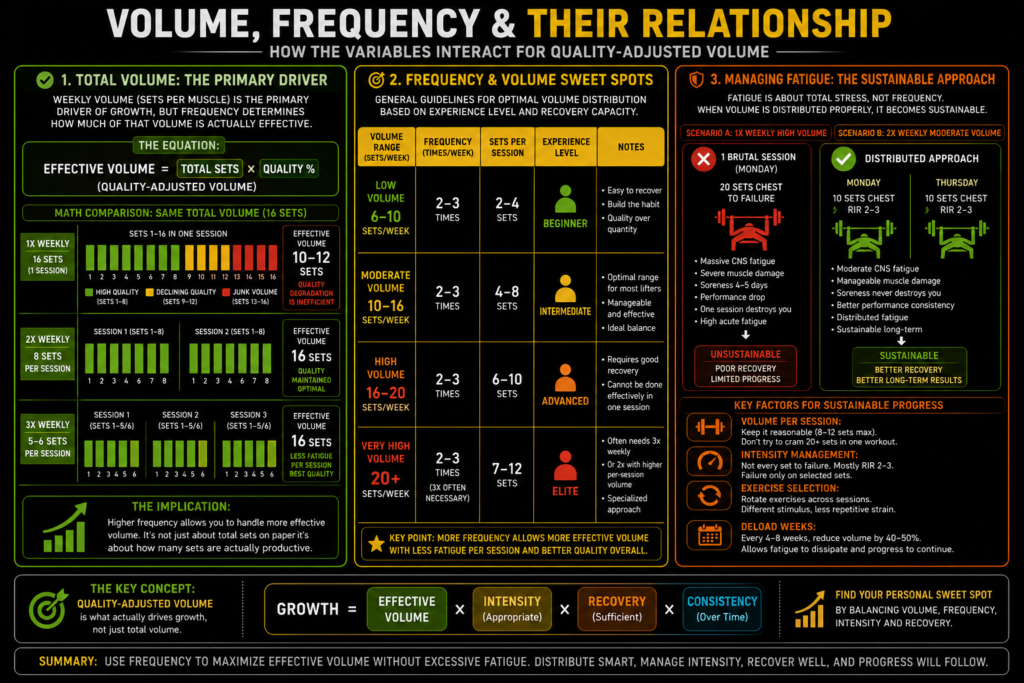
The Total Volume Equation
The principle:
- Weekly volume (sets per muscle) is primary growth driver
- But frequency affects achievable volume
- Interactive relationship
The math:
1x weekly approach:
- Need all 16 sets in one session
- Sets 1-8: High quality
- Sets 9-12: Declining quality
- Sets 13-16: Junk volume (too fatigued)
- Effective volume: ~10-12 sets
- Quality degradation
2x weekly approach:
- 8 sets per session
- All sets high quality
- Effective volume: 16 sets
- Quality maintained
3x weekly approach:
- 5-6 sets per session
- All sets very high quality
- Effective volume: 16 sets
- Less fatigue per session
- Optimal quality
The implication:
- Higher frequency allows more effective volume
- Not just theoretical volume, but actually productive sets
- Quality-adjusted volume
The Frequency-Volume Sweet Spots
By total weekly volume:
Low volume (6-10 sets per muscle weekly):
- 2-3x frequency works well
- 2-4 sets per session
- Easy to recover
- Beginner range
Moderate volume (10-16 sets per muscle weekly):
- 2-3x frequency optimal
- 4-8 sets per session
- Manageable and effective
- Intermediate range
High volume (16-20 sets per muscle weekly):
- 2-3x frequency necessary
- 6-10 sets per session
- Can’t effectively do in one session
- Advanced range
Very high volume (20+ sets per muscle weekly):
- 3x frequency often required
- 7-8 sets per session
- Or 2x with 10-12 sets (challenging)
- Elite/specialized range
Managing Fatigue with Higher Frequency
The concern:
- “Won’t training muscle 3x weekly lead to overtraining?”
- Valid question
The answer:
- Not if volume distributed properly
- Fatigue is about total stress, not frequency
- Context-dependent
The comparison:
Scenario A: 1x weekly, high volume per session
- Monday: 20 sets chest to failure
- Massive CNS fatigue
- Soreness for 4-5 days
- One brutal session
- High acute fatigue
Scenario B: 2x weekly, moderate volume per session
- Monday: 10 sets chest, RIR 2-3
- Thursday: 10 sets chest, RIR 2-3
- Moderate CNS fatigue each session
- Soreness manageable
- Never destroyed
- Distributed fatigue
The result:
- Scenario B: Same total volume, less fatigue
- More sustainable
- Better recovery
- Frequency helps fatigue management
The key factors:
1. Volume per session:
- Keep individual sessions reasonable (8-12 sets per muscle max)
- Don’t try to cram 20 sets into one session
- Session volume control
2. Intensity management:
- Not every set to failure
- Mostly RIR 2-3
- Occasional failure sets
- Controlled intensity
3. Exercise selection:
- Rotate exercises across sessions
- Reduces repetitive strain
- Different stimulus
- Variety
4. Deload weeks:
- Every 4-8 weeks reduce volume 40-50%
- Dissipate accumulated fatigue
- Periodic recovery
Sample Training Splits by Frequency
Practical implementation.
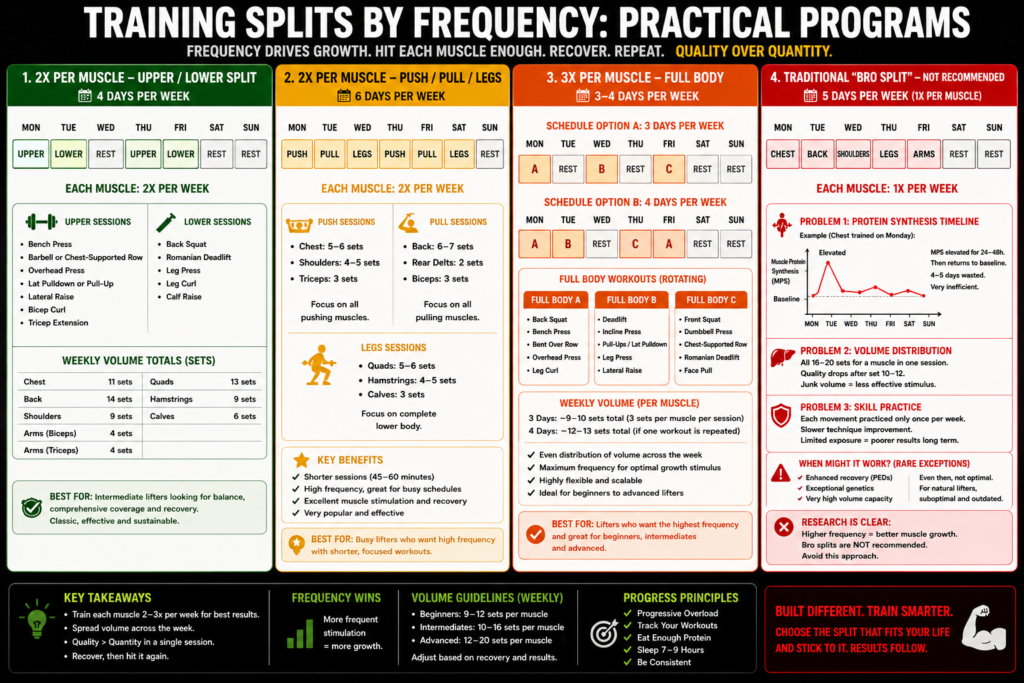
2x Per Muscle: Upper/Lower Split
Schedule:
- Monday: Upper
- Tuesday: Lower
- Thursday: Upper
- Friday: Lower
- 4 days per week
Monday: Upper A
- Bench Press: 4 sets x 6-8 reps
- Bent-Over Row: 4 sets x 8-10 reps
- Overhead Press: 3 sets x 8-10 reps
- Lat Pulldown: 3 sets x 10-12 reps
- Lateral Raise: 3 sets x 12-15 reps
- Bicep Curl: 2 sets x 10-12 reps
- Tricep Extension: 2 sets x 10-12 reps
- Upper body A workout
Tuesday: Lower A
- Squat: 4 sets x 6-8 reps
- Romanian Deadlift: 3 sets x 8-10 reps
- Leg Press: 3 sets x 10-12 reps
- Leg Curl: 3 sets x 10-12 reps
- Calf Raise: 4 sets x 12-15 reps
- Lower body A workout
Thursday: Upper B
- Incline DB Press: 4 sets x 8-10 reps
- Pull-Ups: 4 sets x 6-10 reps
- DB Shoulder Press: 3 sets x 8-10 reps
- Cable Row: 3 sets x 10-12 reps
- Cable Fly: 3 sets x 12-15 reps
- Hammer Curl: 2 sets x 10-12 reps
- Rope Pushdown: 2 sets x 10-12 reps
- Upper body B workout
Friday: Lower B
- Deadlift: 3 sets x 5-8 reps
- Bulgarian Split Squat: 3 sets x 8-10 reps
- Leg Extension: 3 sets x 12-15 reps
- Nordic Curl: 3 sets x 6-10 reps
- Seated Calf Raise: 4 sets x 12-15 reps
- Lower body B workout
Weekly volume totals:
- Chest: 11 sets (2x frequency)
- Back: 14 sets (2x frequency)
- Shoulders: 9 sets (2x frequency)
- Quads: 13 sets (2x frequency)
- Hamstrings: 9 sets (2x frequency)
- Arms: 4 sets each (2x frequency)
- Comprehensive coverage
2x Per Muscle: Push/Pull/Legs (6 Days)
Schedule:
- Monday: Push
- Tuesday: Pull
- Wednesday: Legs
- Thursday: Push
- Friday: Pull
- Saturday: Legs
- Sunday: Off
- 6 days per week
Push sessions (Monday, Thursday):
- Chest: 5-6 sets total
- Shoulders: 4-5 sets total
- Triceps: 3 sets total
- Pushing muscles
Pull sessions (Tuesday, Friday):
- Back: 6-7 sets total
- Rear delts: 2 sets total
- Biceps: 3 sets total
- Pulling muscles
Leg sessions (Wednesday, Saturday):
- Quads: 5-6 sets total
- Hamstrings: 4-5 sets total
- Calves: 3 sets total
- Lower body
Benefits:
- Each muscle 2x weekly
- Shorter sessions (45-60 min)
- Good for busy schedules
- Time-efficient
3x Per Muscle: Full-Body (3-4 Days)
Schedule option A (3 days):
- Monday: Full-body A
- Wednesday: Full-body B
- Friday: Full-body C
- 3 days per week
Schedule option B (4 days):
- Monday: Full-body A
- Tuesday: Full-body B
- Thursday: Full-body C
- Friday: Full-body A (repeat)
- 4 days per week, rotating workouts
Full-body A:
- Squat: 3 sets x 6-8 reps
- Bench Press: 3 sets x 6-8 reps
- Bent-Over Row: 3 sets x 8-10 reps
- Overhead Press: 2 sets x 8-10 reps
- Leg Curl: 2 sets x 10-12 reps
- Compound focus
Full-body B:
- Deadlift: 3 sets x 5-8 reps
- Incline Press: 3 sets x 8-10 reps
- Pull-Ups: 3 sets x 6-10 reps
- Leg Press: 2 sets x 10-12 reps
- Lateral Raise: 2 sets x 12-15 reps
- Different exercises
Full-body C:
- Front Squat: 3 sets x 8-10 reps
- DB Press: 3 sets x 8-10 reps
- Cable Row: 3 sets x 10-12 reps
- RDL: 2 sets x 8-10 reps
- Face Pull: 2 sets x 12-15 reps
- Variation again
Weekly volume (if doing each workout once):
- Each muscle: 9-10 sets total
- But across 3 sessions (3x frequency)
- 3 sets per muscle per session
- Even distribution
If doing 4 days (one workout repeated):
- Volume increases to 12-13 sets for muscles in repeated workout
- Flexible volume
The Traditional Bro-Split (1x Per Muscle)
For comparison (not recommended):
Schedule:
- Monday: Chest
- Tuesday: Back
- Wednesday: Shoulders
- Thursday: Legs
- Friday: Arms
- 5 days per week, each muscle 1x
The problems:
Problem 1: Protein synthesis timeline
- Train chest Monday
- MPS elevated Tuesday-Wednesday
- Baseline Thursday-Sunday (4 days wasted)
- Inefficient
Problem 2: Volume distribution
- All 16-20 chest sets in one session
- Quality suffers after set 10-12
- Junk volume
Problem 3: Skill practice
- Each movement pattern once weekly
- Slower technique improvement
- Limited practice
When it might work:
- Enhanced recovery (PEDs, exceptional genetics)
- Very high volume per session sustainable
- Individual preference and adherence
- Rare exceptions
For natural lifters:
- Suboptimal compared to 2-3x frequency
- Research clearly shows this
- Not recommended
Practical Implementation Considerations
Making it work in real life.
Time Constraints
The concern:
- “I can only train 3-4 days per week”
- Common limitation
The solution:
If 3 days available:
- Full-body 3x weekly
- Each muscle 3x frequency
- 3-4 sets per muscle per session
- Optimal use of time
If 4 days available:
- Upper/Lower 4x weekly
- Each muscle 2x frequency
- 6-8 sets per muscle per session
- Efficient split
The principle:
- Work with available days
- Maximize frequency within constraint
- Adapt to schedule
Recovery Capacity
The individual variation:
- Some people recover faster
- Some slower
- Many factors (sleep, stress, nutrition, age, training age)
- Highly individual
How to determine your capacity:
Start conservative:
- Begin with 2x frequency
- Moderate volume per session (6-8 sets per muscle)
- Safe starting point
Monitor indicators:
- Performance (weights/reps increasing?)
- Soreness (manageable or excessive?)
- Sleep quality
- Motivation levels
- Tracking metrics
Adjust as needed:
- If recovering well: Consider 3x frequency or higher volume
- If struggling: Reduce to 2x or lower volume per session
- Individualize
Exercise Selection and Rotation
The strategy:
- Don’t do exact same exercises every session
- Rotate variations
- Reduces repetitive strain
- Different stimulus angles
- Variety
Example (chest, 2x weekly):
Session 1:
- Barbell bench press
- Incline DB press
- Cable fly
- Variation A
Session 2:
- DB bench press
- Incline barbell press
- Dip
- Variation B
Benefits:
- Slightly different stimulus each session
- Reduces overuse injury risk
- Comprehensive development
- Strategic rotation
Progression with Higher Frequency
The approach:
- Progress session by session (not just week by week)
- More opportunities to add weight/reps
- Faster progression potential
Example (bench press, 2x weekly):
Week 1:
- Monday: 185 lbs x 8, 8, 7
- Thursday: 185 lbs x 8, 8, 8 (progression from Monday)
- Intra-week progress
Week 2:
- Monday: 190 lbs x 8, 7, 7 (weight increase)
- Thursday: 190 lbs x 8, 8, 7 (progression from Monday)
- Continued progress
The benefit:
- Faster strength gains
- More frequent feedback on progression
- Accelerated adaptation
Common Frequency Mistakes
What to avoid.
Mistake 1: Confusing Soreness with Recovery
The error:
- “I’m still sore, can’t train that muscle yet”
- Waiting for zero soreness
- Soreness misinterpretation
The truth:
- Can train effectively while sore
- DOMS not indicator of recovery status
- Performance is better indicator
- Soreness ≠ lack of recovery
The fix:
- Train on schedule even if slightly sore
- If performance good, you’re recovered
- Soreness decreases with training frequency (adaptation)
- Ignore soreness as metric
Mistake 2: Too Much Volume Per Session
The error:
- “I’ll train chest 3x weekly with 10 sets each session”
- 30 sets total (excessive)
- Quality suffers
- Volume miscalculation
The fix:
- Distribute appropriate weekly volume
- If 15 sets total needed: 5 sets x 3 sessions
- Not 10 sets x 3 sessions (30 total)
- Proper distribution
Mistake 3: Same Exercises Every Session
The error:
- Bench press every chest session (3x weekly)
- Same movement pattern constantly
- Overuse injury risk
- Lack of variation
The fix:
- Rotate exercises across sessions
- Different angles and variations
- Strategic variety
Mistake 4: Training to Failure Every Session
The error:
- High frequency + high intensity (failure)
- Excessive fatigue
- Can’t recover between sessions
- Unsustainable combination
The fix:
- Higher frequency requires moderate intensity (RIR 2-3 most sets)
- Reserve failure for occasional sets
- Intensity management
Mistake 5: Not Adjusting Based on Recovery
The error:
- Blindly following program regardless of recovery status
- Forcing sessions when clearly not recovered
- Ignoring feedback
The fix:
- Monitor performance and recovery
- Adjust frequency/volume if needed
- Deload when accumulated fatigue high
- Responsive programming
Special Considerations
Specific scenarios.
Older Lifters (40+ Years)
The consideration:
- Recovery may be slower
- But higher frequency can still work
- Age factor
The approach:
- Start with 2x frequency
- Slightly lower volume per session than younger lifters
- Emphasize recovery (sleep, nutrition)
- Conservative start
The benefit:
- Frequent stimulus important for muscle maintenance
- More practice opportunities (movement quality)
- Still effective
Injury Rehabilitation
The approach:
- Higher frequency with very low volume
- Frequent, light sessions better than infrequent heavy
- Promotes healing through movement
- Rehabilitation protocol
Example:
- Rehabbing shoulder: 3x weekly, 2-3 sets per session, light weight
- Better than 1x weekly, 6 sets, moderate weight
- Frequent stimulus, low stress
Cutting/Fat Loss Phase
The consideration:
- Recovery capacity reduced (calorie deficit)
- Frequency may need adjustment
- Deficit impact
The approach:
- Maintain frequency (2-3x per muscle)
- Reduce volume per session slightly
- Preserve muscle with frequent stimulus
- Frequency maintained, volume adjusted
Why maintain frequency:
- Muscle protein synthesis still has 48-72 hour timeline
- Frequent stimulus helps preserve muscle during cut
- Preservation strategy
The Bottom Line: 2-3x Per Muscle Wins
The truth about training frequency:
✅ Training each muscle 2-3x per week superior to once weekly (research consensus)
✅ Protein synthesis returns to baseline in 48-72 hours (biological rationale)
✅ Higher frequency allows better volume distribution (quality per session maintained)
✅ Optimal across all training levels (beginners through advanced)
✅ Fatigue management requires proper volume per session (not just frequency)
Key takeaways:
The biological rationale:
- MPS elevated 48-72 hours post-training
- Returns to baseline after 72 hours
- Training 1x weekly = 4-5 days at baseline (no growth)
- Training 2-3x weekly = minimize baseline days (more growth)
- Maximize time spent growing
The research consensus:
- Meta-analysis (Schoenfeld 2016): 2x > 1x frequency
- Multiple studies confirm higher frequency advantage
- When volume equated, frequency still matters
- Evidence overwhelming
Optimal frequency by level:
- Beginners (0-2 years): 2-3x per muscle (full-body 3x weekly)
- Intermediates (2-4 years): 2-3x per muscle (upper/lower or PPL)
- Advanced (4+ years): 2-3x per muscle (PPL or modified splits)
- Consistent across levels
Volume-frequency relationship:
- Total weekly volume primary driver (10-20 sets per muscle)
- Frequency affects achievable quality volume
- Higher frequency allows better distribution
- 1x weekly: Quality degrades after 10-12 sets
- 2-3x weekly: All sets high quality
- Quality-adjusted volume
Sample splits:
2x frequency (4 days):
- Upper/Lower: Monday upper, Tuesday lower, Thursday upper, Friday lower
- Each muscle 2x weekly, 6-8 sets per session
- Classic intermediate split
2x frequency (6 days):
- Push/Pull/Legs: Each done twice weekly
- Each muscle 2x weekly, 5-6 sets per session
- Higher frequency option
3x frequency (3-4 days):
- Full-body: Monday/Wednesday/Friday or 4x weekly rotating
- Each muscle 3x weekly, 3-4 sets per session
- Maximum frequency
Fatigue management:
- Keep volume per session moderate (8-12 sets per muscle max)
- Use RIR 2-3 most sets (not failure every set)
- Rotate exercises across sessions
- Deload every 4-8 weeks (50% volume reduction)
- Sustainable approach
Why 1x weekly fails:
- 4-5 days at baseline (wasted growth opportunity)
- Must cram all volume in one session (quality suffers)
- Less frequent skill practice (slower progress)
- Suboptimal across all metrics
Why 2-3x weekly wins:
- More days spent in growth phase (MPS elevated)
- Better volume distribution (quality maintained)
- More skill practice (faster progression)
- Better fatigue management (distributed load)
- Optimal on all fronts
Common mistakes:
- Confusing soreness with lack of recovery
- Too much volume per session with higher frequency
- Same exercises every session (overuse risk)
- Training to failure every session (unsustainable)
- Not adjusting based on recovery feedback
- Pitfalls to avoid
Special considerations:
- Older lifters: 2x frequency, slightly lower volume per session
- Injury rehab: Higher frequency, very low volume per session
- Cutting: Maintain frequency, reduce volume slightly
- Context-specific adjustments
Priority actions:
- Calculate current frequency (times per week each muscle trained)
- If training 1x weekly: Switch to 2x minimum (upper/lower or PPL)
- Distribute total weekly volume across sessions (not all in one)
- Use exercise rotation (different variations each session)
- Monitor recovery (performance, sleep, motivation)
- Deload every 6-8 weeks (reduce volume 50%)
- Implementation checklist
STOP TRAINING EACH MUSCLE ONCE WEEKLY. START TRAINING 2-3X PER MUSCLE. DISTRIBUTE VOLUME ACROSS SESSIONS. MAINTAIN QUALITY PER SET. MAXIMIZE GROWTH.
Ready to build a complete evidence-based training program with optimal frequency distribution, strategic volume allocation, exercise rotation protocols, and recovery management systems that maximize muscle growth through proper training frequency? Understanding frequency is just the beginning. Get comprehensive programming guidance. Stop wasting days at baseline. Start maximizing growth opportunities.
REFERENCES
SECTION 1 — Muscle protein synthesis timeline: the 48-72 hour growth window
[1] Damas F et al. — PubMed/Acta Physiologica, 2016 Controlled study tracking muscle protein synthesis (MPS) rates via deuterium oxide ingestion in 10 men over 10 weeks of resistance training; mixed MPS rates were significantly elevated at 24 to 48 hours post-exercise in the early phases of training; with repeated bouts, the acute MPS response was compressed and returned toward baseline more rapidly as training adaptation occurred; the study establishes that MPS elevation is a time-limited response to each training session rather than a sustained week-long process; provides the mechanistic rationale for the article’s argument that waiting 7 days between sessions leaves 4 to 5 days without a meaningful anabolic stimulus https://pubmed.ncbi.nlm.nih.gov/27273636/
SECTION 2 — Frequency meta-analysis: 2x per week superior to 1x
[2] Schoenfeld BJ, Ogborn D & Krieger JW — PubMed/Sports Medicine, 2016 Systematic review and meta-analysis examining the effect of resistance training frequency on muscular hypertrophy; 10 studies were analyzed comparing training muscle groups between 1 and 3 times per week on a volume-equated basis; training a muscle group twice per week produced superior hypertrophic outcomes compared to once per week; whether 3 times per week is superior to twice per week could not be definitively determined from available data; the authors concluded that major muscle groups should be trained at least twice weekly to maximize muscle growth; the foundational frequency meta-analysis directly cited in the article, establishing the scientific consensus that twice-weekly training outperforms once-weekly training https://pubmed.ncbi.nlm.nih.gov/27102172/
SECTION 3 — Bro-split vs. higher-frequency split: controlled comparison in trained men
[3] Schoenfeld BJ et al. — PubMed/Journal of Strength and Conditioning Research, 2015 RCT comparing 20 trained men performing either a split-body routine training each muscle once per week or a total-body routine training each muscle three times per week over 8 weeks, with volume equated; the total-body (3x frequency) group produced significantly greater increases in elbow flexor muscle thickness than the split-body (1x frequency) group; no significant differences were found in other measures, but effect sizes consistently favored higher frequency; the most-cited controlled trial of bro-split versus higher-frequency training in experienced lifters, directly supporting the article’s recommendation to move away from once-per-week muscle group training https://pubmed.ncbi.nlm.nih.gov/25599582/
SECTION 4 — Two versus three times per week: similar outcomes when volume equated
[4] Lasevicius T et al. — PMC/Journal of Human Kinetics, 2019 RCT in 36 resistance-trained men comparing volume-equated training performed 2 versus 3 times per week over 10 weeks; both groups showed similar gains in back squat 1RM, bench press 1RM, and muscle thickness; no statistically significant advantage for 3x over 2x frequency when total weekly volume was matched; this finding supports the article’s conclusion that 2x per week is sufficient to reap the majority of frequency benefits, and that 3x per week is an optional further step rather than a necessity https://pmc.ncbi.nlm.nih.gov/articles/PMC6724585/







Leave a Reply
You must be logged in to post a comment.