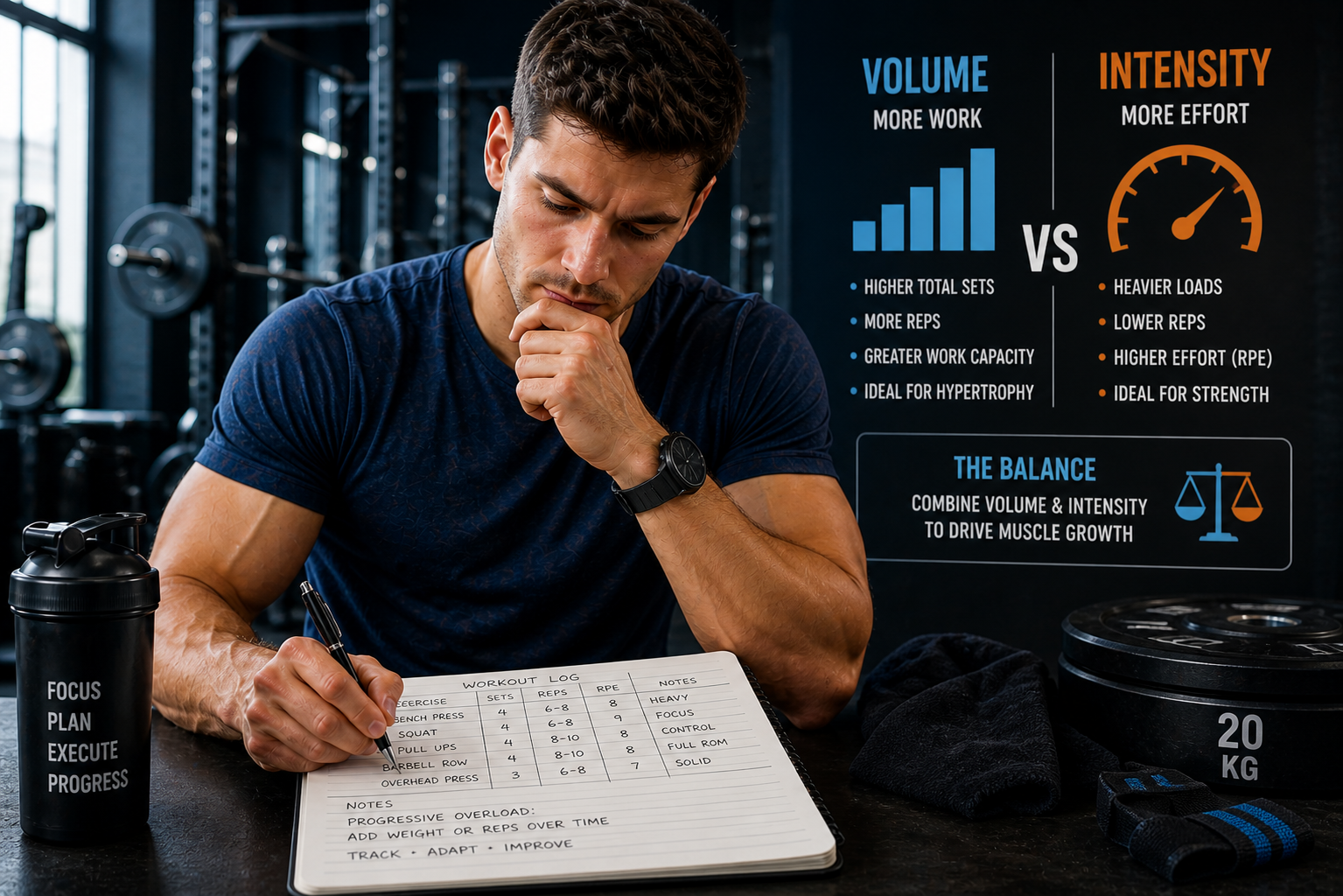
Training to failure every set? Or doing more total sets? The answer determines whether you build muscle or just burn out.
You see two approaches everywhere. High volume: 20+ sets per muscle weekly. High intensity: Every set to absolute failure.
You’re doing one or the other. Or randomly switching between them. And your results are mediocre.
You think:
- More volume is always better
- Training to failure is necessary
- Intensity matters more than volume
- You need both equally
Wrong on all counts. The research is clear: Volume (total sets per muscle per week) is the PRIMARY driver of hypertrophy. Intensity (proximity to failure) matters, but has a threshold once you hit 1-3 RIR (reps in reserve), additional intensity provides minimal benefit and significantly increases fatigue, injury risk, and recovery demands. The sweet spot: Moderate-high volume (10-20 sets per muscle weekly) with moderate intensity (1-3 RIR most sets, occasional failure). Not 30 sets to failure. Not 5 sets with 5 RIR. Strategic volume with controlled intensity.
In this comprehensive guide, I’ll define volume and intensity precisely (the metrics that matter), reveal what the research actually shows (dose-response relationships), explain why both extremes fail (too much volume or too much intensity), provide the optimal ranges for muscle growth (evidence-based targets), show you how to program both variables (practical implementation), and address recovery implications (the limiting factor).
Whether you’re training for maximum hypertrophy or struggling with progress, understanding the volume-intensity relationship is critical.
Let’s optimize both variables for maximum muscle growth.
TABLE OF CONTENTS
Defining Volume and Intensity
Precise definitions matter.
What Is Volume?
The metric:
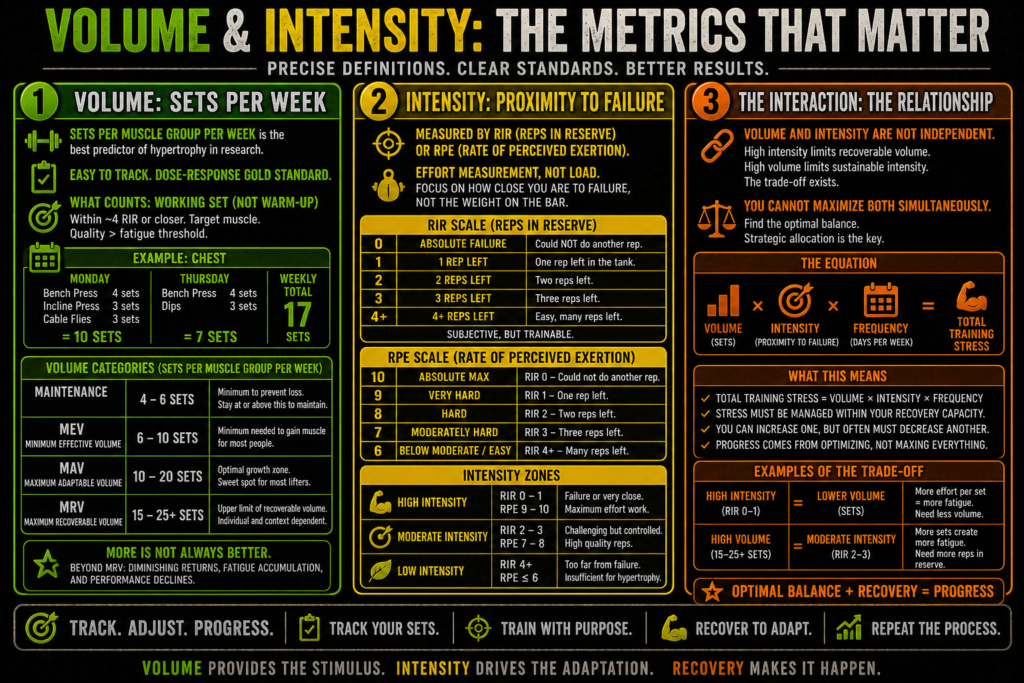
- Sets per muscle group per week
- This is “volume” in research and evidence-based programming
- Set-based measurement
NOT volume:
- Total reps (less useful metric)
- Total weight lifted (tonnage interesting but not primary driver)
- Total time under tension (TUT correlated but not causal)
- Common confusions
Why sets per week:
- Best predictor of hypertrophy in research
- Easy to track and manipulate
- Dose-response relationship established
- Gold standard metric
What counts as a set:
- Working set (not warm-up)
- Taken within 4 RIR (reps in reserve) or closer
- For target muscle (not ancillary involvement)
- Quality threshold
Example calculation (Chest):
- Monday: Bench press 4 sets, Incline DB press 3 sets, Flies 3 sets = 10 sets
- Thursday: Bench press 4 sets, Dips 3 sets = 7 sets
- Weekly chest volume: 17 sets
Volume categories:
Maintenance volume (MV):
- Minimum to prevent muscle loss
- Typically: 4-6 sets per muscle per week
- Baseline
Minimum effective volume (MEV):
- Minimum to gain muscle
- Typically: 6-10 sets per muscle per week
- Growth threshold
Maximum adaptive volume (MAV):
- Optimal range for growth
- Typically: 10-20 sets per muscle per week
- Sweet spot
Maximum recoverable volume (MRV):
- Maximum you can recover from
- Highly individual: 15-25+ sets per muscle per week
- Upper limit
What Is Intensity?
The metric:
- Proximity to failure
- Measured in RIR (reps in reserve) or RPE (rate of perceived exertion)
- Effort measurement
NOT intensity:
- Load (weight on bar) that’s “intensity of load” or “%1RM”
- Different concept in research
- Common confusion
The RIR scale:
- RIR 0: Absolute failure (couldn’t do another rep)
- RIR 1: 1 rep left in tank (could do 1 more, maybe 2)
- RIR 2: 2 reps left
- RIR 3: 3 reps left
- RIR 4+: Easy, many reps left
- Subjective scale
The RPE scale (alternative):
- RPE 10: Absolute max effort (RIR 0)
- RPE 9: Very hard (RIR 1)
- RPE 8: Hard (RIR 2)
- RPE 7: Moderately hard (RIR 3)
- RPE 6 or below: Moderate to easy
- 0-10 effort scale
What counts as “high intensity”:
- RIR 0-1 (failure or very close)
- RPE 9-10
- Maximum effort
What counts as “moderate intensity”:
- RIR 2-3
- RPE 7-8
- Controlled effort
What counts as “low intensity”:
- RIR 4+
- RPE 6 or below
- Insufficient for hypertrophy
Example:
- Bench press: 185 lbs x 10 reps, could have done 12 = RIR 2 (moderate intensity)
- Squat: 315 lbs x 8 reps, absolute failure = RIR 0 (high intensity)
- Practical application
The Interaction
The relationship:
- Volume and intensity are NOT independent
- High intensity limits recoverable volume
- High volume limits sustainable intensity
- Trade-off exists
The equation:
- Volume × Intensity × Frequency = Total Training Stress
- Manage total stress within recovery capacity
- Recovery constraint
The implication:
- Can’t maximize both simultaneously
- Must find optimal balance
- Strategic allocation
- Optimization required
What the Research Shows
The evidence base.
The Volume-Hypertrophy Dose-Response
The landmark meta-analysis (Schoenfeld et al., 2017):
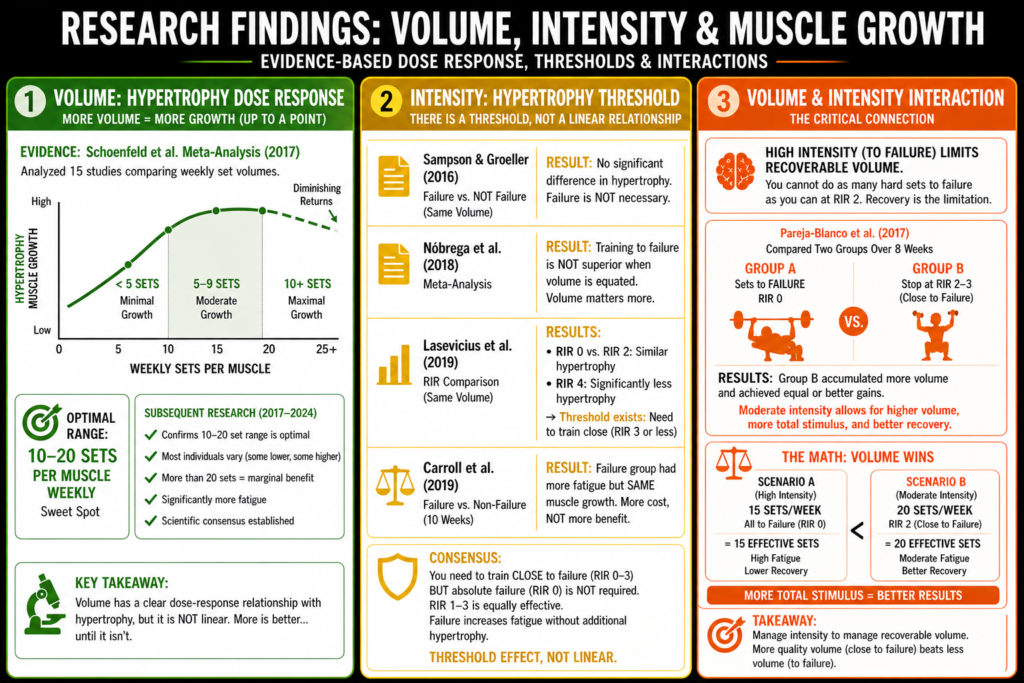
- Analyzed 15 studies
- Compared different weekly set volumes
- Key findings:
Results:
- <5 sets per week: Minimal growth
- 5-9 sets per week: Moderate growth
- 10+ sets per week: Maximal growth
- Clear dose-response
The curve:
- Not linear (more isn’t always better infinitely)
- Diminishing returns after ~10 sets
- Optimal range: 10-20 sets per muscle per week
- Sweet spot identified
Subsequent research (2017-2024):
- Confirmed 10-20 set range optimal for most
- Individual variation exists (some respond to lower, some tolerate higher)
- More than 20 sets: Marginal additional benefit, significantly more fatigue
- Consensus established
The practical takeaway:
- Most people: 10-20 sets per muscle per week
- Beginners: Start lower end (10-12 sets)
- Advanced: Can use higher end (15-20 sets)
- Very few benefit from >20 sets
- Evidence-based targets
The Intensity-Hypertrophy Relationship
The research findings:
Study 1 (Sampson & Groeller, 2016):
- Compared training to failure vs. not to failure
- Same volume
- Results: No significant difference in hypertrophy
- Failure not necessary
Study 2 (Nóbrega et al., 2018):
- Meta-analysis on failure training
- Results: Training to failure NOT superior for hypertrophy when volume equated
- Volume matters more
Study 3 (Lasevicius et al., 2019):
- Compared sets at different RIRs: RIR 0, RIR 2, RIR 4
- Results:
- RIR 0 and RIR 2: Similar hypertrophy
- RIR 4: Significantly less hypertrophy
- Threshold exists: Need RIR 3 or closer
Study 4 (Carroll et al., 2019):
- Compared failure vs. non-failure over 10 weeks
- Results: Failure group had more fatigue, same muscle growth
- Failure = more cost, not more benefit
The consensus:
- Need to train close to failure (RIR 0-3)
- But going to absolute failure (RIR 0) not required
- RIR 1-3 equally effective
- Failure increases fatigue without additional hypertrophy
- Threshold effect, not linear
The mechanism:
- Mechanical tension drives growth
- Achieved with high motor unit recruitment
- High recruitment occurs at RIR 3 or closer (when effort high)
- RIR 0 vs. RIR 2: Same recruitment, same stimulus
- Biological explanation
The Volume × Intensity Interaction
The critical finding:
- High intensity (failure training) limits recoverable volume
- Can’t do as many sets to failure as you can to RIR 2
- Recovery limitation
Study (Pareja-Blanco et al., 2017):
- Group A: Sets to failure (RIR 0)
- Group B: Sets stopping at 20% velocity loss (roughly RIR 2-3)
- Results: Group B accumulated more volume, had equal or better strength/power gains
- Moderate intensity allows more volume
The practical implication:
- 20 sets per week at RIR 2: Recoverable
- 20 sets per week at RIR 0: Not recoverable for most
- Moderate intensity enables higher volume
- Higher total stimulus
- Strategic intensity management
The math:
- Scenario A: 15 sets per week, all to failure = 15 effective sets, high fatigue
- Scenario B: 20 sets per week, to RIR 2 = 20 effective sets, moderate fatigue
- Scenario B: More total stimulus, better recovery
- Volume wins
Why High Volume Alone Fails
The too-much-volume problem.
The Junk Volume Trap
What is junk volume:
- Sets that don’t stimulate growth
- Because too far from failure (RIR 5+)
- Or because inadequate recovery between sets
- Ineffective volume
The scenario:
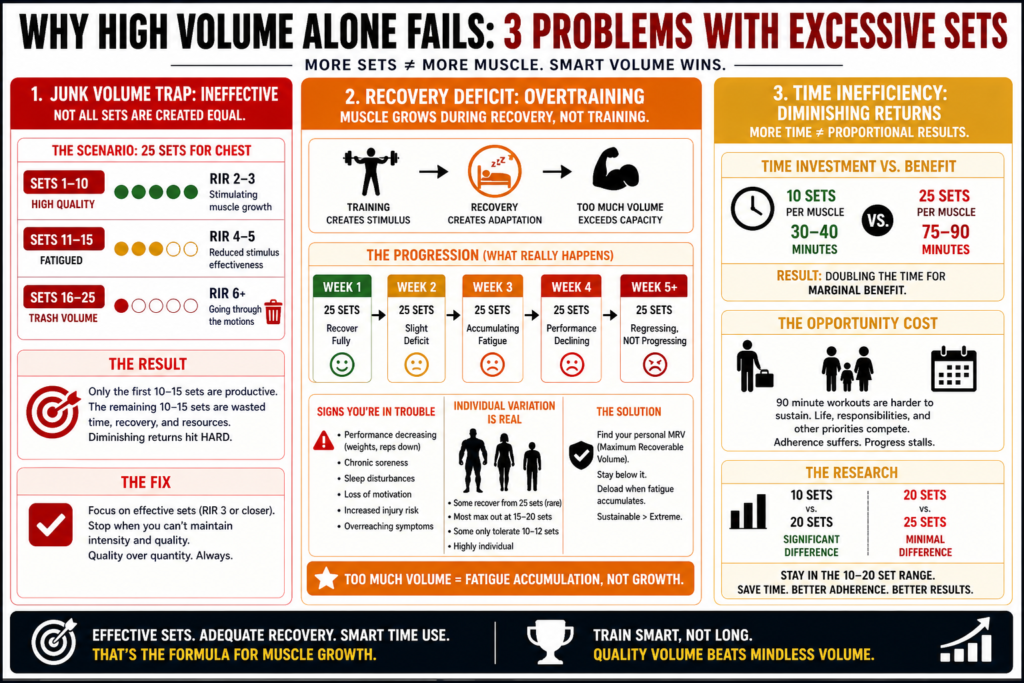
- “I need 25 sets for chest”
- First 10 sets: High quality (RIR 2-3)
- Sets 11-15: Fatigued (RIR 4-5)
- Sets 16-25: Trash (RIR 6+, just going through motions)
- Quality degradation
The result:
- Only first 10-15 sets were productive
- Remaining 10-15 sets = wasted time and recovery resources
- Diminishing returns
The fix:
- Focus on effective sets (RIR 3 or closer)
- Stop when can’t maintain intensity
- Quality over quantity
- Effective volume prioritization
The Recovery Deficit
The problem:
- Muscle grows during recovery, not during training
- Training creates stimulus, recovery creates adaptation
- Too much volume exceeds recovery capacity
- Overtraining
The progression:
- Week 1: 25 sets, recover fully
- Week 2: 25 sets, slight deficit
- Week 3: 25 sets, accumulating fatigue
- Week 4: 25 sets, performance declining
- Week 5+: Regressing, not progressing
- Fatigue accumulation
The signs:
- Performance decreasing (weights/reps going down)
- Chronic soreness
- Sleep disturbances
- Loss of motivation
- Increased injury risk
- Overreaching symptoms
The individual variation:
- Some recover from 25 sets (rare)
- Most max out at 15-20 sets
- Some only recover from 10-12 sets
- Highly individual
The solution:
- Find your personal MRV (maximum recoverable volume)
- Stay below it
- Deload when fatigue accumulates
- Sustainable volume
The Time Inefficiency
The math:
- 10 sets per muscle: ~30-40 minutes
- 25 sets per muscle: ~75-90 minutes
- Doubling time for marginal benefit
The opportunity cost:
- 90-minute workouts = harder to sustain
- Life responsibilities compete
- Adherence suffers
- Practical limitation
The research:
- 10 sets vs. 20 sets: Significant difference
- 20 sets vs. 25 sets: Minimal difference
- Diminishing returns
The practical conclusion:
- Stay in 10-20 set range
- Save time
- Better adherence
- Efficiency
Why High Intensity Alone Fails
The always-to-failure problem.
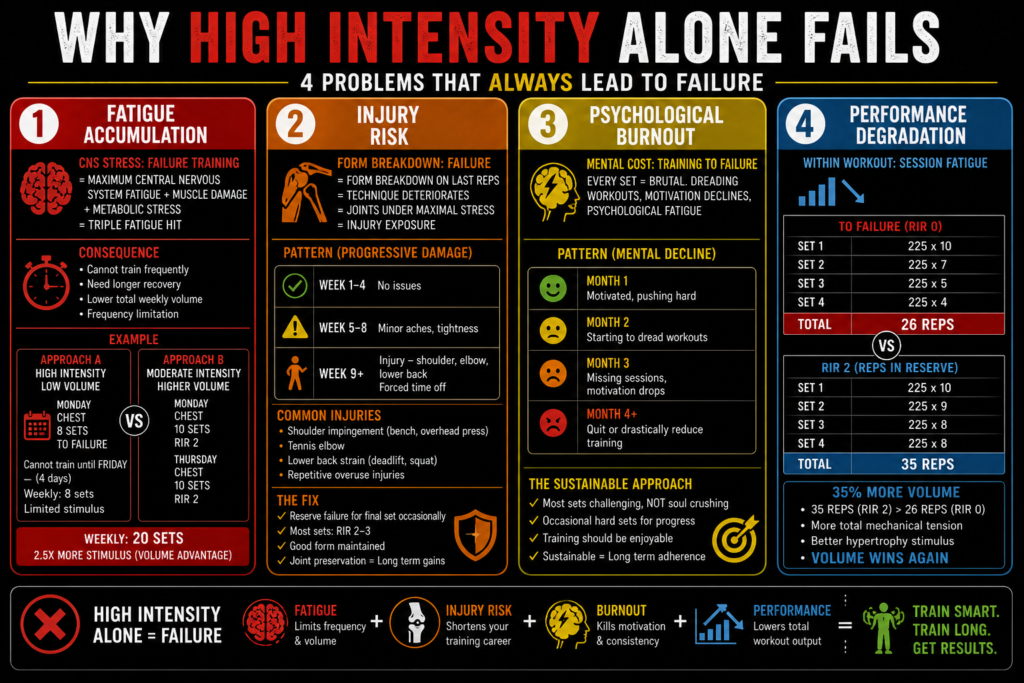
The Fatigue Accumulation Problem
The mechanism:
- Failure training = maximum central nervous system (CNS) fatigue
- Maximum muscle damage
- Maximum metabolic stress
- Triple fatigue hit
The consequence:
- Can’t train as frequently
- Need longer recovery between sessions
- Lower total weekly volume
- Frequency limitation
The example:
Approach A: High intensity, low volume
- Monday: Chest, 8 sets to failure
- Can’t train chest again until Friday (4 days later)
- Weekly volume: 8 sets
- Limited total stimulus
Approach B: Moderate intensity, higher volume
- Monday: Chest, 10 sets to RIR 2
- Thursday: Chest, 10 sets to RIR 2
- Weekly volume: 20 sets
- 2.5x more stimulus
The result:
- Approach B: More total volume = more growth
- Volume advantage
The Injury Risk
The mechanism:
- Failure = form breakdown
- Last reps technique deteriorates
- Joints under maximal stress
- Injury exposure
The pattern:
- Week 1-4: No issues
- Week 5-8: Minor aches
- Week 9+: Injury (shoulder, elbow, lower back)
- Forced time off
- Progressive damage
Common injuries from chronic failure training:
- Shoulder impingement (bench, overhead press to failure)
- Tennis elbow (too many failure sets)
- Lower back strain (deadlift/squat to failure repeatedly)
- Overuse injuries
The fix:
- Reserve failure for final set or occasionally
- Most sets RIR 2-3 (good form maintained)
- Joint preservation
The Psychological Burnout
The mental cost:
- Training to failure every set = brutal
- Dreading workouts
- Motivation declines
- Psychological fatigue
The pattern:
- Month 1: Motivated, pushing hard
- Month 2: Starting to dread gym
- Month 3: Missing sessions
- Month 4+: Quit or drastically reduce
- Unsustainable
The sustainable approach:
- Most sets challenging but not soul-crushing
- Occasional hard sets
- Enjoyable enough to maintain long-term
- Adherence
The Performance Degradation Within Workout
The within-session fatigue:
- Set 1 to failure: 225 lbs x 10 reps
- Set 2 to failure: 225 lbs x 7 reps (fatigue from set 1)
- Set 3 to failure: 225 lbs x 5 reps
- Set 4 to failure: 225 lbs x 4 reps
- Rapid performance drop
The alternative (stopping at RIR 2):
- Set 1 to RIR 2: 225 lbs x 10 reps
- Set 2 to RIR 2: 225 lbs x 9 reps
- Set 3 to RIR 2: 225 lbs x 8 reps
- Set 4 to RIR 2: 225 lbs x 8 reps
- Maintained performance
The total volume:
- Failure approach: 10+7+5+4 = 26 reps
- RIR 2 approach: 10+9+8+8 = 35 reps
- 35% more volume
The stimulus:
- 35 reps at RIR 2 > 26 reps at RIR 0
- More total mechanical tension
- Better hypertrophy stimulus
- Volume wins again
The Optimal Volume-Intensity Balance
Evidence-based targets.
The Volume Targets
General recommendations by training status:
Beginners (0-2 years training):
- 8-12 sets per muscle per week
- Start lower, progress upward
- Conservative start
Intermediates (2-4 years):
- 12-18 sets per muscle per week
- Most growth occurs here
- Sweet spot
Advanced (4+ years):
- 15-20 sets per muscle per week
- Some may tolerate 20-25
- Highly individual
- Upper range
By muscle group (examples):
Large muscles (chest, back, quads):
- 12-20 sets per week
- Can handle higher volume
- Higher capacity
Medium muscles (shoulders, hamstrings, triceps, biceps):
- 10-16 sets per week
- Moderate volume
- Mid-range
Small muscles (calves, abs, rear delts):
- 8-12 sets per week
- Less volume needed
- Lower requirement
The principle:
- Start at lower end of range
- Add sets over weeks/months
- Find personal optimal (where growth occurs without excessive fatigue)
- Progressive approach
The Intensity Targets
The recommendation:
- Most sets: RIR 2-3 (RPE 7-8)
- Some sets: RIR 1 (RPE 9)
- Occasional sets: RIR 0 (RPE 10, failure)
- Controlled intensity
The distribution (per muscle per week):
Example: 16 sets chest weekly
- 10 sets: RIR 3 (moderately hard)
- 4 sets: RIR 2 (hard)
- 2 sets: RIR 1 (very hard)
- 0-1 sets: RIR 0 (failure, optional)
- Pyramidal intensity
Why this works:
- Accumulate volume without excessive fatigue
- Most sets effective (RIR 3 or closer)
- Minimize injury risk (most sets not to failure)
- Maximize recovery (not constantly destroyed)
- Balanced stimulus and recovery
When to go to failure:
- Final set of exercise (won’t impact next sets)
- Isolation exercises (lower injury risk than compounds)
- Occasionally, not every session
- Strategic application
When NOT to go to failure:
- Compound lifts with injury risk (heavy squats, deadlifts)
- First sets of exercise (would impair subsequent sets)
- Every single set (unsustainable)
- Intelligent avoidance
The Frequency Component
The research:
- Higher frequency (training muscle 2-3x weekly) better than once weekly
- Allows distribution of volume
- Frequency matters
The application:
Low frequency (muscle 1x weekly):
- Must do all 16 sets in one session
- Difficult to maintain intensity
- Later sets are junk
- Suboptimal
High frequency (muscle 2-3x weekly):
- Distribute 16 sets across 2-3 sessions
- Each session: 5-8 sets (high quality maintained)
- Better total stimulus
- Optimal
Example comparison:
1x weekly:
- Monday: 16 sets chest
- Sets 1-8: Good quality
- Sets 9-16: Declining quality, accumulating fatigue
- Quality degradation
2x weekly:
- Monday: 8 sets chest (all high quality)
- Thursday: 8 sets chest (all high quality)
- Total: 16 sets, all effective
- Quality maintenance
The recommendation:
- Train each muscle 2-3x weekly
- Distribute volume
- Optimal frequency
Programming Volume and Intensity
Practical implementation.
The Linear Periodization Approach
The concept:
- Start with higher volume, moderate intensity
- Progress to moderate volume, higher intensity
- Alternate between phases
- Structured variation
Phase 1: Accumulation (4-6 weeks)
- Volume: High (upper end of range, 16-20 sets)
- Intensity: Moderate (RIR 2-3 most sets)
- Goal: Build work capacity, hypertrophy
- Volume emphasis
Phase 2: Intensification (3-4 weeks)
- Volume: Moderate (lower end of range, 10-14 sets)
- Intensity: High (RIR 1-2 most sets, some to failure)
- Goal: Build strength, maintain muscle
- Intensity emphasis
Phase 3: Deload (1 week)
- Volume: Low (50% reduction)
- Intensity: Moderate (RIR 3-4)
- Goal: Recovery, dissipate fatigue
- Recovery
Repeat cycle
- Progressive waves
Why this works:
- Accumulation builds muscle
- Intensification builds strength
- Deload allows recovery
- Sustainable long-term
- Periodized approach
The Daily Undulating Periodization (DUP)
The concept:
- Vary volume and intensity within week
- Different stimulus each session
- Intra-week variation
Example (chest, 2x weekly):
Monday: Volume day
- 10 sets total
- RIR 3 most sets
- Higher reps (10-15)
- Hypertrophy focus
Thursday: Intensity day
- 6 sets total
- RIR 1-2 most sets
- Lower reps (6-8)
- Strength focus
Weekly total:
- 16 sets (combined)
- Varied stimulus
- Comprehensive development
Why this works:
- Targets multiple adaptations
- Prevents monotony
- Manages fatigue within week
- Varied stimulus
The Autoregulation Approach
The concept:
- Adjust volume/intensity based on daily readiness
- No fixed program
- Responsive to recovery status
- Individualized adjustment
The method:
Daily assessment:
- How do you feel?
- How’s performance on first working set?
- Readiness check
If feeling great:
- Push volume (add sets)
- Or push intensity (closer to failure)
- Capitalize on readiness
If feeling fatigued:
- Reduce volume (fewer sets)
- Or reduce intensity (more RIR)
- Respect recovery needs
The implementation:
- Week 1: 18 sets at RIR 2 (felt great)
- Week 2: 14 sets at RIR 3 (felt tired)
- Week 3: 16 sets at RIR 2 (recovered)
- Flexible approach
Why this works:
- Accounts for life stress, sleep variation
- Prevents forced overtraining
- Sustainable
- Individualized
The drawback:
- Requires experience (know your body)
- Can lead to undertraining if too conservative
- Skill required
The Practical Hybrid Approach
The recommendation (combining methods):
Base program (planned):
- Set weekly volume target (e.g., 16 sets chest)
- Set intensity target (most sets RIR 2-3)
- Distribute across 2 sessions
- Foundation structure
Autoregulation (within structure):
- If feel great: Add 1-2 sets or push to RIR 1-2
- If feel tired: Reduce 1-2 sets or increase RIR
- Flexible execution
Periodization (across blocks):
- 6-week accumulation block (higher volume)
- 4-week intensification block (lower volume, higher intensity)
- 1-week deload
- Macro structure
Why this works:
- Structure prevents aimless training
- Autoregulation prevents overtraining
- Periodization manages long-term fatigue
- Best of all methods
Sample Programs
Putting it into practice.
Sample 1: Beginner Program (Full Body, 3x Weekly)
Weekly volume per muscle: 9-12 sets
Day 1 (Monday):
- Squat: 3 sets x 8-10 reps, RIR 3
- Bench Press: 3 sets x 8-10 reps, RIR 3
- Bent-Over Row: 3 sets x 8-10 reps, RIR 3
- 9 sets total for quads, chest, back
Day 2 (Wednesday):
- Romanian Deadlift: 3 sets x 10-12 reps, RIR 3
- Overhead Press: 3 sets x 8-10 reps, RIR 3
- Lat Pulldown: 3 sets x 10-12 reps, RIR 3
- 9 sets for hamstrings, shoulders, back
Day 3 (Friday):
- Leg Press: 3 sets x 10-12 reps, RIR 2
- Incline DB Press: 3 sets x 8-10 reps, RIR 2
- Cable Row: 3 sets x 10-12 reps, RIR 2
- 9 sets for quads, chest, back
Weekly totals:
- Quads: 6 sets (Monday, Friday)
- Hamstrings: 3 sets (Wednesday)
- Chest: 6 sets (Monday, Friday)
- Back: 9 sets (all 3 days)
- Shoulders: 3 sets (Wednesday)
- Low-moderate volume, moderate intensity
Progression:
- Add 1-2 sets per muscle every 4 weeks
- Gradually increase to 12-15 sets per muscle
- Progressive volume
Sample 2: Intermediate Program (Upper/Lower, 4x Weekly)
Weekly volume per muscle: 12-16 sets
Day 1 (Monday): Upper A
- Bench Press: 4 sets x 6-8 reps, RIR 2
- Bent-Over Row: 4 sets x 8-10 reps, RIR 2
- Overhead Press: 3 sets x 8-10 reps, RIR 3
- Lat Pulldown: 3 sets x 10-12 reps, RIR 3
- Lateral Raise: 3 sets x 12-15 reps, RIR 2
- Bicep Curl: 2 sets x 10-12 reps, RIR 2
- Tricep Extension: 2 sets x 10-12 reps, RIR 2
Day 2 (Tuesday): Lower A
- Squat: 4 sets x 6-8 reps, RIR 2
- Romanian Deadlift: 3 sets x 8-10 reps, RIR 2
- Leg Press: 3 sets x 10-12 reps, RIR 3
- Leg Curl: 3 sets x 10-12 reps, RIR 3
- Calf Raise: 4 sets x 12-15 reps, RIR 2
Day 3 (Thursday): Upper B
- Incline DB Press: 4 sets x 8-10 reps, RIR 2
- Pull-Ups: 4 sets x 6-10 reps, RIR 2
- DB Shoulder Press: 3 sets x 8-10 reps, RIR 3
- Cable Row: 3 sets x 10-12 reps, RIR 3
- Cable Fly: 3 sets x 12-15 reps, RIR 2
- Hammer Curl: 2 sets x 10-12 reps, RIR 2
- Overhead Extension: 2 sets x 10-12 reps, RIR 2
Day 4 (Friday or Saturday): Lower B
- Deadlift: 3 sets x 5-8 reps, RIR 2
- Bulgarian Split Squat: 3 sets x 8-10 reps, RIR 2
- Leg Extension: 3 sets x 12-15 reps, RIR 2
- Nordic Curl or Leg Curl: 3 sets x 8-12 reps, RIR 3
- Seated Calf Raise: 4 sets x 12-15 reps, RIR 2
Weekly totals:
- Chest: 11 sets (moderate-high volume)
- Back: 14 sets (high volume)
- Shoulders: 9 sets (moderate volume)
- Quads: 13 sets (high volume)
- Hamstrings: 9 sets (moderate volume)
- Biceps/Triceps: 4 sets each (maintenance)
- Balanced distribution
Intensity notes:
- Most sets RIR 2-3
- Last set of main lifts occasionally to RIR 1
- Isolation exercises can go to RIR 1-2 more often
- Moderate intensity
Sample 3: Advanced Program (Push/Pull/Legs, 6x Weekly)
Weekly volume per muscle: 16-20 sets
(Structure provided, full workout details abbreviated for space)
Monday: Push A
- Chest: 6 sets (bench variations)
- Shoulders: 4 sets (overhead press, lateral raise)
- Triceps: 3 sets
Tuesday: Pull A
- Back: 7 sets (rows, pulldowns)
- Rear delts: 2 sets
- Biceps: 3 sets
Wednesday: Legs A
- Quads: 6 sets (squat, leg press)
- Hamstrings: 4 sets (RDL, curl)
- Calves: 3 sets
Thursday: Push B
- Chest: 5 sets (different variations)
- Shoulders: 4 sets
- Triceps: 3 sets
Friday: Pull B
- Back: 7 sets (different exercises)
- Rear delts: 2 sets
- Biceps: 3 sets
Saturday: Legs B
- Quads: 6 sets
- Hamstrings: 4 sets
- Calves: 3 sets
Weekly totals:
- Chest: 11 sets
- Back: 14 sets
- Shoulders: 8 sets (+ 4 rear delts)
- Quads: 12 sets
- Hamstrings: 8 sets
- Biceps/Triceps: 6 sets each
- High volume, 2x frequency
Intensity:
- First exercises: RIR 2-3
- Final set of compounds: RIR 1-2
- Isolation exercises: RIR 1-2
- Occasional failure on isolations
- Progressive intensity
The Bottom Line: Volume Wins, But Intensity Has a Threshold
After explaining everything:
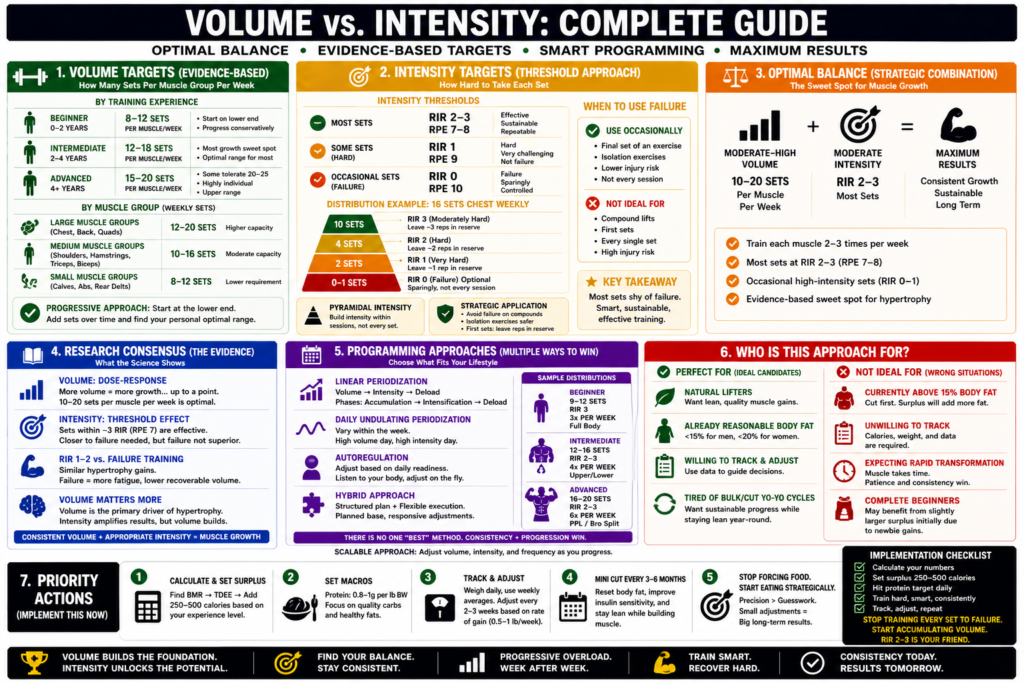
The truth about volume vs. intensity:
✅ Volume is the PRIMARY driver of hypertrophy (sets per week most important)
✅ Intensity has a threshold RIR 3 or closer is sufficient (failure not required)
✅ High volume with moderate intensity beats low volume at maximum intensity (more total stimulus)
✅ Optimal range: 10-20 sets per muscle weekly, most sets RIR 2-3 (evidence-based sweet spot)
✅ Both extremes fail too much volume or always to failure (recovery matters)
Key takeaways:
Volume definition:
- Sets per muscle group per week
- Working sets within 4 RIR or closer
- Primary metric
Volume targets:
- Beginners: 8-12 sets per muscle weekly
- Intermediates: 12-18 sets
- Advanced: 15-20 sets
- Very few benefit from >20 sets
- Evidence-based ranges
Intensity definition:
- Proximity to failure (RIR or RPE)
- NOT load/weight
- Effort measurement
Intensity targets:
- Most sets: RIR 2-3 (effective and sustainable)
- Some sets: RIR 1 (hard but not failure)
- Occasional: RIR 0 (failure, sparingly)
- Threshold approach
The research consensus:
- Volume dose-response: 10-20 sets optimal
- Intensity threshold: RIR 3 or closer needed, but failure not superior to RIR 1-2
- Failure training: Same hypertrophy, more fatigue, lower recoverable volume
- Volume matters more
Why high volume alone fails:
- Junk volume (too many sets, quality deteriorates)
- Recovery deficit (exceeds capacity)
- Time inefficiency (diminishing returns after 20 sets)
- Quality over quantity
Why high intensity alone fails:
- Fatigue accumulation (CNS, muscle damage)
- Injury risk (form breakdown at failure)
- Psychological burnout (unsustainable)
- Within-workout performance drop (can’t maintain volume)
- Unsustainable approach
The optimal balance:
- Moderate-high volume (10-20 sets per muscle weekly)
- Moderate intensity (RIR 2-3 most sets)
- 2-3x frequency per muscle
- Occasional high-intensity sets (RIR 0-1)
- Strategic combination
Programming approaches:
- Linear periodization (volume → intensity phases)
- Daily undulating (vary within week)
- Autoregulation (adjust to readiness)
- Hybrid (structure + flexibility)
- Multiple valid methods
Sample volume distributions:
- Beginner: 9-12 sets, RIR 3, 3x weekly full body
- Intermediate: 12-16 sets, RIR 2-3, 4x weekly upper/lower
- Advanced: 16-20 sets, RIR 2-3, 6x weekly PPL
- Scalable approach
Failure training application:
- Reserve for: Final sets, isolation exercises, occasionally
- Avoid on: First sets, heavy compounds, every session
- Strategic use
Priority actions:
- Calculate current weekly volume per muscle (count sets)
- Adjust to 10-20 set range (add or reduce as needed)
- Train most sets to RIR 2-3 (stop shy of failure)
- Distribute across 2-3 sessions per muscle (frequency)
- Track performance (weights/reps should increase over time)
- Deload every 6-8 weeks (reduce volume 50%)
- Implementation checklist
STOP TRAINING EVERY SET TO FAILURE. START ACCUMULATING VOLUME AT RIR 2-3. 10-20 SETS PER MUSCLE WEEKLY. TRAIN 2-3X PER WEEK. PROGRESSIVE OVERLOAD OVER TIME.
Ready to build a complete evidence-based training program with optimal volume distribution, strategic intensity management, periodization protocols, and progressive overload systems that maximize muscle growth while minimizing fatigue and injury risk? Understanding volume vs. intensity is just the beginning. Get comprehensive programming guidance that actually works. Stop guessing about training variables. Start optimizing systematically.
REFERENCES
SECTION 1 — Volume dose-response: the evidence for 10-20 sets per muscle per week
[1] Schoenfeld BJ, Ogborn D & Krieger JW — PubMed/Journal of Sports Science, 2017 Meta-regression of 15 studies (34 treatment groups) examining the dose-response relationship between weekly resistance training volume and muscle hypertrophy; a clear graded response was found whereby higher weekly set volumes produced greater hypertrophic gains; training with more than 10 sets per muscle per week produced significantly greater hypertrophy than lower volumes; provides the primary evidence base for the article’s 10 to 20 set per muscle per week recommendation and the volume-centric model of hypertrophy https://pubmed.ncbi.nlm.nih.gov/27433992/
SECTION 2 — Failure vs. non-failure: similar hypertrophy, but failure costs more
[2] Refalo MC et al. — PMC/Sports Medicine, 2023 Systematic review and meta-analysis of 15 studies examining the effect of resistance training proximity to failure on muscle hypertrophy; there was a trivial statistical advantage for training to set failure versus non-failure (effect size 0.19, 95% CI 0.00 to 0.37, p=0.045); this advantage was not moderated by volume load or relative load; training to momentary muscular failure induces higher acute neuromuscular fatigue than stopping with 1 to 2 reps in reserve, meaning failure reduces recoverable volume; the most comprehensive meta-analysis on this topic, directly supporting the article’s argument that failure training provides a negligible hypertrophy advantage relative to its fatigue cost and that 1 to 2 RIR is effectively equivalent to failure for muscle growth https://pmc.ncbi.nlm.nih.gov/articles/PMC9935748/
[3] Lacerda LT et al. — PubMed/Journal of Sports Sciences, 2024 Eight-week randomized crossover RCT (n=18 resistance-trained individuals) directly comparing sets taken to momentary muscular failure versus sets stopped at a perceived 1 to 2 RIR; increases in quadriceps thickness were similar between the failure and RIR conditions; sets performed to momentary muscular failure consistently induced higher acute neuromuscular fatigue and greater repetition loss from the first to final set; 1 to 2 RIR allowed similar volume load accumulation as failure over the intervention while producing lower fatigue; training close to failure without reaching it is sufficient to promote hypertrophy similar to momentary failure while allowing for better intra-session volume maintenance https://pubmed.ncbi.nlm.nih.gov/38393985/
SECTION 3 — Velocity loss as a proxy for RIR: moderate stopping points preserve volume
[4] Pareja-Blanco F et al. — PubMed/European Journal of Applied Physiology, 2017 Controlled study comparing two groups performing the same exercises: one stopping at a 20% velocity loss per set (approximately RIR 2 to 3) versus one stopping at a 40% velocity loss (approaching failure); the 20% group accumulated significantly more total volume load (due to less within-set fatigue) and showed equal or superior strength and power adaptations over 8 weeks; the 40% velocity loss group showed greater levels of metabolic stress and mechanical fatigue per session; provides the mechanistic evidence for the article’s claim that stopping short of failure preserves performance across subsequent sets, allowing greater total set volume to be accumulated within each session https://pubmed.ncbi.nlm.nih.gov/28097372/
SECTION 4 — Insufficient proximity to failure: RIR 4+ limits hypertrophic stimulus
[5] Grgic J et al. — PMC/Journal of Science and Medicine in Sport, 2021 Systematic review and meta-analysis of studies comparing failure versus non-failure resistance training for muscular strength and hypertrophy; when volume was not equated, failure training produced greater hypertrophy, but when volume was equated, the difference was eliminated; in studies where non-failure groups trained with 4 or more RIR, hypertrophic outcomes were substantially lower than groups training close to failure; the pattern across the literature confirms a proximity threshold: sets must be within 3 to 4 RIR to be effective, while sets further from failure represent junk volume; validates the article’s claim that RIR 4 or higher produces significantly less hypertrophy than closer-to-failure training, establishing the lower boundary of effective training intensity https://pmc.ncbi.nlm.nih.gov/articles/PMC9068575/






Leave a Reply
You must be logged in to post a comment.