
Wondering if you can gain muscle without tracking macros or following a structured diet? Here’s what science and real-world experience reveal.
You want to build muscle. But you don’t want to track calories, weigh food, or follow a strict meal plan.
Can you still make gains?
You’ve seen conflicting information:
- “You MUST be in a caloric surplus”
- “Newbies can build muscle without trying”
- “Just eat more protein”
- “Diet is 80% of results”
So what’s the truth? Can you actually build muscle without a formal diet?
Here’s the honest answer: Yes, you can build muscle without following a structured diet, but only in specific scenarios and with significantly slower progress. Complete beginners, overweight individuals returning to training after a break, genetically gifted people, and enhanced athletes can build muscle eating intuitively. However, for sustained long-term progress, most people will eventually need to structure their nutrition with adequate protein (0.7-1g per pound) and a slight caloric surplus (200-400 calories above maintenance).
In this comprehensive guide, I’ll explain what “dieting for muscle building” actually means and why it matters, reveal the specific scenarios where muscle growth happens without structured nutrition, show you how long you can progress without dieting and when you’ll plateau, provide the minimal nutrition requirements to support muscle growth without full dieting, and help you decide if structured nutrition is necessary for your goals and situation.
Whether you’re a beginner overwhelmed by diet advice or someone seeking the minimum effective approach, this article provides the honest truth.
Let’s separate exceptions from the rule.
TABLE OF CONTENTS
What Does “Dieting for Muscle Building” Actually Mean?
Clarifying terms prevents confusion.
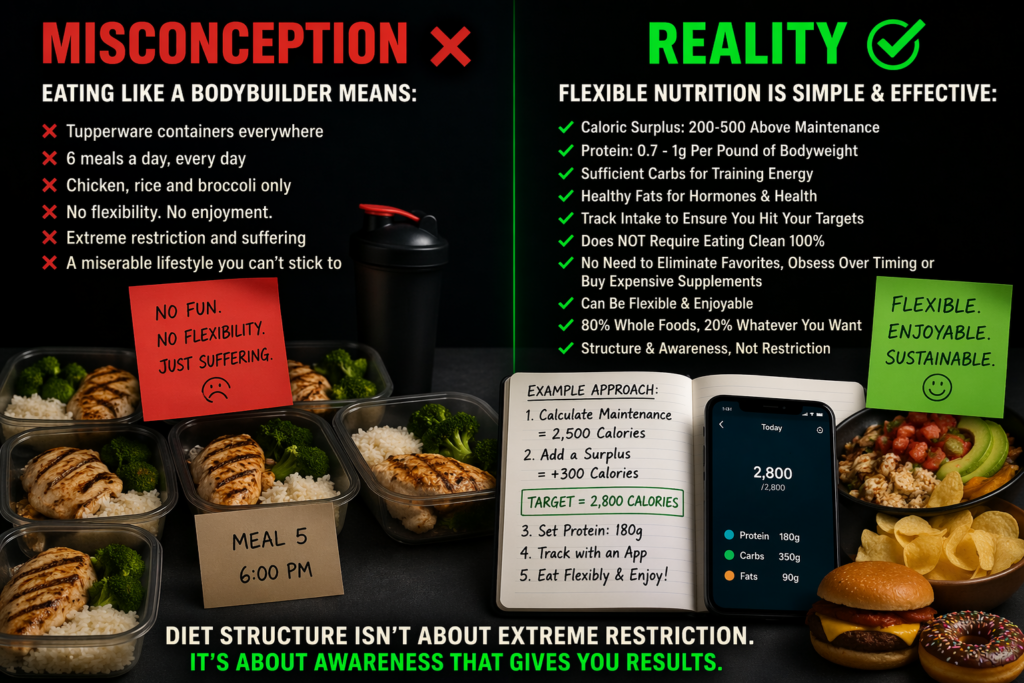
What Most People Think It Means
Common misconception:
- Eating like a bodybuilder
- Tupperware containers everywhere
- 6 meals daily
- Chicken, rice, broccoli only
- No flexibility, no enjoyment
- Extreme restrictive lifestyle
This is NOT what it means.
What It Actually Means
Structured nutrition for muscle building (bulking):
Core requirements:
- Caloric surplus (200-500 above maintenance)
- Adequate protein (0.7-1g per pound body weight)
- Sufficient carbohydrates for training energy
- Healthy fats for hormone production
- Tracking intake to ensure targets met
What it does NOT require:
- Eating “clean” 100% of time
- Eliminating favorite foods
- Meal timing precision
- Expensive supplements
- Suffering or misery
- Can be flexible and enjoyable
Example structured approach:
- Calculate daily calorie needs: 2,500 maintenance
- Add 300 calorie surplus: 2,800 daily target
- Set protein: 180g (for 180-pound person)
- Track intake with app
- 80% whole foods, 20% whatever you want
The key: Structure and awareness, not suffering and restriction.
Why Structured Nutrition Matters
What a surplus provides:
Energy for muscle building:
- Building muscle requires energy beyond maintenance
- Body needs raw materials (protein) AND fuel (calories)
- Surplus ensures both available
- Without surplus, muscle building severely limited
Optimal hormone environment:
- Adequate calories support testosterone production
- Chronic deficit suppresses anabolic hormones
- Surplus creates anabolic environment
- Hormones matter for natural lifters
Recovery support:
- Training creates damage
- Body needs resources to repair
- Surplus provides recovery fuel
- Better recovery = more growth
The research:
- Studies consistently show surplus needed for optimal muscle gain
- Deficit or maintenance results in minimal growth (except exceptions we’ll discuss)
- Can’t build something from nothing
- Physics and biology align
Can You Build Muscle Without a Structured Diet?
The short answer with critical nuance.
Yes, But With Major Limitations
When it works:
- Specific scenarios only (covered next section)
- Initial beginner phase
- Limited timeframe
- Slower progress than with structure
What you’re missing without structure:
Protein sufficiency:
- May or may not hit 0.7-1g per pound
- Inconsistent daily intake
- Suboptimal for muscle building
- Likely insufficient
Caloric surplus:
- Eating “more” isn’t same as controlled surplus
- May be in deficit, maintenance, or excessive surplus
- Results unpredictable
- Flying blind
Consistency:
- Structured diet ensures daily adherence
- Intuitive eating varies day to day
- Inconsistency slows progress
- Unreliable approach
The Long-Term Reality
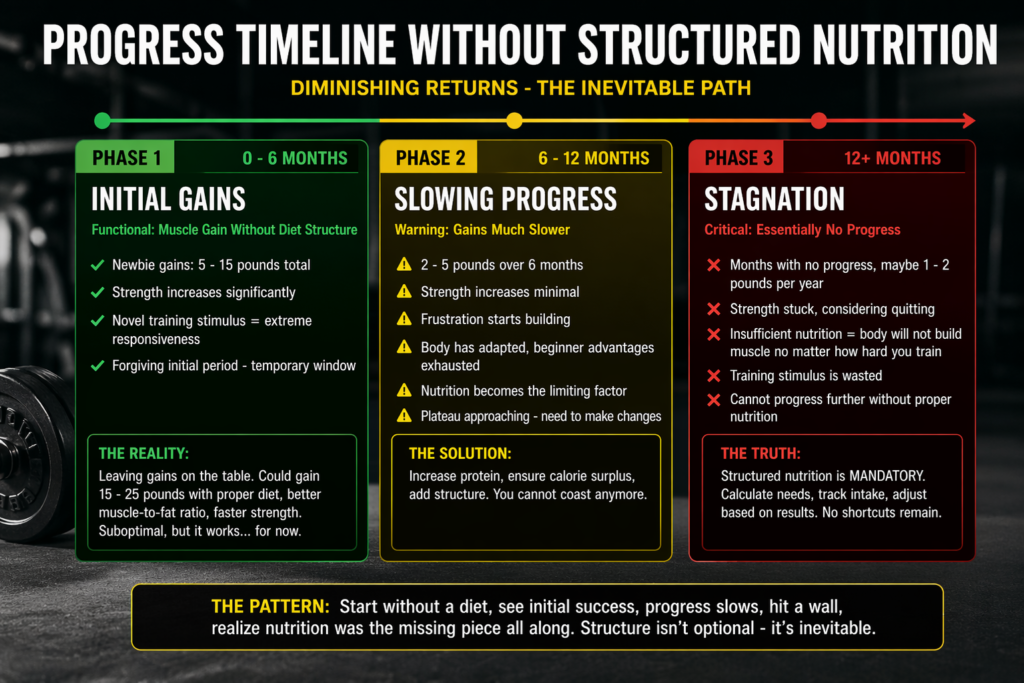
Initial phase (0-6 months):
- Some muscle gain possible without diet
- Newbie gains or special circumstances
- Feels like it’s working
- Honeymoon period
Intermediate phase (6-18 months):
- Progress slows or stops
- Body adapted to training
- Need more precise nutrition
- Plateau inevitable
Advanced phase (18+ months):
- Impossible to progress without structure
- Gains measured in ounces not pounds
- Need perfect nutrition
- Structure becomes mandatory
The pattern: Start without diet, eventually hit wall, must structure nutrition to continue.
When Can You Build Muscle Without Dieting?
The specific exceptions to the rule.
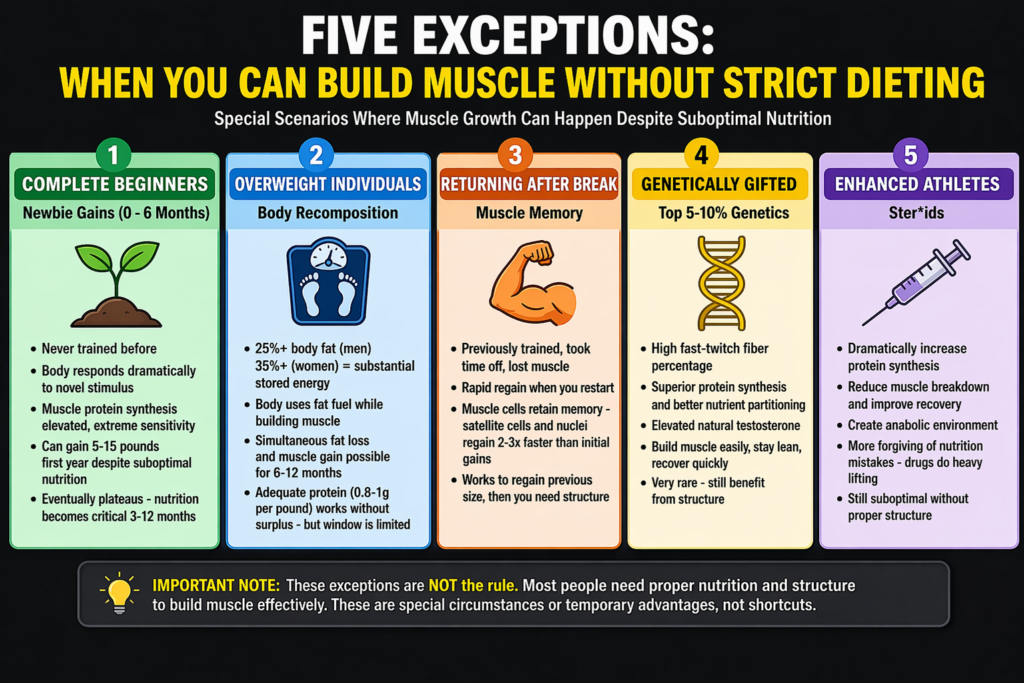
Exception 1: Complete Beginners (Newbie Gains)
Why beginners are different:
The newbie gain phenomenon:
- Never trained with weights before
- Body responds dramatically to novel stimulus
- Muscle protein synthesis elevated for weeks/months
- Extreme sensitivity to training
What happens:
- Start lifting weights
- Don’t change diet at all
- Still build 5-15 pounds muscle first year
- Strength increases rapidly
- Gains happen despite suboptimal nutrition
The mechanism:
- Untrained muscles extremely responsive
- Training stimulus alone triggers growth
- Body prioritizes muscle building initially
- Nutrition becomes limiting factor later
- Temporary advantage
How long this lasts:
- 3-6 months for most people
- Maybe 6-12 months for some
- Eventually plateaus
- Then nutrition becomes critical
Real example:
- 160-pound beginner starts lifting
- Eats same diet as before (no tracking)
- Gets 2,200 calories daily, 100g protein (unaware)
- Gains 8 pounds first 6 months (some muscle, some fat)
- Progress despite inadequate protein
Eventually:
- Month 7-8: Progress slows
- Month 9-12: Minimal gains
- Must increase protein and calories
- Newbie grace period ends
Exception 2: Overweight Individuals
Body composition advantage:
Why this works:
- High body fat percentage (25%+ for men, 35%+ for women)
- Substantial stored energy available
- Body can use fat for fuel while building muscle
- Simultaneous fat loss and muscle gain possible
The process (body recomposition):
- Start weight training
- Maintain current calorie intake (or slight deficit)
- Body burns fat for energy
- Uses dietary protein for muscle building
- Net result: Less fat, more muscle
What’s required:
- Adequate protein intake (0.8-1g per pound)
- Resistance training
- Calorie deficit or maintenance
- Not a surplus
Research support:
- Multiple studies show overweight beginners can recomp
- Lose fat and gain muscle simultaneously
- Only works when significantly overfat
- Eventually need surplus for continued muscle gain
Timeline:
- First 6-12 months: Recomp possible
- As body fat decreases (under 20% men, 30% women): Becomes harder
- Eventually need surplus to gain more muscle
- Limited window
Real example:
- 200-pound man, 30% body fat
- Starts lifting, maintains 2,500 calories
- After 8 months: 190 pounds, 20% body fat
- Lost 22 pounds fat, gained 12 pounds muscle
- Worked without surplus initially
Exception 3: Returning After Time Off (Muscle Memory)
The muscle memory advantage:
What muscle memory is:
- Previously trained but took time off
- Lost muscle during break
- Muscle cells retain “memory” (satellite cells)
- Rapid regain when restarting
The science:
- During initial training, muscles gain nuclei
- These nuclei don’t disappear even when muscle shrinks
- When retraining, these nuclei enable rapid regrowth
- Regaining faster than initial gaining
How fast:
- Can regain lost muscle 2-3x faster than initially built
- Example: Took 1 year to build, regain in 4-6 months
- Works without strict diet
- Accelerated timeline
What’s required:
- Resume training
- Reasonable protein intake (not necessarily optimal)
- Time (several months)
- Structure helps but not mandatory initially
Real example:
- Lifter trains 3 years, builds to 180 pounds 12% body fat
- Stops training 1 year, drops to 165 pounds 18% body fat
- Resumes training, eats normally (no tracking)
- Regains most size in 5-6 months
- Muscle memory effect
The limitation:
- Only works to regain previous size
- To exceed previous peak, need structured nutrition
- Memory effect doesn’t last forever
- Temporary boost
Exception 4: Genetically Gifted Individuals
Natural advantage:
Genetic factors:
- High ratio of fast-twitch muscle fibers
- Superior protein synthesis response
- Better nutrient partitioning
- Elevated natural testosterone
- Biological advantage
What this looks like:
- Build muscle easily without trying
- Stay lean while eating whatever
- Recover quickly
- Respond dramatically to training
- Top 5-10% genetics
The reality:
- Very rare (most people aren’t this)
- Still benefit from structured nutrition
- Maximize genetic potential
- Advantage, not magic
Even with great genetics:
- Structured nutrition produces better results
- Can’t overcome terrible diet completely
- Just more forgiving of mistakes
- Still follow basic principles
Exception 5: Enhanced Athletes (Steroids)
Pharmacological advantage:
How steroids change equation:
- Dramatically increase protein synthesis
- Reduce muscle protein breakdown
- Improve recovery
- Alter nitrogen balance
- Anabolic environment regardless of diet
Research showing:
- Studies where steroid users gain muscle without training
- Certainly gain muscle with training but poor diet
- Far more forgiving of nutrition mistakes
- Drugs do heavy lifting
What happens:
- Enhanced athlete eats poorly
- Still builds muscle
- Not optimal, but works
- Pharmaceutical support
Important note:
- This article focuses on natural lifters
- If enhanced, different rules apply
- But structured nutrition still better
- Drugs don’t eliminate nutrition importance
How Long Can You Progress Without Structured Nutrition?
The timeline of diminishing returns.
Phase 1: Initial Gains (0-6 Months)
What happens:
- Muscle gain without diet structure
- Newbie gains or special circumstances
- 5-15 pounds total gain (muscle + fat)
- Strength increases significantly
Why it works:
- Novel training stimulus
- Extreme muscle responsiveness
- Forgiving initial period
- Temporary window
What you’re leaving on table:
- Could gain 15-25 pounds with proper diet
- Ratio of muscle to fat better with structure
- Strength gains faster
- Suboptimal but functional
Phase 2: Slowing Progress (6-12 Months)
What happens:
- Gains become much slower
- Might add 2-5 pounds over 6 months
- Strength increases minimal
- Frustration building
Why progress slows:
- Body adapted to training
- Beginner advantages exhausted
- Nutrition becomes limiting factor
- Plateau approaching
What you need:
- Increase protein significantly
- Ensure caloric surplus
- Add structure
- Can’t coast anymore
Phase 3: Stagnation (12+ Months)
What happens:
- Essentially no progress for months
- Maybe 1-2 pounds yearly
- Strength stuck
- Considering quitting
Why stagnation occurs:
- Insufficient nutrition
- Body won’t build without resources
- Training stimulus wasted
- Can’t progress further
What’s required:
- Structured nutrition mandatory
- Calculate needs
- Track intake
- Adjust based on results
- No shortcuts remain
Minimum Nutrition Requirements Without “Dieting”
The least you need to know.
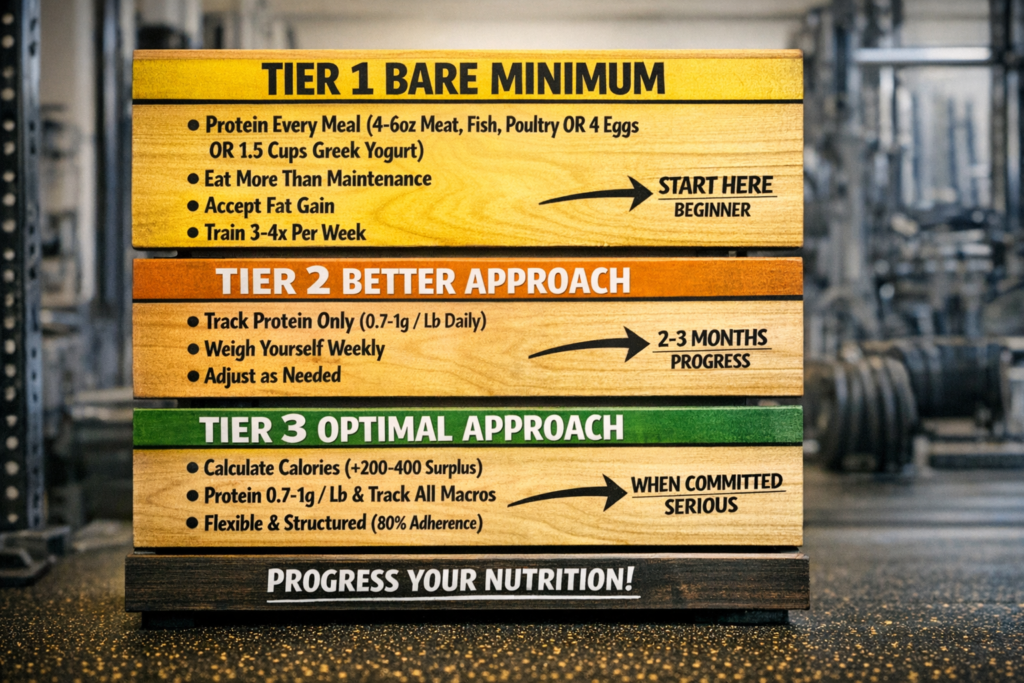
If You Absolutely Won’t Track Anything
Bare minimum principles:
Principle 1: Eat protein every meal
- 4-6oz meat, fish, or poultry per meal
- Or 4 eggs
- Or 1.5 cups Greek yogurt
- Or 1.5 scoops protein powder
- At every meal
Principle 2: Eat more than maintenance
- Add one extra meal or large snack daily
- Don’t try to stay lean while bulking
- Accept some fat gain
- Can’t build muscle from nothing
Principle 3: Train consistently
- 3-4 days weekly minimum
- Progressive overload
- Follow actual program
- Nutrition supports training
Slightly Better: Track Protein Only
The 80/20 approach:
What to do:
- Track only protein intake
- Aim for body weight in grams (180lb = 180g protein)
- Don’t track calories, carbs, or fats
- Protein is most important
Why this works better:
- Ensures adequate protein
- More likely in surplus naturally
- Simple enough to maintain
- Key nutrient covered
How to implement:
- Use app to track protein only
- Ignore other macros
- Hit target daily
- Eat to appetite for everything else
- Simplified approach
Even Better: Track Protein and Weight
Adding feedback loop:
What to do:
- Track protein daily (0.7-1g per pound)
- Weigh yourself weekly
- Adjust food if not gaining
- Basic accountability
If gaining 0.5-1 pound weekly:
- Current approach working
- Continue as is
- Don’t change anything
If not gaining weight:
- Add one extra meal
- Or larger portions
- Reassess in 2 weeks
- Simple adjustment
Should You Structure Your Nutrition?
Decision framework.
When You DON’T Need Structure (Yet)
You might skip structure if:
Complete beginner (first 3-6 months):
- Never trained before
- Just want to try lifting
- See how body responds
- Learning phase
Testing commitment:
- Not sure if you’ll stick with it
- Don’t want to invest time in nutrition yet
- Want to see if you enjoy training
- Exploration phase
Very overweight:
- 30%+ body fat
- Can recomp initially
- Focus on establishing habits
- Foundation phase
When You SHOULD Structure Nutrition
You need structure if:
Serious about results:
- Committed to building muscle
- Want optimal progress
- Willing to invest effort
- Results matter
Past beginner phase:
- Training 6+ months
- Progress has slowed
- Hit plateau
- Need next level
Competing or specific goals:
- Want to compete someday
- Training for specific physique
- Time-sensitive goals
- Performance matters
Wasted months frustrating:
- Tired of minimal progress
- Want to maximize effort
- Stop spinning wheels
- Efficiency matters
The Minimal Effective Structure
You don’t need perfection:
What you actually need:
- Daily protein target (0.7-1g per pound)
- Rough calorie target (surplus of 200-400)
- Track most days (80% adherence fine)
- Flexible structure
What you DON’T need:
- Perfect macro ratios
- Meal timing precision
- Expensive supplements
- Suffering or restriction
- Unnecessary extremes
The Bottom Line: You Can, But Should You?
After examining all angles:
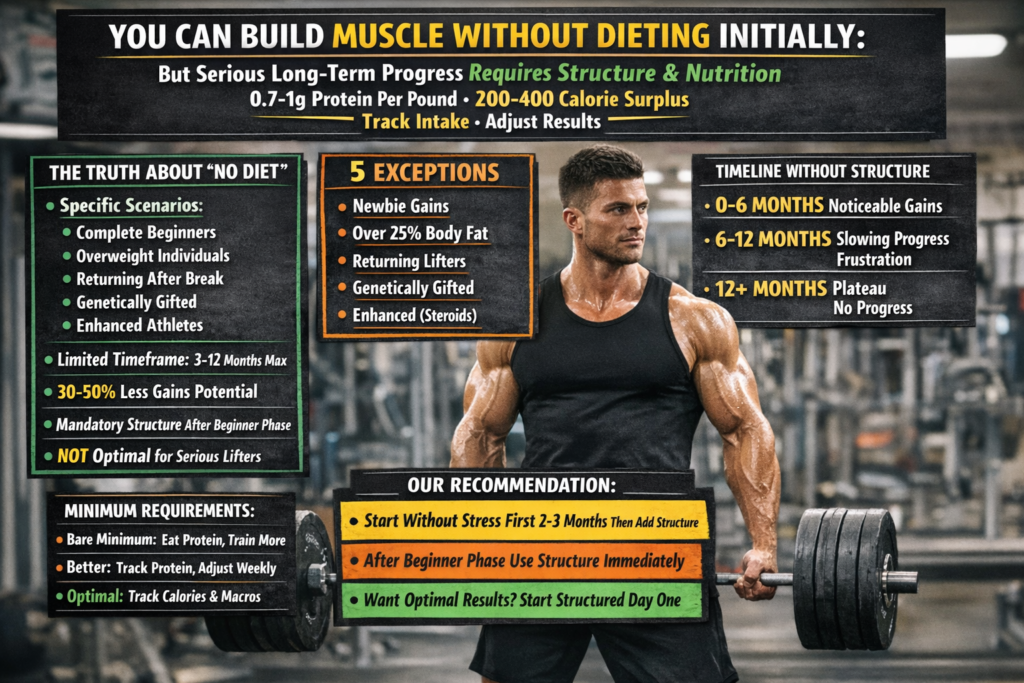
The truth about building muscle without structured nutrition:
✅ Possible in specific scenarios (beginners, overweight, returning after break, gifted genetics, enhanced)
✅ Limited timeframe of effectiveness (3-12 months maximum for most)
✅ Significantly slower progress (leaving 30-50% potential gains on table)
✅ Eventually mandatory for continued progress (structure needed past beginner phase)
❌ Not optimal for anyone serious about results (suboptimal by definition)
The five exceptions where muscle growth happens without dieting:
Exception 1: Complete beginners (0-6 months)
- Newbie gains phenomenon
- Body extremely responsive initially
- Can gain 5-15 pounds without diet changes
- Eventually plateaus
Exception 2: Overweight individuals (6-12 months)
- 25%+ body fat for men, 35%+ for women
- Can recomp (lose fat, gain muscle simultaneously)
- Works until relatively lean
- Then need surplus
Exception 3: Returning after break (3-6 months)
- Muscle memory effect
- Rapid regain of previous size
- 2-3x faster than initial gaining
- Only to previous peak
Exception 4: Genetically gifted (variable)
- Top 5-10% genetics
- More forgiving of nutrition mistakes
- Still benefit from structure
- Rare advantage
Exception 5: Enhanced athletes (ongoing)
- Steroid use changes rules
- More forgiving of poor nutrition
- Still suboptimal without structure
- Not focus of this article
Minimum nutrition requirements without full structure:
Bare minimum (least effective):
- Eat protein every meal (4-6oz meat/poultry/fish)
- Eat more food overall (extra meal or large snack)
- Train consistently (3-4 days weekly)
Better approach:
- Track protein only (0.7-1g per pound daily)
- Weigh weekly
- Adjust food if not gaining 0.5-1 lb weekly
Optimal approach:
- Calculate calorie needs
- Set protein target (0.7-1g per pound)
- Track intake with app
- Adjust based on results
- Structure with flexibility
Timeline of progress without structure:
Months 0-6:
- Noticeable gains possible
- Works for exceptions
- Suboptimal but functional
Months 6-12:
- Progress slowing significantly
- Frustration building
- Structure becoming necessary
Months 12+:
- Minimal to no progress
- Plateau indefinitely
- Must add structure to continue
The recommendation:
If you’re a complete beginner:
- Start training without stressing about diet
- Just eat more protein
- See if you enjoy lifting
- Add structure after 2-3 months when committed
If you’re past beginner phase:
- Structure nutrition immediately
- You’re wasting training effort
- Can’t progress without it
- Stop spinning wheels
If you want optimal results:
- Structure nutrition from day one
- It’s not that complicated
- Worth the effort
- Maximize every workout
YOU CAN BUILD MUSCLE WITHOUT DIETING INITIALLY. BUT FOR SERIOUS LONG-TERM PROGRESS, STRUCTURE NUTRITION: 0.7-1G PROTEIN PER POUND, 200-400 CALORIE SURPLUS, TRACK INTAKE, ADJUST BASED ON RESULTS.
Ready to stop leaving gains on the table and build a complete, evidence-based nutrition plan that maximizes muscle growth without unnecessary restriction, provides sustainable meal strategies you’ll actually follow, and delivers consistent results without spinning your wheels for months? Understanding when diet matters is just the start. Get a comprehensive guide to calculating exact calorie and protein needs, building flexible meal plans that fit your lifestyle, implementing progressive training that demands proper nutrition, and achieving your physique goals as efficiently as possible. Stop guessing about nutrition. Start following proven strategies that optimize every workout.
REFERENCES
SECTION 1 — Untrained individuals exhibit greater hypertrophic response to resistance training
[1] Lopez P et al. — PMC/Medicine and Science in Sports and Exercise, 2021 Systematic review and network meta-analysis of 28 studies involving 747 healthy adults; untrained participants demonstrated significantly greater muscle hypertrophy from resistance training compared to those with previous training experience (p=0.033); the large window for adaptation in untrained individuals masks differential effects of training variables that matter more in experienced lifters; muscle hypertrophy in untrained participants was achieved across all load ranges, indicating the training stimulus alone is highly effective regardless of load during the beginner phase; provides the evidence base for why beginners can build muscle without nutritional optimization https://pmc.ncbi.nlm.nih.gov/articles/PMC8126497/
[2] Hubal MJ & Lopez P et al. — PMC/Journal of Strength and Conditioning Research, 2019 Systematic review and meta-analysis of resistance training effects on whole-body muscle growth in healthy adult males; training status was identified as a decisive variable in potential muscle mass gain, with untrained individuals demonstrating consistently greater hypertrophy gains than trained individuals; as training experience accumulates, precision in both training programming and nutritional strategies becomes increasingly important for optimal anabolic balance; directly validates the article’s premise that early training progress occurs without nutritional optimization but that structure becomes progressively more important https://pmc.ncbi.nlm.nih.gov/articles/PMC7068252/
SECTION 2 — Body recomposition: simultaneous fat loss and muscle gain
[3] Barakat C et al. — Strength and Conditioning Journal, 2020 Comprehensive narrative review of body recomposition across multiple populations; despite common belief that simultaneous fat loss and muscle gain only occurs in untrained and overweight individuals, substantial evidence from multiple studies demonstrates the phenomenon in resistance-trained individuals as well; the two primary drivers of body recomposition are progressive resistance training combined with evidence-based nutritional strategies, particularly adequate protein intake; initial fat mass, training status, and protein intake are the primary moderating variables; directly validates the article’s Exception 2 (overweight individuals) and provides the broader context for when recomposition is possible without a caloric surplus https://journals.lww.com/nsca-scj/fulltext/2020/10000/body_recomposition__can_trained_individuals_build.3.aspx
SECTION 3 — Muscle memory: myonuclei retention and accelerated retraining
[4] Bruusgaard JC et al. — PubMed/PNAS, 2010 Foundational in vivo imaging study demonstrating that new myonuclei acquired during overload exercise precede hypertrophy and are not lost during subsequent detraining; newly formed nuclei are retained even during severe atrophy lasting a considerable portion of the animal’s lifespan; the elevated number of myonuclei after a prior hypertrophic episode retarded disuse atrophy and provided a cellular mechanism for muscle memory; this myonuclear permanence explains why retraining is faster than initial training and why previously trained individuals regain muscle mass more rapidly; establishes the molecular mechanism underlying the article’s Exception 3 (returning after a break) https://pubmed.ncbi.nlm.nih.gov/20713720/
[5] Gundersen K — PubMed/Journal of Experimental Biology, 2016 Review describing the cellular memory model of skeletal muscle; previously trained muscle fibres retain an elevated number of myonuclei even after returning to baseline mass; fibres with more myonuclei grow faster when subjected to overload exercise; myonuclei may be stable for at least 15 years in humans and potentially permanent; the elevated nuclear content constitutes a functionally important memory of previous training that enables accelerated retraining; in elderly individuals the difficulty of recruiting myonuclei argues for early strength training as a public health measure; consolidates the cellular basis for the muscle memory effect the article describes for returning trainees https://pubmed.ncbi.nlm.nih.gov/26792335/
SECTION 4 — Total daily protein as the primary nutritional variable
[6] Morton RW et al. — PMC/British Journal of Sports Medicine, 2018 Meta-analysis of 49 RCTs with 1,863 participants; protein supplementation significantly increased fat-free mass, one-repetition maximum strength, and muscle fiber cross-sectional area during resistance training; gains in fat-free mass plateaued at approximately 1.62 g/kg/day total protein; total protein intake was the strongest predictor of hypertrophic outcomes; training experience moderated the protein response, with trained individuals showing greater absolute benefits from protein adequacy; provides the evidence base for the article’s recommendation that hitting a protein target (0.7-1g per pound) is the minimum effective nutritional intervention before full diet structure becomes necessary https://pmc.ncbi.nlm.nih.gov/articles/PMC5867436/




Leave a Reply
You must be logged in to post a comment.