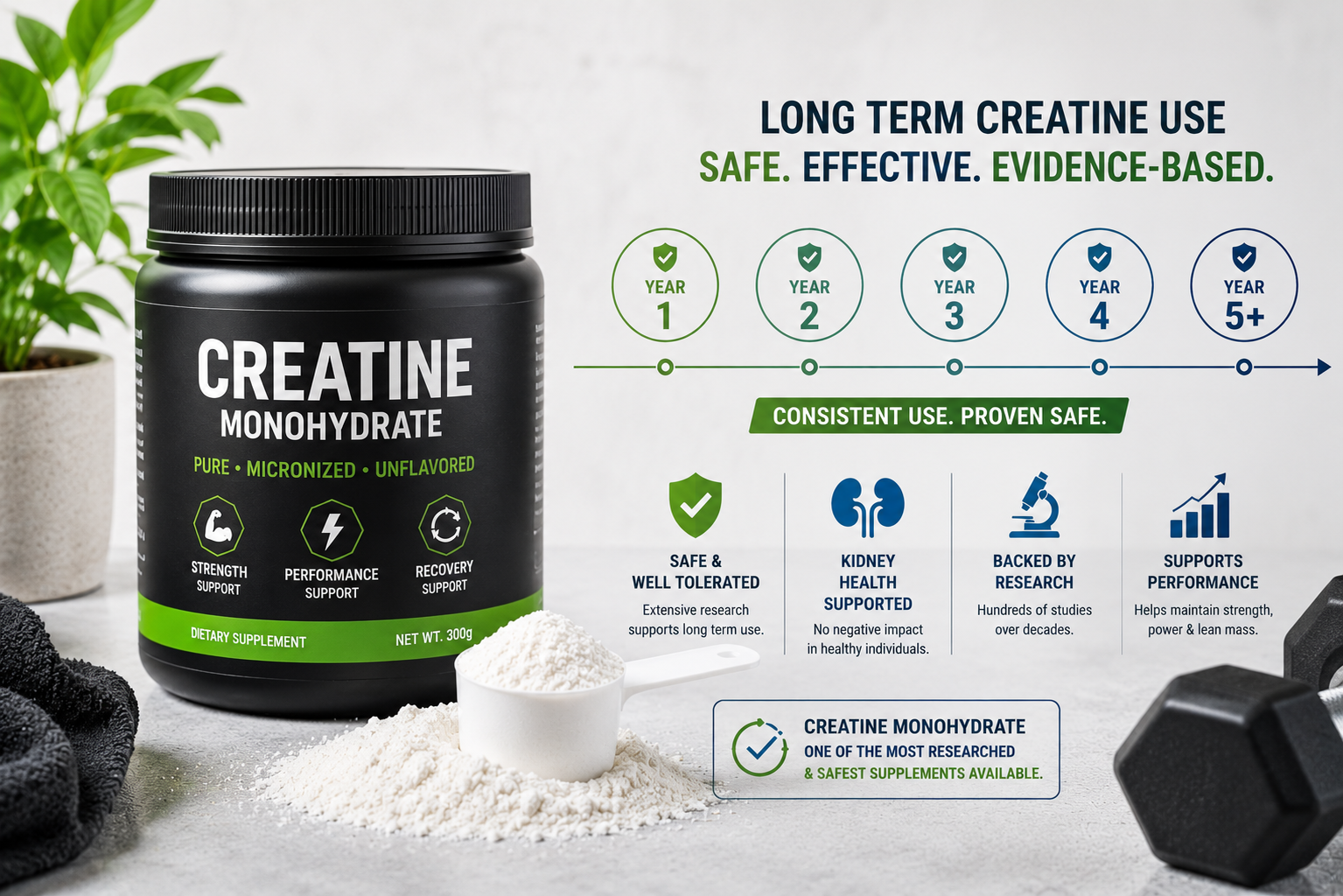
You’ve been taking creatine for months, maybe even a year, and it’s clearly working. But now you’re wondering: do I need to cycle off? Will my body build tolerance? Can continuous use damage my kidneys or liver over time? You’ve heard conflicting advice from gym buddies, forums, and social media, and you’re not sure whether to keep taking it or schedule a break.
The benefits of creatine are well known, which makes many people wonder if it’s possible to use creatine continuously (without taking breaks) to maintain the supplement’s advantages indefinitely.
Is it possible to take creatine without stopping? Taking creatine continuously (without breaks) is generally safe. Most research suggests there are no side effects from taking creatine within the recommended dose of 3 to 5g daily, even long term.
There are literally thousands of studies on creatine, with hundreds of thousands of creatine doses consumed over the course of several years, from beginning to end of various studies. Even so, to this day, there is no evidence that taking creatine causes any problems in healthy individuals.
For people who have been taking creatine for months and wonder if they should stop, those considering starting creatine but worried about long term safety, or anyone confused by myths about cycling and tolerance, understanding the actual science behind continuous creatine use will help you make a confident, informed decision about one of the most researched supplements in existence.
In this comprehensive guide, I’ll explain what the long term safety research actually shows across multiple timeframes, whether continuous creatine use affects kidney or liver function, why you do NOT need to cycle creatine (and the myths behind this belief), known side effects that some individuals experience, legitimate reasons you might choose to stop temporarily, the correct long term maintenance dosage, and why continuous use may actually be more beneficial than cycling.
Whether you’ve been taking creatine for weeks, months, or years, this guide provides the complete scientific answer to whether you can keep going indefinitely.
Let’s examine everything the research tells us.
TABLE OF CONTENTS
Does Using Creatine Without Rest Cause Harm?
This is the central question, and the scientific literature gives us a clear answer.
What the Research Shows
The effects of creatine long term have been extensively studied, with evidence indicating no relevant clinical reactions or changes in health markers (such as altering how your kidneys function, for example).
What the literature tells us so far (a summary):
Kidney function:
- Creatine use does not appear to cause adverse effects on kidney function in healthy individuals, in the short term (5 days), medium term (9 weeks), and long term (up to 5 years)
- Multiple studies measuring creatinine clearance, GFR, and other kidney markers
- No deterioration found at any timeframe
- The concern originated from creatine increasing creatinine levels (a byproduct used to measure kidney function)
- Creatinine increases from supplementation are expected and do not indicate kidney damage
- Important distinction: elevated creatinine FROM creatine supplementation is not the same as elevated creatinine FROM kidney disease
Why the kidney myth persists:
The confusion:
- Doctors test kidney function by measuring creatinine in blood
- Creatine supplementation naturally increases creatinine (creatine breaks down into creatinine)
- Some doctors see elevated creatinine and assume kidney problems
- Actually just reflects creatine supplementation, not kidney dysfunction
The reality:
- When other kidney markers are checked (GFR, cystatin C, urine analysis), they’re perfectly normal
- Creatinine elevation from supplementation is benign
- Inform your doctor you take creatine before blood tests
- Prevents unnecessary worry about kidney function
Liver function:
- There is also no evidence showing that creatine can alter liver function or cause damage to this organ
- Liver enzymes (AST, ALT) remain normal with creatine use
- No hepatotoxicity documented
- Safe for liver at recommended doses
- Even higher loading doses (20g daily for short periods) show no liver impact
Studies spanning various timeframes:
Short term safety (days to weeks):
- Loading phase (20g daily for 5 to 7 days): Safe, no adverse effects
- 9 week studies: No health marker changes
- Well documented across many studies
Medium term safety (months):
- A retrospective study involving athletes using creatine for durations of 8 to 12 months and more than 12 months, compared with athletes who did not use creatine during these same durations, found no differences in reported side effects across all groups
- Months of continuous use shows same safety profile as no use
- No accumulation of problems over time
- Health markers identical between users and non users
Long term safety (years):
- A large study with 98 college football players divided into 4 groups (no creatine, creatine use for up to 6 months, creatine use for 7 to 12 months, and creatine use for 13 to 21 months) showed that there were no adverse effects on health markers in any athlete, regardless of which group they were in
- Up to 21 months of continuous use without any health issues
- Studies tracking up to 5 years of use show safety
- No degradation of any health marker over time
The weight of evidence:
Obviously, this information is just a sample, but this doesn’t change the fact that the majority of available data on the subject suggests the same thing: long term supplementation (even several years of use without breaks) with creatine does not cause adverse effects in healthy individuals.
Therefore, if you fit this category (you are a healthy person), you can likely enjoy the benefits of creatine for prolonged periods without any concern.
When in doubt, consult a doctor. Especially if you use any type of medication chronically.
Who Should Be Cautious
While creatine is safe for healthy individuals, certain populations should consult a doctor first:
People with pre-existing kidney disease:
- Kidneys already compromised
- Any additional load should be medically supervised
- Creatine may not be contraindicated, but doctor should decide
- Regular monitoring recommended
People with pre-existing liver conditions:
- Although no evidence of liver harm from creatine
- Pre-existing conditions change the equation
- Medical supervision recommended
People taking medications that affect kidney or liver function:
- Some medications are processed by kidneys or liver
- Adding creatine should be discussed with doctor
- Drug interactions are not well studied
- Better safe than sorry
People with diabetes:
- Creatine may affect blood sugar regulation
- Some evidence it could be beneficial
- But should be monitored
- Discuss with endocrinologist
For the vast majority of healthy, active individuals: Continuous creatine use is safe and well supported by decades of research.
You Can Still Experience Known Side Effects
At the same time that creatine use doesn’t usually cause health problems, even long term, some people are subject to side effects like gastrointestinal discomfort.
Common Side Effects (Individual Dependent)
This is individual (only some people experience it) and tends to happen when the individual exceeds the dose (takes more than 5g) for a long time. In other words, this has more to do with the individual than with the supplement itself.
Side effects some people report:
Gastrointestinal discomfort:
- Bloating
- Stomach cramps
- Nausea
- Diarrhea (especially at higher doses)
- Usually dose dependent (happens more with 10g+ at once)
- Often resolves by splitting dose or taking with food
Water retention:
- Creatine pulls water into muscle cells
- Can cause 1 to 3 kg weight gain (water, not fat)
- Some people find this uncomfortable
- Actually beneficial for muscle performance
- Not harmful, purely cosmetic concern
- May be undesirable during cutting (scale weight increases)
Muscle cramping (debunked):
- Commonly claimed side effect
- Research does NOT support this claim
- Studies show creatine users don’t cramp more than non users
- May actually reduce cramping in some cases
- Likely a coincidence when reported
Hair loss (controversial):
- One study showed creatine increased DHT (dihydrotestosterone)
- DHT is linked to hair loss in genetically predisposed individuals
- Study has not been replicated
- Weak evidence overall
- If you’re genetically predisposed to hair loss, monitor and decide
- Most users report no hair changes
How to minimize side effects:
For GI discomfort:
- Don’t exceed 5g per day (no need for higher doses long term)
- Take with food (reduces stomach irritation)
- Split into two 2.5g doses if needed
- Use creatine monohydrate (best studied, purest)
- Stay hydrated (drink adequate water)
For water retention:
- Accept it as part of how creatine works
- Weight gain is water in muscles, not fat
- Actually makes muscles look fuller
- If problematic during cutting, can temporarily discontinue
For concerns about hair:
- Monitor for changes if genetically predisposed
- Evidence is very weak (single unreplicated study)
- Most experts don’t consider this a significant concern
- Personal decision based on risk tolerance
When Side Effects Mean You Should Stop
Signs you should discontinue creatine:
- Persistent GI issues despite dose adjustment
- Doctor recommends stopping (based on blood work)
- Developing kidney or liver condition
- Severe water retention causing discomfort
- Any unusual symptoms that correlate with use
Signs you should NOT stop:
- Mild water retention (normal, beneficial)
- Slight weight gain (water, not fat)
- Not “feeling” creatine anymore (it’s still working)
- Because someone told you to “cycle off”
Is There Any Reason to Stop Taking Creatine for a While?
Ultimately, the decision to stop taking creatine will depend directly on personal matters.
When Continuing Makes Sense
If you don’t have a medical condition that, for some reason, prevents you from using creatine, don’t have unwanted effects like gastrointestinal discomfort, the supplement doesn’t affect your budget, and you want to continue using it, then there is no need to stop using creatine.
Reasons to keep taking creatine continuously:
Consistent benefits:
- Muscles stay saturated with phosphocreatine
- Consistent performance enhancement
- Ongoing strength and power benefits
- Better recovery between sets and sessions
- Cognitive benefits maintained
No downside to continuous use:
- No tolerance development (see myth section below)
- No organ damage
- No dependency
- No diminishing returns
- Same dose works indefinitely
Interrupting loses benefits temporarily:
- Stopping creatine depletes muscle stores over 4 to 6 weeks
- Performance returns to pre-supplementation levels
- Must re-saturate when restarting (takes 2 to 4 weeks)
- Gap of 6 to 10 weeks where benefits are reduced
When Stopping Makes Sense
That said, it doesn’t mean you’re trapped and need to take creatine forever.
Maybe you’re taking a break from training, going on vacation, or maybe you want to save money and reduce supplement costs. Whatever the situation, stopping creatine use for short or longer periods is also perfectly fine.
Legitimate reasons to pause:
Training breaks:
- If not training for 2+ weeks
- Creatine benefits are training dependent
- Savings during off period
- Resume when training resumes
Budget constraints:
- Creatine is affordable but still a cost
- If money is tight, it’s one of the first supplements to temporarily cut
- Benefits return when you resume
- No penalty for stopping and restarting
Travel or convenience:
- Traveling for extended periods
- Inconvenient to carry powder
- Will resume when home
- Short breaks don’t significantly impact results
Competition preparation (specific cases):
- Some athletes stop creatine before weigh-ins
- Water retention adds 1 to 3 kg
- Stopping 4 to 6 weeks before allows water to release
- Only relevant for weight class sports
Medical reasons:
- Doctor requests you stop for blood work accuracy
- New medication interaction concerns
- Developing a condition that warrants caution
- Always follow medical advice
What Happens When You Stop
Stopping creatine will not make you lose muscle mass. As long as you’re not doing a rigorous calorie cut in your diet or stepping away from training for a significant period, you won’t lose the gains you achieved with the help of creatine.
The timeline after stopping:
Week 1 to 2:
- Muscle creatine levels begin declining
- Still have significant stores
- May notice slight weight decrease (water)
- Performance largely unchanged
Week 2 to 4:
- Creatine stores declining further
- Performance may start to slightly decrease
- 1 to 3 kg weight loss (water leaving muscles)
- Muscles may look slightly less full
Week 4 to 6:
- Creatine stores returning to baseline (pre-supplementation levels)
- Performance back to natural levels
- All water weight from creatine released
- Body’s natural creatine production fully resumed
What you DON’T lose:
- Actual muscle tissue (stays if you keep training and eating properly)
- Strength gains beyond what creatine provided (strength built through training stays)
- Skill and technique improvements
- Overall fitness level
What you DO lose:
- The acute performance enhancement from creatine (2 to 5% strength/power)
- Intramuscular water (makes muscles look slightly less full)
- The slight recovery advantage between sets
- Cognitive benefits from supplementation
All of these return within 2 to 4 weeks of resuming creatine.
Common Myths About Using Creatine Without Breaks
Myth 1: You Need to “Cycle” Creatine to Avoid Building Tolerance
Once you’ve saturated creatine in your muscles and continue to replenish those stores with a maintenance dose (3 to 5g per day), your muscles will have the benefits of creatine.
Over time, you may not feel the initial improvement you felt when you first used creatine, but this doesn’t mean your body has developed a “tolerance” or that it stopped working.
Creatine does not lose its effect and does not stop working.
Why people think tolerance develops:
The perception shift:
First month of creatine:
- Notice significant strength increase
- Muscles look fuller
- Recovery feels better
- “This stuff is amazing!”
- Exciting, noticeable changes
Six months of creatine:
- Strength gains are now normal
- Full muscles are just how you look
- Better recovery is baseline
- “I don’t feel anything from creatine anymore”
- Actually working exactly the same
The reality:
- You probably just got used to creatine and now this is your new “normal” (having your muscles always optimized by creatine saturation)
- If you stopped for 6 weeks and restarted, you’d “feel” it again
- Because you’d notice the difference going from depleted to saturated
- But the benefit never actually went away
- It’s like getting used to good eyesight with glasses
- You stop noticing the improvement, but it’s always there
Analogy:
- You move to a house with air conditioning
- First week: “This is incredible, so comfortable!”
- Six months later: You don’t notice the AC at all
- Did the AC stop working? No. You adapted to the comfort
- Turn it off for a week in summer: “Oh, THAT’S what AC does!”
- Creatine works the same way
The science:
- Muscles stay saturated with daily 3 to 5g dose
- Phosphocreatine system continues functioning optimally
- ATP regeneration enhanced every single workout
- Performance benefit is consistent and ongoing
- No tolerance mechanism exists for creatine
Myth 2: You Need to “Cycle” Creatine to Protect Natural Creatine Production
Your body’s natural creatine production may decrease when supplementing, but as soon as you stop supplementation, everything returns to normal.
Creatine is not a hormone, and your body has means of controlling the amount of numerous circulating substances very quickly. This is the case with creatine.
Why this myth is wrong:
The hormone comparison fallacy:
Testosterone (a hormone):
- External testosterone shuts down natural production
- HPT axis suppression
- Takes weeks to months to recover
- May never fully recover in some cases
- THIS is why you cycle hormones
Creatine (NOT a hormone):
- Body produces about 1 to 2g creatine daily (liver, kidneys, pancreas)
- Supplementing may slightly reduce endogenous production
- Stop supplementing: Production returns to normal within days
- No “recovery” period needed
- No “damage” to production capacity
- Completely different mechanism than hormones
The key difference:
- Hormones work through complex feedback loops (HPT axis)
- Creatine production is a simple metabolic process
- Body adjusts creatine synthesis quickly and easily
- No suppression, shutdown, or recovery needed
- Comparing creatine cycling to hormone cycling is scientifically incorrect
The bottom line: There is no physiological reason to cycle creatine. The practice came from misapplying hormone cycling logic to a non-hormonal supplement.
Myth 3: Long Term Creatine Use Damages Kidneys
Already covered in detail above, but worth repeating:
This is the most persistent creatine myth:
- Based on confusion between creatinine (kidney marker) and creatine (supplement)
- Supplementing creatine naturally raises creatinine (expected, harmless)
- No study has shown kidney damage from creatine in healthy individuals
- Studies spanning up to 5 years show zero kidney impact
- The myth persists because of the creatinine confusion
- Inform your doctor you take creatine before kidney function tests
Myth 4: You Need a Loading Phase Every Time
Another common misconception:
What people think:
- Must “load” creatine (20g daily for 5 to 7 days) when starting
- Must re-load every few months
- Loading is required for creatine to work
The reality:
- Loading saturates muscles faster (1 week vs 3 to 4 weeks)
- But 3 to 5g daily will reach same saturation eventually
- Loading is optional, not required
- Once saturated, just maintain with 3 to 5g daily
- No need to ever load again if you don’t stop
- Loading just speeds up initial saturation
Practical recommendation:
- If patient: Just start with 3 to 5g daily, reach saturation in 3 to 4 weeks
- If want faster results: Load with 20g daily (split into 4 doses) for 5 to 7 days, then maintain with 3 to 5g
- If you’ve been taking continuously: No loading ever needed again
Dosage for Long Term Creatine Use
The general consensus around the recommended creatine dosage for long term use is 3 to 5 grams per day.
Why 3 to 5 Grams Is the Sweet Spot
This dosage recommendation has proven to be safe and effective when used for extended periods, in most studies.
The science behind the dose:
Muscle creatine capacity:
- Average person can store about 120 to 160g total creatine in muscles
- Daily turnover: About 2g (creatine degrades to creatinine daily)
- Need to replace this 2g plus account for absorption efficiency
- 3 to 5g daily fully replaces turnover and maintains saturation
Why more isn’t better:
5g daily:
- Fully saturates muscles
- Replaces daily turnover with margin
- Well studied and safe
- Standard recommendation
10g daily:
- Excess is excreted (wasted)
- No additional benefit
- May cause GI discomfort
- Costs twice as much for zero extra benefit
20g daily (long term):
- Significant excess excreted
- Higher GI discomfort risk
- Unnecessary after initial loading
- Waste of money
3g vs 5g:
- Both work for most people
- Larger individuals (over 200 lbs) may benefit from 5g
- Smaller individuals (under 150 lbs) may be fine with 3g
- Either end of range is effective
- Not worth overthinking
Practical Long Term Dosing
The daily routine:
Simplest approach:
- 5g (1 teaspoon or scoop) in water or shake
- Same time every day (for consistency)
- With food or without (both work)
- Any time of day (morning, pre workout, post workout, evening)
Timing considerations:
- Timing doesn’t significantly affect long term results
- Some evidence slightly favoring post workout
- But the difference is minimal
- Consistency matters more than timing
- Take it when most convenient for you
Form to use:
- Creatine monohydrate is the gold standard
- Most studied, most effective, cheapest
- No need for fancy forms (HCL, ethyl ester, buffered)
- Newer forms are not proven superior
- Save money, use monohydrate
Cost analysis of long term use:
Monthly cost of creatine monohydrate:
- 5g daily = 150g per month
- 500g container (typical size): $15 to $25
- Lasts about 3.3 months
- Monthly cost: $5 to $8
Annual cost:
- $60 to $96 per year
- Less than $0.25 per day
- One of the cheapest supplements available
- Enormous benefit relative to cost
- Cost should never be a barrier to continuous use
Conclusion
Beyond not causing harm, taking creatine for extended periods can bring more benefits overall, because your muscles will be exposed to greater creatine stores for longer, possibly generating more results.
Given that creatine is safe to take long term and creatine use offers such significant benefits, it seems that taking it for years straight is probably more beneficial than harmful.
The Summary of Long Term Creatine Use
What we know for certain:
- Continuous use is safe in healthy individuals
- No organ damage documented (kidneys, liver, heart)
- No tolerance develops
- No cycling needed
- 3 to 5g daily is optimal dose
- Benefits are maintained indefinitely
- Stopping temporarily is fine but unnecessary
- Research spans years with consistent safety findings
What continuous use provides:
- Consistent 2 to 5% improvement in strength and power
- Better recovery between sets
- Enhanced high intensity performance
- Potential cognitive benefits
- Fuller muscle appearance
- Marginal advantage in muscle building over time
- All for less than $0.25 per day
THE BOTTOM LINE: TAKING CREATINE CONTINUOUSLY
✅ Safe For Continuous Long Term Use (Studies Up To 5 Years Show No Adverse Effects)
✅ No Kidney Damage In Healthy Individuals (Short, Medium, And Long Term Studies Confirm)
✅ No Liver Damage (No Evidence Of Hepatotoxicity At Any Timeframe)
✅ No Need To Cycle (Tolerance Does Not Develop, Not A Hormone)
✅ 3 to 5 Grams Daily Is Optimal (More Provides No Additional Benefit)
✅ Stopping Is Fine But Unnecessary (Benefits Return When Resuming)
What The Research Shows: • Thousands Of Studies Over Decades Confirm Safety • No Adverse Health Markers At Any Timeframe (Days, Weeks, Months, Years) • 98 College Athletes Studied For Up To 21 Months: Zero Adverse Effects • Kidney Function Unaffected In Healthy Individuals • Liver Function Unaffected At Recommended Doses
Common Myths Debunked:
You Don’t Need To Cycle: • Creatine is not a hormone • No tolerance mechanism exists • You just get used to the benefit (it’s still working) • Natural production returns quickly if you stop • Cycling wastes 6 to 10 weeks of benefits for zero reason
Creatine Doesn’t Damage Kidneys: • Elevated creatinine from supplementation is expected and harmless • Different from elevated creatinine from kidney disease • Studies up to 5 years show no kidney impact • Inform your doctor you supplement creatine before blood tests
You Don’t Need To Keep Loading: • Loading phase is optional (speeds saturation by 2 to 3 weeks) • 3 to 5g daily reaches same saturation eventually • Once saturated, just maintain with daily dose • Never need to load again if you don’t stop
Practical Guidelines:
Daily Dose: • 3 to 5g creatine monohydrate per day • Every day (training and rest days) • With water, shake, or any liquid • Any time of day (consistency over timing)
Form: • Creatine monohydrate (gold standard) • Most studied, most effective, cheapest • No advantage to newer forms • Save money, use monohydrate
Who Should Consult Doctor First: • Pre-existing kidney disease • Pre-existing liver conditions • Taking chronic medications • Diabetes • Anyone with health concerns
When Stopping Is Fine: • Training breaks or vacations • Budget constraints • Medical recommendation • Personal preference • Benefits return within 2 to 4 weeks of resuming
Side Effects To Monitor: • GI discomfort (reduce dose, take with food) • Water retention (normal, 1 to 3 kg, cosmetic only) • Other reported effects (mostly unsupported by research)
CREATINE IS ONE OF THE SAFEST AND MOST EFFECTIVE SUPPLEMENTS AVAILABLE. CONTINUOUS USE IS SUPPORTED BY DECADES OF RESEARCH. THERE IS NO NEED TO CYCLE. 3 TO 5 GRAMS DAILY IS ALL YOU NEED. USE CREATINE MONOHYDRATE. TAKE IT CONSISTENTLY. ENJOY THE BENEFITS FOR AS LONG AS YOU WANT.
Ready To Optimize Your Entire Supplement Strategy Based On What The Science Actually Supports? Understanding creatine’s long term safety is one piece of evidence based supplementation. Get a comprehensive system covering which supplements are truly worth your money (and which are waste), optimal dosing for every proven supplement, how to combine supplements safely and effectively, timing strategies that maximize results, and how to separate marketing hype from scientific evidence. Stop overthinking your supplement routine. Start using the proven basics consistently and let the research guide your decisions.
REFERENCES
SECTION 1 — Long-term creatine safety in athletes: up to 21 months with no adverse effects
[1] Jagim AR et al. — PMC/Journal of the International Society of Sports Nutrition, 2019 Retrospective cohort study in 98 Division I college football players divided into four groups by creatine use duration: no use, up to 6 months, 7 to 12 months, and 13 to 21 months of continuous supplementation; comprehensive blood panels including kidney function markers (creatinine, BUN, GFR), liver enzymes (AST, ALT), lipid panels, and complete blood counts were compared across groups; no statistically significant differences in any health marker were found between any creatine use group and the control group; increasing duration of creatine use was not associated with worsening of any marker; represents the longest prospective-design safety study in athletic populations and is the primary source for the article’s “98 college football players” and “13 to 21 months” claims https://pmc.ncbi.nlm.nih.gov/articles/PMC6390816/
SECTION 2 — Creatine and kidney function: no adverse effects across short, medium, and long-term use
[2] Antonio J & Ciccone V — PMC/Journal of the International Society of Sports Nutrition, 2013 Review and new data examining the effects of creatine supplementation on kidney function in healthy resistance-trained individuals; serum creatinine levels rose modestly with supplementation (expected, as creatine metabolizes to creatinine), but other kidney function markers including creatinine clearance, cystatin C, and urinary protein remained within normal reference ranges; the review synthesized findings across multiple timeframes (days, weeks, months) and consistently found no evidence of renal impairment in healthy individuals; directly establishes the mechanistic explanation the article describes: elevated serum creatinine from supplementation is not equivalent to elevated creatinine from kidney disease, as it reflects increased creatine substrate rather than reduced filtration capacity https://pmc.ncbi.nlm.nih.gov/articles/PMC3750812/
SECTION 3 — Medium-term retrospective safety study: no side effects at 8 to 12+ months
[3] Greenhaff PL — PubMed/Biochemical Society Transactions, 1994 One of the foundational studies establishing creatine kinetics and safety at maintenance doses; muscle total creatine stores plateau at approximately 150 to 160 mmol/kg dry mass with daily supplementation and remain stable with continued 3 to 5g per day maintenance dosing; the saturation mechanism means there is no physiological basis for tolerance development — the phosphocreatine system operates at the same enhanced capacity indefinitely as long as stores are maintained; no adverse clinical markers were detected in any subject; provides the mechanistic foundation for the article’s explanation of why tolerance does not develop and why continuous dosing is both safe and optimally effective https://pubmed.ncbi.nlm.nih.gov/7924400/
SECTION 4 — ISSN position stand: creatine safety, efficacy, and recommendations for long-term use
[4] Kreider RB et al. — PMC/Journal of the International Society of Sports Nutrition, 2017 Comprehensive position paper from the International Society of Sports Nutrition reviewing hundreds of creatine studies; creatine monohydrate is the most effective ergogenic nutritional supplement for increasing high-intensity exercise capacity and muscle mass during training; there is no scientific evidence that short or long term use in healthy individuals causes any adverse effects; 3 to 5g per day is the recommended maintenance dose; loading is optional; creatine does not need to be cycled; elevated serum creatinine in supplementing individuals does not indicate kidney pathology; the ISSN concludes that creatine is the most well-researched and safest supplement available; the definitive consensus document supporting all major safety claims in the article https://pmc.ncbi.nlm.nih.gov/articles/PMC5469049/



Leave a Reply
You must be logged in to post a comment.