
Building muscle is one of the most common goals among gym-goers and fitness enthusiasts. But here’s a question that comes up all the time and confuses a lot of people: do you really need to eat massive amounts of food to pack on muscle?
Here’s the straight answer that might surprise you: to build muscle, you only need to eat enough to create a modest calorie surplus. Yes, this probably means eating more than you’re used to. But here’s the kicker that nobody talks about: eating way more than necessary won’t give you extra muscle gains. It’ll just make you gain unnecessary body fat.
In this comprehensive guide, I’m going to break down everything you need to know about eating for muscle growth. You’ll learn exactly how much you need to eat, when eating more is actually counterproductive, and how to calculate your precise calorie needs so you can build muscle efficiently without getting fat in the process.
Whether you’re just starting your muscle-building journey or you’ve been spinning your wheels wondering why you’re gaining more fat than muscle, understanding the truth about calorie surplus will change everything.
Let’s dive in and separate the facts from the myths.
TABLE OF CONTENTS
Why You Do Need to Eat More to Build Muscle
Let’s get one thing crystal clear from the start: your body absolutely needs fuel to build muscle tissue. Think of it like construction work you can’t build a house without materials and energy, right? Same principle applies to your body.
Understanding the Energy Balance Equation
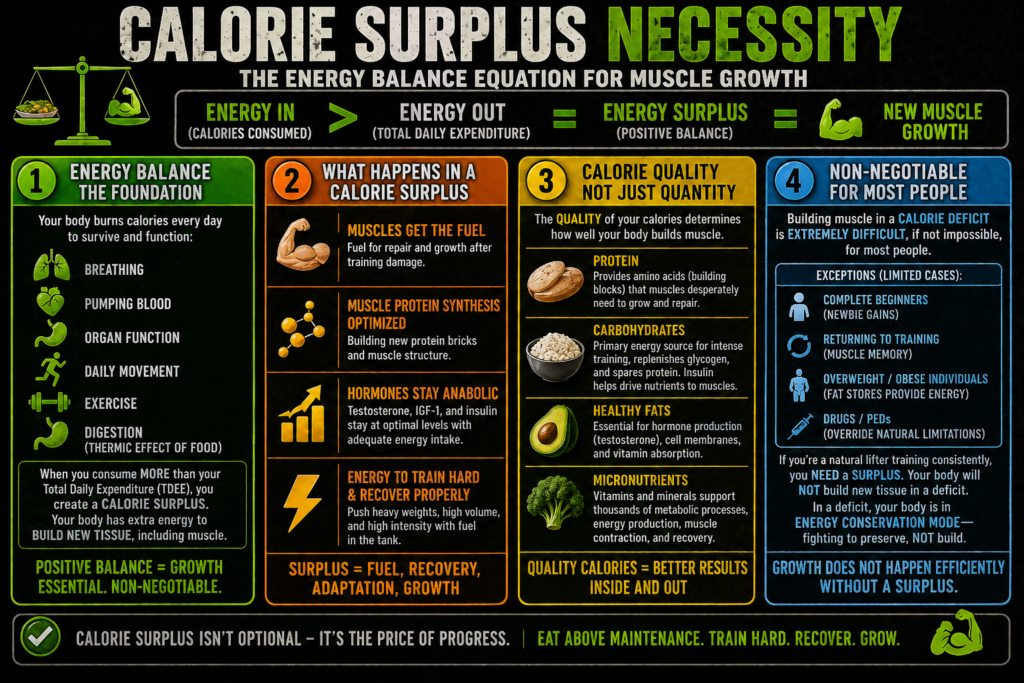
To build muscle, your body requires more energy (calories from the food you eat) than what it needs just to maintain your current weight and support your basic bodily functions. This state is called a calorie surplus or positive calorie balance.
Here’s what this means in practical terms:
Your body burns calories constantly for basic survival functions like breathing, pumping blood, maintaining body temperature, and keeping your organs functioning. On top of that, you burn additional calories through daily movement, exercise, and digestion. When you consume more calories than your total daily energy expenditure, you create a surplus that your body can use for building new tissue, including muscle.
What Happens When You’re in a Calorie Surplus
When you consistently eat in a calorie surplus while resistance training, several positive things happen in your body:
Your muscles get the fuel they need for repair and growth. After you train, your muscle fibers are damaged (in a good way). Your body needs extra energy to repair these fibers and make them bigger and stronger than before. Without adequate calories, this repair process is compromised.
Muscle protein synthesis gets optimized. This is the actual process of building new muscle protein. Think of it as your body laying down new bricks to build a bigger structure. This process requires both the raw materials (protein) and the energy to put everything together (calories from all macronutrients).
Your hormones stay in an anabolic state. Adequate calorie intake helps maintain optimal levels of muscle-building hormones like testosterone, insulin-like growth factor (IGF-1), and insulin itself. When calories are too low, these hormones can decrease, making muscle building much harder.
You have the energy to train hard and recover properly. Let’s be real you can’t push heavy weights and perform high-volume training when you’re running on empty. The surplus gives you the fuel to train with intensity and recover between sessions.
The Role of Calorie Quality (Not Just Quantity)
Now, here’s something super important that a lot of people miss: it’s not just about eating more calories; it’s about eating the right kind of calories.
You could technically eat 3,000 calories of junk food or 3,000 calories of nutritious whole foods, and while both create a surplus, your body will respond very differently to each option.
Quality food provides:
Protein – the essential building blocks (amino acids) that your muscles desperately need to grow. Without adequate protein, you’re basically trying to build a house without bricks.
Carbohydrates – your body’s preferred energy source for intense training. Carbs replenish muscle glycogen, fuel your workouts, and create an insulin response that helps drive nutrients into your muscle cells.
Healthy fats – crucial for hormone production (including testosterone), cell membrane health, and absorption of fat-soluble vitamins. Don’t fear fats; they’re your allies in muscle building.
Micronutrients – vitamins and minerals that support thousands of metabolic processes in your body, from energy production to muscle contraction to recovery.
Think of your body as a high-performance sports car. Sure, you can put cheap, low-grade fuel in it, and it’ll run. But premium fuel makes it perform better, last longer, and operate more efficiently. Same exact concept with your body and food quality.
Why Calorie Surplus Is Non-Negotiable for Most People
Here’s the biological reality: for the vast majority of people (especially those who’ve been training for more than a year), building muscle in a calorie deficit is extremely difficult, if not impossible.
There are some exceptions:
- Complete beginners experiencing “newbie gains”
- People returning to training after a long break (muscle memory effect)
- Significantly overweight individuals who can use their fat stores for energy
- People using performance-enhancing drugs (which override natural limitations)
But if you’re a natural lifter who’s been training consistently, you need that calorie surplus. Your body won’t build new tissue when it’s in energy conservation mode (deficit). It’s fighting to preserve what you have, not build more.
The surplus tells your body “we have plenty of resources; it’s safe to invest in building new muscle tissue.” Without that signal, growth just doesn’t happen efficiently.
Quick reality check: If you’ve been training hard but not seeing muscle growth, there’s a good chance you’re not eating enough. Track your calories for a week honestly (yes, everything, including that “small” snack), and you might be surprised to find you’re at maintenance or even in a slight deficit.
Does Eating More Always Mean Building More Muscle?
This is where things get interesting, and where a lot of people completely mess up their muscle-building efforts.
Once you understand that you need a calorie surplus, it’s super tempting to think “okay, so more food equals more muscle, right?” Like it’s a simple mathematical equation where doubling your surplus doubles your muscle gains.
Here’s the truth bomb: it absolutely does not work that way.
Yes, you need to eat more than your maintenance calories to build muscle effectively. But simply stuffing your face without any strategy or understanding will just make you gain a lot of fat with minimal additional muscle gains.
The Biological Limits of Muscle Growth
Here’s the thing that the supplement companies and “bulk hard bro” crowd don’t want you to know: your body has a strict limit on how much muscle it can build in a given timeframe.
This limit is determined by several factors:
- Your genetics and natural hormonal environment
- How long you’ve been training (training age)
- The quality of your training program
- Your age and sex
- Your recovery capacity
No amount of extra food can override these biological limitations. Your body can only synthesize muscle protein so fast, and once you hit that ceiling, additional calories have nowhere productive to go.
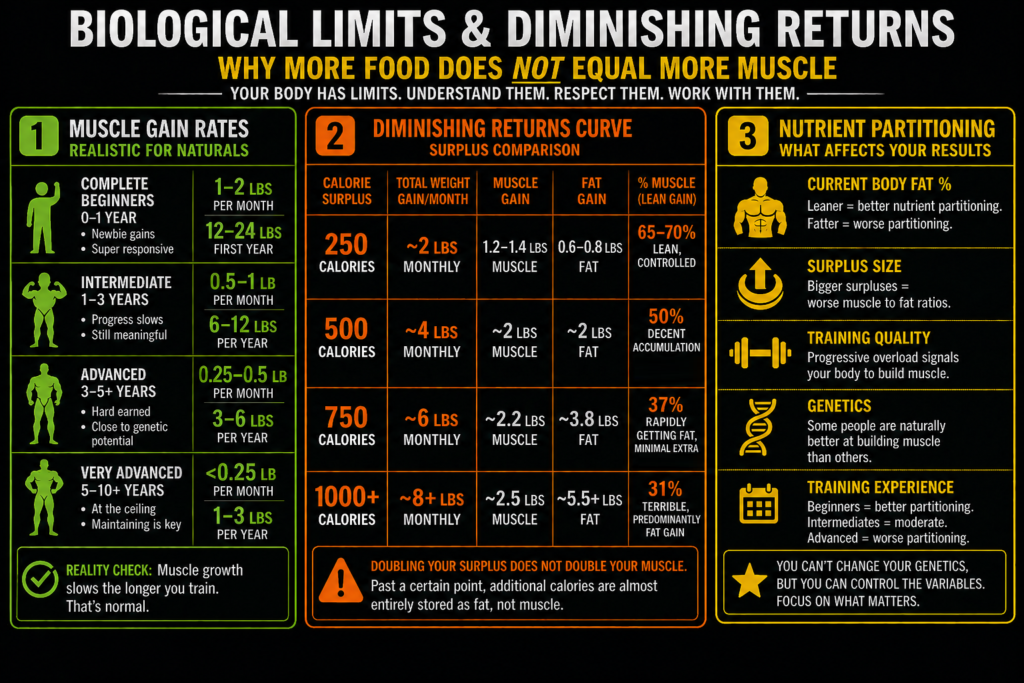
Real-World Muscle Gain Rates (What’s Actually Possible)
Let’s talk real numbers because I know you’re wondering “okay, so exactly how much muscle CAN I build?”
Here’s what decades of research and real-world experience with natural lifters tells us:
Complete beginners (first 6-12 months of proper training):
- Can build approximately 1-2 pounds of muscle per month
- That’s roughly 12-24 pounds of muscle in their first year
- This is the famous “newbie gains” period enjoy it while it lasts!
- Your body is super responsive to the novel stimulus of resistance training
Intermediate lifters (1-3 years of consistent training):
- Can build approximately 0.5-1 pound of muscle per month
- That’s about 6-12 pounds of muscle per year
- Progress definitely slows down, but it’s still meaningful growth
- Requires more precision in training and nutrition
Advanced lifters (3-5+ years of proper training):
- Can build approximately 0.25-0.5 pounds of muscle per month (and that’s being optimistic)
- Maybe 3-6 pounds of muscle per year if everything goes perfectly
- Every single pound is hard-earned at this stage
- You’re getting close to your genetic potential
Very advanced/elite lifters (5-10+ years of training):
- Might build less than 0.25 pounds of muscle per month
- Perhaps 1-3 pounds per year, if any at all
- Essentially at or very close to genetic ceiling
- More focused on maintaining and slowly progressing in strength
The Math That Reveals the Truth
Let’s do some simple math here that’ll blow your mind:
If you’re an intermediate lifter and your body can realistically build about 1 pound of muscle per month, let’s figure out how many extra calories that actually requires.
Building 1 pound of muscle tissue requires approximately 2,500-3,000 total calories. Spread that over a month (30 days), and you’re looking at roughly 80-100 extra calories per day just for the muscle tissue itself.
Of course, you need more than that because:
- You need energy for the training that stimulates growth
- Recovery processes require energy
- Your body isn’t 100% efficient at utilizing nutrients
- The thermic effect of food (calories burned digesting food)
So in practice, a surplus of 250-500 calories above maintenance supports maximum natural muscle growth plus all the associated processes.
But here’s the kicker: if you’re eating a 1,000 calorie surplus thinking it’ll make you build muscle twice as fast, you’re just fooling yourself. Your body will still build that same ~1 pound of muscle per month (its biological limit), but now you’re eating 500-750 extra calories that have to go somewhere. Where do they go? Straight to your fat cells.
The Nutrient Partitioning Problem
Even in a perfect surplus, not all the weight you gain is muscle. Some fat gain is inevitable and actually necessary for the muscle-building process.
But the ratio of muscle to fat that you gain (called nutrient partitioning) depends on several factors:
Your current body fat percentage – Leaner individuals partition nutrients better (more to muscle, less to fat). The fatter you are, the worse your partitioning gets.
The size of your surplus – Bigger surpluses lead to worse partitioning ratios. More of that excess goes to fat storage.
Your training quality – Progressive overload and adequate volume signal your body to build muscle. Poor training means calories have no productive destination.
Your genetics – Some people are naturally better at partitioning nutrients. It’s not fair, but it’s reality.
Your training experience – Beginners partition nutrients better than advanced lifters (more growth potential = better nutrient use).
Here’s what realistic partitioning looks like:
Best case scenario (optimal conditions):
- Very lean starting point (10-12% body fat for men, 18-20% for women)
- Beginner or intermediate trainee
- Excellent training program
- Modest surplus (250-500 calories)
- High protein intake
- Result: Maybe 60-70% of gained weight is muscle, 30-40% is fat
Average scenario (typical conditions):
- Moderate leanness (13-15% body fat for men, 21-24% for women)
- Intermediate trainee
- Good training and nutrition
- Moderate surplus
- Result: About 50% muscle, 50% fat
Worst case scenario (suboptimal conditions):
- High starting body fat (>15% for men, >24% for women)
- Advanced trainee (slow natural growth rate)
- Excessive surplus (1000+ calories) or poor training
- Result: Maybe 30% muscle, 70% fat – terrible ratio
The Diminishing Returns Curve
Let me show you why “eating more” stops helping pretty quickly:
250 calorie surplus (conservative approach):
- Expected weight gain: About 2 pounds per month
- Likely composition: 1.2-1.4 pounds muscle, 0.6-0.8 pounds fat
- Ratio: Approximately 65-70% muscle
- Result: Lean, controlled muscle building
500 calorie surplus (moderate approach):
- Expected weight gain: About 4 pounds per month
- Likely composition: 2 pounds muscle, 2 pounds fat
- Ratio: 50% muscle
- Result: Decent muscle gain but with some fat accumulation
750 calorie surplus (aggressive approach):
- Expected weight gain: About 6 pounds per month
- Likely composition: 2.2 pounds muscle, 3.8 pounds fat
- Ratio: Only 37% muscle
- Result: Rapidly getting fat for minimal extra muscle
1000+ calorie surplus (excessive approach):
- Expected weight gain: 8+ pounds per month
- Likely composition: 2.5 pounds muscle, 5.5+ pounds fat
- Ratio: A terrible 31% muscle
- Result: Predominantly fat gain, minimal muscle advantage
See the pattern? Doubling your surplus from 500 to 1000 calories doesn’t double your muscle gain (2 pounds to 4 pounds). You might build an extra 0.5 pounds of muscle at best, but you’re gaining nearly 4 additional pounds of fat. That’s a horrible trade-off.
This is diminishing returns in action. Past a certain point (around 250-500 calories), additional calories contribute almost entirely to fat storage, not muscle growth.
Why Your Body Has a Speed Limit for Muscle Growth
Understanding why muscle growth has these limits helps you accept reality and plan accordingly:
Muscle protein synthesis has a ceiling. Resistance training triggers muscle protein synthesis (MPS), and adequate protein plus calories support it. But MPS has a maximum rate determined by cellular signaling pathways (mTOR, satellite cells, and others). You can’t force it to go faster by eating more.
Recovery capacity is limited. Your body can only recover from so much training stress. More food doesn’t magically expand your recovery capacity. Overtraining with excessive calories just makes you fat and overtrained.
Hormonal limits exist for natural lifters. Your natural testosterone, growth hormone, and IGF-1 levels set boundaries on muscle growth. More food doesn’t significantly increase these hormones (unless you’re coming from a severe deficit).
Genetic ceiling is real. Everyone has a maximum muscle mass potential based on bone structure, muscle belly lengths, and genetic factors. As you approach this ceiling, growth slows dramatically regardless of nutrition.
The bottom line: There’s an optimal surplus range that supports your maximum natural muscle growth rate. Beyond this range, you’re simply getting fatter while muscle accrual stays roughly the same.
Reality check time: If you’ve been bulking and gaining 3-4 pounds per month but you’re not a complete beginner, take an honest look in the mirror. Is that a lean, muscular physique developing, or are you just getting soft and carrying more fat? Most of that rapid gain is probably fat, not muscle.
When You Absolutely Should NOT Eat More
Here’s a reality check that might sting a bit, but you need to hear it: not everyone should be trying to eat more and bulk up right now. In fact, for some people, trying to build muscle with a calorie surplus is the worst thing they could do.
If you’re currently carrying too much body fat (generally over 15% for men, over 20% for women), increasing your calorie intake to build muscle is probably setting yourself up for failure and frustration.
The Body Fat Percentage Threshold
These aren’t arbitrary numbers I’m pulling out of thin air. Research and decades of real-world experience show that metabolic and hormonal changes occur around these body fat percentages that make muscle building increasingly inefficient.
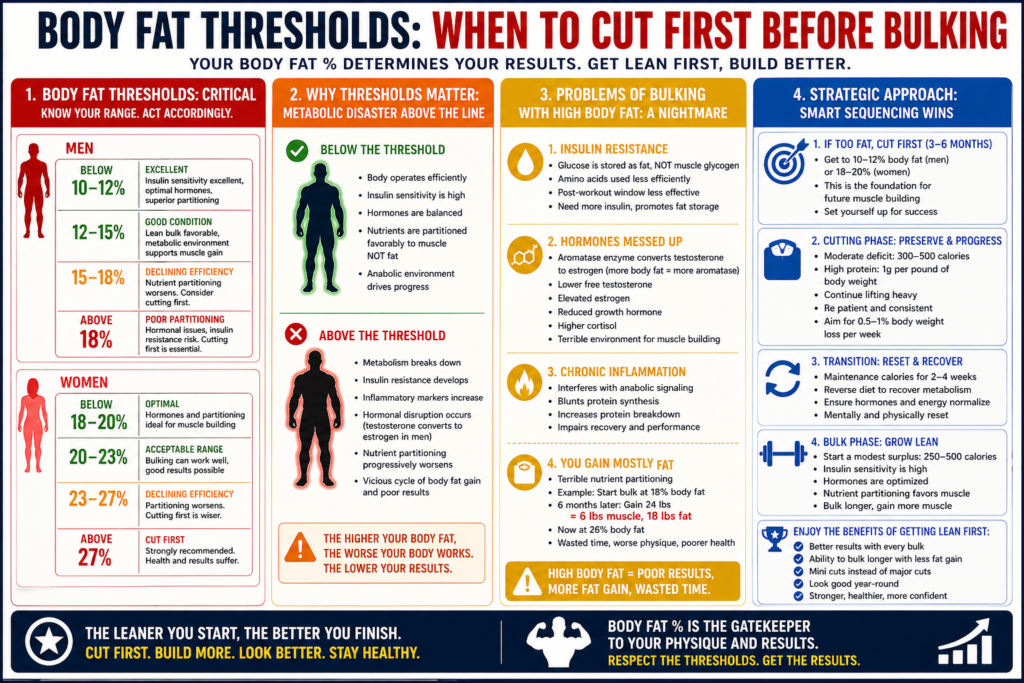
For men:
- Below 10-12%: Excellent insulin sensitivity, optimal hormone production, superior nutrient partitioning
- 12-15%: Good condition for a lean bulk, still favorable metabolic environment
- 15-18%: Declining metabolic efficiency, should seriously consider cutting first
- Above 18%: Poor nutrient partitioning, hormonal issues likely, cutting first is essential
For women:
- Below 18-20%: Optimal hormones and nutrient partitioning for muscle building
- 20-23%: Acceptable range for bulking with good results
- 23-27%: Declining efficiency, cutting first may be wiser
- Above 27%: Cut first strongly recommended before attempting to bulk
Why these specific thresholds matter:
Below the threshold, your body operates efficiently: insulin sensitivity is high, hormones are balanced (favorable testosterone-to-estrogen ratio for men, optimal hormonal balance for women), and nutrients get partitioned favorably toward muscle tissue rather than fat storage.
Above the threshold, things start breaking down: insulin resistance develops, inflammatory markers increase, hormonal disruption accelerates (more testosterone converts to estrogen in men, hormonal imbalances worsen in women), and nutrient partitioning gets progressively worse.
The Metabolic Nightmare of Bulking from High Body Fat
Let me explain exactly what happens when you try to bulk while already carrying too much body fat. It’s not pretty.
Problem #1: Insulin Resistance Ruins Everything
Here’s how this works:
Excess adipose tissue (body fat), especially the visceral fat that surrounds your organs, isn’t just sitting there doing nothing. It’s metabolically active and releases inflammatory compounds called cytokines (TNF-alpha, IL-6, resistin, and others).
These inflammatory molecules wreak havoc on your insulin signaling pathways. Your cells become less responsive to insulin’s signal to absorb glucose and amino acids. This condition is called insulin resistance, and it’s a disaster for muscle building.
What insulin resistance means for you:
- Glucose (from carbs) gets stored as fat more easily instead of replenishing muscle glycogen
- Amino acids from protein are less efficiently transported into muscle cells
- Post-workout nutrition becomes far less effective
- You need more insulin to accomplish the same nutrient uptake (which further promotes fat storage)
The vicious cycle this creates: High body fat → inflammatory cytokines → insulin resistance → poor nutrient partitioning → more calories stored as fat → even higher body fat → worse insulin resistance
It’s a downward spiral that’s hard to break unless you lose the excess fat first.
Problem #2: Your Hormones Get Completely Messed Up
This is especially problematic for men, but women aren’t immune either.
The aromatase problem:
Body fat tissue contains an enzyme called aromatase. This enzyme converts testosterone into estradiol (a form of estrogen). The more body fat you carry, the more aromatase enzyme you have, which means more of your precious testosterone gets converted to estrogen.
The hormonal cascade in men with high body fat:
- Lower free testosterone (both from conversion to estrogen and increased binding to SHBG)
- Elevated estrogen levels (from aromatization)
- Increased SHBG (sex hormone binding globulin, which binds up testosterone and makes it unavailable)
- Reduced growth hormone secretion (GH inversely correlated with body fat)
- Higher cortisol (stress hormone, catabolic)
This creates the exact opposite of what you want for muscle building. You need high testosterone and low estrogen (as a man), not the reverse.
For men specifically: Bulking from 18% body fat to 25% progressively worsens this hormonal disaster. By the time you’re at 25%, your hormonal environment is terrible for muscle building. It would be far smarter to cut down to 10-12% first, optimize your hormones, then bulk from that leaner starting point.
For women: While the mechanisms differ, high body fat still creates hormonal disruptions that make muscle building inefficient and can cause issues with menstrual cycle regularity and overall hormonal balance.
Problem #3: Chronic Inflammation Sabotages Muscle Growth
Excess body fat, particularly visceral fat, creates a state of chronic low-grade inflammation throughout your entire body.
How this impacts muscle building:
- Inflammation interferes with anabolic signaling pathways in muscle cells
- Muscle protein synthesis gets blunted
- Muscle protein breakdown increases
- Satellite cells (muscle stem cells needed for growth) don’t activate as effectively
- Recovery from training is significantly impaired
Training itself causes acute inflammation (which is actually beneficial and part of the adaptation process). But when you add chronic inflammation from excess body fat on top of training-induced inflammation, you create a situation where your body is constantly fighting inflammation rather than building muscle.
Problem #4: You’ll Gain Mostly Fat, Creating a Bigger Problem
Because of all the issues above (insulin resistance, poor hormones, chronic inflammation), your nutrient partitioning becomes terrible when you bulk from high body fat.
The harsh reality:
If you start a bulk at 18% body fat with a 500-calorie surplus, here’s what typically happens:
Month 1-3: You gain 12 pounds total. Maybe 3-4 pounds is muscle, 8-9 pounds is fat. You’re now at 22-23% body fat.
Month 4-6: Partitioning gets even worse as you get fatter. You gain another 12 pounds, but now only 2-3 pounds is muscle, 9-10 pounds is fat. You’re now at 26-27% body fat.
You’ve been “bulking” for 6 months and you’ve gained maybe 6 pounds of muscle but 18 pounds of fat. Was it worth it? Absolutely not.
Now you need to cut for 6-9 months to get back to a reasonable body fat percentage, during which you’ll probably lose 1-2 pounds of that hard-earned muscle. You’ve essentially wasted an entire year.
Problem #5: The Miserable Long Cut Awaits You
Let’s do the math on what you’ve created for yourself:
Starting point: 200 pounds at 18% body fat
- Lean mass: 164 pounds
- Fat mass: 36 pounds
After 6-month bulk: 225 pounds at 26% body fat
- Lean mass: 166.5 pounds (gained 2.5 pounds of muscle, the rest was water/glycogen/fat)
- Fat mass: 58.5 pounds
To get back to 12% body fat:
- Target weight: 189 pounds at 12%
- Need to lose 36 pounds total
At a healthy rate of 1 pound per week (to preserve muscle), that’s 9 months of strict dieting. At a slower rate of 0.5 pounds per week (even safer for muscle retention), that’s 18 months of cutting.
The end result after a year and a half:
- You’re at 190 pounds and 12% body fat
- Lean mass: ~166 pounds
- You’ve gained maybe 2-3 pounds of actual muscle over 18 months of effort
Compare that to if you had cut first, then bulked:
Smart approach: Cut for 4 months (200 lbs at 18% → 180 lbs at 11%), then lean bulk for 8 months (180 lbs at 11% → 195 lbs at 14%), then mini-cut for 2 months (195 lbs at 14% → 190 lbs at 12%)
Result after 14 months: 190 pounds at 12% body fat with 167-168 pounds lean mass (5-6 pounds of muscle gained vs. 2-3 pounds from the wrong approach), and you looked good the entire time instead of getting fat and miserable.
Strategic sequencing matters enormously.
What to Do If You’re Already Too Fat to Bulk
If you’re reading this and realizing you’re in the “too fat to bulk” category, don’t panic. Here’s exactly what you should do:
Step 1: Accept reality and commit to cutting first
- Set a realistic timeline (3-6 months depending on how much fat you need to lose)
- Target getting to 10-12% body fat (men) or 18-20% (women)
- This is your foundation for future muscle building
Step 2: Cut properly to preserve muscle
- Use a moderate calorie deficit (300-500 calories below maintenance, not extreme)
- Keep protein very high (1g per pound of body weight minimum, even 1.2g is better)
- Continue lifting heavy (this is crucial your muscles need a reason to stick around)
- Don’t do excessive cardio (some is fine, but don’t overdo it)
Step 3: Be patient during the cut
- Aim for 0.5-1% of body weight loss per week
- Track progress with weekly weight averages and progress photos
- Expect the process to take several months
- Stay consistent even when it’s hard
Step 4: Transition intelligently to maintenance, then to a surplus
- Don’t immediately jump from cutting to aggressive bulking
- Spend 2-4 weeks at maintenance calories first (reverse diet if coming from aggressive deficit)
- Let your body and metabolism recover
- Then begin a modest surplus (250-500 calories)
Step 5: Enjoy the benefits of bulking from a lean state
- Your insulin sensitivity is now high (nutrients partition well)
- Your hormones are optimized (high testosterone, low estrogen for men)
- Nutrient partitioning favors muscle over fat
- You can bulk for longer before needing to cut again (mini-cuts vs. major cuts)
- You look good throughout the process instead of getting fat and miserable
The psychological benefit: You’ll actually enjoy the process when you can see your muscle definition improving rather than watching yourself get progressively fatter and wondering if you’re building muscle or just getting fat (spoiler: mostly fat).
Real talk: I know cutting when you want to build muscle feels counterintuitive and frustrating. But I promise you, taking 3-4 months to get lean first will set you up for years of successful, efficient muscle building. The short-term sacrifice creates long-term gains.
How to Calculate Exactly How Much You Need to Eat
Alright, let’s get into the practical stuff. No more theory time for action. Here’s how to figure out your precise calorie needs so you can build muscle without unnecessary fat gain.
Step 1: Calculate Your Basal Metabolic Rate (BMR)
Your BMR is the number of calories your body burns just to keep you alive if you were lying in bed all day doing absolutely nothing. This covers all your basic physiological functions: breathing, circulating blood, maintaining body temperature, cell production, nutrient processing, and all the behind-the-scenes work your body does 24/7.
The most accurate equation for most people is the Mifflin-St Jeor equation:
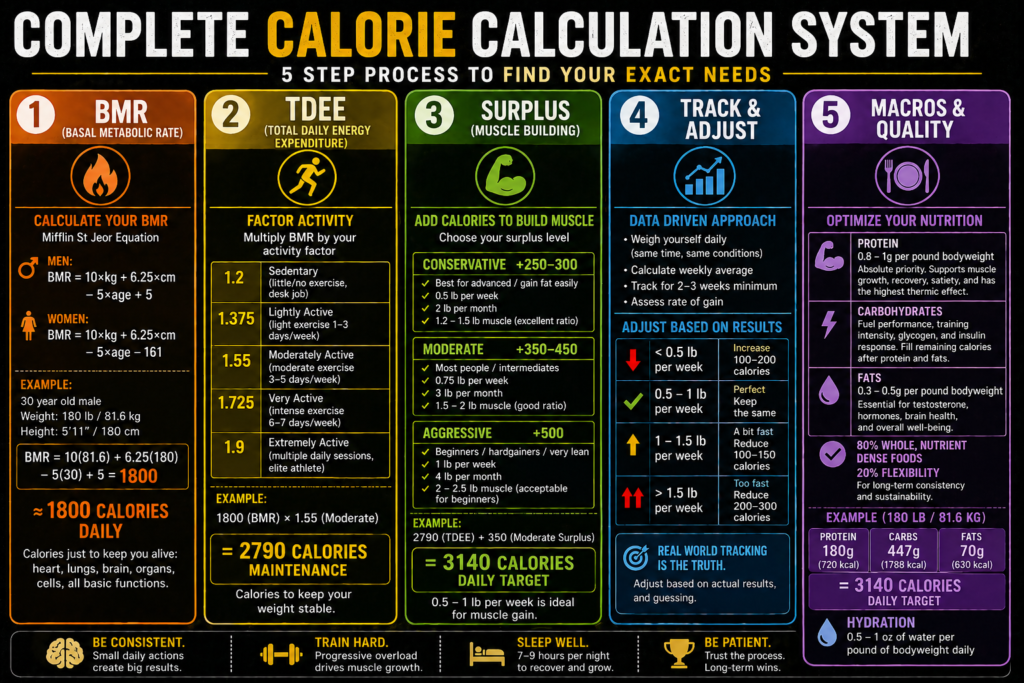
For men: BMR = (10 × weight in kg) + (6.25 × height in cm) – (5 × age in years) + 5
For women: BMR = (10 × weight in kg) + (6.25 × height in cm) – (5 × age in years) – 161
Let’s walk through an example:
30-year-old male, 180 pounds (81.6 kg), 5’11” (180 cm)
BMR = (10 × 81.6) + (6.25 × 180) – (5 × 30) + 5 BMR = 816 + 1,125 – 150 + 5 BMR = 1,796 calories (let’s call it 1,800)
What this number means:
This guy burns approximately 1,800 calories per day just existing. His heart beating, lungs breathing, brain thinking, liver functioning, kidneys filtering, cells regenerating – all of that requires 1,800 calories daily.
But here’s the thing: nobody just lies in bed all day. You walk around, you work, you train, you digest food. All of that requires additional energy on top of your BMR.
That’s why BMR is just the starting point, not your actual daily calorie needs.
Step 2: Factor in Your Activity Level (Calculate TDEE)
TDEE stands for Total Daily Energy Expenditure. This is your BMR plus all the calories you burn through movement, exercise, and the thermic effect of food (calories burned digesting food).
To get your TDEE, multiply your BMR by an activity factor:
Sedentary (little to no exercise): BMR × 1.2
- Desk job with minimal movement
- No structured exercise
- Less than 5,000 steps daily
- Very inactive lifestyle
Lightly active (light exercise 1-3 days per week): BMR × 1.375
- Some walking or light movement
- Gym 1-3 days per week
- 5,000-8,000 steps daily
- Moderately active job or lifestyle
Moderately active (moderate exercise 3-5 days per week): BMR × 1.55
- Regular gym sessions 3-5 times weekly
- Moderate daily activity
- 8,000-12,000 steps daily
- This is where most regular gym-goers fall
Very active (intense exercise 6-7 days per week): BMR × 1.725
- Daily intense training
- Very active job or lifestyle
- 12,000-15,000+ steps daily
- Athletes, coaches, construction workers, etc.
Extremely active (very intense daily exercise or physical job): BMR × 1.9
- Multiple training sessions daily
- Extremely physical job
- 15,000+ steps daily
- Elite athletes, military personnel in training, etc.
Using our example (moderately active male):
TDEE = 1,800 × 1.55 TDEE = 2,790 calories
This means our example guy burns approximately 2,790 calories per day with his current activity level. This is his maintenance intake eating this amount should keep his weight stable.
Important note: Be honest with yourself about your activity level. Most people overestimate. If you train 4 times per week for an hour but have a desk job and are otherwise sedentary, you’re probably “lightly active” or “moderately active,” not “very active.” Those gym sessions are only 4 hours out of 168 hours in a week. The other 164 hours matter too.
Step 3: Add Your Calorie Surplus
Now that you know your maintenance calories, it’s time to add a surplus for muscle building. Remember what we discussed earlier: more isn’t better past a certain point.
Here’s how to choose the right surplus for you:
Conservative surplus (250-300 calories above maintenance):
- Best for: Advanced lifters, people who gain fat easily, former overweight individuals
- Expected weight gain: 0.5 pounds per week, about 2 pounds per month
- Expected composition: Approximately 1.2-1.5 pounds muscle, 0.5-0.8 pounds fat monthly
- Muscle-to-fat ratio: Excellent (around 65-70% muscle)
- Duration sustainable: 4-6 months before mini-cut needed
- Total gain over 6 months: 12 pounds (8-9 pounds muscle, 3-4 pounds fat)
Moderate surplus (350-450 calories above maintenance):
- Best for: Most people, intermediate lifters, balanced approach
- Expected weight gain: 0.75 pounds per week, about 3 pounds per month
- Expected composition: Approximately 1.5-2 pounds muscle, 1-1.5 pounds fat monthly
- Muscle-to-fat ratio: Good (around 55-60% muscle)
- Duration sustainable: 3-4 months before mini-cut
- Total gain over 4 months: 12 pounds (6-7 pounds muscle, 5-6 pounds fat)
Aggressive surplus (500 calories above maintenance):
- Best for: Beginners (newbie gains phase), hardgainers who struggle to gain weight, very lean individuals (<10% body fat)
- Expected weight gain: 1 pound per week, about 4 pounds per month
- Expected composition: Beginners might see 2-2.5 pounds muscle, 1.5-2 pounds fat monthly; intermediates closer to 2 pounds muscle, 2 pounds fat
- Muscle-to-fat ratio: Acceptable for beginners (55-60%), worse for intermediates (50% or less)
- Duration sustainable: 2-3 months before fat accumulation becomes excessive
- Total gain over 3 months: 12 pounds (6 pounds muscle, 6 pounds fat for intermediates)
Why not go higher than 500 calories?
Because, as we discussed earlier, larger surpluses lead to terrible muscle-to-fat ratios. A 1,000 calorie surplus might make you gain 8 pounds per month, but only 2-2.5 pounds will be muscle (same as 500 calorie surplus due to biological limits). The other 5.5-6 pounds is pure fat. That’s a horrible trade-off.
Using our example:
Maintenance: 2,790 calories Moderate surplus: +350 calories Bulking target: 3,140 calories per day
This guy should aim for approximately 3,140 calories daily to support optimal muscle growth without excessive fat gain.
Step 4: Track Progress and Adjust
Here’s where most people fail. They calculate their calories, start eating that amount, and never track or adjust. That’s a mistake.
Your initial calculation is an educated guess based on averages. But you’re not average you’re an individual with unique genetics, metabolism, and activity levels. Real-world tracking tells you what’s actually happening with YOUR body.
The proper tracking protocol:
Weigh yourself daily:
- Same time every day (morning after bathroom, before eating/drinking)
- Naked or same clothing every time
- Same scale, same location in your house
- Record the number but don’t react emotionally to daily changes
Calculate weekly averages:
- Add up all 7 daily weights and divide by 7
- This smooths out daily fluctuations from water retention, food in digestive system, sodium intake, carb intake, etc.
- Daily weight can fluctuate 2-5 pounds easily; weekly averages reveal the true trend
Example tracking:
Week 1: Daily weights of 178, 179, 177, 180, 178, 179, 177 Week 1 average: 178.3 pounds
Week 2: Daily weights of 179, 180, 178, 181, 179, 180, 179 Week 2 average: 179.4 pounds
Week 3: Daily weights of 180, 181, 179, 182, 180, 181, 180 Week 3 average: 180.4 pounds
Rate of gain: 1 pound per week (2 pounds over 2 weeks from week 1 to week 3)
Assessment period (minimum 2-3 weeks):
Don’t judge your progress after 3 days or even one week. Water weight, glycogen storage, and digestive contents can make your weight fluctuate significantly day-to-day and week-to-week.
After 2-3 weeks of consistent tracking, patterns become clear, and you can make informed decisions.
Making adjustments based on results:
Gaining less than 0.5 pounds per week:
- You’re either in a smaller surplus than calculated, or your activity level is higher than estimated
- Action: Increase calories by 100-200
- Reassess after another 2 weeks
Gaining 0.5-1 pound per week:
- Perfect rate for most people
- Sustainable muscle-to-fat ratio
- Action: Maintain current calories
- Continue monitoring weekly
Gaining 1-1.5 pounds per week (and you’re an intermediate or advanced lifter, not a beginner):
- A bit fast, likely accumulating more fat than ideal
- Action: Reduce calories by 100-150
- Reassess after 2 weeks
Gaining more than 1.5 pounds per week:
- Too fast for anyone except complete beginners
- Definitely getting fatter than necessary
- Action: Reduce calories by 200-300
- Reassess after 1-2 weeks
Important notes about the first 1-2 weeks:
When you first start a calorie surplus, especially if you’re coming from maintenance or a deficit, you might see rapid weight gain in the first week or two (3-5 pounds). This is mostly:
- Increased glycogen storage in muscles (glycogen holds water, adding 2-4 pounds)
- More food volume in your digestive system
- Increased water retention from higher carb intake
This initial jump is normal and expected. Don’t panic and reduce calories. By week 3-4, the true rate of gain becomes apparent.
Why calculations are just starting points:
Formulas estimate the average person, but you might have:
- Faster or slower metabolism than average
- More or less NEAT (non-exercise activity thermogenesis fidgeting, spontaneous movement)
- Different digestion efficiency
- Thyroid variations
- Higher or lower stress levels (affects cortisol and metabolism)
Real-world tracking data from your scale is truth. It tells you exactly what your body is doing. Adjust your calories based on actual results, not just formulas.
Step 5: Prioritize Food Quality and Macronutrients
You’ve got your total calorie target figured out. Now let’s talk about what those calories should actually be made of. Because 3,000 calories of pizza and ice cream is very different from 3,000 calories of chicken, rice, and vegetables, even though the calorie total is the same.
Protein (absolute priority #1):
Target: 0.8-1g per pound of body weight (some research supports up to 1.2g/lb during a bulk for extra insurance)
For our 180-pound example: 144-180g protein daily (aim for the higher end to be safe)
Why this amount matters:
- Provides all the amino acids your muscles need for protein synthesis
- High satiety value (helps control appetite even in a surplus)
- Thermic effect of food (30% of protein calories burned during digestion)
- Insurance against accidental deficits (if you miss calories, at least you hit protein)
- Preserves muscle if you end up eating less than planned
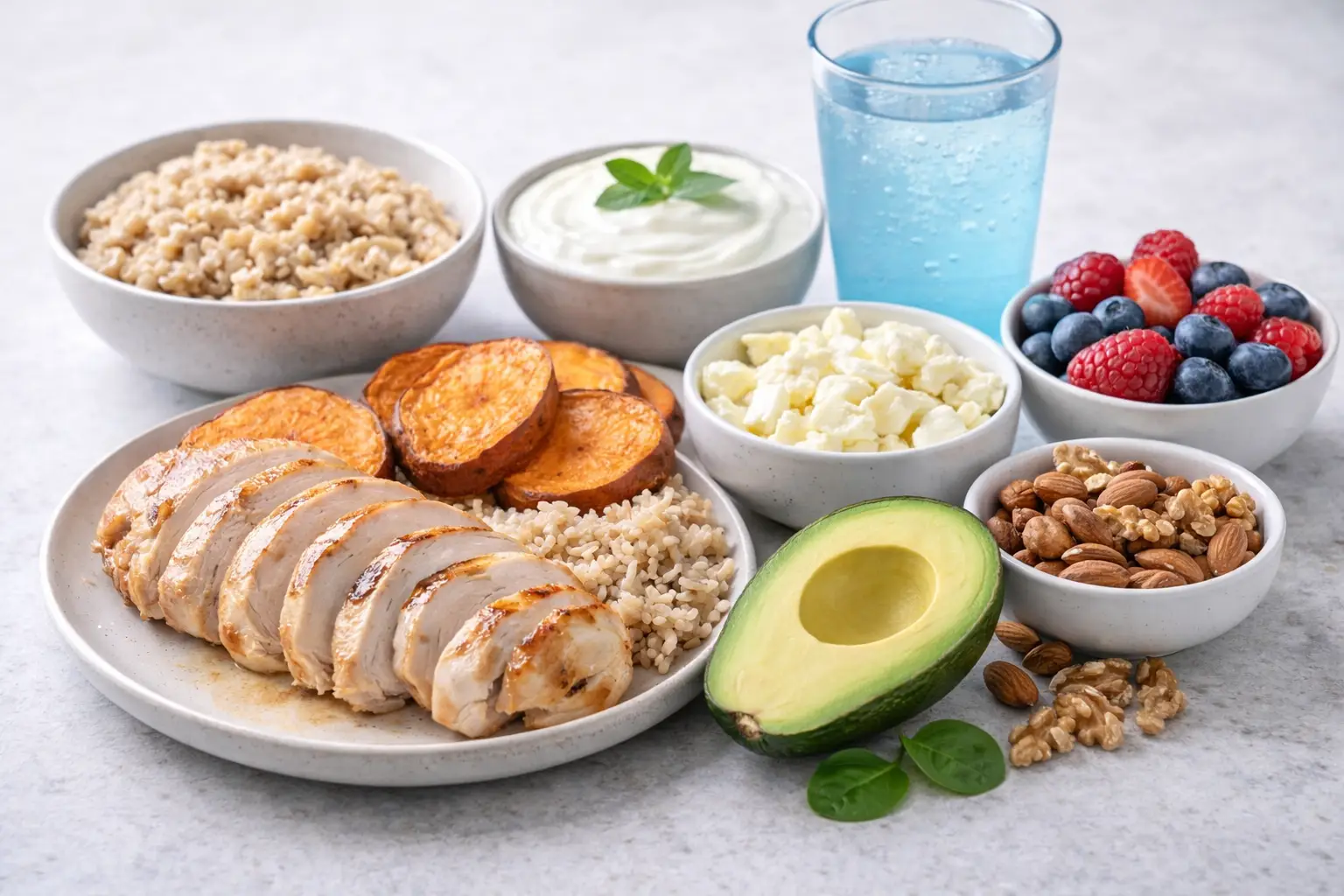
Quality protein sources:
- Chicken breast, turkey breast
- Lean beef (90/10 or leaner), bison
- Fish: salmon, tilapia, tuna, cod
- Eggs and egg whites
- Greek yogurt, cottage cheese, skyr
- Protein powder (whey, casein, or plant-based for convenience)
How to distribute it:
- Spread across 3-5 meals throughout the day
- 25-40g protein per meal is optimal for muscle protein synthesis
- Don’t try to eat all your protein in one meal (your body can only use so much at once for muscle building)
Carbohydrates (fuel for performance):
Role in muscle building:
- Primary fuel source for high-intensity resistance training
- Replenishes muscle glycogen after training
- Creates insulin response (anabolic hormone that drives nutrients into cells)
- Supports training volume and intensity
- Makes eating in a surplus easier (high satiety from protein alone can make surplus difficult)
Target: Fill most of remaining calories after protein and fats are set
Quality carbohydrate sources:
- Oats, oatmeal
- Rice (white or brown, both fine)
- Potatoes (white, sweet, all varieties)
- Quinoa, whole grain pasta
- Whole grain bread, ezekiel bread
- Fruits (bananas, berries, apples, oranges)
- Vegetables (unlimited, all types)
Timing considerations (not mandatory but can help):
- Pre-workout (1-3 hours before): 30-60g carbs for training fuel
- Post-workout (within 1-2 hours after): 40-80g carbs to replenish glycogen
- Remainder distributed across other meals
- Don’t stress too much about timing total daily intake matters most
Fats (hormonal support and health):
Role in muscle building:
- Essential for testosterone production
- Supports cell membrane health
- Required for absorption of fat-soluble vitamins (A, D, E, K)
- Provides satiety and flavor
- Supports overall health and hormone production
Target: 0.3-0.5g per pound of body weight
For our 180-pound example: 54-90g fat daily
Quality fat sources:
- Avocados
- Nuts: almonds, walnuts, cashews, pecans
- Seeds: chia, flax, pumpkin, sunflower
- Olive oil, avocado oil
- Fatty fish: salmon, mackerel, sardines
- Egg yolks
- Nut butters (almond butter, peanut butter)
Important note: Fats are very calorie-dense at 9 calories per gram (vs. 4 calories per gram for protein and carbs). This means small portions contain a lot of calories. Measure your fats carefully it’s easy to accidentally eat way more than intended.
Sample macro breakdown for our 180-pound example (3,140 calorie bulk):
Protein: 180g × 4 calories = 720 calories Fats: 70g × 9 calories = 630 calories Carbohydrates: Remaining calories = 3,140 – 720 – 630 = 1,790 calories ÷ 4 = 447g carbs
Final macros: 180g protein / 447g carbs / 70g fats = 3,140 calories
The 80/20 principle for sustainability:
Here’s a game-changer for long-term consistency:
80% of your calories: Whole, minimally processed, nutrient-dense foods
- This ensures you get all your micronutrients (vitamins, minerals)
- Supports overall health, recovery, and performance
- Provides fiber for digestive health
- Maximizes satiety and food volume
20% flexibility: Less optimal foods, treats, dining out
- Makes your diet sustainable long-term
- Prevents psychological deprivation and burnout
- Allows for social eating situations
- Keeps you sane and happy
Example with 3,000 daily calories:
- 2,400 calories from quality whole foods (chicken, rice, vegetables, fruits, oats, etc.)
- 600 calories flexible (pizza night, dessert, eating out with friends, etc.)
This isn’t a license to eat junk food daily, but it gives you breathing room to live your life without being miserable.
Why food quality matters beyond just calories:
You might be thinking “if my calories and macros are on point, why does food quality matter?”
Micronutrients (vitamins and minerals):
- Required for thousands of enzymatic reactions in your body
- Support muscle contraction, energy production, recovery
- Immune function (you can’t build muscle if you’re sick all the time)
- Bone health, connective tissue health
Fiber:
- Digestive health and regularity
- Helps you feel full (useful in a surplus to avoid excessive eating)
- Supports healthy cholesterol levels
- Feeds beneficial gut bacteria
Phytonutrients and antioxidants:
- Anti-inflammatory compounds that support recovery
- May reduce oxidative stress from training
- Overall health benefits
Real-world example: 3,000 calories from McDonald’s, candy, and soda vs. 3,000 calories from chicken, rice, vegetables, fruits, oats, and healthy fats.
Same calories. Same macros potentially (if you manipulate it right). Vastly different outcomes in terms of:
- How you feel
- Your performance in the gym
- Your recovery between sessions
- Your body composition results
- Your overall health
Don’t out-eat poor food quality. It catches up with you eventually.
Hydration (often overlooked but critical):
Target: 0.5-1 ounce of water per pound of body weight daily
For our 180-pound example: 90-180 ounces daily (about 3-5 liters)
Drink more if:
- Training in hot environment
- Sweating heavily during workouts
- Very active throughout the day
- Consuming high sodium intake
Why hydration matters for muscle building:
- Nutrient transport throughout body
- Muscle fullness and cell volumization
- Performance and strength in gym
- Recovery between sessions
- Digestion and absorption of nutrients
- Temperature regulation
Dehydration of just 2-3% of body weight can significantly impair strength and performance. Don’t sabotage your muscle building by being chronically dehydrated.
By following these five steps methodically, you can dial in your nutrition to support optimal muscle building without unnecessary fat gain. It takes a bit of effort upfront, but once you have your system in place, it becomes second nature.
THE BOTTOM LINE: THE STRATEGIC CALORIE SURPLUS APPROACH
After examining all aspects of muscle-building nutrition, here’s what actually works:
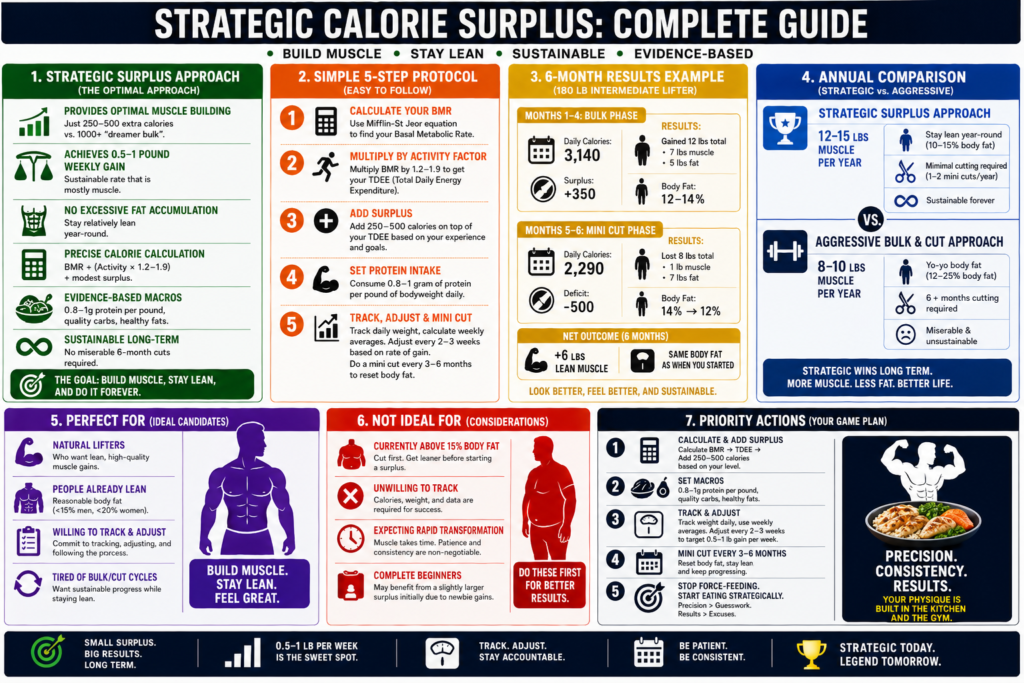
✅ Provides Optimal Muscle Building With Just 250-500 Extra Calories (Vs. 1000+ “Dreamer Bulk”)
✅ Achieves 0.5-1 Pound Weekly Gain (Sustainable, Mostly Muscle)
✅ No Excessive Fat Accumulation (Stay Relatively Lean Year-Round)
✅ Precise Calorie Calculation (BMR + Activity × 1.2-1.9 + Modest Surplus)
✅ Evidence-Based Macros (0.8-1g Protein Per Pound, Quality Carbs, Healthy Fats)
✅ Sustainable Long-Term (No Miserable 6-Month Cuts Required)
Perfect For:
- Natural Lifters Wanting Lean Muscle Gains
- People Already At Reasonable Body Fat (<15% Men, <20% Women)
- Those Willing To Track And Adjust Based On Results
- Anyone Wanting To Stay Lean While Building Muscle
- Trainees Tired Of Bulk/Cut Yo-Yo Cycles
Not Ideal For:
- People Currently Above 15% Body Fat (Cut First)
- Those Unwilling To Track Calories And Weight
- Anyone Expecting Rapid Transformation (Muscle Building Takes Time)
- Complete Beginners (May Benefit From Slightly Larger Surplus Initially)
The Simple Protocol:
- Calculate Your BMR Using Mifflin-St Jeor Equation
- Multiply By Activity Factor (1.2-1.9) For TDEE
- Add 250-500 Calorie Surplus Based On Experience Level
- Set Protein At 0.8-1g Per Pound Bodyweight
- Track Daily Weight, Calculate Weekly Averages
- Adjust Every 2-3 Weeks Based On Rate Of Gain
- Mini-Cut Every 3-6 Months To Reset Body Fat
Sample 6-Month Results For 180-Pound Intermediate:
Month 1-4: 3,140 daily calories (350 surplus), gain 12 pounds (7 muscle, 5 fat), 12% → 14% body fat
Month 5-6: 2,290 daily calories (mini-cut), lose 8 pounds (1 muscle, 7 fat), 14% → 12% body fat
Net outcome: +6 pounds lean muscle, same body fat as start, look better throughout
Annual Comparison:
Strategic Surplus: 12-15 pounds muscle yearly, stay 10-15% body fat, minimal cutting, sustainable forever
Aggressive Bulk/Cut: 8-10 pounds muscle yearly, yo-yo 12-25% body fat, 6+ months cutting, miserable
STOP FORCING FOOD. START EATING STRATEGICALLY. USE PRECISION CALCULATIONS. TRACK WEEKLY PROGRESS. ADJUST BASED ON RESULTS. BUILD MUSCLE EFFICIENTLY WITHOUT GETTING FAT.
Ready To Build A Complete, Customized Bulking Plan That Maximizes Muscle Gain While Minimizing Fat Accumulation, Without Relying On Expensive Supplements Or Forcing Down Food When You’re Already Stuffed? Strategic calorie surplus is one component of intelligent muscle building nutrition. Get a comprehensive guide to calculating your exact calorie and macro needs for your specific body and goals, building affordable meal plans that actually fit your lifestyle and preferences, timing your nutrition for maximum muscle growth and recovery, progressive strategies for increasing food intake without discomfort, and using data-driven adjustments that deliver consistent results month after month. Stop wasting time with trial and error bulking that makes you fat. Start building muscle systematically with a proven, scientific approach that keeps you lean and growing.
REFERENCES
SECTION 1 — The calorie surplus requirement: positive energy balance and muscle protein synthesis
[1] Trexler ET & Smith-Ryan AE — PMC/Frontiers in Nutrition, 2019 Narrative review specifically addressing whether an energy surplus is required to maximize hypertrophy from resistance training; even in the absence of resistance exercise, a positive energy balance in sedentary populations drives increases in lean mass when sufficient dietary protein is consumed; however, the relationship between surplus magnitude and hypertrophic outcome is non-linear and confounded by training status, body composition, and protein intake; excessive surpluses risk disproportionate fat mass gain without proportional increases in lean mass; the review concludes that no validated universal surplus recommendation exists but that overshooting is common and counterproductive; directly supports the article’s core argument that more food does not linearly produce more muscle https://pmc.ncbi.nlm.nih.gov/articles/PMC6710320/
[2] Roth C et al. — PMC/Nutrients, 2023 Eight-week parallel groups RCT comparing resistance-trained individuals assigned to maintenance energy (MAIN), a 5% moderate surplus (MOD), or a 15% high surplus (HIGH); when assigning intended energy surplus sizes of 5 to 15%, faster rates of body mass gain primarily served to increase the rate of fat mass accumulation rather than augmenting muscle thickness or one-repetition maximum strength; the moderate surplus group gained similar muscle thickness to the high surplus group while gaining substantially less fat; directly provides the controlled experimental evidence for the article’s diminishing returns argument, showing that a larger surplus primarily increases fat gain rather than muscle gain in resistance-trained individuals https://pmc.ncbi.nlm.nih.gov/articles/PMC10620361/
SECTION 2 — Obesity, aromatase, and the hormonal case against bulking from high body fat
[3] Cohen PG — PubMed/Medical Hypotheses, 2001 Review of the hypogonadal-metabolic-atherogenic cascade; increased adipose tissue mass is associated with increased aromatase enzyme activity, which converts testosterone to estradiol and leads to further diminished testosterone levels; the resulting lower testosterone favors preferential deposition of additional visceral fat, creating a self-reinforcing cycle; provides the biochemical mechanism underlying the article’s argument that higher body fat creates a progressively worse hormonal environment for muscle building in men, directly explaining why the testosterone-to-estrogen ratio deteriorates as body fat increases https://pubmed.ncbi.nlm.nih.gov/11399122/
[4] Zamir A et al. — PMC/Frontiers in Physiology, 2021 Review examining the relationship between body fat percentage, testosterone, and muscle building outcomes; percent body fat was negatively correlated with testosterone levels; obesity induces male hypogonadism through elevated aromatase activity in adipocytes, converting testosterone to estradiol, combined with adipokines including TNF, IL-6, and leptin that suppress the hypothalamic-pituitary-testicular axis; reduced SHBG from insulin resistance further disrupts free testosterone availability; the paper confirms that an accumulation of body fat beyond a moderate threshold creates the exact hormonal disruption the article describes, worsening nutrient partitioning and making muscle building progressively less efficient https://pmc.ncbi.nlm.nih.gov/articles/PMC8193892/
SECTION 3 — Calorie calculation: the Mifflin-St Jeor equation
[5] Mifflin MD et al. — PubMed/American Journal of Clinical Nutrition, 1990 Validation study of a new predictive equation for resting energy expenditure (REE) developed from measurements in 498 adults (251 normal weight, 247 obese) and tested against five other published equations; the new equation (10 × weight in kg + 6.25 × height in cm − 5 × age + 5 for men, −161 for women) predicted measured REE more accurately than the Harris-Benedict and other established equations in both normal-weight and obese subjects; the Mifflin-St Jeor equation is the most accurate widely-available tool for estimating basal metabolic rate in free-living populations; it is the equation presented in the article’s Step 1 calorie calculation protocol https://pubmed.ncbi.nlm.nih.gov/2305711/

Leave a Reply
You must be logged in to post a comment.