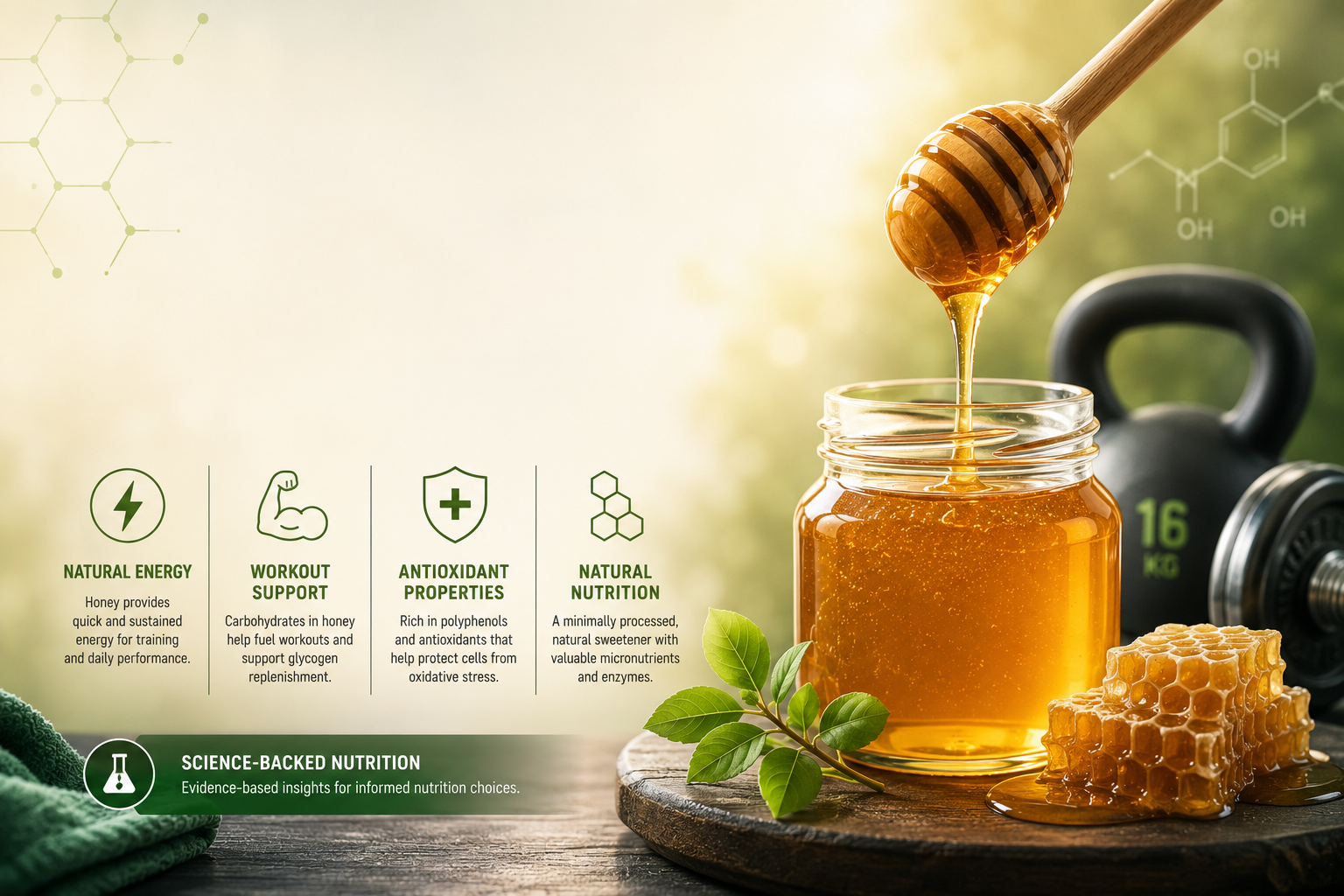
You’re trying to build muscle, control your diet, and someone tells you honey is a great natural sweetener for athletes. But you’re wondering: is honey actually good for bodybuilding, or is it just sugar with better marketing? Will it help your performance and recovery, or sabotage your physique goals?
Honey is more than just a “natural sweetener” it’s a rapid energy source that can be useful in your diet. In this comprehensive guide, we’ll explore whether honey is good or bad for bodybuilding.
For people trying to optimize nutrition for muscle building, maintain energy during intense training, or make informed decisions about carbohydrate sources, understanding honey’s actual impact on performance and body composition can transform how you fuel your workouts and recovery.
In this guide, I’ll explain honey’s complete nutritional profile and macro breakdown, the specific benefits of honey for training and muscle building, potential downsides and when honey can sabotage progress, optimal timing for honey consumption (pre workout, intra workout, post workout), how much honey you should actually consume, and how honey compares to other sugar and carbohydrate sources.
Whether you’re bulking and need easy calories, cutting and wondering if honey fits your macros, or just trying to optimize workout nutrition, understanding the truth about honey will help you make better dietary decisions.
Let’s examine everything you need to know.
Honey Nutritional Profile: What’s Actually In It
Before discussing whether honey is beneficial or problematic, let’s understand exactly what honey contains nutritionally.
Macronutrient Breakdown of Honey
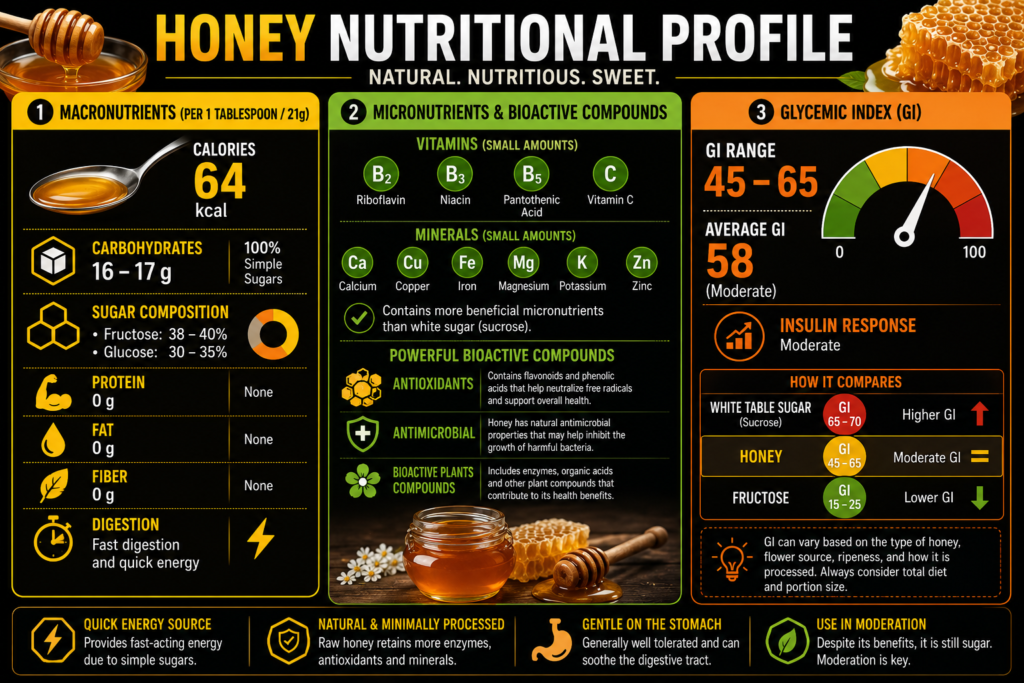
One tablespoon of honey (approximately 21 grams) contains:
Calories: 64
- Primarily from carbohydrates
- Very calorie dense for the volume
- Easy to consume significant calories quickly
Carbohydrates: 16 to 17 grams
- 100% simple carbohydrates (sugars)
- Primarily fructose (fruit sugar) and glucose
- No fiber
- No starch
Protein: 0 grams
- Honey contains zero protein
- Not a protein source whatsoever
- Must be paired with protein if using around workouts
Fat: 0 grams
- Honey contains zero fat
- Pure carbohydrate source
- No omega-3s or other fatty acids
Fiber: 0 grams
- No dietary fiber
- Digests very quickly
- No satiety from fiber content
The sugar composition matters:
Fructose (38 to 40%):
- Fruit sugar
- Metabolized primarily in liver
- Does not spike insulin as much as glucose
- Replenishes liver glycogen specifically
Glucose (30 to 35%):
- Blood sugar
- Directly absorbed into bloodstream
- Spikes insulin
- Replenishes muscle glycogen directly
Other sugars (20 to 30%):
- Maltose, sucrose, and other complex sugars
- Break down into fructose and glucose
- Similar metabolic effects
Water content:
- Honey is approximately 17 to 20% water
- This is why it’s liquid at room temperature
- More concentrated than many fruits
Micronutrient Content
Honey is superior to processed sugars, despite having an identical macronutrient profile. It contains several vitamins and minerals, making each tablespoon a nutrient bomb that supports your health and reduces the risk of deficiencies.
Vitamins in honey (per tablespoon):
B vitamins:
- Vitamin B2 (Riboflavin): Small amounts (under 1% DV)
- Vitamin B3 (Niacin): Small amounts (under 1% DV)
- Vitamin B5 (Pantothenic acid): Small amounts (under 1% DV)
- Vitamin B6: Trace amounts
- Folate: Trace amounts
Vitamin C:
- Small amounts (under 1% DV)
- Acts as antioxidant
- Supports immune function
The reality:
- Micronutrient amounts are very small
- You’d need to consume large amounts for meaningful vitamin intake
- Still better than zero (which is what white sugar provides)
Minerals in honey (per tablespoon):
Calcium:
- 1 to 2 mg (under 1% DV)
- Bone health, muscle contraction
Copper:
- Small amounts
- Energy production, iron absorption
Iron:
- 0.1 mg (under 1% DV)
- Oxygen transport, energy production
Magnesium:
- 0.5 to 1 mg (under 1% DV)
- Muscle function, recovery, sleep
Potassium:
- 11 mg (under 1% DV)
- Electrolyte balance, muscle contraction
Zinc:
- Trace amounts
- Testosterone production, immune function
The micronutrient advantage:
- These amounts seem tiny individually
- But compared to white sugar (zero micronutrients), honey is superior
- Over time, these small amounts add up
- Every bit of micronutrient intake helps prevent deficiencies
Antioxidants and Bioactive Compounds
Honey contains compounds that processed sugars don’t:
Antioxidants:
- Flavonoids (quercetin, kaempferol, apigenin)
- Phenolic acids
- Enzymes (glucose oxidase, catalase)
- Fight free radicals from training
- May reduce inflammation
- Support recovery
Antimicrobial properties:
- Hydrogen peroxide produced by glucose oxidase
- Low pH (acidic nature)
- Natural antibacterial effects
- May support immune health
The darker the honey, the more antioxidants:
- Buckwheat honey: Highest antioxidant content
- Manuka honey: High antimicrobial activity
- Light honey (clover, acacia): Lower but still present
- Processing reduces antioxidant content (buy raw when possible)
Glycemic Index and Insulin Response
Honey’s glycemic index varies by type but is generally moderate:
Glycemic Index (GI) of honey:
- Range: 45 to 65 (varies by type)
- Average: Around 58
- Lower than white sugar (GI 65)
- Lower than glucose (GI 100)
- Higher than fructose alone (GI 19)
Why the variation?
- Fructose to glucose ratio varies by honey type
- Higher fructose = lower GI
- Processing and filtering can affect GI
- Raw vs pasteurized makes small difference
Insulin response:
- Moderate insulin spike (less than pure glucose)
- Fructose component doesn’t spike insulin much
- Glucose component spikes insulin significantly
- Overall effect is moderate
Comparison to other sweeteners:
Table sugar (sucrose):
- GI: 65
- 50% glucose, 50% fructose (once digested)
- Similar to honey but no micronutrients
High fructose corn syrup:
- GI: 55 to 75 (varies)
- 55% fructose, 45% glucose typically
- No micronutrients
- Highly processed
Glucose/dextrose:
- GI: 100
- Fastest blood sugar spike
- Maximum insulin response
- Used in some sports products
Fructose:
- GI: 19
- Minimal insulin spike
- Metabolized in liver
- Slower energy release
Honey sits in the middle: faster than pure fructose, slower than pure glucose, similar to table sugar but with added micronutrients.
Three Benefits of Honey for Bodybuilding
Honey must be treated as a sugar. However, when used strategically, it offers specific benefits for people training intensely.
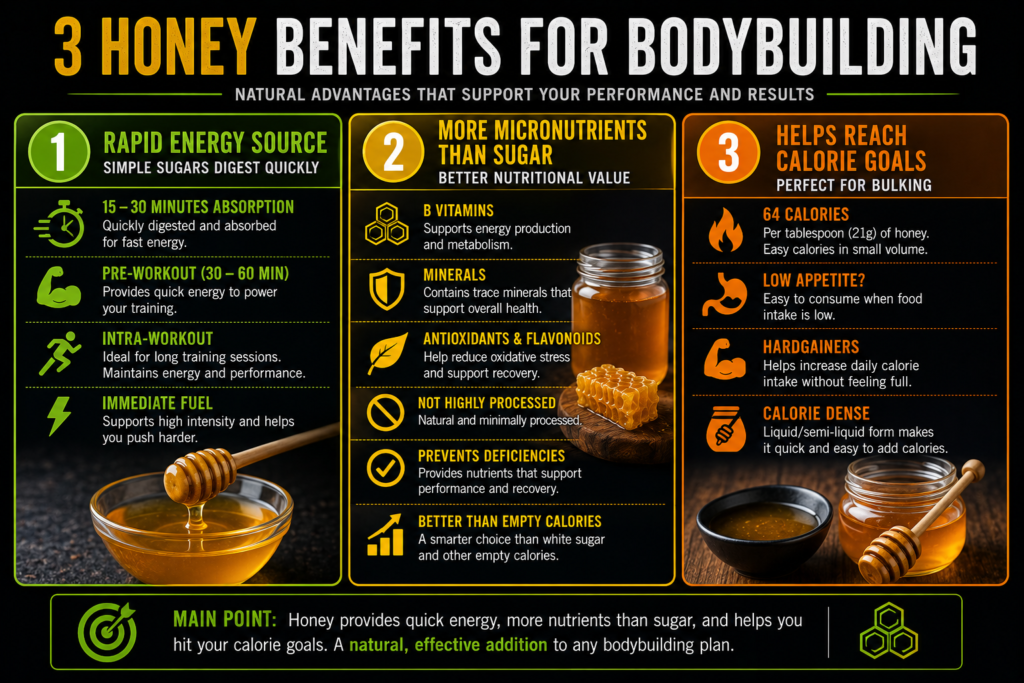
Benefit 1: Rapid Energy Source
Honey is rich in carbohydrates and provides the body’s primary fuel source. The carbohydrates in honey are simple and digest quickly, offering a rapid energy source.
Why rapid energy matters for training:
Pre workout energy:
- Consumed 30 to 60 minutes pre workout
- Glucose component enters bloodstream quickly
- Provides immediate fuel for high intensity work
- Prevents low blood sugar during training
Intra workout fuel:
- Some advanced athletes use honey during long training sessions
- Consumed between sets or during rest periods
- Maintains blood glucose levels
- Prevents energy crashes mid workout
- Particularly useful for sessions over 90 minutes
The mechanism:
Fast digestion:
- Simple sugars require minimal digestion
- Absorbed in small intestine rapidly
- 15 to 30 minutes to peak blood glucose
- No stomach discomfort like complex carbs might cause
Immediate availability:
- Glucose goes directly to working muscles
- Can be used for energy within minutes
- Supports high intensity contractions (heavy sets, sprints)
- Delays fatigue during intense training
The energy boost honey provides is the reason it’s used as a pre workout food option and also as an intra workout carbohydrate, used by some advanced athletes.
Practical application:
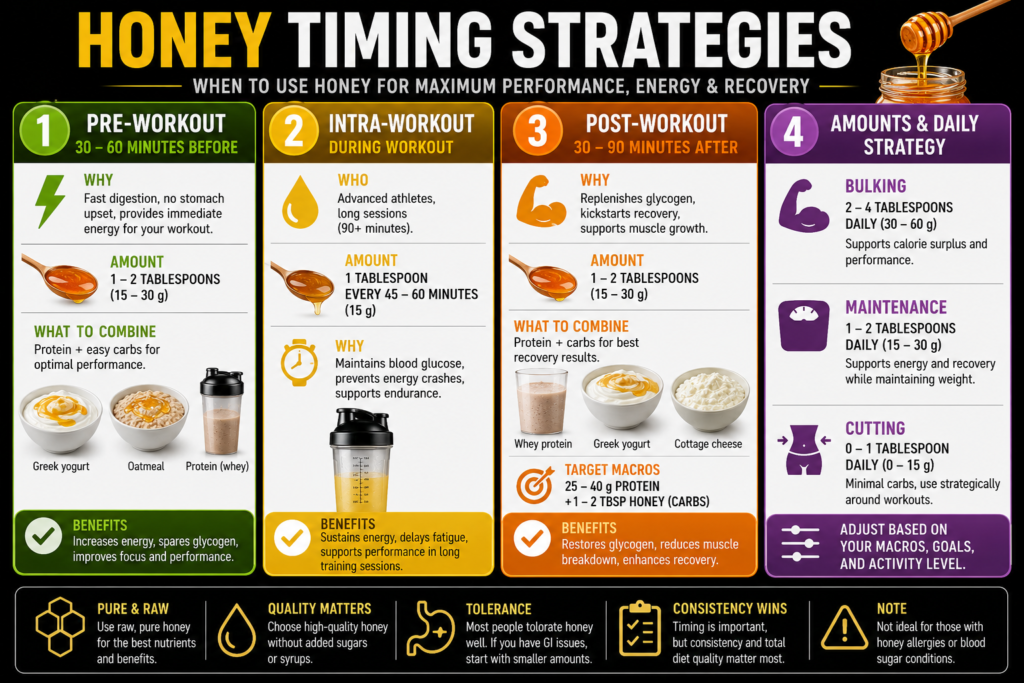
Pre workout honey use:
- 1 to 2 tablespoons (17 to 34g carbs) 30 to 45 minutes before training
- Mix with protein source (Greek yogurt, protein shake)
- Provides quick energy without stomach upset
- Good for early morning training when haven’t eaten
Intra workout honey use (advanced):
- 1 tablespoon every 45 to 60 minutes during very long sessions
- Mix with water or sports drink
- Only necessary for sessions over 90 to 120 minutes
- Most people don’t need intra workout carbs
Who benefits most:
- People training fasted or early morning
- Those doing high volume, high intensity sessions
- Athletes in sports requiring repeated explosive efforts
- Anyone prone to energy crashes during training
Benefit 2: Contains More Micronutrients Than Other Sugars
Honey is better than many other sugars because it’s not highly processed and contains more vitamins and minerals.
This is beneficial because the body needs many nutrients to function properly. If you can cover a decent percentage of your needs with a tasty food like honey, that’s a double advantage.
The nutritional superiority:
Compared to white sugar (per tablespoon):
White sugar:
- Calories: 49
- Carbs: 12.6g
- Vitamins: 0
- Minerals: 0
- Antioxidants: 0
- Processing: Highly refined
Honey:
- Calories: 64
- Carbs: 17g
- Vitamins: Small amounts of B vitamins, vitamin C
- Minerals: Calcium, copper, iron, magnesium, potassium, zinc
- Antioxidants: Flavonoids, phenolic acids, enzymes
- Processing: Minimal (especially raw honey)
The advantage is clear: For similar calories and carbs, honey provides actual micronutrients.
How this helps bodybuilders:
Preventing micronutrient deficiencies:
- Hard training increases nutrient demands
- Restrictive diets (especially cutting) risk deficiencies
- Every source of vitamins and minerals helps
- B vitamins support energy metabolism
- Minerals support muscle contraction and recovery
Better than “empty calories”:
- White sugar is literally empty calories (zero nutrition)
- Honey at least provides some nutritional value
- If you’re consuming sugar anyway, honey is smarter choice
- Particularly relevant if you eat honey regularly
Supporting overall health:
- Antioxidants fight training induced oxidative stress
- Antimicrobial properties may support immune system
- Better immune health = fewer missed training days
- Healthier gut may improve nutrient absorption
The caveat:
Don’t overestimate the benefit:
- Micronutrient amounts are still small
- One tablespoon won’t meet significant percentage of daily needs
- Can’t rely on honey as primary vitamin/mineral source
- Still need diverse whole foods for adequate micronutrition
Even though it contains vitamins, eating honey without limits and without specific context can cause you to overdo the amount of simple carbohydrates and make you accumulate fat.
Benefit 3: Can Help Reach Your Calorie Goals More Easily
Rich in carbohydrates, honey helps increase total caloric intake without the need to add more food volume, which can make your life much easier when you need to eat many calories but don’t have much appetite or feel full easily.
Why this matters for bulking:
The bulking challenge:
- Building muscle requires calorie surplus (300 to 500+ above maintenance)
- Eating large volumes of whole foods can be difficult
- Clean foods are often very filling
- Some people have low appetite
- Hitting calorie targets becomes a chore
Honey as a solution:
Calorie dense, low volume:
- 64 calories per tablespoon
- Very small physical volume
- Doesn’t fill you up
- Easy to consume even when not hungry
Liquid/semi-liquid:
- Can be mixed into other foods and drinks
- Doesn’t require chewing or extensive digestion
- Can be consumed quickly
- Less mentally taxing than eating more food
Practical bulking applications:
Add to protein shakes:
- 2 tablespoons in post workout shake = 128 extra calories, 34g carbs
- Improves taste significantly
- Boosts calorie content without extra volume
- Helps hit carb and calorie targets
Mix with oatmeal or yogurt:
- Makes meal more palatable
- Adds 60 to 130 calories easily
- Minimal added volume
- Increases carb content for energy
Use in homemade snacks:
- Protein bars, energy balls, etc.
- Binds ingredients together
- Natural sweetener
- Boosts calorie density
Example scenario:
Hardgainer struggling to reach 3,200 calories:
- Needs 400g carbs daily
- Eating whole grains, rice, potatoes all day
- Feeling stuffed, can’t eat more volume
Solution: Add honey strategically:
- 1 tbsp in morning oatmeal: 64 cal, 17g carbs
- 2 tbsp in post workout shake: 128 cal, 34g carbs
- 1 tbsp in evening Greek yogurt: 64 cal, 17g carbs
- Total: 256 calories, 68g carbs with minimal volume
This makes hitting the 3,200 calorie target much easier without feeling overly full.
Who benefits most:
- People with low appetite (“hardgainers”)
- Those bulking who struggle to eat enough
- Athletes with very high calorie needs (4,000+ calories)
- Anyone who finds whole food volume overwhelming
Who should be cautious:
- People cutting (honey provides calories without satiety)
- Those with normal or high appetite (easy to overconsume)
- Anyone prone to overeating sugary foods
Two (Possible) Downsides of Honey for Bodybuilding
Despite benefits, honey has potential downsides depending on your goals and context.
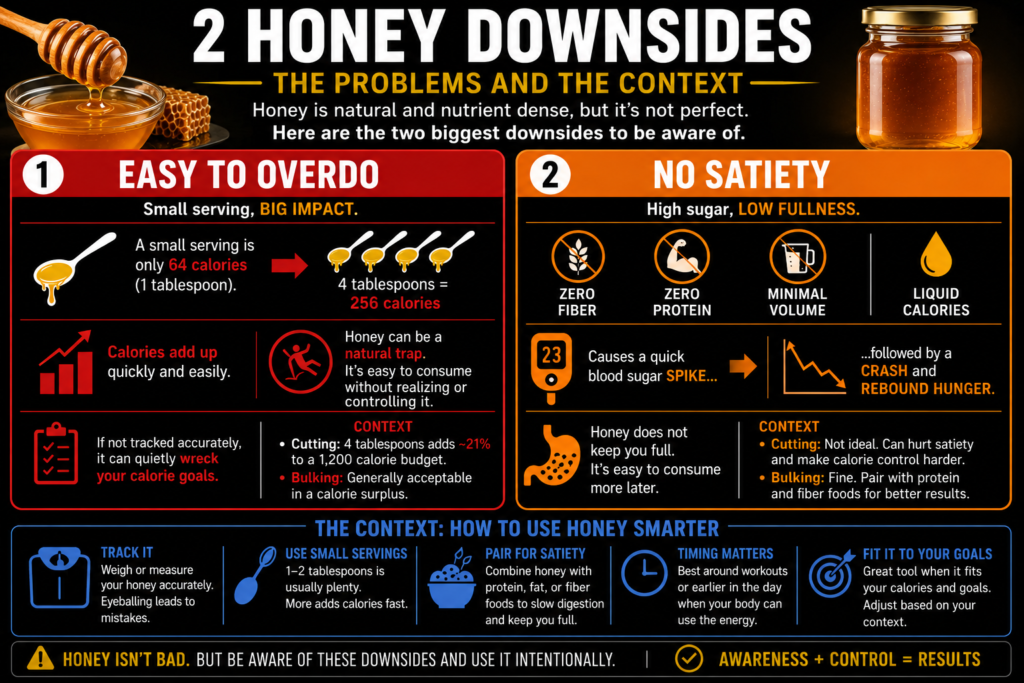
Downside 1: It’s Easy to Overdo
Because of honey’s small serving size, it’s very easy to overdo. This can be counterproductive when you need to control caloric intake during a cutting diet.
In fact, even when the goal is to gain muscle mass (during bulking), it doesn’t take much for calories to accumulate and exceed your daily targets.
Why overconsumption happens:
Serving size perception:
- “One tablespoon” sounds small
- 64 calories doesn’t sound like much
- But tablespoons add up quickly
- 4 tablespoons = 256 calories, 68g carbs (almost like a meal)
Liquid calories don’t register:
- Brain doesn’t register liquid/semi-liquid calories as well as solid food
- You can consume honey and still feel hungry
- Unlike eating chicken or rice, honey doesn’t trigger fullness
- Easy to add to multiple things throughout day
The “it’s natural” trap:
Honey is also one of those foods that many people consume without control under the pretense of being something natural. However, whether natural or not, if you exceed your caloric needs because of honey, you will accumulate fat.
The psychology:
- “It’s natural” = people think it’s “free”
- Doesn’t count the same way as “junk food” in people’s minds
- More liberal with portions
- Don’t track it as carefully
The reality:
- Natural ≠ calorie free
- Natural ≠ can’t make you fat
- Sugar is sugar, regardless of source
- Calories from honey count exactly the same as calories from table sugar
Example of how it adds up:
Morning routine:
- Coffee with 1 tbsp honey: 64 cal
- Oatmeal with 2 tbsp honey: 128 cal
- Subtotal: 192 calories before even considering the actual food
Throughout the day:
- Protein shake with 1 tbsp honey: 64 cal
- Greek yogurt with 1 tbsp honey: 64 cal
- Tea with 1 tbsp honey: 64 cal
- Subtotal: 192 more calories
Total from honey alone: 384 calories, 102g carbs
If cutting on 1,800 calories:
- Honey is 21% of daily calorie budget
- Provides zero protein or fat
- Takes up significant carb allocation
- Doesn’t provide any satiety
- This is problematic
If bulking on 3,200 calories:
- Honey is 12% of calorie budget
- Helps reach carb target easily
- Doesn’t interfere with whole food consumption
- This is fine
The lesson: Track honey just like any other food. Don’t give it a free pass because it’s “natural.”
Downside 2: Doesn’t Satisfy Hunger
Honey is a low volume food so that, no matter how much you consume, it probably won’t leave you feeling full, which can leave you hungry despite having consumed a higher number of calories.
Why this is problematic:
No satiety factors:
Volume:
- Stomach stretch receptors signal fullness
- Honey has minimal volume
- Doesn’t physically fill your stomach
- No fullness signal to brain
Fiber:
- Fiber slows digestion and increases fullness
- Honey has zero fiber
- Passes through digestive system quickly
- Leaves you wanting more food soon after
Protein:
- Protein is most satiating macronutrient
- Honey has zero protein
- Doesn’t trigger satiety hormones like protein does
- Hunger returns quickly
The blood sugar rollercoaster:
Rapid spike:
- Simple sugars cause quick blood glucose rise
- Insulin released to manage blood sugar
- Energy feels high temporarily
Rapid drop:
- Insulin clears glucose from blood
- Blood sugar drops (sometimes below baseline)
- Energy crashes
- Hunger and cravings return
Rebound hunger:
- Low blood sugar triggers hunger hormones
- Body wants more quick carbs
- Cycle continues
- Can lead to overeating
This is not a problem during bulking, but if you’re consuming honey while on a cutting diet, you should consume it with foods that are higher in volume, like fruits, to get more satiety.
Strategies to improve satiety when using honey:
Pair with protein:
- Greek yogurt + honey
- Protein shake + honey
- Cottage cheese + honey
- Protein provides satiety honey lacks
Combine with high fiber foods:
- Oatmeal + honey (oats provide fiber)
- Apple slices + honey (fruit provides fiber and volume)
- Whole grain toast + nut butter + honey
- Fiber slows digestion and increases fullness
Use strategically around training:
- Pre workout: Quick energy is the goal (satiety not needed)
- Intra workout: Energy boost without fullness (advantage)
- Post workout: Part of recovery meal (include protein and complex carbs for satiety)
Avoid consuming honey alone:
- Don’t eat honey by itself when hungry
- Always part of a balanced meal or snack
- Prevents blood sugar rollercoaster
- Prevents unsatisfying calorie consumption
Should You Use Honey Before Workouts?
Honey is perfect for a pre workout meal or snack because it provides quick energy, since it’s fast digesting and contains carbohydrates.
The Case for Pre Workout Honey
Why honey works pre workout:
Fast digestion:
- Won’t cause stomach discomfort during training
- Simple sugars absorbed in 15 to 30 minutes
- Available as energy when training begins
- No bloating or cramping
Energy availability:
- Glucose enters bloodstream quickly
- Muscles can use immediately for contractions
- Supports high intensity work
- Prevents low blood sugar during training
Doesn’t require much prep time:
- Can consume 30 to 45 minutes before training
- Don’t need 2 to 3 hours like with large meal
- Good for early morning training
- Convenient
Honey can be consumed before workouts and even during workouts because it’s digested so quickly that it won’t cause gastrointestinal issues and will provide quick energy for training.
How to Use Honey Pre Workout
Timing:
- 30 to 60 minutes before training
- Closer to training (30 min) for quick energy
- Further from training (60 min) if combined with protein
Amount:
- 1 to 2 tablespoons (17 to 34g carbs)
- Less if also eating other carbs
- More if training fasted or very early morning
Combination strategies:
Option 1: Honey + protein (ideal):
- Greek yogurt (protein) + 1 to 2 tbsp honey (carbs)
- Protein shake + honey
- Cottage cheese + honey
- Provides quick carbs AND protein for sustained energy
Option 2: Honey + slower carbs:
- Oatmeal + honey
- Whole grain toast + honey
- Banana + honey
- Provides immediate energy (honey) + sustained energy (complex carbs)
Option 3: Honey alone (acceptable if needed):
- 1 to 2 tbsp honey straight
- Mixed in water or tea
- Quick pre workout energy
- Not ideal but works in a pinch
If you’re looking for a more sustainable energy source for your pre workout meal, you can combine it with a slower digesting carbohydrate (like oatmeal) and protein to have a steady flow of energy even after the honey is digested.
Example pre workout meals with honey:
60 minutes before training:
- 1 cup oatmeal + 1 scoop whey protein + 1 tbsp honey + berries
- Macros: 400 cal, 30g protein, 55g carbs, 7g fat
- Sustained energy throughout workout
30 minutes before training:
- 1 cup Greek yogurt (0%) + 2 tbsp honey
- Macros: 230 cal, 24g protein, 38g carbs, 0g fat
- Quick energy + protein for muscle preservation
15 minutes before training (if short on time):
- Protein shake + 1 tbsp honey + banana
- Macros: 280 cal, 25g protein, 45g carbs, 2g fat
- Fast acting, minimal stomach load
Who Benefits Most from Pre Workout Honey
Best for:
- People training early morning (fasted or with little time to eat)
- Those prone to low energy during workouts
- Athletes doing high intensity or explosive training
- Anyone who gets stomach upset from complex carbs pre workout
Less beneficial for:
- People training later in day with meals already consumed
- Those doing low intensity steady state cardio
- Anyone with insulin sensitivity issues
- People cutting who need satiety from pre workout meal
Should You Use Honey After Workouts?
Honey is also a great option to consume post workout and is particularly useful for those who struggle to reach their calorie goals.
The Case for Post Workout Honey
You can eat honey after training because it helps replenish your glycogen stores that were diminished due to intense physical activity, although this is not as urgent as most people imagine.
The glycogen replenishment argument:
What happens during training:
- Muscles use glycogen (stored carbohydrate) for energy
- Intense training depletes muscle glycogen by 30 to 40%
- Very long/intense sessions can deplete 60 to 80%
- Body needs carbs to restore these levels
Why fast carbs help:
- Simple sugars replenish glycogen quickly
- Insulin spike from carbs helps shuttle nutrients into muscle
- Glucose goes directly to depleted muscles
- Faster recovery of glycogen stores
The “anabolic window” myth:
Old thinking:
- Must consume carbs + protein within 30 minutes post workout
- Miss the window = suboptimal gains
- Creates anxiety about immediate post workout nutrition
Current evidence:
- “Window” is much longer than thought (several hours)
- Total daily carb and protein intake matters more than exact timing
- Pre workout meal still providing nutrients post workout
- Immediate post workout nutrition is helpful but not critical
The reality:
- If training fasted: Post workout nutrition more important
- If had pre workout meal: Post workout timing less critical
- Either way, honey can be useful post workout carb source
How to Use Honey Post Workout
Additionally, you should not consume honey alone. Protein is the other essential macronutrient you need after a workout to ensure the start of muscle recovery.
The ideal post workout approach:
Honey + protein combination:
- Whey protein shake + 1 to 2 tbsp honey
- Greek yogurt + honey + fruit
- Cottage cheese + honey
- Provides fast carbs (honey) + fast protein (whey/Greek yogurt)
Timing:
- Within 30 to 90 minutes post workout
- Not critical to rush
- More important if training fasted
- Less urgent if had pre workout meal
Amount:
- 1 to 2 tablespoons honey (17 to 34g carbs)
- Combined with 25 to 40g protein
- Adjust based on total daily carb needs
Example post workout meals with honey:
Option 1: Classic post workout shake:
- 1 to 2 scoops whey protein
- 1 to 2 tbsp honey
- 1 cup milk or water
- Optional: banana for additional carbs
- Macros: 300 to 400 cal, 40 to 50g protein, 40 to 60g carbs
Option 2: Greek yogurt bowl:
- 1.5 cups Greek yogurt (0% or 2%)
- 2 tbsp honey
- 1/2 cup berries
- Macros: 320 cal, 36g protein, 48g carbs, 1g fat
Option 3: Cottage cheese + honey:
- 1 cup cottage cheese (low fat)
- 1 tbsp honey
- 1/2 cup pineapple
- Macros: 250 cal, 28g protein, 32g carbs, 2g fat
Post Workout Honey for Different Goals
Bulking (calorie surplus):
- Use 2 tbsp honey in post workout meal
- Helps hit carb targets easily
- Supports glycogen replenishment
- Provides easy calories
Maintenance:
- 1 to 2 tbsp as part of balanced post workout meal
- Moderate carb intake
- Prioritize protein still
Cutting (calorie deficit):
- 0 to 1 tbsp honey if using
- Carbs are limited, may prefer to “spend” them on more filling foods
- Protein still priority
- Consider skipping honey and using fruit instead for more volume
How Many Tablespoons of Honey Should You Use?
In general, a serving of 1 to 2 tablespoons of honey (about 20g) before or after training can offer a good amount of simple carbohydrates. This amount provides approximately 17 to 34 grams of carbohydrates.
Determining Your Honey Intake
Factors to consider:
Your daily carb target:
- Bulking (400g carbs): 2 tbsp honey = 8.5% of carbs (fine)
- Maintenance (300g carbs): 2 tbsp = 11% of carbs (acceptable)
- Cutting (150g carbs): 2 tbsp = 23% of carbs (significant, may want less)
Your training intensity and duration:
- High intensity, long sessions (90+ min): 2 tbsp justified
- Moderate sessions (60 min): 1 to 2 tbsp fine
- Short/low intensity (under 45 min): 1 tbsp or skip
Your meal timing:
- Training fasted: More honey helpful (1 to 2 tbsp)
- Recent meal before training: Less honey needed (0 to 1 tbsp)
- Multiple meals throughout day: Honey less critical
General recommendations by goal:
Bulking:
- 2 to 4 tbsp daily (34 to 68g carbs)
- Divided between meals and around workouts
- Helps hit calorie surplus
- Provides easy carbs
Maintenance:
- 1 to 2 tbsp daily (17 to 34g carbs)
- Primarily around workouts
- Moderate, sustainable amount
Cutting:
- 0 to 1 tbsp daily (0 to 17g carbs)
- Only if fits macros comfortably
- Prioritize protein and filling carbs
- May be better to skip entirely
It’s important to remember and emphasize that honey consumption should be adjusted according to your caloric needs and is not a “free” food that can be consumed without control under the pretense of being natural.
Tracking Honey Intake
How to track accurately:
Measure, don’t estimate:
- Use actual measuring spoon
- Level off (don’t heap)
- 1 level tablespoon = 21g = 64 calories
- Heaping tablespoon = 30g+ = 90+ calories
Log it in your tracking app:
- Enter as “honey, 1 tbsp” or weigh for accuracy
- Counts toward daily carb total
- Counts toward daily calorie total
- Don’t give it special treatment
Account for it in daily macros:
- If using 2 tbsp (34g carbs), reduce other carbs by 34g
- Maintain protein target (non negotiable)
- Adjust fats as needed
- Keep total calories on target
Does Honey Help With Muscle Hypertrophy?
Honey can definitely play a role in the muscle hypertrophy process, mainly due to its composition of simple carbohydrates, which are quickly absorbed by the body.
How Honey Supports Muscle Growth
Pre workout energy:
- Before training, honey can be useful for providing energy that will make you train hard and stimulate muscle growth
- Better energy = better performance
- Better performance = heavier weights, more reps
- Superior stimulus = more muscle growth over time
Post workout recovery:
- After training, it will help replenish lost energy and, together with protein, will start the muscle recovery process
- Glycogen replenishment supports recovery
- Insulin spike from carbs aids protein absorption
- Creates anabolic environment
Supporting training volume:
- Adequate carb intake supports training frequency
- Can train harder and more often
- More quality volume = more growth stimulus
- Honey is one convenient carb source
Additionally, honey has anti-inflammatory and antioxidant properties, which can contribute to better recovery and overall health.
The anti-inflammatory benefits:
- Intense training creates inflammation
- Some inflammation is necessary (signals adaptation)
- Excessive inflammation impairs recovery
- Honey’s antioxidants may help moderate inflammation
- Better recovery = more consistent training
The realistic perspective:
Honey alone won’t build muscle:
- Requires progressive overload (strength training program)
- Requires adequate total protein (1g per lb minimum)
- Requires calorie surplus or maintenance
- Requires consistency over months/years
Honey is a tool that can help:
- Provides energy for better training
- Convenient carb source around workouts
- Easier to hit calorie and carb targets
- Supports recovery when combined with protein
- Better than processed sugar due to micronutrients
Honey’s role in hypertrophy process:
- Minor but positive
- Supports training and recovery
- Better than doing nothing
- Not magical or necessary
- One piece of larger puzzle
Can You Mix Honey with Whey Protein?
Mixing honey with whey protein is not only possible but can also be quite beneficial.
Why Honey + Whey Works Well
Whey protein is a high quality protein source, rich in essential amino acids that are crucial for muscle repair and growth.
By adding honey to whey protein, you not only improve the flavor of the shake but also add fast digesting carbohydrates. As we’ve seen, these carbohydrates can help replenish muscle glycogen stores more quickly, an important aspect for post workout recovery.
The synergistic effects:
Improved taste:
- Whey protein alone can be boring
- Honey adds natural sweetness
- Makes shake more enjoyable
- Better adherence to nutrition plan
Complete post workout nutrition:
- Protein for muscle repair (25 to 40g from whey)
- Carbs for glycogen replenishment (17 to 34g from honey)
- Both macros in one convenient shake
- No need for separate meal immediately
Additionally, the combination of carbohydrates from honey with protein from whey can improve protein absorption by the body due to insulin action, enhancing the effects of muscle protein synthesis, which is essential for muscle growth.
The insulin mechanism:
How it works:
- Carbs spike insulin
- Insulin is anabolic hormone
- Insulin shuttles amino acids into muscle cells
- Promotes protein synthesis
- Reduces protein breakdown
The evidence:
- Some studies show carbs + protein superior to protein alone post workout
- Other studies show minimal difference if daily nutrition adequate
- Timing is less critical than once thought
- Still, combining is convenient and may provide small benefit
Practical honey + whey combinations:
Basic post workout shake:
- 1 to 2 scoops whey protein (25 to 50g protein)
- 1 to 2 tbsp honey (17 to 34g carbs)
- 8 to 12 oz water or milk
- Blend or shake
- Consume within 60 minutes post workout
Enhanced shake:
- 1 scoop whey protein
- 1 tbsp honey
- 1 banana (adds more carbs and potassium)
- 1 cup milk (adds protein and carbs)
- Ice
- Macros: 400+ cal, 40g protein, 60g carbs
Bulking shake:
- 2 scoops whey protein
- 2 tbsp honey
- 1 cup oats (blend into powder first)
- 2 tbsp peanut butter
- 1 cup whole milk
- Macros: 800+ cal, 60g protein, 90g carbs, 25g fat
THE BOTTOM LINE: IS HONEY GOOD OR BAD FOR BODYBUILDING?
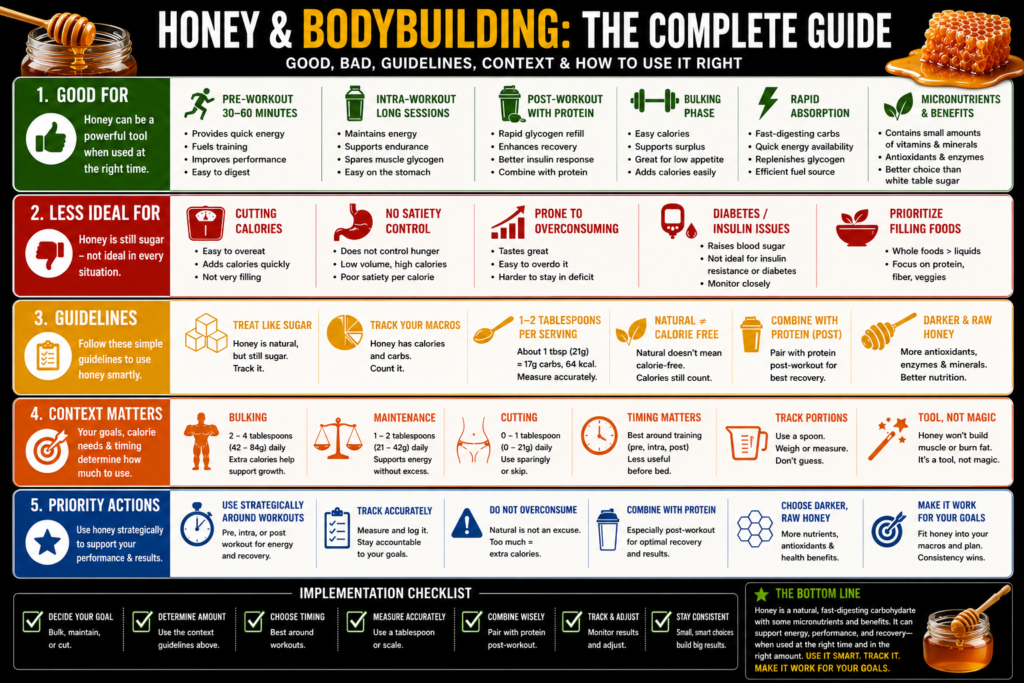
✅ Excellent Rapid Energy Source (Pre and Intra Workout)
✅ Superior to Processed Sugars (Contains Micronutrients and Antioxidants)
✅ Helps Reach Calorie Goals (When Bulking or High Calorie Needs)
✅ Supports Glycogen Replenishment (Post Workout Recovery)
✅ Easy to Overconsume (Must Track Like Any Other Food)
✅ Provides Zero Satiety (Not Ideal for Cutting)
Honey Is Good For:
- Pre Workout Energy (30 to 60 Minutes Before Training)
- Intra Workout Fuel (Long Sessions Over 90 Minutes)
- Post Workout Recovery (Combined With Protein)
- Bulking Phase (Easy Carbs and Calories)
- People With Low Appetite Struggling to Eat Enough
Honey Is Less Ideal For:
- Cutting Phase (Calories Without Satiety)
- People Trying to Control Hunger
- Those Prone to Overconsuming Sweets
- Anyone With Diabetes or Insulin Issues
Key Principles:
Nutritional Profile:
- 64 calories per tablespoon
- 16 to 17g carbohydrates (simple sugars)
- Zero protein, zero fat, zero fiber
- Small amounts of vitamins and minerals
- Contains antioxidants and antimicrobial compounds
Treat It Like Sugar:
- Natural does not equal calorie free
- Must be tracked in daily macros
- Easy to overconsume if not measured
- Counts toward daily carb and calorie totals
Timing Matters:
- Best around workouts (pre, intra, post)
- 1 to 2 tablespoons per serving
- Always combine with protein post workout
- Can pair with complex carbs pre workout
Advantages Over White Sugar:
- Contains B vitamins (B2, B3, B5)
- Contains minerals (calcium, copper, iron, magnesium, potassium)
- Rich in antioxidants (especially darker honey)
- Antimicrobial properties
- Less processed (especially raw honey)
Practical Guidelines:
- Bulking: 2 to 4 tbsp daily (helps hit surplus)
- Maintenance: 1 to 2 tbsp daily (moderate use)
- Cutting: 0 to 1 tbsp daily (prioritize filling foods)
- Always measure portions accurately
- Track in nutrition app like any other food
HONEY IS A TOOL, NOT A MAGIC SOLUTION. USE IT STRATEGICALLY AROUND WORKOUTS FOR ENERGY AND RECOVERY. TRACK IT ACCURATELY IN YOUR MACROS. DON’T OVERCONSUME UNDER THE “IT’S NATURAL” EXCUSE. COMBINE WITH PROTEIN POST WORKOUT. CHOOSE DARKER, RAW HONEY FOR MAXIMUM MICRONUTRIENTS. MAKE IT WORK FOR YOUR GOALS, NOT AGAINST THEM.
Ready To Optimize Your Entire Nutrition Strategy Around Training for Maximum Muscle Growth and Performance? Understanding honey is just one piece of workout nutrition. Get a complete system covering optimal pre workout meals for different training types and goals, intra workout nutrition strategies for endurance and performance, post workout recovery protocols backed by research, carbohydrate timing and cycling for muscle building and fat loss, and supplement timing and stacking for enhanced results. Stop guessing about workout nutrition. Start using evidence based strategies that actually support your training and physique goals.
REFERENCES
SECTION 1 — Honey nutritional composition: antioxidants, bioactive compounds, and comparison to refined sugar
[1] Alvarez-Suarez JM et al. — PMC/Nutrients, 2013 Comprehensive review of the chemical composition and bioactive properties of honey; honey contains flavonoids (quercetin, kaempferol, luteolin, apigenin), phenolic acids, carotenoids, and enzymes including glucose oxidase and catalase; antioxidant activity varies significantly by botanical origin, with darker honeys (buckwheat, manuka) exhibiting the highest antioxidant content; these compounds are entirely absent from refined sugar and high fructose corn syrup; honey also produces hydrogen peroxide through glucose oxidase activity, contributing to antimicrobial properties; directly supports the article’s comparative claim that honey provides meaningful bioactive compounds that processed sweeteners do not, and the recommendation to choose darker, raw honey for maximum micronutrient and antioxidant content https://pmc.ncbi.nlm.nih.gov/articles/PMC3750511/
SECTION 2 — Glycemic index of honey vs. other sweeteners and glucose response
[2] Atkinson FS, Foster-Powell K & Brand-Miller JC — PubMed/Diabetes Care, 2008 Comprehensive international GI database paper listing glycemic index values for 2,480 foods from multiple studies; honey was assigned a GI of approximately 58 (moderate), compared to white sugar (sucrose) at approximately 65, pure glucose at 100, and fructose at approximately 19; the moderate GI reflects honey’s mixed fructose-glucose composition, with the fructose component lowering the overall glycemic response compared to pure glucose; provides the evidence-based GI values used in the article’s comparison of honey to other sweeteners, supporting the article’s description of honey as producing a moderate insulin response suitable for pre and post-workout use https://pubmed.ncbi.nlm.nih.gov/18835944/
SECTION 3 — Pre-exercise carbohydrate: rapid glycogen availability supports performance
[3] Podlogar T & Wallis GA — PMC/Nutrients, 2022 Review of the role of muscle and liver glycogen as rate-limiting fuels for moderate to high-intensity exercise; muscle glycogen depletion below 100 mmol/kg dry weight causes a 20 to 50% reduction in high-intensity performance; pre-exercise carbohydrate ingestion raises blood glucose and insulin, promoting glycogen storage and sparing endogenous stores during training; simple carbohydrates with moderate to high GI (such as honey) are absorbed rapidly and are available as fuel within 15 to 30 minutes of ingestion; pre-exercise feeding is most beneficial when training fasted or when the last meal was more than 3 hours prior; provides the mechanistic basis for the article’s recommendation to consume 1 to 2 tablespoons of honey 30 to 60 minutes before training https://pmc.ncbi.nlm.nih.gov/articles/PMC5409683/
SECTION 4 — Post-exercise carbohydrate and glycogen replenishment
[4] Burke LM et al. — PubMed/Journal of Sports Science, 2011 Review of post-exercise carbohydrate intake and muscle glycogen resynthesis; ingesting carbohydrate immediately after exercise activates glycogen synthase, accelerating glycogen storage; the rate of glycogen resynthesis is maximized with carbohydrate intake of approximately 1 to 1.2 g/kg body weight per hour; simple carbohydrates with moderate to high GI produce faster initial replenishment compared to lower-GI sources; combining carbohydrates with protein further enhances glycogen synthesis when total carbohydrate intake is suboptimal; total daily carbohydrate intake ultimately determines glycogen status more than acute post-exercise timing when training frequency is normal; directly supports the article’s section on post-workout honey use for glycogen replenishment and the recommendation to combine honey with whey protein post-exercise https://pubmed.ncbi.nlm.nih.gov/21660839/

Leave a Reply
You must be logged in to post a comment.