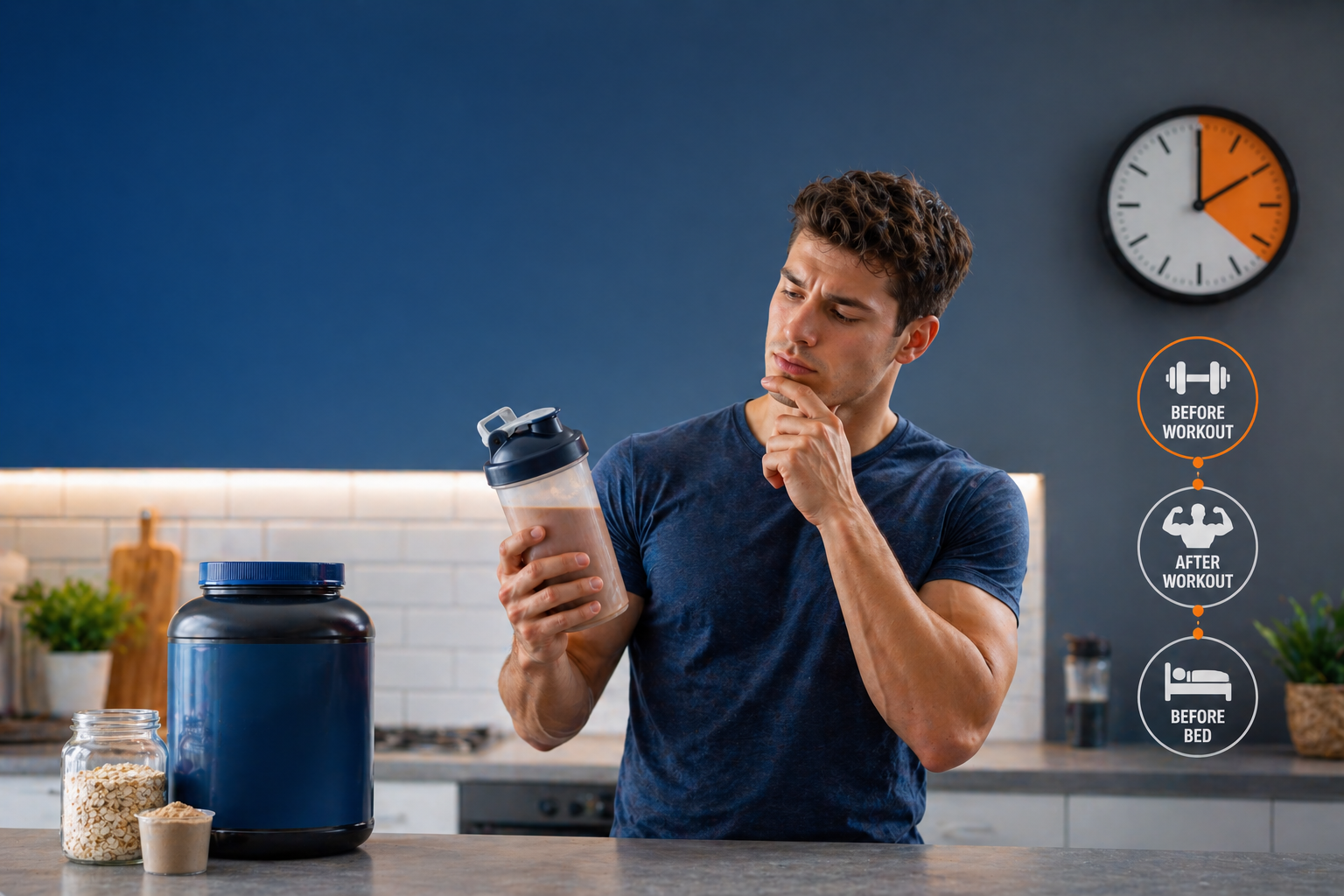
You just bought your first mass gainer supplement, and now you’re standing in your kitchen staring at the tub, wondering: should I take this before my workout or after? Does timing even matter? Will the wrong choice waste the supplement or hurt my gains?
When it comes to supplementation, a frequent question is whether to take mass gainer before or after training to get the maximum benefit from the supplement and achieve better results.
Generally, taking mass gainer after your workout is better because consuming a highly caloric beverage before physical activity can cause digestive symptoms in some people. Additionally, the high carbohydrate and protein content of mass gainer will be very welcome after training to amplify muscle recovery. However, there are no “mandatory” times to use mass gainers. If taking mass gainer pre-workout fits your nutritional needs perfectly, there are ways to do it while avoiding digestive problems.
For people trying to gain weight and build muscle, understanding when and how to use mass gainer effectively can make the difference between smooth progress and frustrating digestive issues or wasted supplements. Many lifters take mass gainer at the wrong times, experience problems, and conclude the supplement doesn’t work – when timing was the only issue.
In this comprehensive guide, I’ll explain whether it’s better to take mass gainer before or after your workout (and why), how to properly take mass gainer pre-workout if you choose this approach, optimal post-workout mass gainer protocols for maximum benefit, whether you can take mass gainer both before AND after training, other effective times throughout the day to consume mass gainer, and whether you can mix mass gainer with other supplements safely.
Whether you’re a hardgainer struggling to consume enough calories, an athlete trying to bulk up, or someone who just wants to maximize the effectiveness of their mass gainer, understanding optimal timing will help you gain weight and build muscle without digestive distress.
Let’s break down everything you need to know about mass gainer timing.
TABLE OF CONTENTS
Key Points to Understand First
Before diving into the details, here are the fundamental truths about mass gainer timing:
Taking mass gainer after training can be useful for amplifying muscle hypertrophy, since the body will better utilize the proteins and carbohydrates present in the mass gainer during the post-workout recovery window.
If you prefer or need to, you can mix your mass gainer dose with other supplements to increase the practicality of pre- or post-workout supplementation (creatine, protein powder, pre-workout, etc.).
It’s possible to split the total mass gainer dose, so you can use half before training and the other half after training, reducing digestive load while maintaining total calorie intake.
When choosing to take mass gainer before training, it’s best to allow at least 30-60 minutes to avoid digestive problems and allow the supplement to be properly digested and absorbed.
Mass gainer can be consumed at any time of day, not just around workouts. The most important factor is hitting your total daily calorie target consistently.
Now let’s examine each aspect in detail.
Is It Better to Take Mass Gainer Before or After Your Workout?
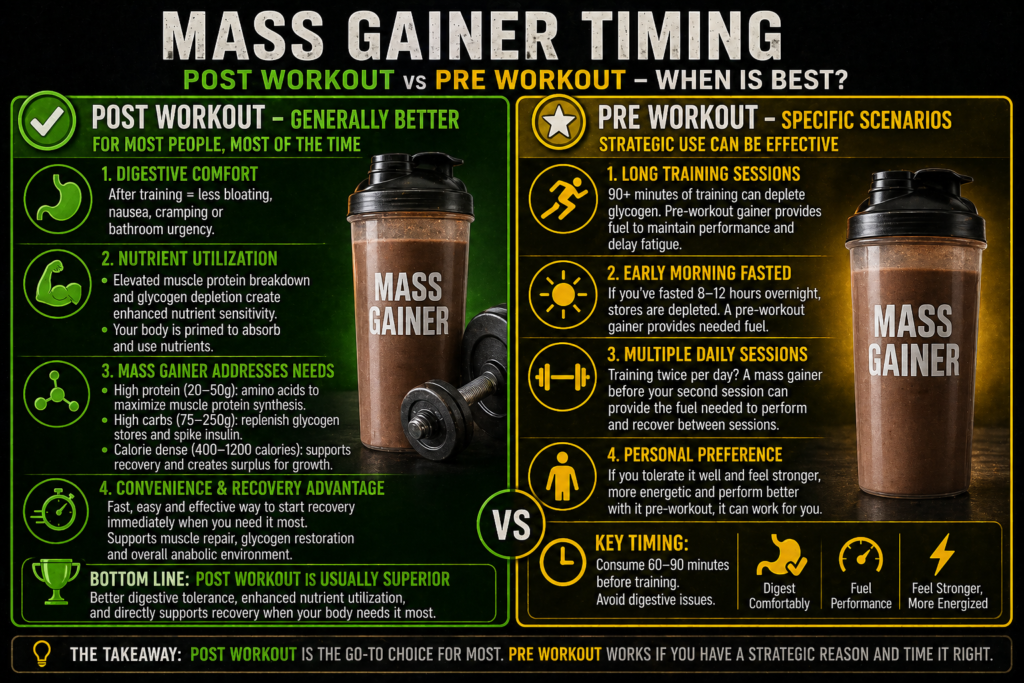
Although you can take mass gainer at any time of day, it’s generally better to take mass gainer after your workout.
Why Post-Workout Is Usually Superior
Reason 1: Digestive comfort during training
Mass gainers provide a large amount of carbohydrates at once, along with protein and some fat. The combination of these nutrients, and depending on their sources, can cause some people to experience gastrointestinal symptoms like gas, nausea, and the urge to use the bathroom – which is not preferable if you take mass gainer before training.
Common digestive issues from pre-workout mass gainer:
Bloating and fullness:
- Mass gainers contain 400-1,200+ calories per serving
- Large volume of liquid and nutrients in stomach
- Creates uncomfortable fullness sensation
- Makes training difficult and unpleasant
Nausea:
- High carbohydrate load can cause stomach upset
- Sweetness and thickness of shake may trigger nausea
- Worse during intense exercise (blood diverted from digestive system)
- Can completely ruin a training session
Cramping:
- Stomach cramps from large nutrient load
- Intestinal cramping as contents move through
- Abdominal discomfort during exercises (especially squats, deadlifts)
- Side stitches during cardio or conditioning
Urgency to use bathroom:
- Large carbohydrate and liquid load stimulates digestion
- May need to interrupt workout for bathroom
- Embarrassing and inconvenient
- Disrupts training flow and intensity
If you’re one of the “lucky ones” who suffers from these symptoms, this is definitely something to consider when choosing the time to take mass gainer.
Individual variation:
- Some people tolerate pre-workout mass gainer perfectly fine
- Others experience severe digestive distress
- Depends on digestive system sensitivity, ingredients in the mass gainer, and total serving size
- You won’t know until you try (start conservatively)
Reason 2: Nutrient utilization post-workout
Additionally, consuming large amounts of protein and carbohydrates after training is beneficial because these nutrients will help build and repair muscles and replenish glycogen stores that were depleted during the training session.
What happens after intense training:
Muscle protein breakdown (MPB):
- Training creates micro-tears in muscle fibers
- Muscle protein breakdown is elevated
- Without adequate nutrition, you remain in a catabolic (breakdown) state
- Net muscle loss can occur if nutrition is inadequate
Glycogen depletion:
- Intense training depletes muscle glycogen (stored carbohydrates)
- Heavy lifting can deplete glycogen by 30-40%
- High-volume training or extended sessions deplete more
- Glycogen must be replenished for next training session
Enhanced nutrient sensitivity:
- Post-workout, muscles are more sensitive to insulin
- Glucose uptake is enhanced (better glycogen replenishment)
- Amino acid uptake is increased (more protein synthesis)
- This “window” lasts several hours, not just 30 minutes
How mass gainer addresses these needs:
High protein content (20-50g per serving):
- Provides amino acids for muscle protein synthesis
- Shifts from catabolic to anabolic state
- Supports muscle repair and growth
- Particularly beneficial with fast-digesting proteins (whey)
High carbohydrate content (75-250g per serving):
- Rapidly replenishes depleted glycogen stores
- Spikes insulin (drives nutrients into muscle cells)
- Provides energy for recovery processes
- Prevents muscle protein breakdown for energy
Complete calorie package:
- 400-1,200+ calories in convenient liquid form
- Easy to consume when solid food appetite is low
- Convenient when time is limited post-workout
- Contributes significantly to daily calorie surplus
The post-workout advantage:
Taking mass gainer after training takes advantage of your body’s heightened ability to utilize nutrients for recovery and growth, rather than having a heavy, uncomfortable mass of food in your stomach during training.
When Pre-Workout Might Make Sense
However, in some situations, you can use mass gainer before training without fearing unwanted effects. You just need to be more strategic about when you consume the supplement before training.
Scenarios where pre-workout mass gainer works:
Long training sessions (90+ minutes):
- Glycogen stores may become depleted mid-session
- Pre-workout carbs help maintain performance
- Reduces fatigue during extended training
- Beneficial for sports practices, long lifting sessions, or combined lifting + cardio
Early morning training (fasted or minimal breakfast):
- Haven’t eaten in 8-12 hours overnight
- Glycogen stores relatively depleted
- Pre-workout mass gainer provides fuel
- Prevents training in deeply fasted state (which some people tolerate poorly)
Multiple training sessions daily:
- Training twice per day (morning and evening)
- Need fuel for second session
- Pre-workout mass gainer before second session helps performance
- Post-workout from first session may not be sufficient
Personal preference with good tolerance:
- Some people simply prefer training with food in their system
- Feel stronger and more energized
- Tolerate pre-workout mass gainer well digestively
- If it works for you, use it
The key: Timing it far enough before training to avoid digestive issues (more on this below).
How to Take Mass Gainer Before Your Workout
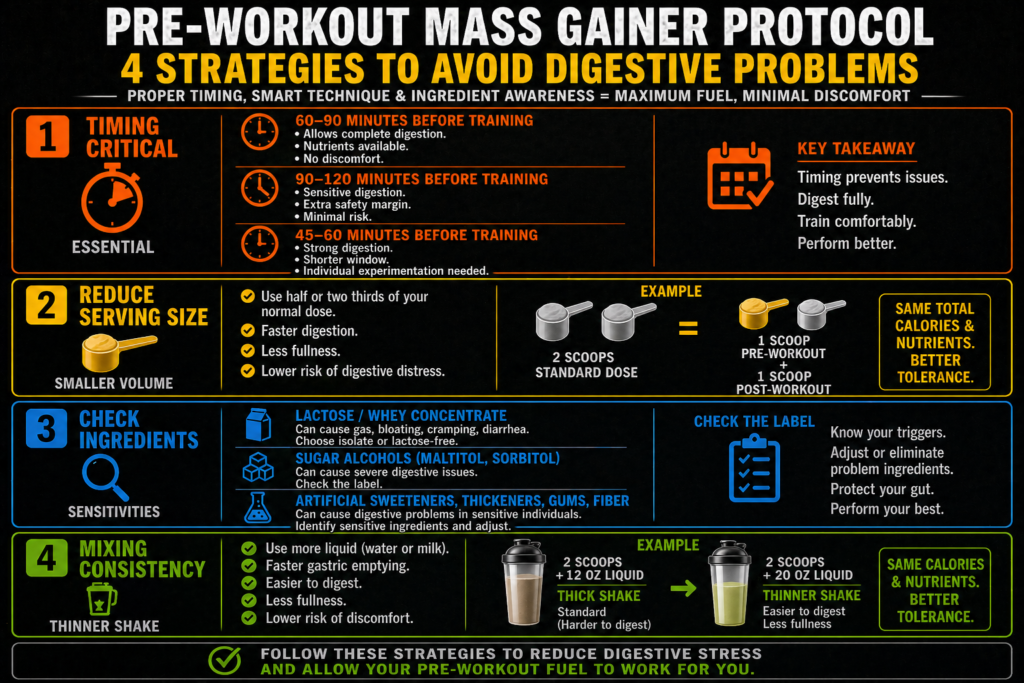
If you prefer to take mass gainer before training, you need to take some basic precautions.
Timing is Critical
Avoid taking the complete dose of mass gainer very close to training (less than 30-60 minutes), so you have time to digest the supplement and any potential digestive problems occur before you train rather than during.
The digestion timeline for mass gainer:
Immediately after consumption:
- Mass gainer enters stomach
- Begins mixing with stomach acid
- Protein and carbs start breaking down
- Stomach feels very full
15-30 minutes:
- Partial gastric emptying begins
- Liquid starts moving to small intestine
- Some absorption starting
- Still significant stomach fullness
30-60 minutes:
- Majority of liquid phase has left stomach
- Small intestine actively absorbing nutrients
- Blood sugar and insulin rising
- Amino acids entering bloodstream
- Stomach fullness significantly reduced
60-90 minutes:
- Most nutrients absorbed
- Stomach nearly empty
- Blood sugar peaked and stabilizing
- Peak energy availability
- Digestive system mostly cleared
90-120 minutes:
- Complete absorption
- Stable energy levels
- No digestive discomfort
- Ready for intense training
Optimal pre-workout timing:
For most people:
- 60-90 minutes before training
- Allows complete digestion
- Nutrients available for training
- No digestive discomfort
For those with sensitive digestion:
- 90-120 minutes before training
- Extra safety margin
- Ensures complete gastric emptying
- Minimizes any risk of issues
For those with strong digestion:
- 45-60 minutes before training
- Can tolerate shorter window
- Still risky to go much shorter
- Individual experimentation needed
Reduce the Serving Size
Strategy: Use half or two-thirds of your normal mass gainer dose pre-workout
Benefits:
- Smaller volume = faster digestion
- Less stomach fullness
- Lower risk of digestive issues
- Still provides energy for training
Example:
- Standard dose: 2 scoops (1,000 calories)
- Pre-workout: 1 scoop (500 calories)
- Post-workout: 1 scoop (500 calories)
- Same total intake, better tolerance
Check Ingredients for Sensitivities
Additionally, read the mass gainer label carefully and see if it contains any ingredients you’re sensitive to.
Common problematic ingredients:
Lactose (from whey concentrate):
- For example, some mass gainers contain whey protein in its most basic form, which includes a lot of lactose and is disastrous for someone with intolerance
- Causes gas, bloating, cramping, diarrhea
- Worse when consumed pre-workout (digestive distress during training)
- Solution: Choose mass gainers with whey isolate or lactose-free formulas
Sugar alcohols:
- Maltitol, sorbitol, xylitol
- Cause severe gas and diarrhea in many people
- Often added to “low-sugar” mass gainers
- Check ingredient list carefully
Artificial sweeteners:
- Sucralose, aspartame, acesulfame-K
- Some people experience digestive upset
- Can cause bloating or stomach discomfort
- Individual tolerance varies
Thickeners and gums:
- Xanthan gum, guar gum, carrageenan
- Can cause bloating in sensitive individuals
- Slow gastric emptying (more fullness)
- Not problematic for most people
Fiber:
- Some mass gainers add fiber for “health benefits”
- High fiber pre-workout can cause gas and urgency
- Better to consume fiber at other times
- Check fiber content per serving
How to identify sensitive ingredients:
Step 1: Review the ingredient list Step 2: Note any ingredients you’ve had issues with before Step 3: If uncertain, try a small serving (half dose) first Step 4: Monitor your response during training Step 5: Adjust ingredients, brand, or timing accordingly
Mixing Consistency
Make the shake less thick:
- Use more liquid (water or milk)
- Creates thinner consistency
- Faster gastric emptying
- Easier to digest
- Less stomach fullness
Example:
- Standard mix: 2 scoops + 12 oz liquid = very thick
- Pre-workout mix: 2 scoops + 20 oz liquid = thinner, easier to digest
Pre-Workout Mass Gainer Protocol Summary
Optimal pre-workout mass gainer strategy:
1. Timing: 60-90 minutes before training (90-120 if very sensitive)
2. Serving size: Half to two-thirds of normal dose (reduce volume)
3. Ingredients: Check for lactose, sugar alcohols, excess fiber – avoid if sensitive
4. Consistency: Mix with extra liquid for thinner shake
5. Test first: Try on a lighter training day to assess tolerance
6. Individual adjustment: Everyone responds differently, find what works for you
How to Take Mass Gainer After Your Workout
If you choose to take mass gainer post-workout, it’s best to consume it within 2 hours after your training session to take advantage of the body’s increased ability to utilize nutrients after an intense exercise session.
The Post-Workout Window (Debunking Myths)
It’s important to note that there’s no urgent need for post-workout supplementation, as popular belief dictates.
The myth:
- Must consume protein and carbs within 30 minutes post-workout
- Otherwise, muscle growth is compromised
- The “anabolic window” closes rapidly
- Miss it and you’ve wasted your workout
The reality:
Your body takes several hours (days actually) to rebuild muscle mass after a workout, and your body remains more sensitive to nutrients for a similar time period.
The actual post-workout nutrient sensitivity timeline:
0-2 hours post-workout:
- Peak insulin sensitivity
- Highest glycogen resynthesis rates
- Elevated muscle protein synthesis
- Optimal nutrient uptake
2-6 hours post-workout:
- Still elevated insulin sensitivity (70-80% of peak)
- Good glycogen resynthesis
- Continued elevated muscle protein synthesis
- Still excellent nutrient uptake
6-24 hours post-workout:
- Moderately elevated nutrient sensitivity
- Muscle protein synthesis remains above baseline
- Muscle repair and growth continue
- Benefits of nutrient intake persist
24-48 hours post-workout:
- Gradually returning to baseline
- Muscle protein synthesis still slightly elevated (especially in beginners)
- Recovery processes ongoing
- Adequate nutrition still important
The research evidence:
Studies comparing immediate post-workout nutrition vs. delayed nutrition (2-3 hours later) show minimal differences in muscle growth and recovery when total daily protein and calories are matched.
What actually matters:
- Total daily protein intake (0.7-1g per lb body weight)
- Total daily calorie intake (surplus for muscle gain)
- Consistent nutrient timing across the day
- Multiple protein feedings distributed throughout 24 hours
However, it’s recommended to take mass gainer within two hours – not because you’ll lose gains otherwise, but so it doesn’t affect the rest of your diet. This way you can fit more meals into your day without feeling excessively full.
Practical Post-Workout Timing
Why the 2-hour recommendation makes sense:
Meal spacing:
- If you train at 5 PM and don’t consume mass gainer until 8 PM, that’s close to dinner time
- Mass gainer is 400-1,200 calories
- Hard to eat dinner shortly after
- Disrupts meal schedule
Appetite management:
- Post-workout appetite is often suppressed
- Liquid mass gainer is easier to consume than solid food
- Taking it earlier prevents eating too late
- Maintains regular eating schedule
Practical convenience:
- Most people are at or near the gym immediately post-workout
- Easy to consume shake in locker room or car
- Convenient timing
- Becomes consistent routine
Sample post-workout timing scenarios:
Scenario 1 – Afternoon training:
- 4:00 PM: Finish training
- 4:15 PM: Consume mass gainer (500-1000 calories)
- 7:00 PM: Regular dinner meal
- Works well, adequate spacing
Scenario 2 – Morning training:
- 7:00 AM: Finish training
- 7:15 AM: Consume mass gainer
- 10:00 AM: Mid-morning meal
- 1:00 PM: Lunch
- Excellent spacing throughout day
Scenario 3 – Evening training:
- 7:00 PM: Finish training
- 7:20 PM: Consume mass gainer
- 9:30 PM: Light snack if needed before bed
- May interfere with sleep if too close to bedtime (adjust if needed)
Maximizing Post-Workout Mass Gainer Effectiveness
Optimal post-workout mass gainer protocol:
Timing: Within 1-2 hours post-workout (sooner is convenient but not critical)
Hydration: Drink water during and after training before mass gainer
- Prevents confusing dehydration with hunger
- Improves nutrient absorption
- Aids recovery
Full dose: Can use complete serving post-workout
- Digestive system not stressed by training anymore
- Better tolerance than pre-workout
- Maximizes calorie intake when you need it
Mix with milk if bulking aggressively:
- Adds extra calories and protein
- Whole milk: +150 calories, +8g protein per cup
- Helps reach very high calorie targets (3,500-4,000+)
Or mix with water if managing calories:
- Fewer total calories
- Easier on digestion for some people
- Still provides all the mass gainer nutrients
Combine with creatine:
- Post-workout is excellent time for creatine
- Carbs in mass gainer help creatine uptake
- Convenient to mix together
- No downside to combination
Can I Take Mass Gainer Both Before AND After Training?
Another strategy you can try with your mass gainer is dividing the supplement portion in half and taking half before training and half after.
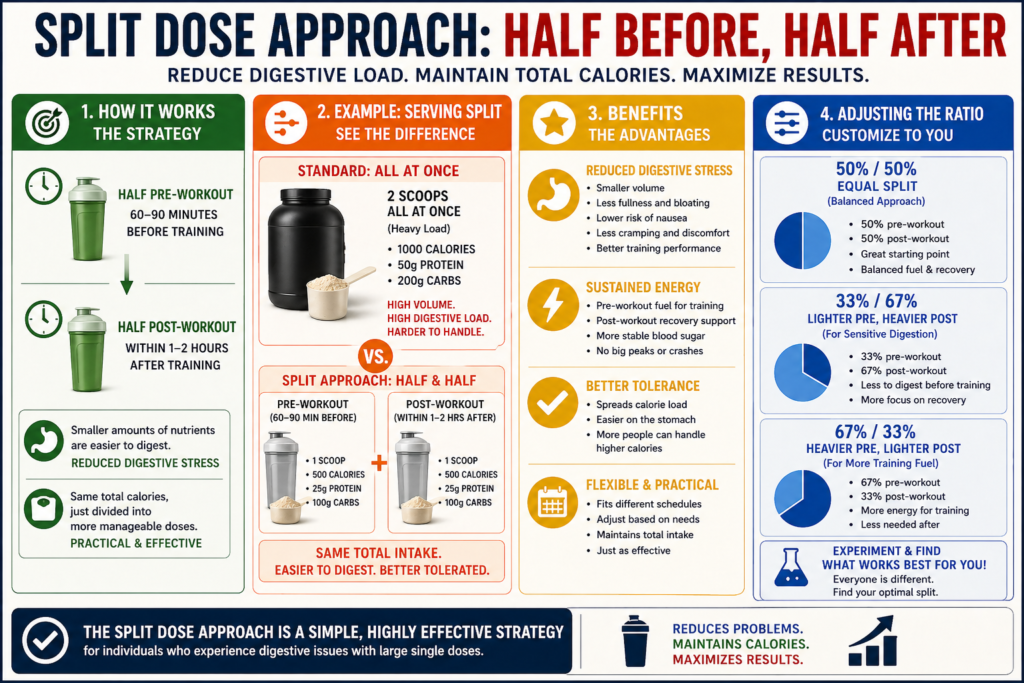
This split-dose approach can be highly effective for certain individuals and situations.
How the Split-Dose Strategy Works
Taking half of your total mass gainer dose pre-workout and the other half post-workout will help reduce digestion problems while you train, because you’ll be consuming a smaller amount of all nutrients, which will be easier to digest.
Example serving split:
Standard single dose:
- 2 scoops mass gainer
- 1,000 calories total
- 50g protein
- 200g carbs
- All at once (heavy digestive load)
Split dose:
- 1 scoop pre-workout (60-90 min before)
- 500 calories
- 25g protein
- 100g carbs
- Easier to digest
Plus:
- 1 scoop post-workout (within 1-2 hours)
- 500 calories
- 25g protein
- 100g carbs
- Easy to digest
Total: Same 1,000 calories, 50g protein, 200g carbs – just split into two smaller, more manageable doses
Benefits of the Split-Dose Approach
Reduced digestive stress:
- Smaller volume per serving
- Less stomach fullness
- Lower risk of nausea, cramping, or discomfort
- Better training performance
Sustained energy:
- Pre-workout dose provides fuel for training
- Post-workout dose supports recovery
- Maintains more stable blood sugar
- No dramatic peaks and crashes
Better overall tolerance:
- Even people who can’t tolerate full dose pre-workout often handle half dose fine
- Spreads calorie load across day
- Prevents overwhelming digestive system
Flexible scheduling:
- Can adjust split ratio (1/3 pre, 2/3 post, or other ratios)
- Customize to your tolerance
- Experiment to find optimal balance
Maintains total calorie intake:
Dividing your portion into two doses would be just as effective for increasing your calorie intake as if you consumed the complete dose of mass gainer all at once. You’ve just fractionated the dose.
The math is simple:
- 1,000 calories taken once = 1,000 total calories
- 500 calories taken twice = 1,000 total calories
- Same daily intake, different distribution
Optimal Split-Dose Protocol
If you choose to take half a dose of mass gainer before your workout, you should still give yourself at least 60 minutes to allow it to be digested before training.
Recommended split-dose timeline:
For 5:00 PM training:
- 3:30 PM: Half dose mass gainer (1 scoop)
- 5:00 PM: Train
- 6:00 PM: Half dose mass gainer (1 scoop)
For 7:00 AM training:
- 6:00 AM: Half dose mass gainer (small pre-workout serving)
- 7:00 AM: Train
- 8:00 AM: Half dose mass gainer (post-workout)
- 10:00 AM: Regular breakfast/meal
Adjusting the split ratio:
50/50 split (most common):
- Equal calories before and after
- Balanced approach
- Good starting point
33/67 split (lighter pre-workout):
- 1/3 dose before (smaller, easier to digest)
- 2/3 dose after (majority of calories when you can handle more)
- Better for sensitive digestion
67/33 split (heavier pre-workout):
- 2/3 dose before (more fuel for training)
- 1/3 dose after (lighter, leaves room for meal)
- For those who train better with more pre-workout fuel
Experiment to find what works best for your digestion, training performance, and schedule.
Can I Take Mass Gainer at Other Times of Day?
If your goal is to increase your calorie intake to gain more muscle mass, then taking mass gainer will be a useful tool regardless of what time of day you consume it.
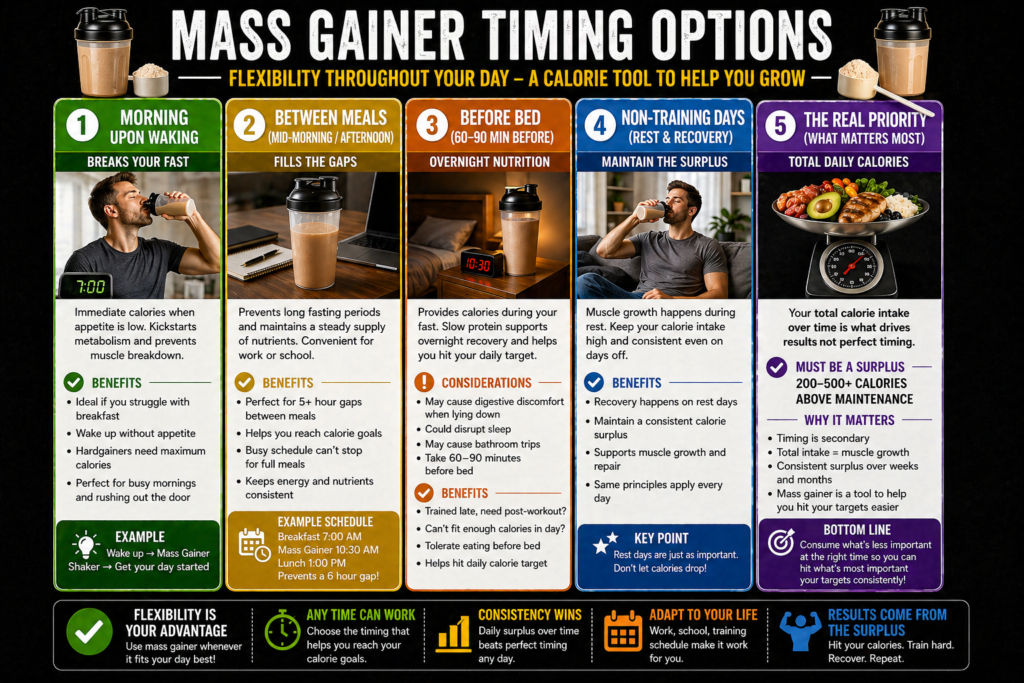
Mass Gainer as a Calorie Tool, Not Just Workout Nutrition
Mass gainers are simply a more convenient way to get a higher number of calories in your diet when you can’t eat lots of solid foods.
Why mass gainer works at any time:
Calorie density:
- 400-1,200 calories per serving
- Equivalent to large meal
- Much easier to drink than eat that much food for some people
Liquid form:
- Doesn’t require chewing
- Less filling than solid food
- Can consume even when not very hungry
- Faster to prepare and consume
Complete macronutrients:
- Protein for muscle building
- Carbs for energy and glycogen
- Some fats for calories and hormones
- Convenient all-in-one nutrition
Taking a dose of mass gainer would be like adding an extra meal to your day that you couldn’t manage with solid foods. Therefore, there’s no bad time to consume the supplement, except perhaps immediately before training.
Strategic Times Throughout the Day
Morning (upon waking):
Benefits:
- Breaks overnight fast
- Provides immediate calories
- Easy to consume when appetite is low
- Kickstarts metabolism
- Prevents muscle breakdown from fasted state
Who benefits:
- People who struggle with breakfast
- Those who wake up without appetite
- Hardgainers needing maximum calories
- Busy people rushing in the morning
Example: Wake at 6 AM, consume mass gainer by 6:15 AM, regular breakfast at 9 AM if desired
Between meals (mid-morning or mid-afternoon):
Benefits:
- Fills calorie gap between main meals
- Prevents long fasting periods
- Maintains steady nutrient intake
- Convenient at work, school, etc.
Who benefits:
- Those with long gaps between meals (5+ hours)
- People struggling to reach daily calorie targets
- Busy individuals who can’t stop for full meals
Example: Breakfast at 7 AM, mass gainer at 10:30 AM, lunch at 1 PM (prevents 6-hour gap)
Before bed:
Benefits:
- Provides calories during overnight fast
- Slow-digesting protein supports overnight recovery
- Helps hit daily calorie target
- May prevent morning hunger
Considerations:
- Some people experience digestive discomfort lying down with full stomach
- Might disrupt sleep if taken too close to bedtime
- May cause nighttime bathroom trips
- Works better if consumed 60-90 minutes before bed
Who benefits:
- People who train late and need post-workout nutrition
- Those who can’t fit enough calories during the day
- Individuals who tolerate eating before bed well
Non-training days:
Same principles apply:
- Can use mass gainer any time
- Helps maintain calorie surplus on rest days
- Recovery happens on rest days too
- Consistency is key for muscle growth
At the end of the day, you can take your mass gainer when it’s most convenient for you (as long as it doesn’t affect your training) because mass gainer will only help you build muscle if you’re consistently consuming sufficient calories to drive muscle growth and training intensely enough in the gym to give your muscles a reason to grow.
The Real Priority: Total Daily Calories
What actually matters for muscle growth:
Total daily calorie intake:
- Must be in surplus (200-500+ calories above maintenance)
- Consistent surplus over weeks and months
- Timing is secondary to total intake
Total daily protein:
- 0.7-1g per pound of body weight
- Distributed across 3-5 meals
- Timing is helpful but not critical
Progressive training stimulus:
- Lifting heavier weights over time
- Increasing volume (sets, reps)
- Challenging your muscles consistently
Mass gainer is a tool to hit your calorie and protein targets more easily. When you consume it during the day is far less important than whether you’re hitting your targets consistently.
Example comparison:
Person A – “Perfect” timing:
- Takes mass gainer immediately post-workout every day
- But only hitting 2,500 calories daily (maintenance for them)
- Result: No muscle growth (no surplus)
Person B – “Random” timing:
- Takes mass gainer whenever convenient (morning, afternoon, evening – varies)
- Consistently hitting 3,200 calories daily (500 surplus)
- Result: Steady muscle growth (surplus achieved)
Person B builds more muscle despite “imperfect” timing because total calories matter more.
Can I Mix Mass Gainer With Other Supplements?
When taking mass gainer before or after training, you might wonder if it’s possible to mix it with other supplements that could also be used at these times.
Generally, you can mix your mass gainer dose with any other supplement.
Safe and Beneficial Supplement Combinations
Mass gainer + Creatine (highly recommended):
Benefits:
- For example, if you take creatine after training, there’s no problem mixing it with mass gainer
- Carbs in mass gainer help drive creatine into muscles (insulin response)
- Convenient one-shake solution
- Both support muscle growth through different mechanisms
How to combine:
- Add 5g creatine monohydrate to mass gainer shake
- Mix thoroughly
- Consume post-workout or any time of day
- Creatine doesn’t need specific timing (daily dose is what matters)
Mass gainer + Whey protein (for extra protein):
Benefits:
- Increases total protein content
- Useful if mass gainer has lower protein ratio
- Helps reach daily protein targets
- Both are dairy-based (mix well together)
How to combine:
- Add 1 scoop whey (25g protein) to mass gainer
- Increases protein without excessive calories
- Particularly useful if mass gainer is carb-heavy
Example:
- Mass gainer alone: 50g protein, 200g carbs
- Plus whey: 75g protein, 200g carbs (better ratio for muscle building)
Mass gainer + Pre-workout (if taken pre-training):
Considerations:
- You can also take mass gainer close to or with (if you can handle it) your pre-workout supplement
- Pre-workout contains stimulants (caffeine, etc.)
- Mass gainer is calorie-dense
- Combination creates a lot of stomach content
If combining:
- Take 60-90 minutes before training (not closer)
- Consider half-dose mass gainer with pre-workout
- Or take pre-workout 30 min before training, mass gainer 90 min before
- Monitor tolerance carefully
Alternative: Take pre-workout 30 minutes before training (on empty-ish stomach for best effect), take mass gainer post-workout
Mass gainer + BCAAs (generally unnecessary):
The reality:
- Mass gainer already contains complete protein
- Complete protein includes BCAAs naturally
- Adding separate BCAAs is redundant
- Waste of money
Verdict: Skip BCAAs if using mass gainer (you’re already getting them)
Mass gainer + Glutamine:
Benefits:
- Glutamine may support recovery and immune function
- Can be mixed without issues
- Some mass gainers include glutamine already
How to combine:
- Add 5-10g glutamine to shake
- Mix well
- Consume post-workout
Evidence note: Glutamine supplementation benefits are debated; not essential but not harmful
Mass gainer + Beta-alanine:
Benefits:
- Beta-alanine improves endurance and buffers muscle acid
- Can be mixed with mass gainer
- Convenient to take together
How to combine:
- Add 3-5g beta-alanine to mass gainer
- May cause tingling sensation (harmless)
- Take daily for cumulative effect
Potential Issues With Mixing
Just keep in mind that some combinations might amplify digestive problems if you have food sensitivities.
Problematic combinations for sensitive individuals:
Mass gainer (with lactose) + Whey concentrate (more lactose):
- Double lactose load
- Severe symptoms for lactose intolerant individuals
- Solution: Use whey isolate or lactose-free mass gainer
Mass gainer + Fiber supplement:
- Both can cause bloating
- High fiber + large calorie load = digestive distress
- Solution: Take fiber at different time of day
Mass gainer + High-fat foods:
- Slows digestion dramatically
- Increases stomach fullness and discomfort
- Can cause nausea
- Solution: Keep fats moderate when using mass gainer
But, in theory, mixing mass gainer with other supplements won’t “cancel out” the benefits of any of them.
The supplements work through different mechanisms:
- Mass gainer: Provides calories, protein, carbs
- Creatine: Increases muscle energy stores (ATP/phosphocreatine)
- Whey: Additional fast-digesting protein
- Pre-workout: Stimulates CNS, increases performance
No negative interactions between these supplements. They complement each other.
Practical Mixing Tips
Mixing order:
- Add liquid to shaker first (prevents clumping)
- Add powders (mass gainer, creatine, whey, etc.)
- Close lid securely
- Shake vigorously for 20-30 seconds
- Let sit 30 seconds, shake again
Liquid amount:
- Use more liquid when combining multiple supplements
- Prevents overly thick consistency
- Easier to drink and digest
Taste considerations:
- Some supplement combinations taste worse than components alone
- Experiment with flavors
- Consider unflavored supplements to control flavor
THE BOTTOM LINE: MASS GAINER TIMING
After examining all aspects of when to take mass gainer, here’s what you need to understand:
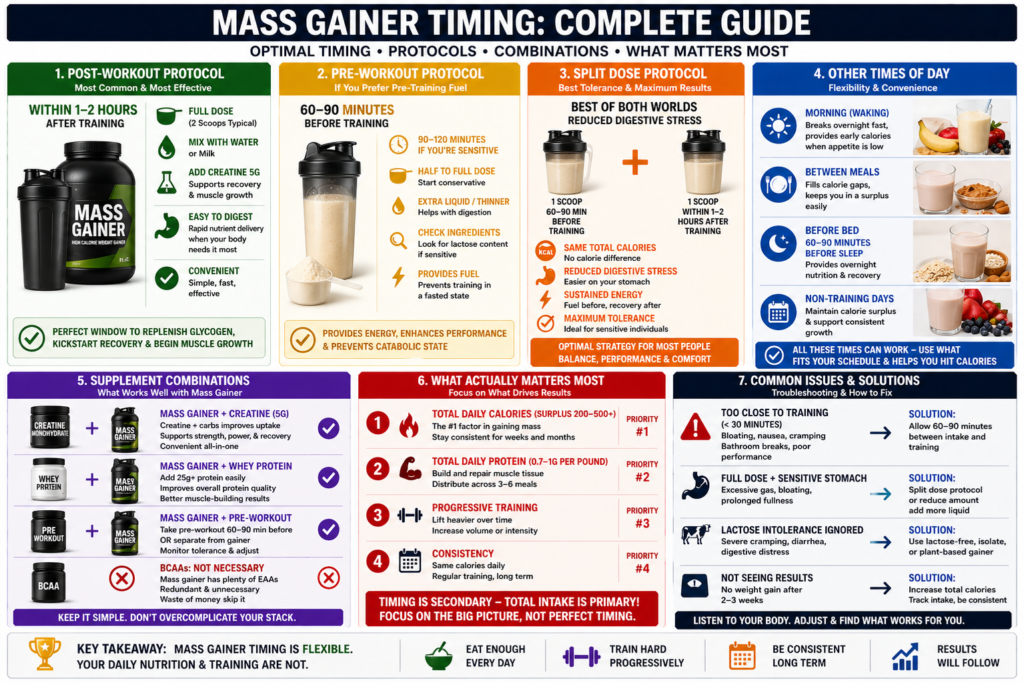
✅ Post-Workout Is Generally Best (Better Digestive Tolerance, Supports Recovery)
✅ Pre-Workout Works If Timed Properly (60-90 Minutes Before, Avoid Digestive Issues)
✅ Can Split Dose Before And After (Half Before, Half After Reduces Digestive Load)
✅ Can Take Any Time Of Day (Total Daily Calories Matter Most)
✅ Can Mix With Other Supplements (Creatine, Whey, Pre-Workout All Compatible)
✅ Individual Tolerance Varies (Experiment To Find What Works For You)
Perfect For Post-Workout Mass Gainer:
- Most People (Better Digestive Tolerance Than Pre-Workout)
- Those With Sensitive Stomachs (Avoids Training With Full Stomach)
- People Who Want Maximum Convenience (Take Immediately After Leaving Gym)
- Anyone Following Traditional Bodybuilding Protocols
Perfect For Pre-Workout Mass Gainer:
- Those Who Tolerate It Well (No Digestive Issues)
- Early Morning Trainers (Need Fuel After Overnight Fast)
- People With Very Long Training Sessions (90+ Minutes)
- Athletes With Multiple Daily Sessions
Perfect For Split Dosing:
- Those With Digestive Sensitivity (Smaller Doses Tolerated Better)
- People Wanting Energy For Training Plus Post-Workout Recovery
- Anyone Struggling With Very Large Mass Gainer Servings
- Flexible Approach For Experimentation
Optimal Mass Gainer Timing Protocols:
Post-Workout (Most Common):
- Timing: Within 1-2 hours after training
- Serving: Full dose (1-2 scoops depending on calorie needs)
- Mix with: Water or milk (milk adds calories)
- Combine with: Creatine (5g)
- Benefits: Supports recovery, easy to digest, convenient
Pre-Workout (If Preferred):
- Timing: 60-90 minutes before training (90-120 if very sensitive)
- Serving: Half to full dose (start conservative)
- Mix with: Extra liquid for thinner consistency
- Check for: Lactose and problematic ingredients
- Benefits: Provides training fuel, prevents fasted training
Split Dose (Best Tolerance):
- Pre-workout: Half dose (1 scoop) 60-90 min before
- Post-workout: Half dose (1 scoop) within 1-2 hours after
- Total: Same calories as single dose
- Benefits: Reduced digestive stress, sustained energy, maximum tolerance
Other Times Of Day:
- Morning upon waking (breaks fast, easy when low appetite)
- Between meals (fills calorie gaps)
- Before bed (overnight nutrition, 60-90 min before sleep)
- Non-training days (maintain calorie surplus for recovery)
Common Digestive Issues From Poor Timing:
Too Close To Training (<30 Minutes):
- Stomach fullness and bloating
- Nausea during exercise
- Cramping and discomfort
- Urgent bathroom needs
- Compromised training performance
Taking Full Dose On Sensitive Stomach:
- Excessive gas and bloating
- Prolonged fullness (hours)
- Nausea from volume
- Solution: Split dose or reduce serving size
Lactose Intolerance Ignored:
- Severe cramping and gas
- Diarrhea (worst if during training)
- Stomach pain
- Solution: Choose whey isolate-based or plant-based mass gainers
Supplement Combinations That Work:
Mass Gainer + Creatine:
- Add 5g creatine monohydrate to shake
- Carbs help creatine uptake
- Convenient single shake
- Take post-workout or any time
Mass Gainer + Whey Protein:
- Adds 25g protein to shake
- Improves protein-to-carb ratio
- Helps reach daily protein targets
- Mix thoroughly
Mass Gainer + Pre-Workout:
- If pre-workout timing, take both 60-90 min before
- Or separate: pre-workout 30 min before, mass gainer post-workout
- Monitor caffeine + full stomach tolerance
Mass Gainer + BCAAs:
- Unnecessary (mass gainer has protein with BCAAs)
- Waste of money
- Skip BCAAs if using mass gainer
What Actually Matters Most:
Total Daily Calories (Priority #1):
- Must be in surplus (200-500+ above maintenance)
- Consistent surplus over weeks and months
- Mass gainer helps achieve this easily
- Timing is secondary to total intake
Total Daily Protein (Priority #2):
- 0.7-1g per pound of body weight
- Distributed across multiple meals
- Mass gainer contributes significantly
- Timing less critical than total
Progressive Training (Priority #3):
- Lift heavier over time
- Increase volume progressively
- Train hard enough to grow
- Supplements only work with proper training
Consistency (Priority #4):
- Same total calories daily
- Regular training schedule
- Consistent sleep and recovery
- Long-term adherence matters most
STOP OVERTHINKING MASS GAINER TIMING. START FOCUSING ON TOTAL DAILY CALORIES. TAKE IT POST-WORKOUT FOR CONVENIENCE. OR SPLIT THE DOSE IF SENSITIVE. OR USE ANY TIME THAT FITS YOUR SCHEDULE. CONSISTENCY BEATS PERFECT TIMING EVERY TIME.
Ready To Build A Complete Mass Gaining Strategy That Maximizes Muscle Growth Through Proper Calorie Surplus, Strategic Supplementation, And Progressive Training? Understanding mass gainer timing is just one small piece. Get a comprehensive muscle-building system that includes personalized daily calorie targets based on your metabolism and goals, meal planning that combines whole foods with strategic supplementation, training programs designed for maximum muscle growth, guidance on choosing the right mass gainer for your needs and budget, and progression strategies that ensure continuous gains over months and years. Stop obsessing over minor timing details. Start building a complete system that drives consistent muscle growth through proper nutrition, hard training, and adequate recovery.
REFERENCES
SECTION 1 — Carbohydrate availability from fruit sugars: fructose and glucose kinetics during exercise
[1] Gonzalez JT & Betts JA — PMC/Nutrients, 2019 Review of fructose co-ingestion to increase carbohydrate availability during exercise; in the fasted state the main fuels during exercise are muscle glycogen and plasma glucose, which can be depleted by 40 to 60% within 90 minutes of moderate to high-intensity work; because glucose and fructose are absorbed via different intestinal transport proteins (SGLT1 and GLUT5 respectively), combining them increases total carbohydrate absorption capacity; fructose is rapidly converted in the intestine and liver to glucose and lactate before entering systemic circulation; fruits that contain both glucose and fructose (bananas, apples, grapes, mangoes) therefore utilize dual absorption pathways for faster delivery of energy to working muscles; provides the biochemical foundation for the article’s recommendation of glucose-and-fructose-containing fruits as superior pre-workout fuel https://pmc.ncbi.nlm.nih.gov/articles/PMC6852172/
[2] Levine L et al. — PubMed/Journal of Applied Physiology, 1983 Controlled exercise study comparing pre-workout ingestion of fructose, glucose, and water 45 minutes before 30 minutes of running at 75% VO2max; fructose ingestion produced significantly less muscle glycogen depletion than glucose or placebo, and maintained stable blood glucose and insulin concentrations throughout exercise, avoiding the reactive hypoglycemia observed with glucose at the onset of exercise; the authors attributed the glycogen-sparing effect of fructose to its more stable glycemic and insulinemic profile; provides direct experimental evidence that the fructose naturally present in pre-workout fruits (apples, grapes, bananas) offers a stable blood glucose response without the mid-exercise crash associated with pure glucose https://pubmed.ncbi.nlm.nih.gov/6662766/
SECTION 2 — Glycogen stores and exercise capacity: why carbohydrate fuel matters
[3] Podlogar T & Wallis GA — PMC/Nutrients, 2022 Review of the role of muscle and liver glycogen as rate-limiting fuels for moderate to high-intensity exercise; muscle and liver glycogen together account for only approximately 4% of the body’s total energy reserves but are the primary substrate for high-intensity exercise ATP production; glycogen depletion below 100 mmol/kg dry weight causes a 20 to 50% reduction in performance at 80% peak power intensity; exogenous carbohydrate ingestion before and during exercise spares endogenous glycogen stores and sustains exercise capacity; glucose and glucose-derived carbohydrates are the most effective sources for replenishing muscle glycogen; establishes why eating carbohydrate-rich fruits before training meaningfully impacts performance for sessions lasting more than 45 to 60 minutes https://pmc.ncbi.nlm.nih.gov/articles/PMC5409683/
SECTION 3 — Banana as pre-workout fuel: carbohydrate delivery and the potassium-cramp claim
[4] Miller KC — PMC/Journal of Athletic Training, 2012 Controlled crossover study of 9 euhydrated men examining whether eating bananas after exercise in the heat increases plasma potassium or prevents exercise-associated muscle cramps (EAMCs); consuming 1 or 2 bananas post-exercise produced only marginal and delayed increases in plasma potassium concentration, occurring 30 to 60 minutes after ingestion; plasma glucose, however, increased significantly within 15 minutes of consuming 2 servings, suggesting the primary acute benefit of bananas is carbohydrate delivery rather than potassium replacement; the authors concluded that eating bananas is unlikely to be an effective treatment for exercise-associated muscle cramping; this study nuances the article’s claims about bananas and cramp prevention, showing the carbohydrate content is the primary mechanistic driver of performance benefit, not the potassium-cramp pathway https://pmc.ncbi.nlm.nih.gov/articles/PMC3499889/
SECTION 4 — Pre-exercise carbohydrate timing for performance
[5] Schabort EJ et al. — PubMed/Medicine and Science in Sports and Exercise, 2000 RCT comparing exercise performance 3 hours versus 6 hours after a moderate-to-high carbohydrate meal; performance was significantly better in the 3-hour condition, with higher carbohydrate availability, greater glycogen utilization, and longer time to exhaustion; the 6-hour condition produced lower insulin levels and reliance on fat, reducing performance capacity; establishes that pre-exercise carbohydrate timing within a 2 to 3 hour window meaningfully enhances exercise capacity compared to eating too early; contextualizes the article’s 30 to 60 minute fruit timing recommendation by showing that carbohydrate availability at the time of training directly determines performance outcome https://pubmed.ncbi.nlm.nih.gov/10861332/


Leave a Reply
You must be logged in to post a comment.