
Considering T3 for rapid fat loss? This thyroid hormone accelerates metabolism dramatically but causes muscle loss, cardiac stress, and thyroid suppression. Here’s the complete truth.
You’ve heard T3 melts fat while you sleep. Bodybuilders use it for contest prep. The results seem dramatic.
You’re tempted by the metabolic boost but uncertain if the side effects are as serious as claimed or manageable with proper dosing.
You’ve been told:
- “T3 is the secret to getting shredded”
- “Just use low doses and you’ll be fine”
- “It’s just replacing a natural hormone”
- “Everyone uses it for cutting”
Misleading and dangerous. The truth: T3 (triiodothyronine/Cytomel) is a thyroid hormone that regulates metabolism by increasing mitochondrial activity and energy expenditure. When used supraphysiologically (above natural levels), it increases metabolic rate 15-25%, causing rapid fat loss BUT also muscle loss (catabolic to muscle protein), complete thyroid suppression (natural production shuts down for weeks-months), cardiovascular stress (tachycardia, arrhythmias, hypertension), and rebound weight gain after cessation. Typical “cycles” start at 12.5-25mcg daily, pyramid up to 75-100mcg over weeks, then taper down. Duration: 6-8 weeks maximum. This is prescription medication being abused—not a supplement. Safer alternatives exist.
In this comprehensive guide, I’ll explain what T3 is (thyroid hormone function), reveal the mechanism (how it increases metabolism), detail typical protocols (pyramid dosing and tapering), show all side effects (cardiovascular, muscular, thyroid suppression), explain why muscle loss occurs (catabolic effect), address thyroid recovery (suppression timeline), and compare to alternatives (clenbuterol, diet optimization).
Whether you’re considering T3 or just curious about thyroid hormone abuse, understanding the complete picture is essential.
Let’s examine T3 use for fat loss with scientific honesty about risks and benefits.
TABLE OF CONTENTS
What Is T3 (Triiodothyronine)?
The thyroid hormone.
The Basic Definition
What it is:
- Triiodothyronine (T3)
- Thyroid hormone produced by thyroid gland
- Most metabolically active thyroid hormone
- Regulates metabolism, energy expenditure, protein synthesis
- Natural hormone
Synthetic version:
- Liothyronine sodium (pharmaceutical name)
- Brand name: Cytomel (most common)
- Oral tablet
- Prescription medication
- Pharmaceutical product
Medical use:
- Treat hypothyroidism (underactive thyroid)
- Replace deficient thyroid hormone
- Restore normal metabolism
- Therapeutic application
Bodybuilding use:
- Supraphysiological doses (above natural levels)
- Accelerate fat loss
- Cutting/contest prep
- Performance enhancement
Normal Thyroid Function
The thyroid hormones:
- T4 (thyroxine): Produced in large amounts by thyroid
- T3 (triiodothyronine): Produced in smaller amounts, more potent
- T3 is 3-4x more metabolically active than T4
- Hormone hierarchy
The conversion:
- T4 converts to T3 in peripheral tissues
- T3 is the active hormone at cellular level
- T4 is prohormone, T3 is active hormone
Normal levels:
- T3: 80-200 ng/dL (varies by lab)
- Tightly regulated by body
- Feedback mechanisms maintain balance
- Homeostatic control
The regulatory axis:
- Hypothalamus releases TRH (thyrotropin-releasing hormone)
- Pituitary releases TSH (thyroid-stimulating hormone)
- Thyroid produces T4 and T3
- High T3/T4 suppresses TRH and TSH (negative feedback)
- HPT axis
How T3 Increases Fat Loss
The metabolic mechanisms.
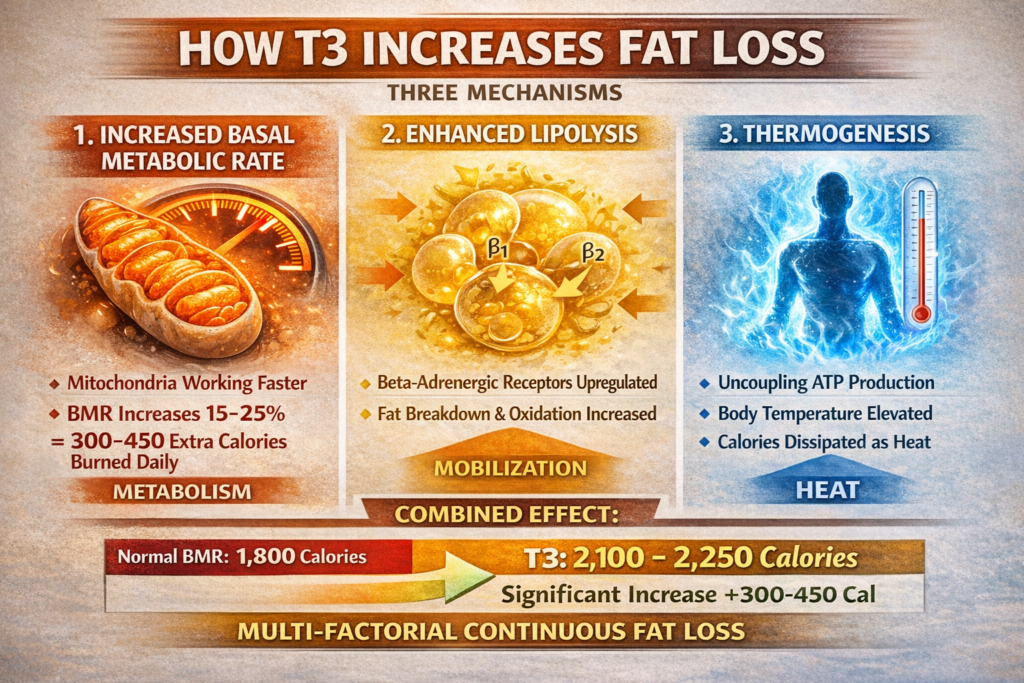
Mechanism 1: Increased Basal Metabolic Rate
The process:
- T3 enters cells and binds to nuclear receptors
- Triggers gene transcription
- Increases production of metabolic enzymes
- Mitochondria work harder and faster
- Cellular metabolism acceleration
The effect:
- Basal metabolic rate (BMR) increases 15-25%
- More calories burned at rest
- Happens 24/7 (even sleeping)
- Continuous elevated metabolism
The numbers:
- Normal BMR: 1800 calories/day (example)
- On T3: 2100-2250 calories/day (+15-25%)
- Extra 300-450 calories burned daily
- Significant caloric increase
Mechanism 2: Enhanced Lipolysis
The process:
- T3 increases sensitivity to catecholamines (adrenaline, noradrenaline)
- Beta-adrenergic receptors upregulated
- Fat breakdown (lipolysis) enhanced
- Synergistic fat mobilization
The result:
- Stored fat released into bloodstream more easily
- Fat oxidation (burning) increased
- Accelerated fat loss
Mechanism 3: Thermogenesis
The process:
- Increased mitochondrial activity generates heat
- Uncoupling of ATP production (some energy wasted as heat)
- Body temperature slightly elevated
- Heat production
The effect:
- More calories dissipated as heat
- Contributes to fat loss
- Energy waste (beneficial for fat loss)
The Combined Effect
Why T3 is so effective:
- Increases calories burned (BMR up)
- Increases fat mobilization (lipolysis)
- Increases heat production (thermogenesis)
- Works continuously
- Multi-factorial fat loss
The speed:
- Effects noticeable within days to 1-2 weeks
- Rapid fat loss (1-2+ lbs per week above diet alone)
- Fast-acting
Typical T3 Protocols
User-reported dosing (not medical recommendations).
Critical Disclaimer
Prescription medication:
- T3 (Cytomel) requires prescription
- Using without medical supervision is dangerous
- Illegal in many jurisdictions without prescription
- Controlled substance
No “safe” recreational use:
- Designed for hormone replacement in deficiency
- Not for performance enhancement
- All information anecdotal (user reports)
- Off-label abuse
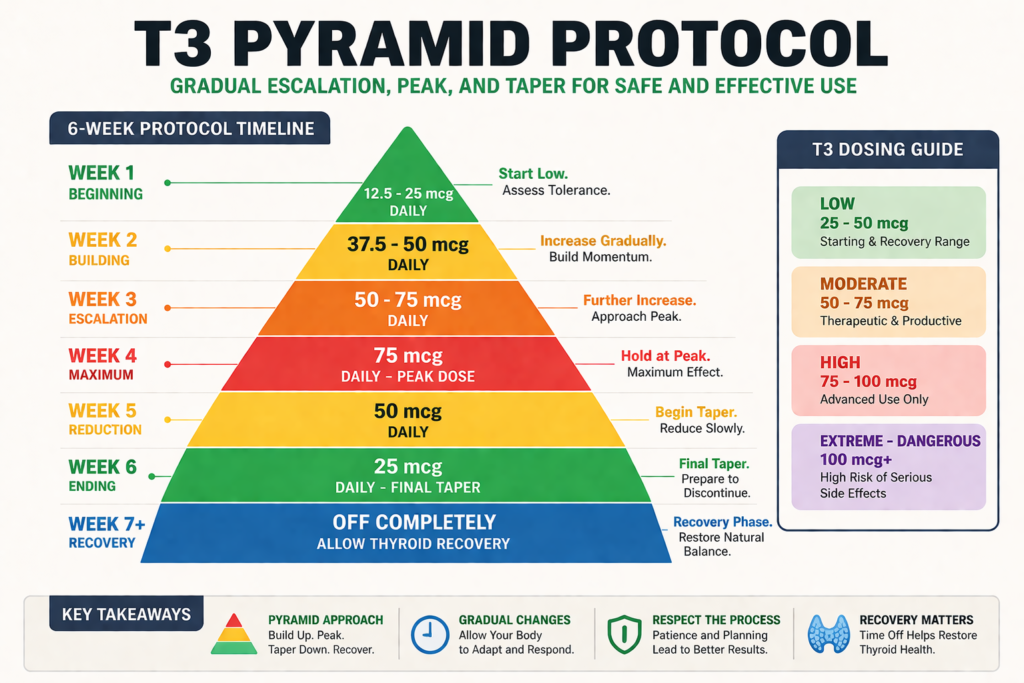
The Pyramid Protocol
Standard approach:
- Start low
- Increase gradually (pyramid up)
- Hold at peak
- Decrease gradually (taper down)
- Gradual escalation and reduction
Why pyramid:
- Minimize initial shock to system
- Allow thyroid suppression to occur gradually
- Tapering allows natural thyroid to restart
- Mitigation strategy
Example 6-Week Cycle
Week 1:
- Day 1-7: 12.5-25mcg daily
- Starting dose
Week 2:
- Day 8-14: 37.5-50mcg daily
- Increase
Week 3:
- Day 15-21: 50-75mcg daily
- Further increase
Week 4:
- Day 22-28: 75mcg daily (peak dose)
- Holding pattern
Week 5:
- Day 29-35: 50mcg daily
- Begin taper
Week 6:
- Day 36-42: 25mcg daily
- Final taper
Week 7+:
- Off completely
- Allow thyroid recovery
- Recovery period
Dosing Range (Anecdotal)
Low dose:
- 25-50mcg daily
- Minimal but noticeable fat loss
- Fewer side effects
- Conservative
Moderate dose:
- 50-75mcg daily
- Standard cutting dose
- Noticeable fat loss and side effects
- Typical
High dose:
- 75-100mcg daily
- Aggressive fat loss
- Severe side effects likely
- Aggressive (not recommended)
Extreme (dangerous):
- 100mcg+ daily
- Used by some competitors
- Very high side effect risk
- Not advisable
Timing and Splitting Doses
Half-life:
- T3 half-life: ~24 hours
- Once-daily dosing sufficient
- Single dose possible
The debate:
- Some split dose (half morning, half afternoon)
- May reduce side effects (heart rate spikes)
- May provide more stable levels
- No definitive answer
- Either approach used
Best practice:
- Morning dosing preferred (mimics natural cortisol rhythm)
- Empty stomach for absorption
- Consistent timing
- Optimization
Cycle Duration
Typical:
- 6-8 weeks maximum
- Shorter if side effects severe
- Limited duration
Why short:
- Thyroid suppression worsens over time
- Side effects accumulate
- Muscle loss risk increases
- Diminishing returns (body adapts)
- Self-limiting
Recovery time:
- Off-period should equal on-period (minimum)
- 6 weeks on = 6+ weeks off
- Thyroid recovery takes time
- Adequate break essential
Side Effects of T3
What to expect.
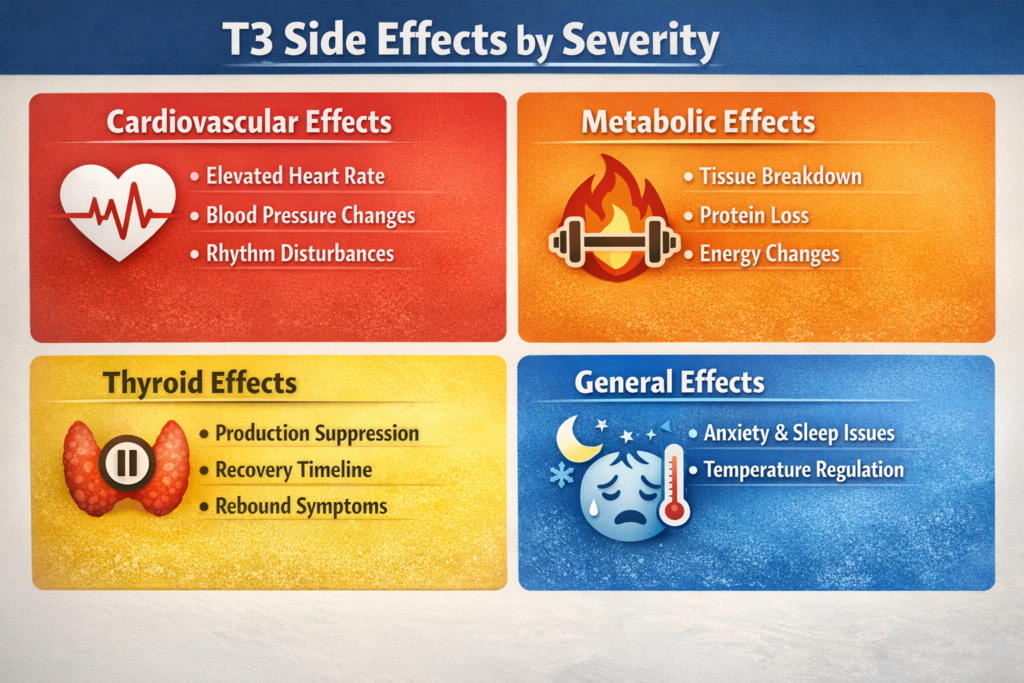
Cardiovascular Side Effects
Side Effect 1: Tachycardia (Elevated Heart Rate)
The mechanism:
- T3 increases cardiac contractility
- Heart beats faster and harder
- Direct cardiac stimulation
The numbers:
- Resting heart rate can increase 10-30 bpm
- Normal 60-70 bpm → 80-100 bpm
- Sustained elevation
The experience:
- Awareness of heartbeat
- Palpitations
- Discomfort
- Cardiac awareness
The risk:
- Cardiac strain
- Especially problematic during exercise
- Heart stress
Side Effect 2: Hypertension (High Blood Pressure)
The mechanism:
- Increased cardiac output
- Vasoconstriction possible
- Blood pressure elevation
The risk:
- Sustained hypertension damages arteries
- Stroke risk
- Heart attack risk
- Cardiovascular danger
Side Effect 3: Arrhythmias
The mechanism:
- Electrical conduction in heart affected
- T3 alters ion channel function
- Rhythm disturbances
The manifestation:
- Irregular heartbeat
- Atrial fibrillation possible
- Ventricular arrhythmias (rare but dangerous)
- Potentially serious
Side Effect 4: Cardiac Hypertrophy (Long-term)
The mechanism:
- Prolonged increased workload
- Heart muscle thickens (adaptation)
- Can become pathological
- Structural remodeling
The risk:
- Heart failure
- Reduced cardiac efficiency
- Long-term damage
Metabolic and Muscular Side Effects
Side Effect 5: Muscle Loss (Critical)
The mechanism:
- T3 increases protein catabolism (breakdown)
- Muscle protein used for energy (gluconeogenesis)
- Protein synthesis may decrease
- Catabolic to muscle
Why this occurs:
- T3 accelerates ALL metabolism (not just fat)
- Body doesn’t selectively burn only fat
- Muscle tissue broken down for amino acids
- Amino acids converted to glucose for energy
- Non-selective catabolism
The severity:
- Can lose significant muscle
- Even with high protein intake
- Even with resistance training
- Especially without anabolic steroids
- Serious concern for bodybuilders
The mitigation:
- High protein intake (1.5-2g/lb body weight)
- Resistance training (stimulates muscle retention)
- Anabolic steroids (many users stack with steroids to prevent muscle loss)
- Keep T3 dose moderate
- Damage control
The irony:
- Bodybuilders want fat loss, not muscle loss
- T3 causes both
- Must carefully balance
- Double-edged sword
Thyroid Suppression
Side Effect 6: Natural Thyroid Shutdown
The mechanism:
- Exogenous T3 detected by hypothalamus/pituitary
- Negative feedback activates
- TSH production suppressed
- Thyroid gland stops producing T3/T4
- Thyroid gland may atrophy slightly
- Complete suppression
The timeline:
- Suppression begins within days
- Complete shutdown within 2-4 weeks
- Rapid suppression
Recovery:
- After cessation, thyroid slowly restarts
- Can take 2-8 weeks (or longer)
- Some cases: Prolonged suppression (months)
- Rare cases: Permanent hypothyroidism
- Variable recovery
Post-cycle symptoms:
- Fatigue
- Weight gain (rebound effect)
- Depression
- Cold intolerance
- Low energy
- Hypothyroid symptoms
The rebound effect:
- Metabolism crashes below baseline temporarily
- Rapid fat gain possible
- Muscle loss continues
- Post-cycle crash
Other Side Effects
Side Effect 7: Anxiety and Nervousness
The mechanism:
- Sympathetic nervous system activation
- Increased catecholamine sensitivity
- CNS stimulation
The experience:
- Restlessness
- Jitteriness
- Anxiety
- Mental discomfort
Side Effect 8: Insomnia
The mechanism:
- Increased energy expenditure
- Elevated heart rate
- CNS stimulation
- Sleep disruption
The severity:
- Difficulty falling asleep
- Reduced sleep quality
- Chronic sleep deprivation
- Quality of life impact
Side Effect 9: Excessive Sweating
The mechanism:
- Increased thermogenesis
- Body temperature slightly elevated
- Thermoregulation through sweating
- Heat dissipation
The experience:
- Sweating more than usual
- Night sweats
- Discomfort
- Perspiration increase
Side Effect 10: Tremors
The mechanism:
- Increased beta-adrenergic activity
- Neuromuscular effects
- Motor symptoms
The experience:
- Hand tremors (fine tremor)
- Similar to caffeine overdose
- Shaking
Side Effect 11: Headaches
The mechanism:
- Vascular effects
- Increased blood pressure
- Cephalgia
Side Effect 12: Increased Bowel Motility
The mechanism:
- T3 affects GI tract motility
- Increases intestinal contractions
- GI stimulation
The result:
- More frequent bowel movements
- Diarrhea possible
- Digestive changes
Side Effect 13: Menstrual Irregularities (Women)
The mechanism:
- Thyroid hormones affect reproductive hormones
- HPO axis disruption
- Hormonal imbalance
The manifestation:
- Irregular periods
- Amenorrhea (absence of period)
- Cycle disruption
Overdose Risk
The danger:
- Unlike steroids (chronic harm), T3 overdose can cause acute crisis
- Thyrotoxicosis (thyroid storm)
- Medical emergency
- Acute toxicity possible
Symptoms of overdose:
- Severe tachycardia (heart rate 120-150+ bpm)
- High fever
- Agitation, confusion
- Chest pain
- Seizures
- Medical emergency
The treatment:
- Hospitalization
- Beta-blockers (reduce heart rate)
- Supportive care
- No specific antidote
- Requires emergency care
The Muscle Loss Problem
Why T3 is problematic for bodybuilders.
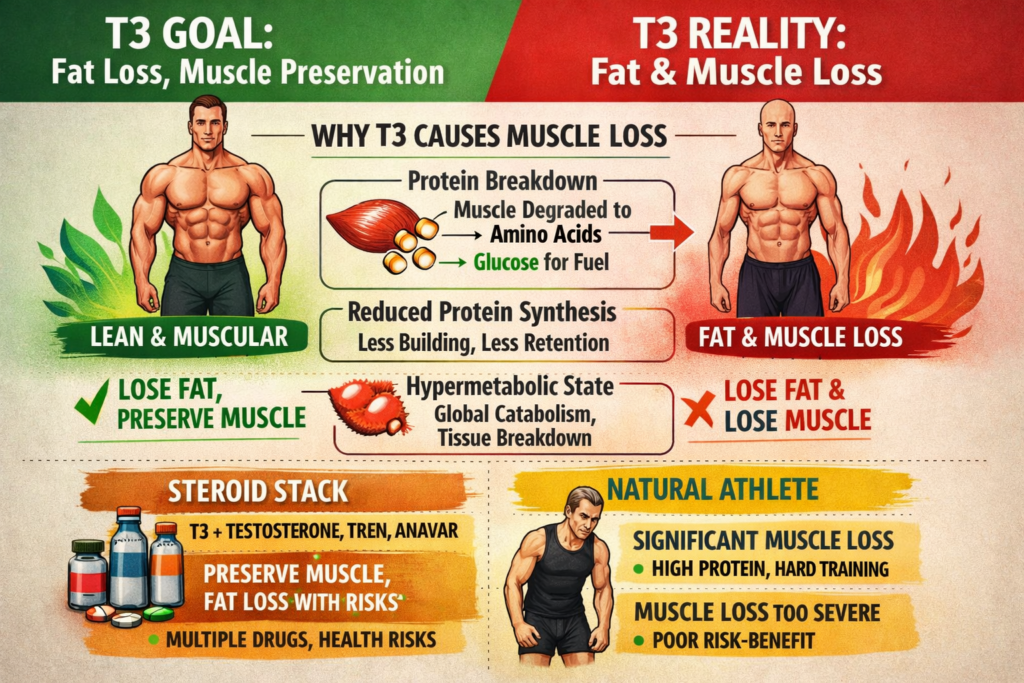
The Fundamental Issue
The goal:
- Lose fat
- Preserve muscle
- Achieve lean, muscular physique
- Selective catabolism desired
The T3 reality:
- Loses fat AND muscle
- Non-selective catabolism
- Indiscriminate tissue loss
The dilemma:
- Effective fat burner
- But also effective muscle burner
- Trade-off
Why T3 Causes Muscle Loss
Mechanism 1: Protein catabolism
- T3 increases protein breakdown throughout body
- Muscle protein degraded to amino acids
- Amino acids converted to glucose (gluconeogenesis)
- Muscle used for fuel
Mechanism 2: Reduced protein synthesis
- Anabolic processes may be suppressed
- Less muscle building
- Reduced muscle retention signal
Mechanism 3: Hypermetabolic state
- Body in constant energy deficit (burning more than consuming)
- All tissues catabolized for energy
- Muscle not spared
- Global catabolism
The Steroid Solution
Why bodybuilders stack T3 with steroids:
- Anabolic steroids preserve muscle mass
- Counter T3’s catabolic effects
- Allow fat loss while maintaining muscle
- Synergistic use
Common stacks:
- T3 + testosterone (200-500mg/week)
- T3 + trenbolone (muscle-sparing)
- T3 + anavar or winstrol (cutting)
- Multi-drug approach
The problem:
- Now using multiple drugs
- Compounding side effects
- Health risks multiply
- Complexity and danger increase
Without Steroids
For natural athletes:
- T3 causes significant muscle loss
- High protein and training help but don’t prevent
- Risk-benefit poor
- Not recommended
The verdict:
- T3 unsuitable for drug-free athletes
- Muscle loss too severe
- Better alternatives exist
- Avoid if natural
T3 vs. Other Fat Loss Methods
Comparison.
T3 vs. Clenbuterol
Clenbuterol:
- Beta-2 agonist
- Increases metabolic rate ~10%
- Muscle-sparing (slight anabolic effect)
- Side effects: Tremors, cramps, insomnia, tachycardia
- No hormonal suppression
- Alternative stimulant
T3:
- Thyroid hormone
- Increases metabolic rate 15-25%
- Muscle-wasting (catabolic)
- Side effects: All of above plus thyroid suppression, muscle loss
- Hormonal suppression (thyroid)
- More powerful, more dangerous
The comparison:
- T3 more effective for fat loss
- But also more muscle loss and thyroid suppression
- Clenbuterol safer overall
- Trade-offs
T3 vs. DNP
DNP:
- Mitochondrial uncoupler
- Increases metabolic rate 20-30%+
- Extremely dangerous (can be lethal)
- Most dangerous option
T3:
- Less dangerous than DNP (low bar)
- More controllable
- Still significant risks
- Safer than DNP (relatively)
T3 vs. Diet and Cardio
Natural methods:
- Caloric deficit through diet
- Cardiovascular exercise
- Fat loss: 1-2 lbs per week sustainable
- No side effects (healthy)
- Muscle preserved or gained
- Safe and effective
T3:
- Faster fat loss possible (2-3+ lbs weekly)
- Multiple severe side effects
- Muscle loss risk
- Thyroid suppression
- Fast but risky
The verdict:
- Natural methods superior for most people
- T3 only for specific contexts (competitive bodybuilding)
- Speed not worth health cost for recreational users
- Natural preferred
Recovery and PCT
Post-cycle thyroid recovery.
The Recovery Process
Timeline:
- Weeks 1-2 post-T3: Thyroid still suppressed, low energy, rebound weight gain
- Weeks 3-4: TSH begins rising, thyroid slowly restarting
- Weeks 5-8: Thyroid function normalizing (for most)
- Some cases: Months for full recovery
- Variable recovery
Factors affecting recovery:
- Dose used (higher = longer suppression)
- Duration of use (longer = longer recovery)
- Individual variation
- Dose and time dependent
No True PCT Exists
The problem:
- Unlike steroids (where SERMs restart natural testosterone)
- No drugs effectively restart thyroid quickly
- No PCT drugs
The approach:
- Tapering (gradual dose reduction)
- Allows thyroid to slowly resume function
- Natural recovery only
Supportive measures:
- Adequate iodine intake (thyroid needs iodine)
- Selenium supplementation
- Avoid caloric restriction (allows metabolic recovery)
- Patience
- Supportive only
When to Seek Medical Help
Concerning signs:
- Prolonged hypothyroid symptoms (>8 weeks post-cycle)
- Severe fatigue
- Massive weight gain
- Depression
- Persistent issues
Medical intervention:
- Bloodwork (TSH, free T3, free T4)
- May require temporary thyroid medication
- Endocrinologist consultation
- Professional help
The Honest Recommendation
Evidence-based guidance.
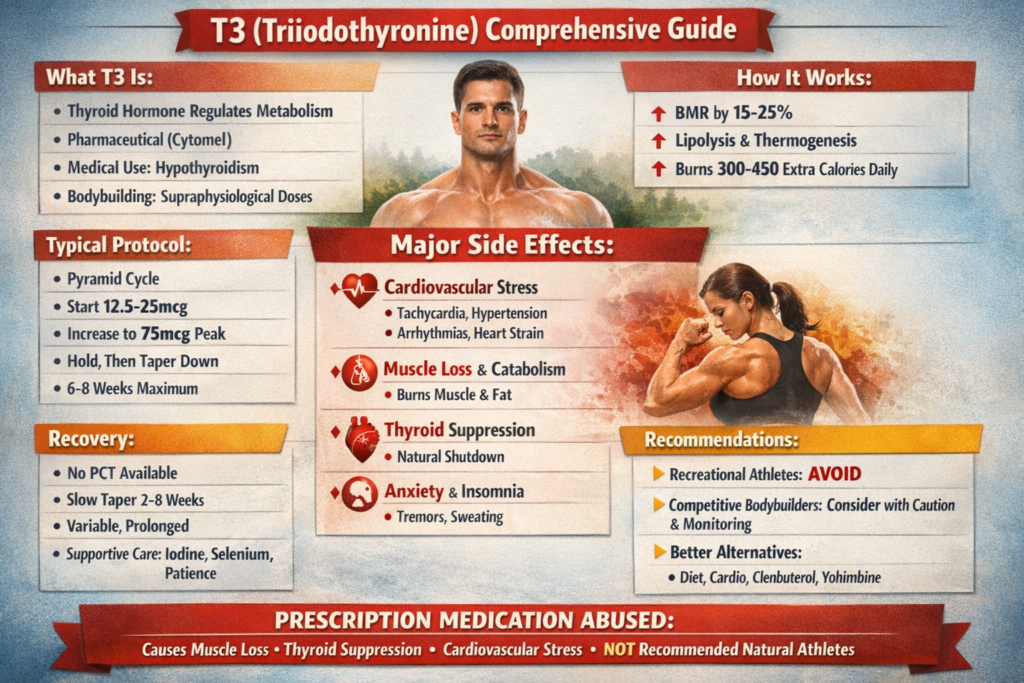
For Recreational Athletes
Avoid T3:
- Risks outweigh benefits
- Muscle loss unacceptable
- Thyroid suppression problematic
- Natural methods effective
- Not worth it
For Competitive Bodybuilders
Consider carefully:
- Understand risks completely
- Only with steroid stack (muscle preservation)
- Medical monitoring (bloodwork)
- Contest prep only (specific goal)
- Informed decision
If using:
- Start lowest effective dose
- Monitor heart rate and blood pressure daily
- High protein intake (2g/lb minimum)
- Continue resistance training
- Limit duration (6-8 weeks maximum)
- Harm reduction
Better Alternatives
For most people:
- Optimize diet (caloric deficit, high protein)
- Increase cardio
- Patience (sustainable fat loss)
- Natural methods
For those wanting pharmacological assistance:
- Clenbuterol (if legal in region)
- Yohimbine
- ECA stack (ephedrine, caffeine, aspirin – where legal)
- All safer than T3
- Alternatives
This article is informational only. We do not condone or recommend T3 abuse. T3 is prescription medication for treating hypothyroidism, not for performance enhancement. Using T3 for fat loss causes muscle loss, thyroid suppression, cardiovascular stress, and other serious side effects. If considering any fat loss strategy, consult qualified medical professionals and prioritize safe, sustainable methods.
REFERENCES
SECTION 1 — Mechanism: thermogenesis, metabolic rate, and mitochondrial activity
[1] Silva JE — PubMed/Endocrine Reviews, 1995 Comprehensive review of T3’s thermogenic mechanism; T3 stimulates both the production and consumption of energy within cells, increasing oxygen consumption through parallel effects on mitochondrial structure and composition, and on lipid, carbohydrate, and protein metabolism; T3 may also increase the proton permeability of the inner mitochondrial membrane, partially uncoupling energy production and releasing energy as heat rather than ATP; these thermogenic effects are restricted to homeothermic animals, representing a coordinated response to temperature maintenance; establishes the mechanistic basis for the article’s description of how supraphysiological T3 elevates BMR 15 to 25% through mitochondrial activation and thermogenesis https://pubmed.ncbi.nlm.nih.gov/8527221/
SECTION 2 — T3 muscle catabolism and lean tissue loss
[2] Burman KD et al. — PubMed/Metabolism, 1986 Metabolic balance study in ten obese patients during caloric restriction treated with T3 (0.36 to 1.01 micrograms/kg/day); mean weight loss increased by 92 g/day during T3 therapy; T3 significantly increased resting energy expenditure and sleeping heart rate; nitrogen loss remained significantly elevated even in the fourth week of treatment when fat loss had returned to pre-treatment rates; the researchers concluded that prolonged T3 treatment produces significant lean tissue losses beyond those caused by caloric restriction alone; provides direct human evidence for the article’s central warning that T3 catabolizes muscle as well as fat https://pubmed.ncbi.nlm.nih.gov/3830935/
[3] Salvatore D et al. — PMC/Metabolites, 2021 Review of thyroid hormone action in skeletal muscle atrophy; skeletal muscle is among the primary T3 target tissues, with T3 regulating proliferation, metabolism, differentiation, and growth; under physiological conditions T3 stimulates both protein synthesis and degradation, but at supraphysiological levels the catabolic action predominates, shifting the protein balance toward breakdown via the ubiquitin-proteasome system and autophagy-lysosome pathways; hyperthyroidism increases urinary nitrogen and methylhistidine excretion, indicating reduced protein stores from increased muscle catabolism; amino acids released from muscle serve as substrates for hepatic gluconeogenesis; directly maps the molecular pathways by which supraphysiological T3 causes the muscle wasting the article describes https://pmc.ncbi.nlm.nih.gov/articles/PMC8625289/
SECTION 3 — Cardiovascular effects of supraphysiological T3
[4] Jabbar A et al. — PMC/Cureus, 2025 Clinical review of T3-containing thyroid hormone therapies; T3 boosts energy production by increasing mitochondrial number and activity; supraphysiological T3 doses may transiently increase heart rate, enhance myocardial oxygen demand, and predispose to arrhythmias including atrial fibrillation; T3’s rapid onset of action (half-life approximately 24 hours) and higher potency compared to T4 create pulsatile serum peaks after oral dosing; these cardiovascular risks are especially relevant in patients with pre-existing heart disease or older adults; also notes that exogenous thyroid hormone suppression therapy is associated with osteoporosis and fracture risk at TSH levels below 0.03 mIU/L; consolidates the cardiovascular risk profile for T3 described in the article’s side effects section https://pmc.ncbi.nlm.nih.gov/articles/PMC12370163/
SECTION 4 — HPT axis suppression: the negative feedback mechanism
[5] Fekete C & Lechan RM — PMC/Endocrine Reviews, 2014 Mechanistic review of the hypothalamic-pituitary-thyroid axis negative feedback regulation; hypophysiotropic TRH neurons in the hypothalamic paraventricular nucleus are the central regulators of the HPT axis; elevated circulating T3 inhibits TRH synthesis at the transcriptional level and suppresses TSH subunit gene expression in pituitary thyrotrophs; exogenous T3 or T4 administration triggers the same negative feedback as endogenous hormone, suppressing both TRH and TSH production within days; provides the endocrine physiology underlying the article’s explanation of why exogenous T3 shuts down the thyroid gland’s natural hormone production and why post-cycle hypothyroid symptoms occur https://pmc.ncbi.nlm.nih.gov/articles/PMC2000455/
[6] Ross DS et al. — PubMed/Journal of Clinical Endocrinology and Metabolism, 2023 Clinical review of the approach to suppressed TSH, covering exogenous etiologies including thyroid hormone use for athletic performance enhancement; in patients with cardiovascular disease, severe TSH suppression (below 0.1 mIU/L) is associated with increased risk of sinus tachycardia, premature atrial and ventricular beats, diastolic dysfunction, and atrial fibrillation; the Framingham database cohort showed a 32% risk of atrial fibrillation over 10 years in patients with TSH below 0.1 mU/L versus 8% in those with normal TSH; exogenous thyroid hormone suppression is also linked to increased osteoporotic fracture risk; explicitly identifies athletic performance enhancement as a recognized exogenous cause of TSH suppression and documents associated cardiovascular risks https://academic.oup.com/jcem/article/108/2/472/6795451







Leave a Reply
You must be logged in to post a comment.