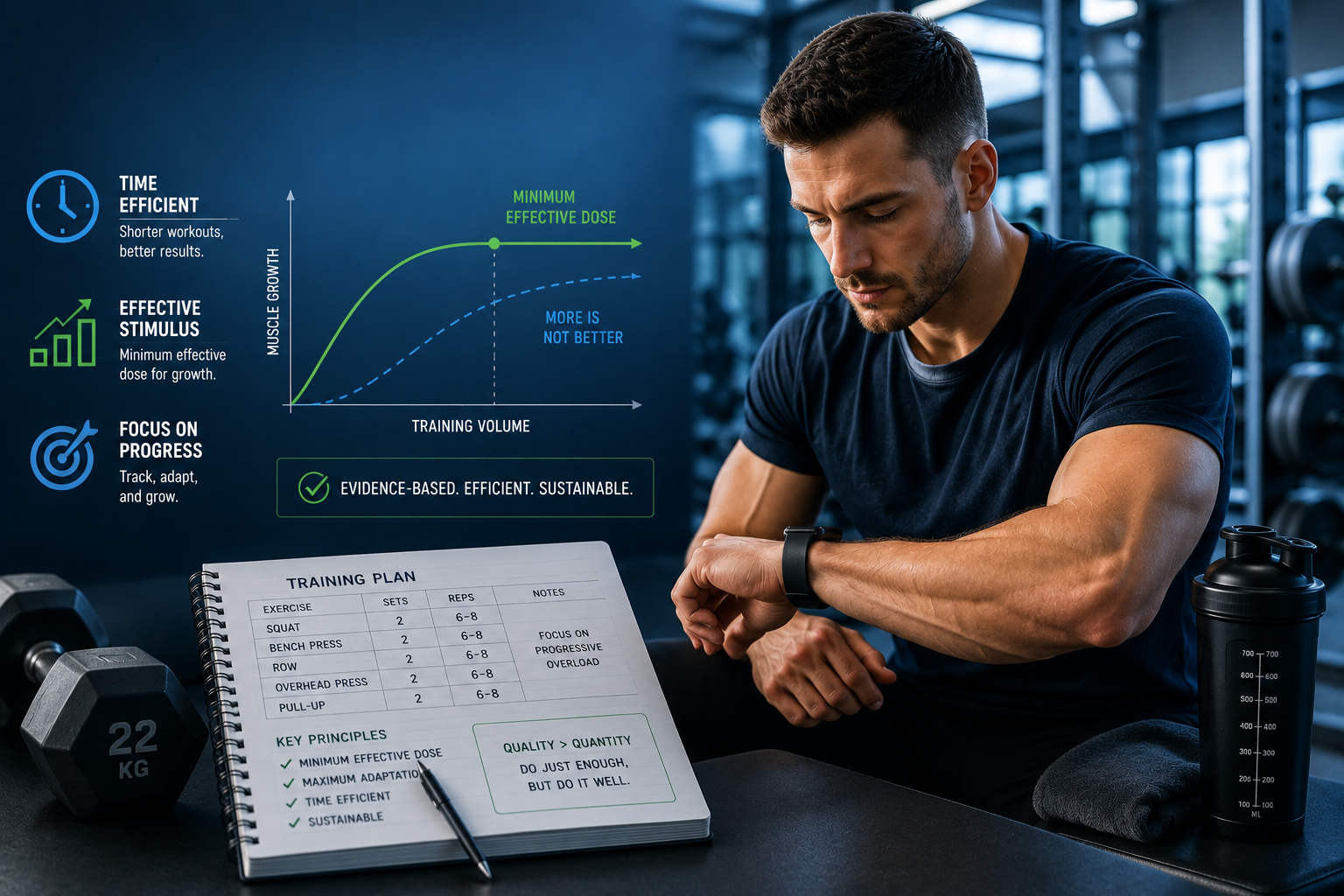
You’re busy. You have a job, family, social life, and a million other commitments. You want to build muscle, but you don’t have hours to spend in the gym every day. So here’s the question that’s probably been on your mind: what’s the absolute minimum amount of training you can do and still see real muscle growth?
The minimum effective dose for muscle growth is surprisingly low – you can build muscle with just 2-3 training sessions per week, 45-60 minutes each, training each muscle group 2x weekly with 10-20 sets per muscle group per week. However, this approach maximizes efficiency, not results. More training volume (up to a point) builds more muscle, but there are massive diminishing returns beyond the minimum threshold.
For people with limited time, understanding the minimum effective dose is liberating. You don’t need to live in the gym to build an impressive physique. But you also need to understand what you’re trading off – training at the minimum dose builds muscle, just not as quickly as higher volumes would.
In this comprehensive guide, I’ll explain exactly what the minimum effective dose for muscle growth is, the science behind why it works, how to structure your training to maximize results with minimal time investment, when doing the bare minimum makes sense (and when it doesn’t), and how to progress from minimum dose to optimal dose as your schedule allows.
Whether you’re a busy professional trying to stay in shape, a parent with limited free time, or someone just starting out who wants to know the essential basics, understanding the minimum effective dose will help you build muscle efficiently without wasting time on unnecessary training volume.
Let’s cut through the noise and find out exactly how little you can train while still making real progress.
TABLE OF CONTENTS
What Is the Minimum Effective Dose for Muscle Growth?
The concept of “minimum effective dose” comes from medicine – it’s the smallest dose of a medication that produces the desired therapeutic effect. Apply this to training, and you get: what’s the least amount of exercise you can do and still trigger meaningful muscle growth?
The Research-Based Answer
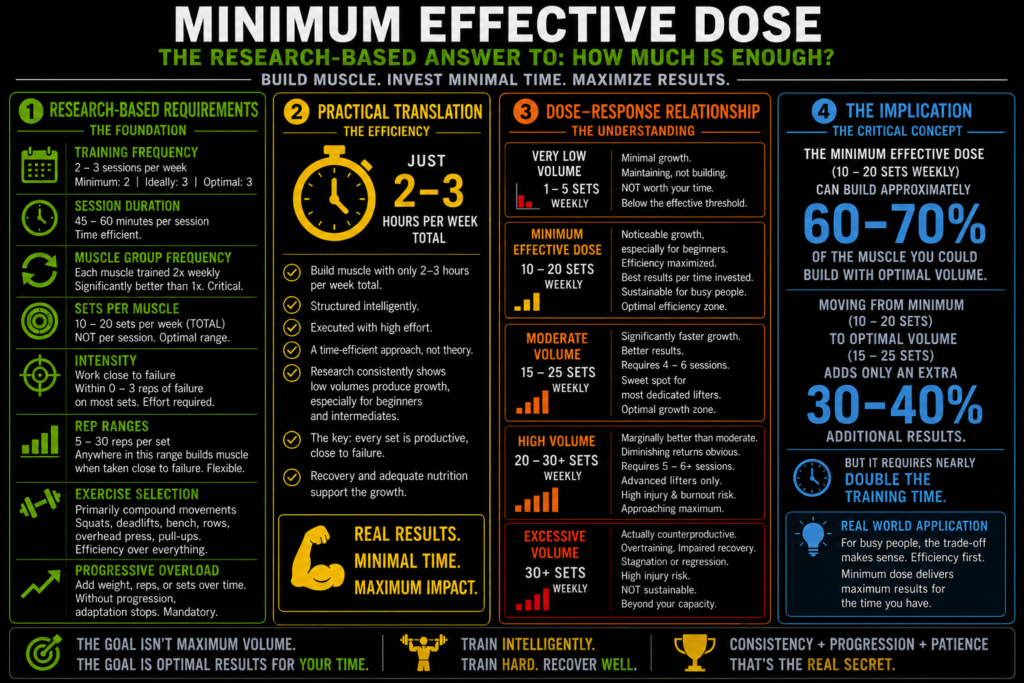
Based on current scientific literature and real-world application, the minimum effective dose for muscle growth includes:
Training frequency: 2-3 sessions per week (minimum 2, ideally 3)
Session duration: 45-60 minutes per session
Muscle group frequency: Each muscle group trained 2x per week (significantly better than 1x)
Sets per muscle group: 10-20 sets per week total (not per session)
Intensity: Working close to failure (within 0-3 reps of failure) on most sets
Rep ranges: 5-30 reps per set (anywhere in this range builds muscle when taken close to failure)
Exercise selection: Primarily compound movements (squats, deadlifts, bench press, rows, overhead press, pull-ups)
Progressive overload: Adding weight, reps, or sets over time (without progression, adaptation stops)
The practical translation: You can build muscle training just 2-3 hours per week total if that training is structured intelligently and executed with high effort.
This isn’t theory – research consistently shows that relatively low training volumes can produce muscle growth, especially in beginners and intermediates. The key is that every set must be productive (taken close to failure), recovery must be adequate, and nutrition must support growth.
What “Minimum Effective Dose” Actually Means
Let’s be crystal clear about what we’re discussing:
Minimum effective dose means:
- The least training volume that triggers muscle protein synthesis and adaptation
- Enough stimulus to cause measurable muscle growth over weeks and months
- The threshold below which you’re wasting your time (no meaningful results)
- An efficiency-focused approach for time-constrained individuals
Minimum effective dose does NOT mean:
- The optimal amount of training for maximum muscle growth (that’s higher)
- The fastest way to build muscle (more volume builds muscle faster, up to a point)
- What advanced bodybuilders do (they train far beyond minimum dose)
- A long-term strategy for maximizing your genetic potential (though it can be a starting point)
Think of it this way: If building muscle was like filling a bathtub, the minimum effective dose is the smallest trickle of water that eventually fills the tub. Yes, it fills up. But a larger stream (more volume) fills it faster. And at some point, opening the faucet wider doesn’t speed things up because the drain can’t handle it (recovery limitations).
The Dose-Response Relationship
Understanding how muscle responds to training volume helps clarify why minimum dose works but isn’t optimal.
Very low volume (below minimum dose):
- 1-5 sets per muscle group weekly
- Minimal muscle growth
- Mostly just maintaining existing muscle
- Not worth the time investment
Minimum effective dose:
- 10-20 sets per muscle group weekly
- Noticeable muscle growth (especially for beginners)
- Efficiency maximized (best results per time invested)
- Sustainable long-term for busy people
Moderate volume (optimal for most):
- 15-25 sets per muscle group weekly
- Significantly faster muscle growth
- Better results than minimum dose
- Requires 4-6 training sessions weekly
- Sweet spot for most dedicated lifters
High volume (approaching maximum recoverable):
- 20-30+ sets per muscle group weekly
- Marginally better results than moderate volume
- Diminishing returns become obvious
- Requires 5-6+ sessions weekly
- Only beneficial for advanced lifters
- High injury and burnout risk
Excessive volume (beyond recovery capacity):
- 30+ sets per muscle group weekly
- Actually counterproductive (overtraining)
- Impaired recovery leads to stagnation or regression
- High injury risk
- Not sustainable
The practical implication: Minimum dose (10-20 sets per muscle per week) might build 60-70% of the muscle you’d build with optimal volume (15-25 sets). That extra 30-40% of results requires nearly double the training time. For busy people, this trade-off makes sense.
Why Minimum Dose Works
You don’t need massive training volume to trigger muscle protein synthesis and adaptation. Here’s why minimal training can still build muscle:
Muscle protein synthesis (MPS) activation:
- A single set taken close to failure activates MPS for 24-48 hours
- Additional sets extend this window but don’t dramatically amplify it
- The first few hard sets per muscle group provide the majority of the growth stimulus
- Sets 1-5 per muscle per session are highly productive
- Sets 6-10+ have progressively less impact
Mechanical tension is the primary driver:
- Muscle growth primarily responds to mechanical tension (heavy loads on muscle fibers)
- You create high tension with just a few hard sets of compound exercises
- More sets create more total tension, but diminishing returns apply
Recovery capacity matters:
- Your body can only recover from so much training stress
- If you’re only training 10-20 sets per muscle weekly, recovery is almost never an issue
- Better recovery means each session is more productive
- Minimum dose keeps you fresh and progressing
Frequency compensates for low volume:
- Training each muscle 2x weekly with lower volume per session
- Provides two separate MPS spikes per week
- Superior to training once weekly with double the volume
- Allows you to maintain intensity and quality on every set
The Time Investment Reality
Let’s break down exactly how little time minimum effective dose requires:
Sample minimum dose full-body routine (3x weekly):
Session structure:
- Compound lower body: 3 sets (squat or deadlift variation)
- Compound horizontal push: 3 sets (bench press variation)
- Compound vertical pull: 3 sets (pull-up or lat pulldown)
- Compound horizontal pull: 2 sets (row variation)
- Compound vertical push: 2 sets (overhead press)
- Accessory arm work: 2 sets (optional)
Time breakdown:
- Warm-up: 5-10 minutes
- Working sets: 30-40 minutes (15 sets × 2-3 minutes per set including rest)
- Cool-down/stretch: 5 minutes
- Total: 45-55 minutes
Weekly commitment: 3 sessions × 50 minutes = 2.5 hours weekly
That’s it. Less time than most people spend scrolling social media daily, yet it’s enough to build noticeable muscle over months.
What Results Look Like at Minimum Dose
Let’s set realistic expectations for what minimum effective dose training achieves:
Beginners (first 6-12 months):
- Can build 8-15 pounds of muscle in first year with minimum dose
- Close to what they’d achieve with higher volume (newbie gains are robust)
- Strength increases of 50-100%+ on major lifts
- Dramatic physique transformation despite minimal time investment
Intermediates (1-3 years training):
- Can build 4-8 pounds of muscle yearly with minimum dose
- This is 60-70% of what optimal volume would produce
- Continued steady progress but slower than higher volume
- Maintenance of muscle becomes easier over time
Advanced (3+ years training):
- Can build 2-4 pounds of muscle yearly with minimum dose
- Significantly less than optimal volume would produce (maybe 40-50%)
- Progress becomes very slow
- More of a maintenance approach than growth-focused
The honest assessment: Minimum dose training absolutely works, especially for beginners. But as you advance, the gap between minimum and optimal widens. Eventually, most people either increase volume to keep progressing or accept slower gains in exchange for time efficiency.
When Minimum Dose Makes Sense
Minimum effective dose training is ideal for:
Time-constrained individuals:
- Busy professionals working 50-60+ hours weekly
- Parents with young children and limited personal time
- Students balancing academics, work, and social life
- Anyone with multiple demanding commitments
Beginners building consistency:
- New to training and overwhelmed by complex programs
- Need to establish the habit before increasing volume
- Want to avoid burnout from doing too much too soon
- Learning proper exercise technique with limited exercises
Injury recovery or limitations:
- Recovering from injury and can’t handle high volume
- Managing chronic conditions requiring reduced training stress
- Older adults needing longer recovery between sessions
- Those with physically demanding jobs (construction, nursing, etc.)
Maintenance phases:
- Achieved desired physique and want to maintain it
- Taking a mental break from intense training
- Traveling frequently and need minimal gym time
- During stressful life periods (moving, job changes, relationship issues)
Those who hate training:
- Recognize the importance of resistance training but don’t enjoy it
- Want minimum viable fitness without it dominating their life
- Prefer spending time on other activities (sports, hobbies, family)
- View training as medicine (necessary but not pleasurable)
When Minimum Dose Doesn’t Make Sense
Minimum effective dose is NOT ideal for:
Competitive athletes or physique competitors:
- Bodybuilders, powerlifters, CrossFit athletes
- Need to maximize muscular development
- Competition requires pushing closer to genetic limits
- Time investment is part of the sport
Those with specific ambitious goals:
- Want to build 40+ pounds of muscle
- Trying to reach genetic muscular potential
- Have specific strength goals requiring high volume
- Preparing for a transformation (wedding, reunion, photo shoot)
People who genuinely love training:
- Find training therapeutic and enjoyable
- Use gym time as stress relief and meditation
- Prefer spending 60-90 minutes in the gym
- Training is their primary hobby
Those who’ve plateaued at minimum dose:
- Been training minimum volume for 12+ months
- Progress has completely stalled
- Need to increase stimulus to continue adapting
- Ready to commit more time to training
The key is being honest with yourself about your goals, priorities, and what you’re willing to sacrifice to achieve your physique aspirations.
The Science Behind Minimum Effective Dose Training
Understanding why minimum dose works requires diving into the physiology of muscle growth. Don’t worry – I’ll keep this practical and applicable, not overly academic.
Muscle Protein Synthesis: The Foundation
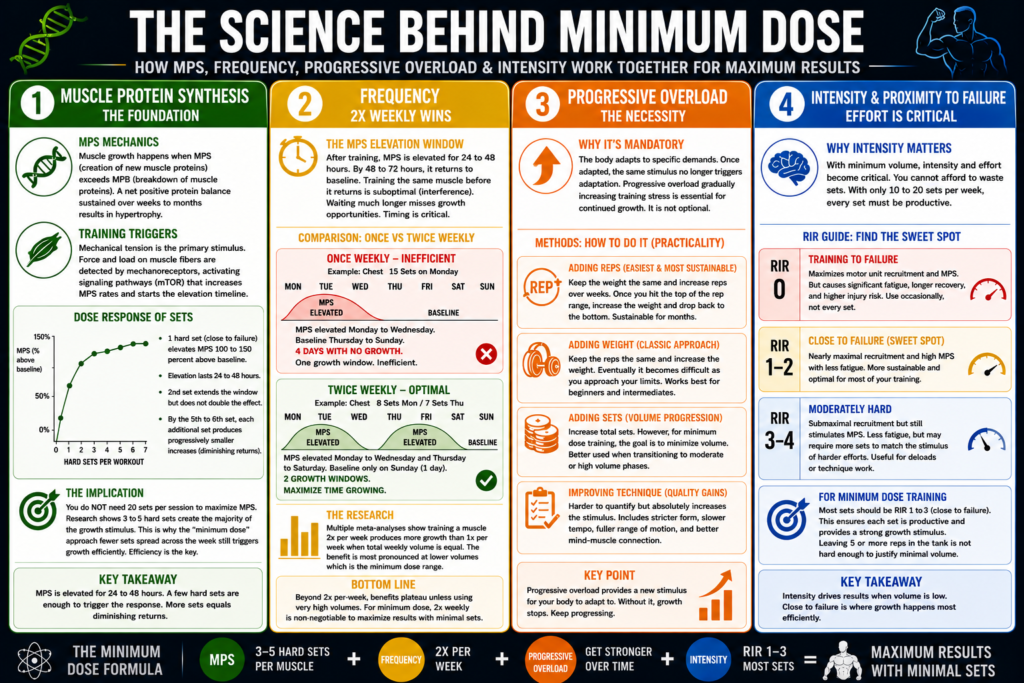
Muscle growth happens when muscle protein synthesis (MPS) – the creation of new muscle proteins – exceeds muscle protein breakdown (MPB) over time. This net positive protein balance, sustained over weeks and months, results in muscle hypertrophy (growth).
How training triggers MPS:
Mechanical tension is the primary stimulus:
- When you lift weights, muscle fibers experience mechanical tension (force/load)
- This tension is detected by mechanoreceptors in muscle cells
- These receptors activate signaling pathways (primarily mTOR pathway)
- mTOR activation increases muscle protein synthesis rates
The dose-response for individual sets:
- One hard set (close to failure) elevates MPS by approximately 100-150% above baseline
- This elevation lasts 24-48 hours (depending on training status)
- A second set to the same muscle group extends this window but doesn’t double the effect
- By the 5th-6th set, each additional set provides progressively smaller MPS increases
The practical implication:
- You don’t need 20 sets per muscle per session to maximize MPS
- 3-5 hard sets create the majority of the growth stimulus
- This is why minimum dose (fewer sets, spread across the week) still triggers muscle growth
Frequency: Why Training Each Muscle 2x Weekly Works
One of the most important findings in recent training research is that training frequency matters more than previously thought, especially when working with lower total volumes.
The MPS elevation window:
- After a training session, MPS remains elevated for 24-48 hours (trained individuals have shorter windows than beginners)
- By 48-72 hours post-training, MPS has returned to baseline
- Training the same muscle again before MPS returns to baseline is suboptimal (interference with recovery)
- But waiting much longer than 72 hours means missed growth opportunities
Why 2x weekly beats 1x weekly:
Once weekly approach:
- Train chest Monday with 15 sets
- MPS elevated Monday evening through Wednesday
- MPS at baseline Thursday through Sunday (4 days of no growth stimulus)
- Only one growth window per week
Twice weekly approach:
- Train chest Monday with 8 sets
- MPS elevated Monday evening through Wednesday
- Train chest again Thursday with 7 sets
- MPS elevated Thursday evening through Saturday
- MPS at baseline only Sunday (1 day)
- Two separate growth windows per week
The research evidence:
- Multiple meta-analyses show 2x weekly frequency produces more muscle growth than 1x weekly when total volume is equal
- The benefit is most pronounced at lower total weekly volumes (like minimum dose range)
- Beyond 2x weekly (training 3x, 4x, 5x weekly), benefits plateau unless you’re doing very high total volumes
For minimum dose training: 2x weekly frequency is non-negotiable. It’s how you maximize results with minimal total sets. Three times weekly is even better if your schedule allows, but the jump from 1x to 2x provides the largest benefit.
Progressive Overload: The Necessity for Continued Adaptation
Your body adapts to the specific demands you place on it. Once you’ve adapted to a training stimulus, that stimulus no longer triggers further adaptation. This is why progressive overload – gradually increasing the training stress over time – is essential for continued muscle growth.
Methods of progressive overload (in order of practicality for minimum dose training):
1. Adding reps (easiest and most sustainable):
- Keep the weight the same, increase reps over weeks
- Example: Week 1: 3 sets × 8 reps with 185 lbs → Week 4: 3 sets × 12 reps with 185 lbs
- Once you hit top of rep range (e.g., 12 reps), increase weight and drop back to bottom of range (8 reps)
- Sustainable progression method that works for months
2. Adding weight (classic method):
- Keep reps the same, increase weight over weeks
- Example: Week 1: 3 sets × 10 reps with 135 lbs → Week 4: 3 sets × 10 reps with 145 lbs
- Eventually becomes difficult as you approach strength limits
- Works better for beginners than advanced lifters
3. Adding sets (volume progression):
- Keep weight and reps the same, increase sets
- Example: Week 1: 2 sets × 10 reps → Week 6: 4 sets × 10 reps
- Useful but limited for minimum dose training (by definition, you’re trying to minimize volume)
- Better for transitioning from minimum to moderate volume
4. Improving technique and tempo (quality progression):
- Lift the same weight for same reps but with stricter form, slower tempo, or fuller range of motion
- Harder to quantify but definitely increases stimulus
- Example: Bench press touching chest vs. stopping 2 inches short creates more tension
For minimum dose training: Focus primarily on rep progression within a range (e.g., 8-12 reps), then increase weight when you hit the top of the range. This provides clear, measurable progress without requiring more time in the gym.
The minimum viable progression:
- If you can add 5 lbs to a lift every 4-6 weeks, you’re progressing
- If you can add 1-2 reps to your sets every 2-3 weeks, you’re progressing
- Progression doesn’t need to be rapid; it just needs to exist
- Even small improvements compound over months and years
Intensity: Why Proximity to Failure Matters
When training with minimum volume, intensity of effort becomes critical. You can’t afford to waste sets with half-hearted effort because you’re only doing 10-20 sets per muscle weekly.
Defining proximity to failure:
- Reps in Reserve (RIR): How many more reps you could do before failure
- RIR 0 = complete failure (can’t complete another rep)
- RIR 1 = could do 1 more rep
- RIR 2 = could do 2 more reps
- RIR 3+ = multiple reps left in the tank
The research on proximity to failure and muscle growth:
Training to failure (RIR 0):
- Maximizes muscle fiber recruitment and MPS per set
- Creates significant fatigue and requires longer recovery
- Higher injury risk if technique breaks down
- Useful occasionally but not necessary on every set
Training close to failure (RIR 1-2):
- Nearly maximal muscle fiber recruitment and MPS
- Less systemic fatigue than training to failure
- Sustainable set-to-set and week-to-week
- Optimal for most training
Training moderately hard (RIR 3-4):
- Submaximal muscle fiber recruitment
- Still triggers MPS but less than RIR 1-2
- Might need more sets to match the stimulus of fewer harder sets
- Useful for deload weeks or technique practice
Training easy (RIR 5+):
- Minimal muscle fiber recruitment
- Little to no muscle growth stimulus
- Essentially a warm-up or active recovery
- Wasted sets if the goal is muscle growth
For minimum dose training: Most sets should be RIR 1-3 (close to failure). Since you’re only doing a few sets per muscle per session, each set must be productive. Leaving 5+ reps in reserve means you’re not training hard enough to justify the minimal volume.
The practical execution:
- Warm up properly to avoid injury
- Working sets should feel challenging by the last 2-3 reps
- Last rep should be slow and difficult but still good form
- If you finish a set and think “I could’ve done 5 more reps easily,” you didn’t train hard enough
Exercise Selection: Compound Movements Are King
When you only have time for 10-20 sets per muscle weekly, exercise selection becomes critical. You can’t afford to waste time on inefficient isolation exercises when compounds give you far more bang for your buck.
Why compound exercises dominate minimum dose training:
Efficiency (multiple muscles per exercise):
- Squat hits quads, glutes, hamstrings, core in one movement
- Bench press hits chest, shoulders, triceps
- Deadlift hits hamstrings, glutes, back, traps, forearms
- Row hits lats, rhomboids, rear delts, biceps
- Pull-up hits lats, biceps, rear delts, core
Time savings:
- 5 compound exercises train entire body
- Isolation approach would need 15+ exercises for same coverage
- With limited training time, compounds are non-negotiable
Greater mechanical tension:
- Can load compound movements with heavier weights
- More total muscle mass working together = higher force production
- Greater tension = stronger growth stimulus
Functional strength transfer:
- Compound movements improve real-world strength
- Better athletic performance and daily function
- More satisfying progress (adding 50 lbs to squat feels better than cable flies)
Hormonal response:
- Large muscle mass exercises (squats, deadlifts) create greater acute hormonal responses (testosterone, growth hormone)
- While the significance of this for muscle growth is debated, it doesn’t hurt
The essential compound exercises for minimum dose training:
Lower body:
- Squat (back squat, front squat, goblet squat, leg press)
- Hip hinge (deadlift, Romanian deadlift, trap bar deadlift)
- Optional: Lunge or step-up for single-leg strength
Upper body horizontal push:
- Bench press (barbell, dumbbell, incline, flat, decline)
- Excellent for chest, shoulders, triceps
Upper body horizontal pull:
- Barbell row, dumbbell row, seated cable row
- Builds lats, rhomboids, rear delts, biceps
Upper body vertical push:
- Overhead press (barbell, dumbbell, seated, standing)
- Shoulders, triceps, upper chest
Upper body vertical pull:
- Pull-up, chin-up, lat pulldown
- Lats, biceps, rear delts
Sample minimum dose program structure:
Option 1: Full-body 3x weekly
- Session A: Squat, Bench, Row, Overhead Press
- Session B: Deadlift, Pull-up, Bench (variation), Lunge
- Session C: Squat (variation), Row, Overhead Press, Accessory
Option 2: Upper/Lower 2x weekly (4 sessions total)
- Lower A: Squat, Deadlift, Lunge
- Upper A: Bench, Row, Overhead Press, Pull-up
- Lower B: Deadlift (variation), Squat (variation), Leg Curl
- Upper B: Bench (variation), Row (variation), Pull-up, Dips
Sets per exercise: 3-4 sets per exercise is standard
Rep ranges: 5-15 reps for most exercises (lower reps for heavy compounds like deadlifts, higher reps for accessories)
Rest periods: 2-4 minutes between sets of compound exercises (adequate recovery for next hard set)
Recovery: The Often-Overlooked Component
Muscle growth doesn’t happen in the gym – it happens during recovery. When training with minimum volume, recovery is rarely a limiting factor, but you still need to get the basics right.
The recovery requirements for minimum dose training:
Sleep (absolutely non-negotiable):
- 7-9 hours nightly for most adults
- Deep sleep is when growth hormone is released and muscle repair happens
- Even minimum dose training won’t produce results without adequate sleep
- Sleep deprivation impairs protein synthesis and increases muscle breakdown
Nutrition (must support growth):
- Caloric surplus (eat slightly above maintenance if goal is muscle growth)
- Adequate protein (0.7-1g per pound of body weight daily)
- Sufficient carbohydrates (fuel for training performance and recovery)
- Healthy fats (hormonal support, joint health)
- Micronutrients from whole foods
Rest days (built into minimum programs):
- Full-body 3x weekly = 4 rest days weekly
- Upper/Lower 4x weekly = 3 rest days weekly
- More than enough recovery time for muscle repair
- Can include light activity (walking, stretching, recreational sports)
Stress management:
- Training is a stressor; combined with life stress, it can impair recovery
- Manage work stress, relationship stress, financial stress where possible
- Practice stress-reduction (meditation, time in nature, hobbies)
The minimum dose advantage: By definition, you’re not training with high volume, so recovery is easy. You don’t need complicated periodization, deload weeks, or active recovery protocols. Just sleep well, eat adequately, and you’ll recover fine between sessions.
How to Structure Your Minimum Effective Dose Training Program
Knowing the principles is one thing; implementing them is another. Here’s exactly how to structure a minimum dose program that actually works.
Program Design Principles
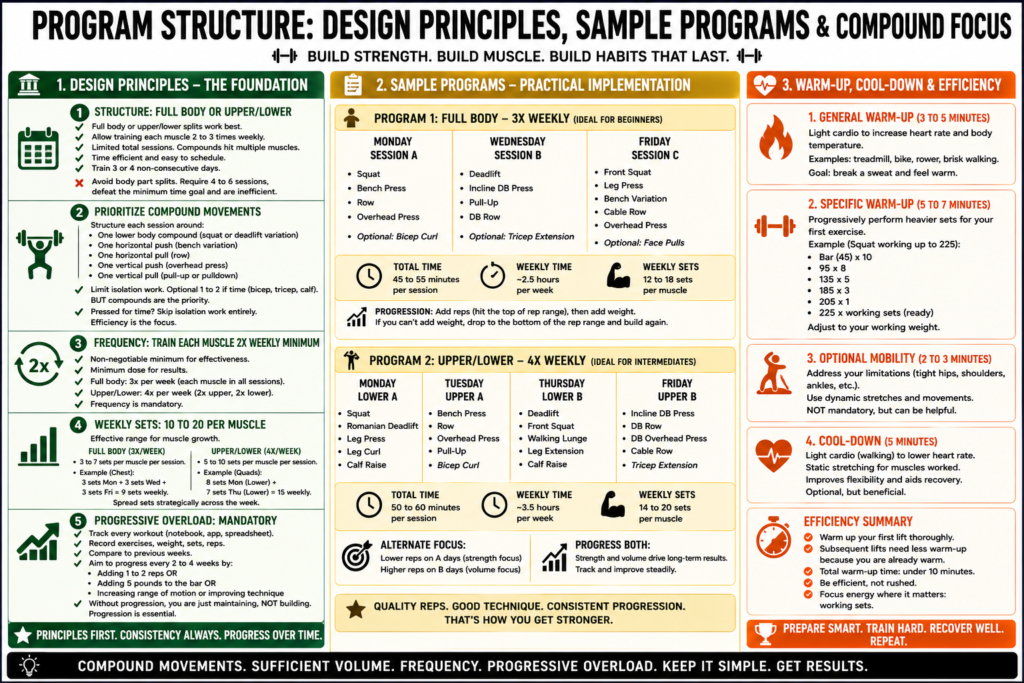
Principle 1: Full-body or upper/lower splits work best
Why these splits:
- Allow training each muscle 2-3x weekly with limited total sessions
- Compounds hit multiple muscles, making sessions time-efficient
- Easy to schedule (3 or 4 non-consecutive days weekly)
Avoid: Body part splits (chest day, back day, leg day, etc.) require 4-6 sessions weekly to hit everything 2x, defeating the “minimum time” goal.
Principle 2: Prioritize compound movements
Structure each session around:
- One lower body compound (squat or deadlift variation)
- One horizontal push (bench press variation)
- One horizontal pull (row variation)
- One vertical push (overhead press)
- One vertical pull (pull-up or pulldown)
Limit isolation exercises:
- If time allows, add 1-2 isolation exercises (bicep curls, tricep extensions, calf raises)
- But compounds are priority; if pressed for time, skip isolation entirely
Principle 3: Train each muscle 2x weekly minimum
This is non-negotiable for minimum dose effectiveness.
How to achieve it:
- Full-body 3x weekly: Each muscle hit all 3 sessions
- Upper/Lower 4x weekly: Each muscle hit 2x (upper twice, lower twice)
- Push/Pull/Legs 6x weekly: Each muscle hit 2x (but this is 6 sessions, no longer “minimum”)
Principle 4: 10-20 weekly sets per muscle group
Distribution matters:
For full-body 3x weekly:
- 3-7 sets per muscle per session
- Example: Chest gets 3 sets Monday, 3 sets Wednesday, 3 sets Friday = 9 weekly sets
For upper/lower 4x weekly:
- 5-10 sets per muscle per session
- Example: Quads get 8 sets Monday (lower), 7 sets Thursday (lower) = 15 weekly sets
Principle 5: Progressive overload is mandatory
Track your workouts:
- Use a notebook, app, or spreadsheet
- Record exercises, weight, sets, reps
- Compare to previous weeks
Aim for progress every 2-4 weeks:
- Add 1-2 reps to your sets
- Or add 5 lbs to the bar
- Or increase range of motion/improve technique
Without progression, you’re just maintaining, not building.
Sample Minimum Dose Programs
Program 1: Full-Body 3x Weekly (Ideal for Beginners)
Schedule: Monday, Wednesday, Friday (or any 3 non-consecutive days)
Session A:
- Squat: 3 sets × 8-12 reps
- Bench Press: 3 sets × 8-12 reps
- Barbell Row: 3 sets × 8-12 reps
- Overhead Press: 2 sets × 8-12 reps
- Optional: Bicep Curl 2 sets × 10-15 reps
Session B:
- Deadlift: 3 sets × 6-10 reps
- Incline Dumbbell Press: 3 sets × 8-12 reps
- Pull-up or Lat Pulldown: 3 sets × 8-12 reps
- Dumbbell Row: 2 sets × 10-15 reps
- Optional: Tricep Extension 2 sets × 10-15 reps
Session C:
- Front Squat or Leg Press: 3 sets × 10-15 reps
- Bench Press (different variation from A): 3 sets × 8-12 reps
- Cable Row: 3 sets × 10-15 reps
- Overhead Press: 2 sets × 8-12 reps
- Optional: Face Pulls 2 sets × 15-20 reps
Total time per session: 45-55 minutes Weekly time commitment: ~2.5 hours Sets per muscle per week: 12-18 sets (depending on muscle group)
Progression: Add reps each week until you hit top of range, then add weight and drop back to bottom of range.
Program 2: Upper/Lower 4x Weekly (Ideal for Intermediates)
Schedule: Monday/Thursday (Lower), Tuesday/Friday (Upper)
Lower A (Monday):
- Squat: 4 sets × 6-10 reps
- Romanian Deadlift: 3 sets × 8-12 reps
- Leg Press or Lunge: 3 sets × 10-15 reps
- Leg Curl: 2 sets × 10-15 reps
- Calf Raise: 2 sets × 12-20 reps
Upper A (Tuesday):
- Bench Press: 4 sets × 6-10 reps
- Barbell Row: 4 sets × 8-12 reps
- Overhead Press: 3 sets × 8-12 reps
- Pull-up or Lat Pulldown: 3 sets × 8-12 reps
- Bicep Curl: 2 sets × 10-15 reps
Lower B (Thursday):
- Deadlift: 3 sets × 5-8 reps
- Front Squat or Leg Press: 3 sets × 10-15 reps
- Walking Lunge: 3 sets × 12-16 reps (per leg)
- Leg Extension: 2 sets × 12-20 reps
- Calf Raise: 2 sets × 12-20 reps
Upper B (Friday):
- Incline Dumbbell Press: 3 sets × 8-12 reps
- Dumbbell Row: 3 sets × 10-15 reps
- Dumbbell Overhead Press: 3 sets × 10-15 reps
- Cable Row or Pull-up: 3 sets × 8-12 reps
- Tricep Extension: 2 sets × 10-15 reps
Total time per session: 50-60 minutes Weekly time commitment: ~3.5 hours Sets per muscle per week: 14-20 sets (depending on muscle group)
Progression: Alternate between strength focus (lower reps, heavier weight) on A days and volume focus (higher reps, moderate weight) on B days. Progress both rep ranges over time.
Warm-Up and Cool-Down Strategies
Even with minimum dose training, you can’t skip warm-up entirely. Injury prevention and performance optimization require proper preparation.
Efficient warm-up (10 minutes maximum):
General warm-up (3-5 minutes):
- Light cardio to increase heart rate and body temperature
- Options: Rowing, cycling, walking, jumping jacks
- Goal: Break a light sweat, feel warm
Specific warm-up (5-7 minutes):
- Warm up for your first exercise with progressively heavier sets
- Example for squatting 225 lbs for working sets:
- Bar only (45 lbs) × 10 reps
- 95 lbs × 8 reps
- 135 lbs × 5 reps
- 185 lbs × 3 reps
- 205 lbs × 1 rep
- 225 lbs × working sets
Mobility work (optional, 2-3 minutes):
- Address specific limitations (tight hips, shoulders, ankles)
- Quick dynamic stretches or mobility drills
- Not mandatory for everyone
Cool-down (5 minutes):
- Light cardio or walking (lower heart rate gradually)
- Static stretching for muscles worked (improves flexibility, aids recovery)
- Optional but beneficial
The time-efficient approach: Warm up for your first main lift thoroughly, then subsequent exercises need less warm-up since you’re already warm. This keeps total warm-up under 10 minutes.
How to Progress from Minimum to Optimal Dose
As life circumstances change or goals evolve, you might decide to increase training volume beyond minimum dose. Here’s how to transition intelligently.
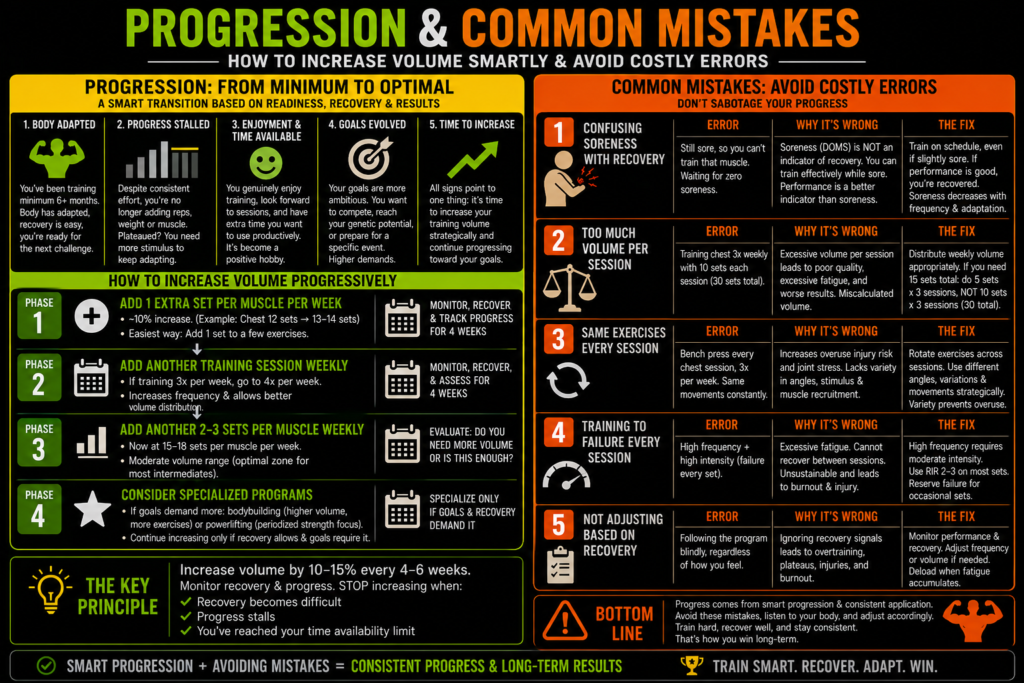
When to consider increasing volume:
You’ve been training minimum dose for 6+ months:
- Your body has adapted well
- You’re comfortable with the routine
- Recovery is easy
- Ready for next challenge
Progress has stalled despite consistent effort:
- You’re no longer adding reps or weight
- Muscle growth has plateaued
- Need more stimulus to continue adapting
You’ve developed a genuine enjoyment of training:
- Look forward to gym sessions
- Have extra time and want to use it productively
- Training has become a positive hobby
Your goals have become more ambitious:
- Want to compete in bodybuilding, powerlifting, or physique
- Aiming to reach genetic muscular potential
- Preparing for a specific event or transformation
How to increase volume progressively:
Phase 1: Add one extra set per muscle group per week (10% increase)
- Example: Chest was 12 sets weekly, increase to 13-14 sets
- Easiest way: Add one set to a few exercises
- Monitor recovery and progress for 4 weeks
Phase 2: Add another training session weekly (if doing 3x, go to 4x)
- Increases frequency and allows more volume distribution
- Monitor recovery and progress for 4 weeks
Phase 3: Add another 2-3 sets per muscle group weekly
- Now at 15-18 sets per muscle weekly (moderate volume range)
- Optimal zone for most intermediate lifters
- Evaluate if you need more or if this is sufficient
Phase 4: Consider specialized programs if goals demand it
- Bodybuilding-specific programs (higher volume, more exercises)
- Powerlifting programs (periodized strength focus)
- Continue increasing only if recovery allows and goals require it
The key principle: Increase volume by 10-15% every 4-6 weeks, monitor recovery and progress, and stop increasing when either (a) recovery becomes difficult, (b) progress stalls, or (c) you’ve reached your time availability limit.
THE BOTTOM LINE: THE MINIMUM EFFECTIVE DOSE APPROACH
After examining all aspects of minimum effective dose training, here’s what you need to understand:
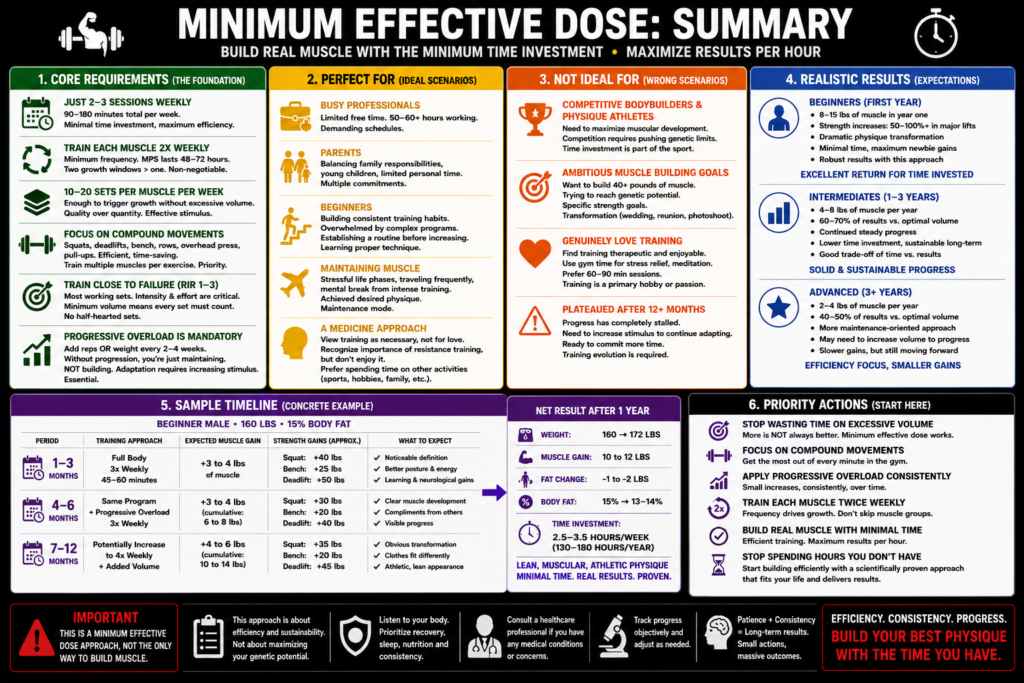
✅ Build Muscle With Just 2-3 Sessions Weekly (90-180 Minutes Total Per Week)
✅ Train Each Muscle 2x Weekly Minimum (Frequency Trumps Single Long Sessions)
✅ 10-20 Sets Per Muscle Per Week (Enough To Trigger Growth Without Excessive Volume)
✅ Focus On Compound Movements (Squats, Deadlifts, Bench, Rows, Overhead Press, Pull-ups)
✅ Train Close To Failure (RIR 1-3 On Most Working Sets)
✅ Progressive Overload Is Mandatory (Add Reps Or Weight Every 2-4 Weeks)
Perfect For:
- Busy Professionals With Limited Free Time
- Parents Balancing Family Responsibilities
- Beginners Building Consistent Training Habits
- Those Maintaining Muscle During Stressful Life Phases
- People Who View Training As Necessary But Don’t Love It
Not Ideal For:
- Competitive Bodybuilders Or Physique Athletes
- Those With Ambitious Muscle-Building Goals (40+ Pounds To Gain)
- Advanced Lifters Approaching Genetic Potential
- People Who Genuinely Love Training And Want More Gym Time
- Anyone Who’s Plateaued After 12+ Months At Minimum Dose
Realistic Results With Minimum Effective Dose:
Beginners (First Year):
- 8-15 pounds of muscle built in year one
- Strength increases of 50-100%+ on major lifts
- Dramatic physique transformation despite minimal time
- Results approach what higher volume would produce (newbie gains are robust)
Intermediates (1-3 Years):
- 4-8 pounds of muscle built yearly
- 60-70% of results compared to optimal volume
- Continued steady progress at lower time investment
- Sustainable long-term approach
Advanced (3+ Years):
- 2-4 pounds of muscle built yearly
- 40-50% of results compared to optimal volume
- More of a maintenance approach
- May need to increase volume to continue progressing
Sample Minimum Dose Results Timeline (Beginner Male, 160 lbs, 15% Body Fat):
Months 1-3:
- Training: Full-body 3x weekly, 45 minutes per session
- Muscle gained: 3-4 pounds
- Strength: Squat +40 lbs, Bench +25 lbs, Deadlift +50 lbs
- Physique: Noticeable muscle definition, better posture
Months 4-6:
- Training: Same program, progressive overload applied
- Muscle gained: 3-4 pounds (cumulative 6-8 lbs)
- Strength: Squat +30 lbs, Bench +20 lbs, Deadlift +40 lbs
- Physique: Clear muscle development, compliments from others
Months 7-12:
- Training: Potentially increased to 4x weekly or added volume
- Muscle gained: 4-6 pounds (cumulative 10-14 lbs total)
- Strength: Squat +35 lbs, Bench +20 lbs, Deadlift +45 lbs
- Physique: Obvious transformation, clothing fits differently, athletic appearance
Net Result After 1 Year:
- Weight: 160 lbs → 172 lbs (10-12 lbs muscle, 1-2 lbs fat)
- Body Fat: 15% → 14% (recomposition despite gaining weight)
- Time Investment: 2.5-3.5 hours weekly (130-180 hours annually)
- Physique: Lean, muscular, athletic build achieved with minimal time
STOP WASTING TIME WITH EXCESSIVE VOLUME. START TRAINING EFFICIENTLY. FOCUS ON COMPOUND MOVEMENTS. PROGRESSIVE OVERLOAD CONSISTENTLY. TRAIN EACH MUSCLE TWICE WEEKLY. BUILD REAL MUSCLE WITH MINIMAL TIME INVESTMENT.
Ready To Build A Complete, Customized Minimum Dose Training Program That Maximizes Muscle Growth Per Hour Invested, Without Wasting Time On Unnecessary Exercises Or Excessive Volume? Understanding the minimum effective dose principles is just the foundation. Get a comprehensive training system that includes personalized program design based on your schedule and experience level, exercise selection optimized for time efficiency and muscle coverage, progression schemes that ensure continuous adaptation and growth, recovery protocols that maximize results from minimal training stress, and strategies for transitioning to higher volume when your goals or schedule evolve. Stop spending hours in the gym you don’t have. Start building muscle efficiently with a scientifically-designed minimum dose approach that fits your life and delivers real results.
REFERENCES
SECTION 1 — Single vs. multiple sets: even low volumes trigger growth
[1] Krieger JW — PubMed/Journal of Strength and Conditioning Research, 2010 Multi-level meta-analysis of 55 effects from 14 studies examining the dose-response relationship between the number of sets per exercise and dynamic strength gains; multiple sets produced significantly greater strength gains than single sets per exercise; however, a clear dose-response emerged whereby the first sets contributed the greatest gains, with each additional set providing progressively smaller incremental returns; provides the evidence base for the article’s claim that the first few hard sets per muscle group provide the majority of the growth stimulus, and that additional sets beyond a minimum threshold generate diminishing returns — the foundational evidence that a small number of productive sets can meaningfully drive adaptation https://pubmed.ncbi.nlm.nih.gov/20093960/
[2] Schoenfeld BJ, Ogborn D & Krieger JW — PubMed/Journal of Sports Science, 2017 Meta-regression of 15 studies (34 treatment groups) examining the dose-response relationship between weekly set volume and muscle hypertrophy; a graded relationship was found, with more than 10 sets per muscle per week producing significantly greater hypertrophy than fewer sets; however, the dose-response was not unlimited: the curve flattened substantially above approximately 10 sets, with each additional set producing smaller hypertrophic increments; provides the volume threshold evidence supporting the article’s 10 to 20 set recommendation as the “minimum effective dose” range where the majority of achievable hypertrophy occurs https://pubmed.ncbi.nlm.nih.gov/27433992/
SECTION 2 — Training frequency: 2x per week superior to 1x per week
[3] Schoenfeld BJ, Ogborn D & Krieger JW — PubMed/Sports Medicine, 2016 Systematic review and meta-analysis comparing 1 versus 2 versus 3 times per week training frequency for muscle hypertrophy; training each muscle group twice per week produced superior hypertrophic outcomes compared to once per week on a volume-equated basis; the authors concluded that major muscle groups should be trained at least twice weekly to maximize muscle growth; the primary evidence base for the article’s recommendation that 2x weekly frequency per muscle is non-negotiable in a minimum effective dose program, explaining why distributing lower volumes across two sessions outperforms concentrating the same volume in one weekly session https://pubmed.ncbi.nlm.nih.gov/27102172/
SECTION 3 — Compound exercises and mechanical tension as the primary hypertrophic mechanism
[4] Schoenfeld BJ — PubMed/Journal of Strength and Conditioning Research, 2010 Comprehensive theoretical review of the mechanisms of muscle hypertrophy and their application to resistance training; mechanical tension is identified as the primary and most potent stimulus for skeletal muscle hypertrophy, mediated through mechanoreceptors activating the mTOR signaling pathway; metabolic stress and muscle damage are secondary contributors; heavy compound exercises (squat, deadlift, bench press, rows, overhead press) generate the highest total mechanical tension because they involve the largest muscle masses under the greatest absolute loads; provides the mechanistic justification for the article’s prioritization of compound movements in minimum dose programming, explaining why a few compound sets yield greater hypertrophic returns per minute than multiple isolation exercises https://pubmed.ncbi.nlm.nih.gov/20847704/






Leave a Reply
You must be logged in to post a comment.