Suffering from bloating, gas, and stomach distension while bulking? Here’s how to fix digestive issues and absorb nutrients properly.
You started your bulk. You’re eating more food to build muscle.
But now your stomach is constantly bloated. You have gas. You feel uncomfortable all day.
Your abs have disappeared under bloating, not just from gaining weight. You feel sluggish after meals. Your stomach makes embarrassing noises.
Is this normal? Can you fix it? Or do you just have to suffer through bulking?
Here’s the complete answer: Bloating and gas during bulking are common but not inevitable. They result from eating significantly more food than your digestive system is accustomed to, particularly rapid increases in fiber, calories, and specific foods. You can minimize or eliminate bloating by: gradually increasing calories (not jumping 1,000+ overnight), splitting meals into smaller portions (5-6 meals vs. 3 massive ones), identifying food intolerances, reducing excess fiber, eating slowly, and limiting artificial sweeteners. Digestive enzyme supplements can help but aren’t mandatory.
In this comprehensive guide, I’ll explain why bloating happens during bulking and whether it’s normal, reveal the 7 most effective strategies to reduce bloating and improve digestion, show you which supplements actually help (and which are waste of money), provide meal timing and food choice strategies for comfortable bulking, and help you identify when bloating indicates a serious medical issue requiring attention.
Whether you’re bloated from aggressive bulking or just want to bulk more comfortably, this article will solve your digestive problems.
Let’s fix your gut and optimize nutrient absorption.
TABLE OF CONTENTS
Is Bloating Normal During Bulking?
Understanding what’s typical versus problematic.
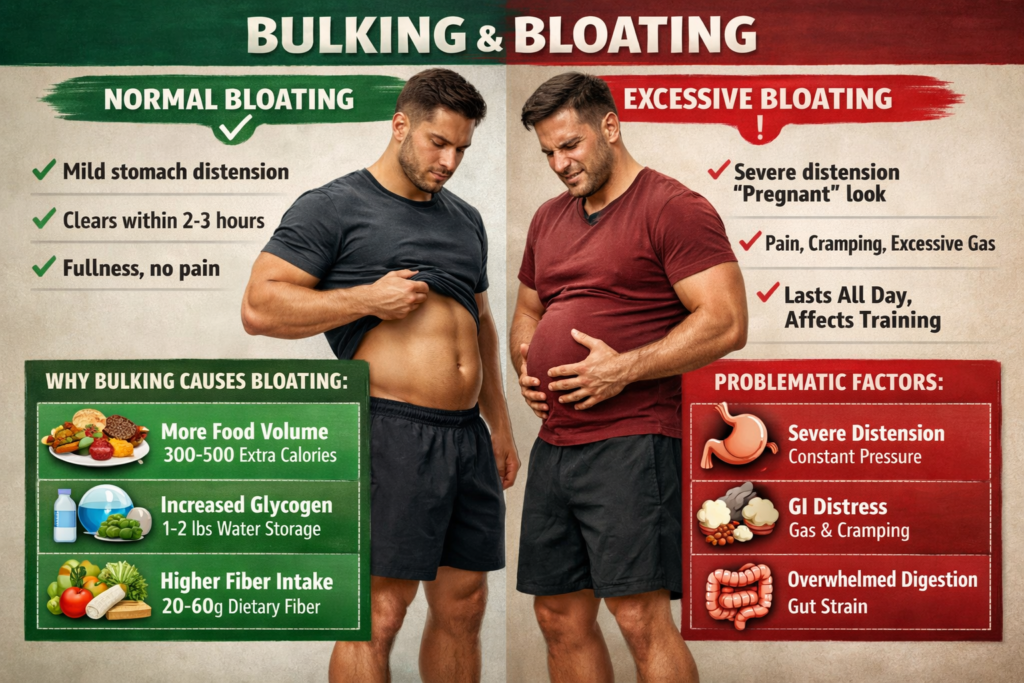
Yes, Some Bloating Is Common
Why bulking causes bloating:
Reason 1: Significantly more food volume
The simple reality:
- Bulking requires 300-500+ extra calories daily
- More food = more volume in digestive system
- Stomach and intestines physically expand
- Visible distension is normal
The math:
- Maintenance: 2,500 calories, maybe 3-4 pounds food daily
- Bulking: 3,200 calories, maybe 5-6 pounds food daily
- Extra 1-2 pounds food in digestive tract at any time
- Physical space taken up
This is unavoidable:
- Can’t create surplus without more food
- More food means fuller digestive system
- Some distension is physics, not pathology
- Completely normal
Reason 2: Increased carbohydrate intake
Glycogen and water storage:
- Bulking means more carbs
- 1g stored glycogen holds 3-4g water
- Muscles store 300-600g glycogen
- 1-2 pounds water weight in muscles
Visual impact:
- Fuller muscles (good)
- Also fuller midsection (unavoidable)
- Not fat, not bloating, just hydration
- Part of bulking
Reason 3: More fiber (often unintentional)
Common pattern:
- Start eating “clean” for bulk
- Increase whole grains, vegetables
- Fiber jumps from 20g to 50g daily
- Digestive system overwhelmed
What happens:
- Fiber ferments in large intestine
- Produces gas
- Causes bloating
- Too much too fast
When Bloating Becomes Problematic
Normal vs. excessive:
Normal bloating:
- Mild stomach distension after meals
- Clears up within 2-3 hours
- No pain, just fullness
- Manageable
- Part of eating more
Excessive bloating:
- Severe distension (look pregnant)
- Lasts all day
- Painful cramping
- Constant gas
- Interferes with training or daily life
- Needs addressing
The distinction matters: Some bloating expected. Severe bloating indicates digestive issues that need fixing.
7 Strategies to Reduce Bloating During Bulking
Practical solutions that actually work.
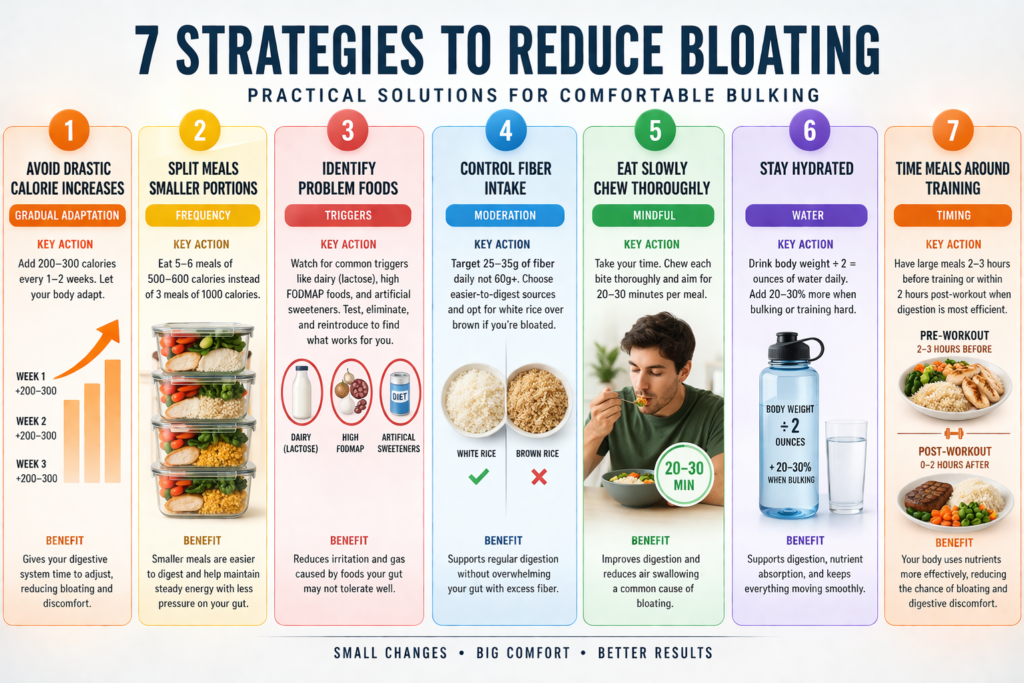
Strategy 1: Avoid Drastic Calorie Increases
The problem with aggressive bulking:
What many people do:
- Maintenance: 2,500 calories
- Start bulk: Jump to 3,500 calories overnight
- 1,000 calorie increase immediately
- Digestive system shocked
What happens:
- Stomach can’t handle sudden volume
- Digestive enzymes insufficient
- Food sits longer, fermenting
- Gas and bloating result
- Overwhelming the system
The better approach:
Week 1-2: Add 200-300 calories
- Maintenance: 2,500
- Week 1: 2,700-2,800
- Gentle increase
- Body adapts
Week 3-4: Add another 200-300
- Now at 2,900-3,100
- Progressive adaptation
- Minimal digestive distress
Week 5+: Final adjustments
- Reach target surplus (3,200)
- Digestive system adapted
- Comfortable eating
Example gradual increase:
Monday (Day 1):
- Add one extra snack (250 calories)
- Banana with peanut butter
- Easy addition
Week 2:
- Add larger dinner portions (200 calories)
- Extra rice, extra meat
- Still manageable
Week 3:
- Add second extra snack (200 calories)
- Greek yogurt with granola
- Reached surplus comfortably
The benefit: Digestive system adapts gradually, minimal bloating.
Strategy 2: Split Meals Into Smaller Portions
The meal frequency solution:
Problem with few large meals:
Typical approach:
- 3 massive meals daily
- 1,000+ calories per meal
- Stomach overfull
- Digestion overwhelmed
- Severe bloating after each meal
Why this causes problems:
- Stomach capacity limited
- Digestive enzymes can’t keep up
- Food sits for hours
- Fermentation and gas
- Uncomfortable and inefficient
Better approach: 5-6 smaller meals
Same calories, distributed:
- 3,000 calories ÷ 5 meals = 600 calories each
- Stomach never overfull
- Continuous digestion
- Less bloating
- More comfortable
Example meal distribution:
3 large meals (problematic):
- Breakfast: 1,100 calories (bloated all morning)
- Lunch: 1,000 calories (bloated all afternoon)
- Dinner: 900 calories (bloated all evening)
- Constantly uncomfortable
5-6 smaller meals (better):
- Meal 1 (7 AM): 500 calories
- Meal 2 (10 AM): 500 calories
- Meal 3 (1 PM): 600 calories
- Meal 4 (4 PM): 500 calories
- Meal 5 (7 PM): 600 calories
- Meal 6 (9 PM): 300 calories (optional)
- Total: 3,000 calories, minimal bloating
Practical benefits:
- Never overly full
- Better nutrient absorption
- Stable energy levels
- Training performance better
- More sustainable
Strategy 3: Identify and Limit Problem Foods
Common culprits causing bloating:
Problem food 1: Dairy (lactose intolerance)
The issue:
- 65% of adults have some lactose intolerance
- Severity varies
- Often undiagnosed
- Worsens with high dairy intake
Bulking makes it worse:
- GOMAD (gallon of milk a day)
- Multiple protein shakes with milk
- Cottage cheese daily
- Greek yogurt
- Lactose overload
Symptoms:
- Severe bloating
- Gas
- Cramping
- Diarrhea
- Very uncomfortable
Solution:
- Reduce dairy significantly
- Use lactose-free alternatives
- Switch to plant milk
- Take lactase enzymes
- Test and adjust
Problem food 2: High FODMAP foods
What are FODMAPs:
- Fermentable carbohydrates
- Poorly absorbed in small intestine
- Ferment in large intestine
- Produce gas
- Common bloating trigger
High FODMAP foods:
- Onions and garlic
- Beans and lentils
- Wheat products
- Apples, pears
- Cauliflower, broccoli (in excess)
What happens during bulking:
- Eating more of everything
- Including high FODMAP foods
- Digestive distress amplified
- Bloating worsens
Solution:
- Identify your triggers
- Reduce or eliminate temporarily
- Reintroduce slowly
- Find personal tolerance
- Individualized approach
Problem food 3: Artificial sweeteners
Common sources:
- Sugar-free protein bars
- Diet sodas
- Sugar-free gum
- Some protein powders
- “Zero calorie” products
Problematic sweeteners:
- Sorbitol
- Xilitol
- Mannitol
- Maltitol
- Sugar alcohols
Why they cause problems:
- Not fully absorbed
- Ferment in intestines
- Draw water into bowel
- Gas and bloating
- Digestive distress
During bulking:
- Often eating multiple protein bars
- Several diet sodas
- Cumulative effect
- Excessive intake
Solution:
- Eliminate sugar-free products
- Use real sugar in moderation
- Choose better protein sources
- Reduce or eliminate
Strategy 4: Control Fiber Intake
The fiber paradox during bulking:
What often happens:
- Decide to bulk “clean”
- Dramatically increase whole grains
- Add lots of vegetables
- Fiber jumps from 20g to 60g daily
- Digestive chaos
Why too much fiber causes problems:
Fermentation:
- Fiber ferments in large intestine
- Bacteria produce gas
- More fiber = more gas
- Bloating and distension
Water absorption:
- Fiber absorbs water
- Expands in intestine
- Feeling of fullness
- Contributes to bloating
The sweet spot: 25-35g daily
Too little (<20g):
- Constipation
- Poor digestive health
- Not ideal
Optimal (25-35g):
- Good digestive function
- Manageable
- Benefits without excess
Too much (50g+):
- Excessive gas
- Severe bloating
- Digestive distress
- Counterproductive
How to manage fiber during bulking:
Choose lower-fiber carb sources:
- White rice instead of brown (less fiber)
- White bread instead of whole wheat
- Regular pasta instead of whole grain
- Easier digestion
Don’t go overboard on vegetables:
- 2-3 servings daily sufficient
- Don’t need 6+ servings
- More isn’t always better
- Moderate approach
Increase fiber gradually:
- Add 5g every few days
- Let gut adapt
- Find your tolerance
- Slow progression
Strategy 5: Eat Slowly and Chew Thoroughly
The overlooked solution:
Why people eat fast during bulking:
- Need to consume lots of food
- Rushing to finish meals
- Eating quickly seems efficient
- Common mistake
What happens when eating fast:
Swallowing air:
- Rapid eating = more air swallowed
- Air accumulates in stomach and intestines
- Causes bloating and gas
- Aerophagia
Poor chewing:
- Large food particles
- Harder to digest
- Sit longer in stomach
- Fermentation increases
- More gas production
Overwhelming digestion:
- Stomach doesn’t have time to signal fullness
- Eat beyond comfortable capacity
- Digestive system overwhelmed
- Bloating results
The solution: Slow down
Practical guidelines:
- 20-30 minutes per meal minimum
- Chew each bite 20-30 times
- Put fork down between bites
- Breathe through nose (reduces air swallowing)
- Mindful eating
Benefits:
- Better digestion
- Less air swallowed
- Improved nutrient absorption
- Reduced bloating
- More comfortable
Yes, it takes longer:
- But it’s worth it
- Better digestion = better results
- Less discomfort = better adherence
- Time well spent
Strategy 6: Stay Hydrated
Water’s role in digestion:
Why hydration matters:
- Helps break down food
- Moves waste through intestines
- Prevents constipation
- Supports enzyme function
- Essential for digestion
During bulking:
- Eating more food
- More fiber (usually)
- Need more water
- Dehydration causes constipation
- Bloating worsens
How much water:
Minimum:
- Body weight in pounds ÷ 2 = ounces daily
- 180 pounds = 90 ounces (2.7 liters)
- More if training intensely
- More in hot climates
During bulking:
- Add 20-30% more
- Support increased food volume
- Aid fiber digestion
- 100-120 ounces for 180-pound person
Timing strategy:
- Sip throughout day
- Not massive amounts at meals (dilutes digestive enzymes)
- Between meals ideal
- Consistent hydration
Strategy 7: Consider Meal Timing Around Training
Strategic eating for better digestion:
Avoid huge meals right before training:
The problem:
- Large meal 30-60 minutes before training
- Blood diverted to digestion
- Food sitting in stomach
- Uncomfortable during workout
- Bloating and sluggishness
Better approach:
- Larger meals 2-3 hours before training
- Or smaller meal 60-90 minutes before
- Or train fasted with post-workout feast
- Timing matters
Post-workout is ideal for large meals:
Why this works:
- Nutrient partitioning improved
- Insulin sensitivity elevated
- Stomach empty from training
- Can handle larger volume
- Less bloating
Example schedule:
Training at 5 PM:
- Meal 1 (7 AM): 500 calories
- Meal 2 (10 AM): 500 calories
- Meal 3 (1 PM): 700 calories (largest pre-training meal, early enough)
- Training (5-6:30 PM)
- Meal 4 (7 PM): 900 calories (largest meal, post-workout)
- Meal 5 (9 PM): 400 calories
- Strategic distribution
Supplements That May Help Digestion
Evidence-based options (not mandatory).
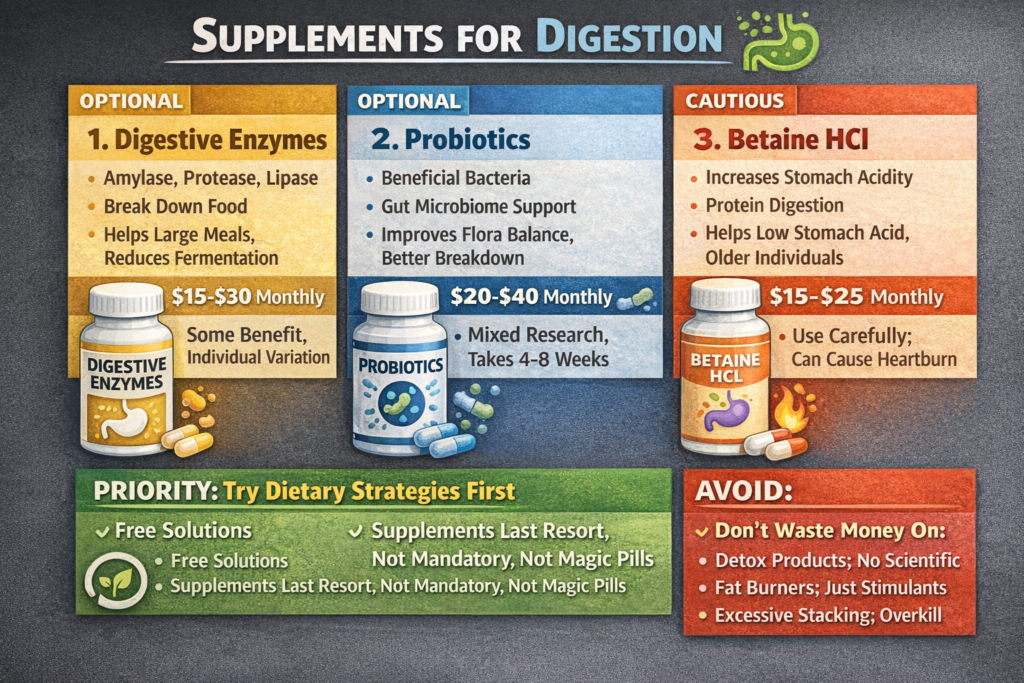
Important Disclaimer
Supplements are last resort:
- Try dietary strategies first
- Free solutions should be attempted
- Supplements cost money
- Often unnecessary
- Not magic pills
When supplements make sense:
- Tried all dietary strategies
- Still experiencing issues
- Want additional support
- Can afford them
- Optional enhancement
Supplement 1: Digestive Enzymes
What they are:
- Proteins that break down food
- Amylase (carbs), protease (protein), lipase (fats)
- Support natural enzyme production
- Aid digestion
How they help:
- Breaking down large meals
- Reducing undigested food
- Less fermentation
- Reduced gas and bloating
Who benefits:
- People eating very large meals
- Those with enzyme insufficiency
- Older individuals (enzyme production decreases)
- Specific use cases
How to use:
- Take with meals
- Follow product directions
- Usually 1-2 capsules per meal
- Not for between meals
Cost:
- $15-30 per month
- Moderate expense
- May or may not help
- Trial and error
Effectiveness:
- Some people report significant improvement
- Others notice little difference
- Individual variation
- Worth trying if other methods failed
Supplement 2: Probiotics
What they are:
- Beneficial bacteria
- Support gut microbiome
- “Good” bacteria
- Various strains available
How they might help:
- Improve gut flora balance
- Better food breakdown
- Reduced inflammation
- Improved gut health
- Indirect benefits
Research evidence:
- Mixed results for bloating
- Some studies show benefit
- Others show minimal effect
- Strain-specific
- Not guaranteed
How to use:
- Daily supplementation
- 10-50 billion CFU typical
- Take on empty stomach
- Consistent use (weeks to months)
Cost:
- $20-40 per month
- Ongoing expense
- Long-term commitment
- Moderate cost
Realistic expectations:
- May take 4-8 weeks to notice effects
- Not immediate solution
- Benefits subtle
- Patience required
Supplement 3: Betaine HCl
What it is:
- Hydrochloric acid supplement
- Increases stomach acidity
- Supports protein digestion
- Less common supplement
How it might help:
- Better protein breakdown
- Improved nutrient absorption
- Less undigested protein
- Reduced fermentation
Who might benefit:
- People with low stomach acid
- Older individuals
- Those on acid-reducing medications
- Specific situations
Caution:
- Can cause heartburn if overused
- Not for everyone
- Start with low dose
- Monitor response
- Use carefully
Cost:
- $15-25 per month
- Affordable
- Worth trying
- Low financial risk
What NOT to Waste Money On
Ineffective or unnecessary:
“Detox” products:
- No scientific support
- Expensive
- Don’t improve digestion
- Marketing scam
“Fat burners” for bloating:
- Don’t reduce bloating
- Just stimulants
- Waste of money
- Avoid
Excessive supplement stacking:
- Taking 10 different digestive supplements
- Expensive
- Often unnecessary
- Diminishing returns
- Overkill
When Bloating Indicates a Serious Problem
Red flags requiring medical attention.
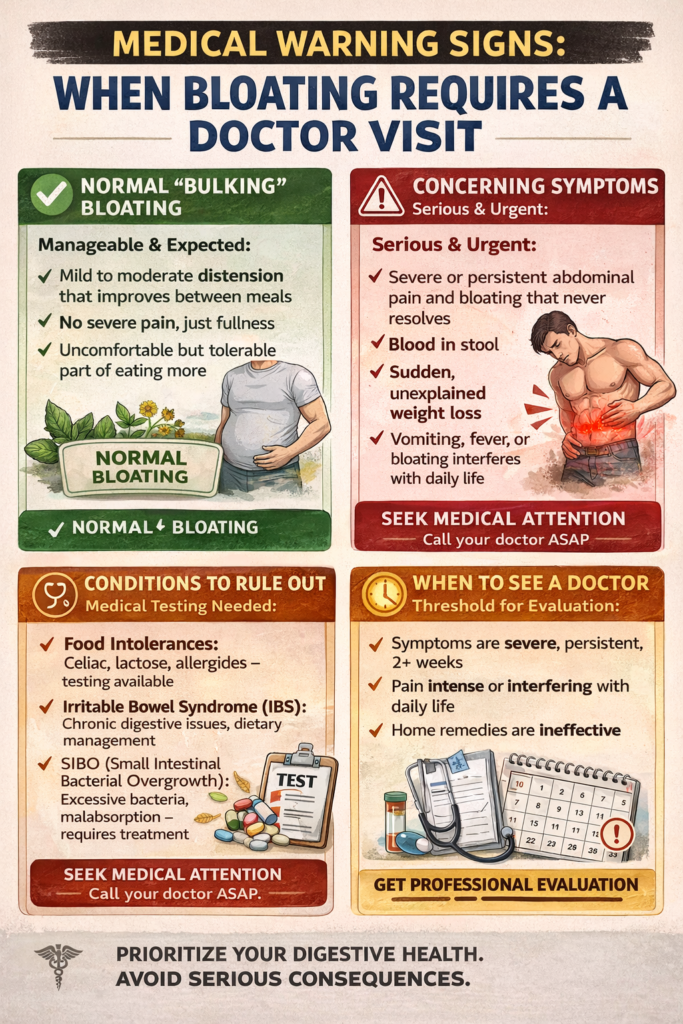
Normal vs. Concerning Symptoms
Normal bulking bloating:
- Mild to moderate distension
- Improves between meals
- No severe pain
- Manageable
- Uncomfortable but tolerable
Concerning symptoms:
- Severe, persistent abdominal pain
- Bloating that never resolves
- Blood in stool
- Unexplained weight loss
- Vomiting
- Fever
- Seek medical attention
Conditions to Rule Out
Potential issues:
Food intolerances/allergies:
- Celiac disease (gluten)
- Lactose intolerance
- Other specific allergies
- Testing available
Irritable Bowel Syndrome (IBS):
- Chronic digestive issues
- Bloating, gas, pain
- Dietary management helps
- Medical diagnosis needed
Small Intestinal Bacterial Overgrowth (SIBO):
- Excessive bacteria in small intestine
- Severe bloating
- Malabsorption
- Requires treatment
Inflammatory Bowel Disease:
- Crohn’s, ulcerative colitis
- More severe symptoms
- Requires medical management
- Serious conditions
When to See a Doctor
See a physician if:
- Symptoms severe and persistent (2+ weeks)
- Interfering with daily life
- Pain is intense
- Other concerning symptoms present
- Home remedies ineffective
- Professional evaluation needed
What doctor can do:
- Order tests (breath test, endoscopy, bloodwork)
- Diagnose specific conditions
- Prescribe treatments
- Provide specialized guidance
- Expert assessment
The Bottom Line: Bloating Is Common But Fixable
After examining all solutions:
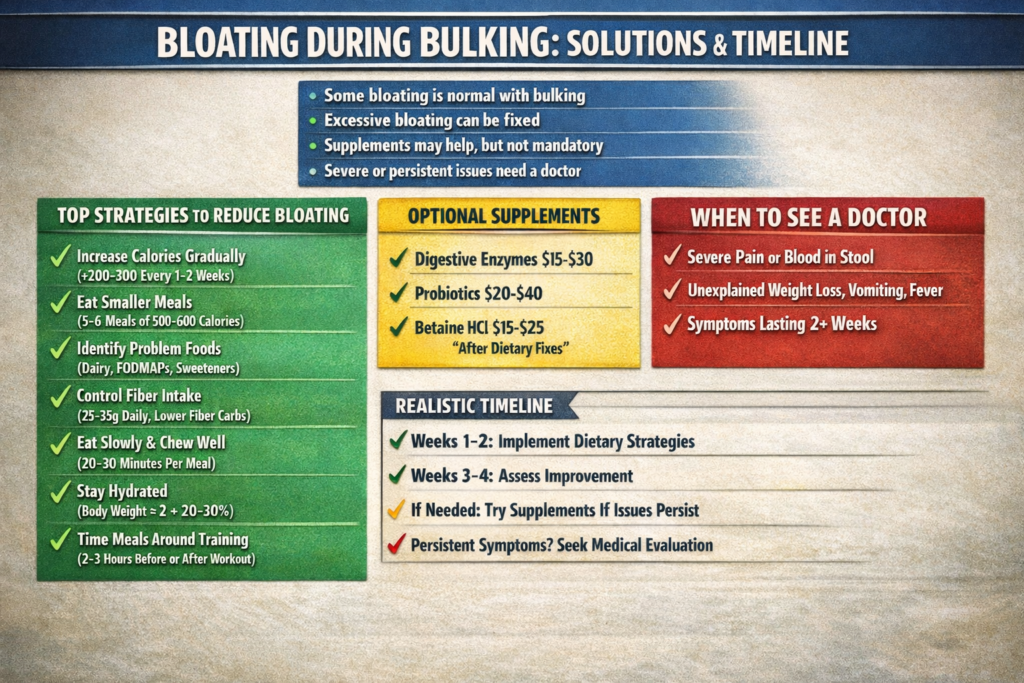
The truth about bloating during bulking:
✅ Some bloating is normal (eating more food = fuller digestive system)
✅ Excessive bloating is fixable (with dietary and lifestyle strategies)
✅ Supplements may help but aren’t necessary (try free solutions first)
✅ Severe, persistent bloating needs medical evaluation (rule out serious conditions)
The 7 most effective strategies to reduce bloating:
1. Avoid drastic calorie increases:
- Add 200-300 calories every 1-2 weeks
- Let digestive system adapt gradually
- Reach target surplus over 4-6 weeks
2. Split meals into smaller portions:
- 5-6 meals of 500-600 calories
- Instead of 3 meals of 1,000 calories
- Never overly full
3. Identify problem foods:
- Dairy (lactose intolerance)
- High FODMAP foods
- Artificial sweeteners
- Test and eliminate
4. Control fiber intake:
- Target 25-35g daily
- Choose lower-fiber carbs (white rice)
- Don’t overdo vegetables
- Increase gradually
5. Eat slowly and chew thoroughly:
- 20-30 minutes per meal
- Chew 20-30 times per bite
- Reduces air swallowing
- Better digestion
6. Stay hydrated:
- Body weight ÷ 2 = minimum ounces
- Add 20-30% during bulking
- Sip throughout day
7. Time meals around training:
- Large meals 2-3 hours before training
- Or smaller meals 60-90 min before
- Largest meal post-workout
Supplements that may help (optional):
- Digestive enzymes ($15-30/month)
- Probiotics ($20-40/month)
- Betaine HCl ($15-25/month)
- Not mandatory, try after dietary fixes
When to see a doctor:
- Severe persistent pain
- Blood in stool
- Unexplained weight loss
- Vomiting or fever
- Symptoms lasting 2+ weeks
- Professional evaluation needed
The realistic approach:
Week 1-2: Implement dietary strategies
- Gradual calorie increase
- Smaller, more frequent meals
- Identify problem foods
- Control fiber
Week 3-4: Assess improvement
- Most people see significant improvement
- Bloating reduces substantially
- More comfortable
If still problematic: Consider supplements
- Try digestive enzymes first
- Add probiotics if needed
- Betaine HCl for specific cases
If severe or persistent: Medical evaluation
- Rule out serious conditions
- Get proper diagnosis
- Professional treatment
SOME BLOATING IS NORMAL DURING BULKING. EXCESSIVE BLOATING IS FIXABLE. IMPLEMENT DIETARY STRATEGIES FIRST. SUPPLEMENTS OPTIONAL. SEVERE CASES NEED MEDICAL ATTENTION.
Ready to optimize your complete bulking strategy with proper calorie progression, strategic meal timing, food selections that minimize bloating while maximizing gains, and a sustainable approach that builds muscle without digestive misery? Fixing bloating is just one piece of effective bulking. Get a comprehensive guide to calculating exact bulking calories, building comfortable meal plans that support digestion, programming training for maximum growth, and achieving your muscle-building goals without unnecessary suffering. Stop tolerating severe bloating. Start bulking intelligently with strategies that work.
REFERENCES
SECTION 1 — FODMAP mechanism: fermentation, gas production, and bloating
[1] Halmos EP et al. — PubMed/Gastroenterology, 2014 Randomized crossover trial in 30 IBS patients and 8 healthy controls comparing 21 days of a low FODMAP diet to a typical Australian diet; IBS patients had significantly lower overall gastrointestinal symptom scores on the low FODMAP diet (22.8 mm vs. 44.9 mm on a 100-mm visual analogue scale, p<0.001); the study also measured stool frequency, weight, water content, and consistency; results confirmed the dual mechanism of FODMAP-induced symptoms: an osmotic effect increasing small bowel water content, and rapid colonic fermentation producing gas that distends the large bowel; the foundational clinical trial establishing that reducing poorly absorbed fermentable carbohydrates directly reduces bloating, abdominal pain, and distension; validates the article’s Strategy 3 (identifying and limiting high FODMAP foods) https://pubmed.ncbi.nlm.nih.gov/24076059/
[2] Ianiro G et al. — PMC/Nutrients, 2024 Comprehensive review of the mechanisms by which the low FODMAP diet reduces IBS symptoms; FODMAPs are poorly absorbed in the small intestine, exert an osmotic effect drawing water into the gut lumen, and are rapidly fermented by colonic microbiota producing hydrogen, carbon dioxide, and methane; these two processes together cause luminal distension, bloating, abdominal pain, and altered motility; additional mechanisms include modulation of visceral hypersensitivity, intestinal permeability changes, and alterations in short-chain fatty acid production; also identifies dietary sources including onions, garlic, beans, wheat, apples, pears, and cauliflower as high FODMAP triggers; provides the mechanistic framework for why eating more food during bulking, particularly if high FODMAP foods are increased, amplifies bloating symptoms https://pmc.ncbi.nlm.nih.gov/articles/PMC10857121/
SECTION 2 — Lactose intolerance: mechanism, prevalence, and bloating
[3] Misselwitz B et al. — PMC/Gut, 2019 Comprehensive update on lactose malabsorption and intolerance covering pathogenesis, diagnosis, and clinical management; a recent meta-analysis estimated worldwide prevalence of lactose malabsorption at 68%; lactase deficiency allows unabsorbed lactose to reach the large intestine where colonic microbiota ferment it, producing short-chain fatty acids and gas including hydrogen, carbon dioxide, and methane; this fermentation drives bloating, abdominal pain, borborygmi, and diarrhea; the amount of lactose that triggers symptoms varies between individuals and depends on dose, gut flora, motility, and visceral sensitivity; lactose intolerance is often undiagnosed and can be worsened dramatically by the high dairy intake common during bulking (protein shakes, cottage cheese, Greek yogurt, milk); directly supports the article’s identification of dairy as one of the primary bulking-related bloating triggers https://pmc.ncbi.nlm.nih.gov/articles/PMC6839734/
SECTION 3 — Sugar alcohols: osmotic and fermentative gastrointestinal effects
[4] Mäkinen KK — PMC/International Journal of Dentistry, 2016 Scientific review of the gastrointestinal disturbances associated with sugar alcohol consumption; sugar alcohols including sorbitol, xylitol, mannitol, and maltitol are incompletely absorbed in the small intestine; at the large intestine they exert an osmotic effect drawing water into the bowel and are fermented by colonic bacteria producing gas; these two processes cause bloating, flatulence, abdominal cramping, and osmotic diarrhea in a dose-dependent manner; specific threshold doses for osmotic diarrhea are established for each polyol; notes that cumulative intake from multiple sugar-free products (protein bars, diet sodas, gum, low-carb snacks) significantly increases total polyol load; directly supports the article’s identification of artificial sweeteners in sugar-free products as an underappreciated source of bulking bloat https://pmc.ncbi.nlm.nih.gov/articles/PMC5093271/






Leave a Reply
You must be logged in to post a comment.