
Trying to bulk but can’t eat enough? Your lack of hunger is sabotaging your gains. Here’s how to fix it.
You know you need to eat more to build muscle. You’ve calculated your calories. You have your meal plan.
But you can’t physically eat that much food. You’re full after three bites. The thought of another meal makes you nauseous.
You think the problem is:
- Your metabolism is too fast
- You’re “hardgainer” genetics
- You need appetite stimulants
- Something is wrong with you
Wrong. You’re naturally lean with a metabolism matched to your body size. Your hunger and satiety mechanisms are conspiring to keep you in equilibrium staying lean. But you can override these signals with strategic nutrition approaches. The solution isn’t forcing food down. It’s making eating easier through calorie density, meal timing, and digestive strategy.
Here’s what’s actually happening: Your body regulates appetite through hormones (leptin, ghrelin), stomach stretch receptors, and blood glucose levels. When you’re lean, leptin is low (makes you less satisfied), but your stomach capacity is also smaller (fills quickly). Trying to eat massive volumes triggers satiety signals before you’ve consumed enough calories. The solution: Increase calorie density, reduce meal size but increase frequency, use liquid calories strategically, and manage fiber intake to prevent excessive fullness.
In this comprehensive guide, I’ll explain why you struggle to eat (the appetite regulation mechanisms), reveal the 5 proven strategies to increase food intake (without forcing), show you how to use calorie-dense foods (get more calories in less volume), provide liquid meal protocols (easiest way to add 500+ calories), and explain meal frequency optimization (smaller meals, more often).
Whether you’re trying to bulk, recover from illness, or just struggle with appetite, these strategies work.
Let’s solve your eating problem systematically.
Why You Can’t Eat Enough (The Physiology)
Understanding the problem before fixing it.
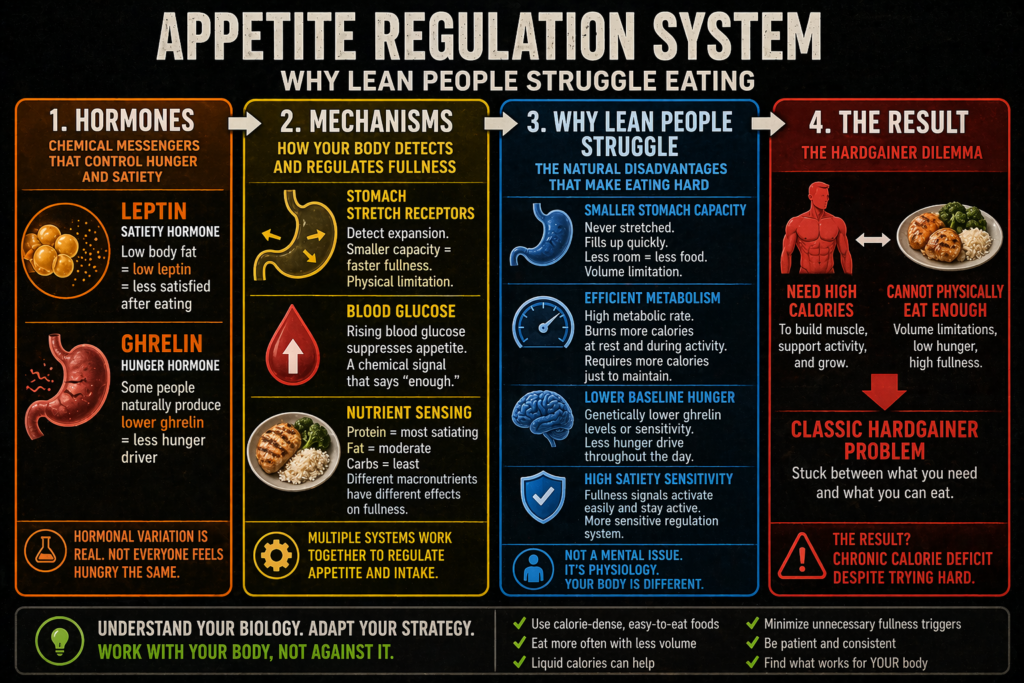
The Appetite Regulation System
The hormones:
Leptin (satiety hormone):
- Produced by fat cells
- Signals “you have enough energy stored”
- Low body fat = low leptin = less satiety
- But paradoxically, lean people still feel full quickly
- Complex regulation
Ghrelin (hunger hormone):
- Produced by stomach
- Signals “you need food”
- Rises before meals
- Some people have naturally lower ghrelin
- Hunger driver
The mechanisms:
Stomach stretch receptors:
- Detect stomach expansion
- Send fullness signals to brain
- Smaller stomach capacity = faster fullness
- Physical limitation
Blood glucose:
- Rising glucose suppresses appetite
- Stable glucose maintains appetite
- Chemical signal
Nutrient sensing:
- Protein most satiating
- Fat moderately satiating
- Carbs least satiating
- Macronutrient effects
Why Lean People Struggle
The lean person’s dilemma:
Smaller stomach capacity:
- Never stretched by large meals
- Fills quickly
- Physical barrier
- Volume limitation
Efficient metabolism:
- Burns calories effectively
- High metabolic rate
- Requires more calories than average
- Energy demands
Lower baseline hunger:
- Some people genetically lower ghrelin
- Don’t feel hungry as often
- Hormonal variation
High satiety sensitivity:
- Fullness signals activate easily
- Strong satiety response
- Sensitive regulation
The result:
- Need high calories (lean, active)
- But can’t physically eat enough volume
- Classic “hardgainer” problem
- Calorie deficit trap
The Non-Solution: Forcing Food
Why forcing doesn’t work:
Creates food aversion:
- Nausea from overeating
- Negative associations with meals
- Makes problem worse
- Psychological damage
Digestive distress:
- Bloating, discomfort
- Poor nutrient absorption
- Reduced appetite next meal
- Physical consequences
Unsustainable:
- Can’t maintain long-term
- Eventually quit
- Back to square one
- Failure pattern
The better way:
- Work with body, not against it
- Strategic eating
- Sustainable approaches
- Smart solutions
Strategy 1: Use Calorie-Dense Foods
The most powerful strategy.
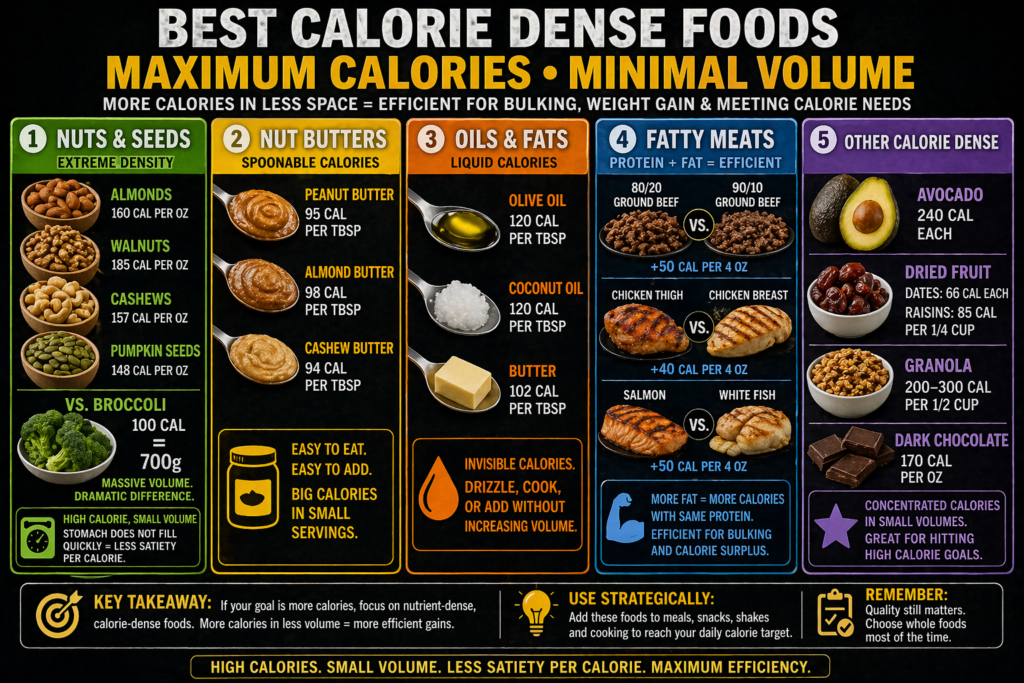
What Are Calorie-Dense Foods?
The definition:
- High calories in small volume
- Example: 1 tbsp peanut butter = 100 calories
- Example: 700g broccoli = 100 calories
- Dramatic difference
Why this works:
- Consume more calories without eating more volume
- Stomach doesn’t fill as quickly
- Less satiety per calorie
- Efficiency
The math:
- Need 3,000 calories daily
- Low-density foods: 6+ pounds of food
- High-density foods: 3 pounds of food
- 50% less volume for same calories
The Best Calorie-Dense Foods
Nuts and seeds:
- Almonds: 160 cal per ounce (28g)
- Walnuts: 185 cal per ounce
- Cashews: 157 cal per ounce
- Sunflower seeds: 165 cal per ounce
- Pumpkin seeds: 148 cal per ounce
- Extreme calorie density
How to use:
- Snack between meals
- Add to oatmeal, yogurt
- Carry in bag for quick calories
- Versatile addition
Nut butters:
- Peanut butter: 95 cal per tbsp
- Almond butter: 98 cal per tbsp
- Cashew butter: 94 cal per tbsp
- Spoonable calories
How to use:
- On toast, bagels
- In shakes (adds 200+ cal)
- By the spoonful
- With fruit
- Easy consumption
Oils and fats:
- Olive oil: 120 cal per tbsp
- Coconut oil: 120 cal per tbsp
- Butter: 102 cal per tbsp
- Liquid calories
How to use:
- Drizzle on vegetables
- Cook with generously
- Add to rice, pasta
- Invisible calories
Fatty cuts of meat:
- 80/20 ground beef vs. 90/10: +50 cal per 4oz
- Chicken thigh vs. breast: +40 cal per 4oz
- Salmon vs. white fish: +50 cal per 4oz
- Protein + fat
Why this works:
- Get protein anyway (need for muscle)
- Bonus fat calories without extra volume
- Efficient protein
Avocado:
- 240 cal per avocado
- Healthy fats
- Versatile
- Nutrient-dense
How to use:
- On toast
- In sandwiches
- With eggs
- In salads
- Easy addition
Dried fruit:
- Dates: 66 cal per date
- Raisins: 85 cal per small box (1.5oz)
- Dried mango: 160 cal per 1/4 cup
- Concentrated fruit
Why better than fresh:
- Water removed, calories concentrated
- Small volume, high calories
- Easy to eat large amounts
- Density advantage
Granola:
- 200-300 cal per 1/2 cup
- Vs. regular cereal: 100-150 cal per cup
- Dense carbs
How to use:
- With yogurt
- With milk
- As snack
- Quick carbs
Dark chocolate:
- 170 cal per ounce (28g)
- Also provides antioxidants
- Treat with benefits
Whole grain dense breads:
- Bagels: 250-300 cal each
- Dense whole grain: 90-120 cal per slice vs. white bread 70-80
- Better bread choices
Practical Implementation
Meal additions:
- Add 2 tbsp peanut butter to breakfast: +200 cal
- Cook vegetables in olive oil (2 tbsp): +240 cal
- Snack on 2oz almonds: +320 cal
- Avocado with lunch: +240 cal
- Total: +1,000 calories with minimal volume
The difference:
- 1,000 calories of chicken and rice: Massive plate, very filling
- 1,000 calories added via fats: Barely noticeable volume
- Same calories, fraction of fullness
Strategy 2: Liquid Meals (Shakes)
The easiest way to add calories.
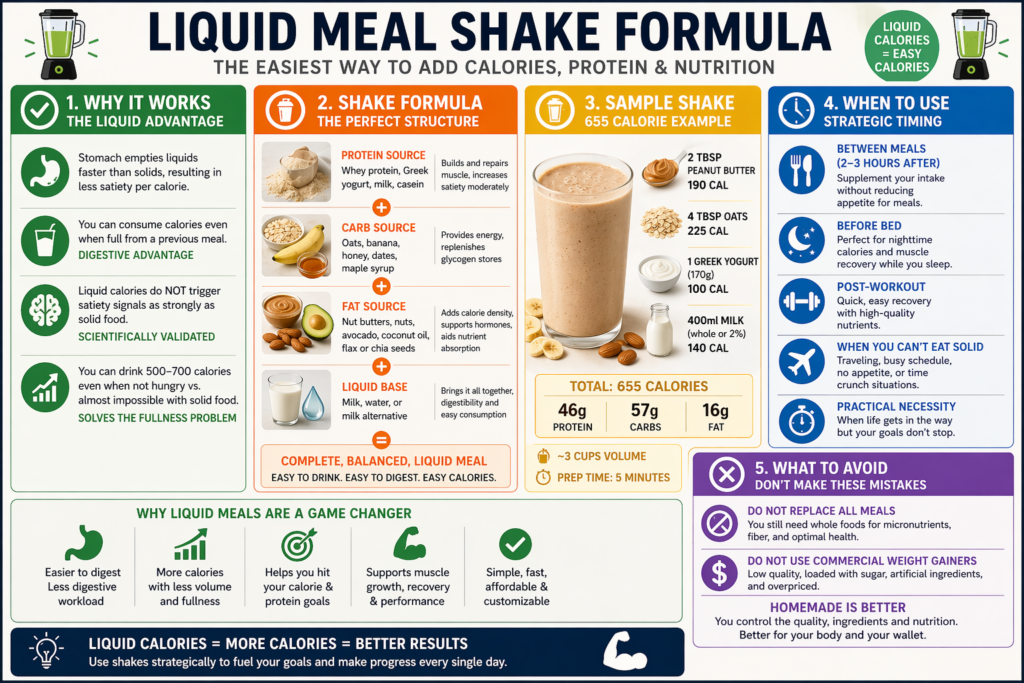
Why Liquid Calories Work
The mechanism:
- Stomach empties liquids faster than solids
- Less satiety per calorie
- Can consume while still full from previous meal
- Digestive advantage
The research:
- Liquid calories don’t trigger satiety as strongly
- People consume more calories when drinking vs. eating
- Scientifically validated
The practical benefit:
- Can drink 500-700 calorie shake even when “not hungry”
- Try eating 500-700 calories of food when full (impossible)
- Solves the fullness problem
The High-Calorie Shake Formula
Base structure:
- Protein source
- Carb source
- Fat source
- Liquid base
- Complete meal
Sample shake (515 calories):
- 2 tbsp peanut butter (30g): 190 cal, 8g protein, 16g fat
- 4 tbsp oats (60g): 225 cal, 7.5g protein, 37g carbs
- 1 Greek yogurt (170g, low-fat): 100 cal, 17g protein
- 400ml skim milk: 140 cal, 14g protein, 20g carbs
- Total: 655 calories, 46g protein, 57g carbs, 16g fat
Note: Original article showed 515 cal, but math adds to ~655. Using corrected numbers.
The advantage:
- 3 cups liquid volume
- Easy to consume in 5 minutes
- Equivalent solid meal would be huge
- Efficiency
Shake Variations
Higher calorie (800+ calories):
- Add 1 banana: +100 cal
- Increase peanut butter to 3 tbsp: +95 cal
- Add 1 scoop whey protein: +120 cal
- Use whole milk instead of skim: +60 cal
- Total: ~1,030 calories
Lower prep version:
- 2 cups whole milk: 300 cal
- 2 scoops whey protein: 240 cal
- 2 tbsp peanut butter: 190 cal
- 1 banana: 100 cal
- Total: 830 calories in 2 minutes
The ingredients library:
Protein sources:
- Whey protein: 120 cal, 24g protein per scoop
- Greek yogurt: 100 cal, 17g protein per 170g
- Milk: 80-150 cal per cup (skim to whole), 8g protein
- Protein base
Carb sources:
- Oats: 150 cal, 27g carbs per 1/2 cup
- Banana: 100 cal, 27g carbs each
- Honey: 60 cal, 17g carbs per tbsp
- Dates: 66 cal, 18g carbs each
- Energy source
Fat sources:
- Nut butters: 95 cal, 8g fat per tbsp
- Nuts: 160 cal, 14g fat per oz
- Avocado: 120 cal, 11g fat per 1/2
- Coconut oil: 120 cal, 14g fat per tbsp
- Calorie booster
When to Use Shakes
Strategic timing:
Between meals:
- 2-3 hours after meal
- Not replacing meals
- Adding calories
- Supplemental
Before bed:
- Don’t need appetite for sleep
- Adds calories without affecting next day appetite
- Nighttime calories
Immediately post-workout:
- When solid food unappealing
- Rapid nutrition delivery
- Recovery window
When genuinely can’t eat solid food:
- Traveling
- Time crunch
- Feeling unwell
- Practical necessity
What NOT to Do
Don’t replace all meals with shakes:
- Need whole food nutrition
- Chewing triggers satiety (good for next meal)
- Psychological satisfaction
- Balance required
Don’t use commercial weight gainers:
- Low-quality protein (often whey concentrate or worse)
- Mostly simple sugars
- Expensive
- Poor nutrient profile
- Inferior option
Why homemade is better:
- Control ingredients
- Higher quality
- Better macros
- More cost-effective
- Know exactly what you’re consuming
- Superior approach
Strategy 3: Smaller, More Frequent Meals
Frequency over size.
The Principle
The traditional approach (doesn’t work for you):
- 3 large meals daily
- 1,000+ calories per meal
- Stomach overfilled
- Hours of fullness
- Overwhelming
The better approach:
- 5-6 smaller meals
- 500-600 calories per meal
- Never overfull
- Always ready for next meal
- Sustainable
The math:
- 3 meals x 1,000 cal = 3,000 cal (feels impossible)
- 6 meals x 500 cal = 3,000 cal (manageable)
- Same total, easier execution
Why This Works
Reason 1: Reduced digestive burden
- Smaller bolus of food
- Digests completely before next meal
- Less bloating and discomfort
- Digestive efficiency
Reason 2: Stable blood sugar
- Prevents extreme spikes/crashes
- More consistent energy
- More consistent appetite
- Metabolic stability
Reason 3: Never extremely full
- Finish each meal slightly satisfied, not stuffed
- Ready to eat again in 2-3 hours
- Appetite preservation
Reason 4: Nutrient variety
- More eating occasions = more food variety
- Better micronutrient coverage
- Less meal monotony
- Nutritional diversity
Reason 5: Psychological acceptance
- Smaller portions less daunting
- Each meal feels achievable
- Mental ease
Sample 6-Meal Day (3,000 calories)
Meal 1 (7:00 AM) – 500 cal:
- 3 eggs scrambled with cheese
- 2 slices whole grain toast with butter
- 1 orange
- Morning fuel
Meal 2 (10:00 AM) – 500 cal:
- Shake: Whey protein, banana, peanut butter, milk
- Liquid calories
Meal 3 (1:00 PM) – 600 cal:
- 6oz chicken breast
- 1 cup rice
- Mixed vegetables cooked in olive oil
- Main meal
Meal 4 (4:00 PM) – 450 cal:
- Greek yogurt with granola and berries
- Handful of almonds
- Snack meal
Meal 5 (7:00 PM) – 600 cal:
- 8oz salmon
- Sweet potato
- Salad with avocado
- Dinner
Meal 6 (10:00 PM) – 350 cal:
- Protein shake with oats
- Pre-bed calories
Total: 3,000 calories, never overly full
Practical Tips
Meal prep:
- Cook in batches (Sunday meal prep)
- Portion into containers
- Grab and eat
- Convenience
Set alarms:
- Every 3 hours
- Eating reminder
- Consistency
- Structure
Portable meals:
- Protein bars
- Trail mix
- Sandwiches
- Shakes in shaker bottle
- Always prepared
Strategy 4: Don’t Skip Breakfast
The most important eating opportunity.
Why Breakfast Matters for Hardgainers
Reason 1: Lost eating opportunity
- Skip breakfast = lose 500-700 calories
- Must compensate with larger meals later
- Already struggle with large meals
- Calorie deficit worsens
Reason 2: Appetite suppression research
- Studies show breakfast skippers eat less total daily calories
- Skipping first meal suppresses appetite for rest of day
- Counterintuitive but documented
- Scientific finding
The mechanism:
- Fasting extends overnight
- Body adapts to fasted state
- Hunger signals downregulate
- Less hungry all day
- Adaptive suppression
Reason 3: Metabolic priming
- Eating upon waking activates metabolism
- Sets digestive system for day
- Establishes eating rhythm
- Metabolic activation
Reason 4: Front-loading calories
- Easier to eat in morning (less full from previous day)
- More time to digest before bed
- Strategic timing
“I Can’t Eat in the Morning”
The reality:
- Usually habit, not physiology
- Body adapts to what you do consistently
- Psychological barrier
The solution:
- Start very small (piece of fruit, small shake)
- Gradually increase over 2-3 weeks
- Body adapts to expect food
- Progressive training
Week 1:
- 1 banana + glass of milk (200 cal)
- Just establishing habit
- Entry point
Week 2:
- 2 eggs + toast (350 cal)
- Building tolerance
- Progression
Week 3+:
- Full breakfast (500+ cal)
- New normal established
- Habit formed
Quick Breakfast Options
For rushed mornings:
- Shake (5 minutes to consume)
- Overnight oats (prep night before)
- Greek yogurt with granola (2 minutes)
- Peanut butter bagel (3 minutes)
- Speed options
The non-negotiable:
- Eat SOMETHING within 1 hour of waking
- Even if small
- Maintain daily eating rhythm
- Consistency
Strategy 5: Manage Fiber Intake Strategically
Fiber is healthy but problematic for hardgainers.
The Fiber Problem
Why fiber reduces appetite:
- Swells in stomach (absorbs water)
- Increases food volume without calories
- Slows gastric emptying
- Prolongs fullness
- Satiety enhancer
The mechanism:
- Fiber expands in GI tract
- Triggers stretch receptors
- Sends satiety signals to brain
- Physical fullness
The consequence:
- High-fiber meal at 12 PM
- Still full at 3 PM
- Can’t eat afternoon meal
- Missed eating opportunity
- Appetite suppression
The example:
- 300g chicken + 500g vegetables + 200g rice = Very full for hours
- 300g chicken + 100g vegetables + 300g rice = Same calories, full for less time
- Volume difference
The Strategy (Not Elimination)
Important clarification:
- DON’T eliminate fiber completely (unhealthy)
- DO strategically place fiber
- Intelligent distribution
Fiber-light meals (3-4 meals daily):
- Focus on protein + carbs + fats
- Minimal vegetables
- Faster digestion
- Quicker return of appetite
- Strategic placement
Example fiber-light meals:
- White rice + chicken + olive oil
- Pasta + ground beef + sauce
- Bagel + peanut butter + banana
- Shake with oats + protein + nut butter
- Low fiber options
Fiber-rich meals (1-2 meals daily):
- Vegetables, whole grains, legumes
- Get nutritional benefits
- Nutritional coverage
Where to place fiber-rich meals:
Before bed:
- Don’t need appetite while sleeping
- Fiber fullness doesn’t matter
- Strategic timing
After longest eating break:
- If you don’t eat 1-7 PM (work/school)
- First meal after can be fiber-rich
- Have time to digest before next meal
- Planned placement
Practical Implementation
Sample day structure:
7 AM – Low fiber:
- Eggs, white toast, banana
- Quick digestion
10 AM – Low fiber:
- Shake with oats, peanut butter, protein
- Liquid calories
1 PM – Moderate fiber:
- Chicken, white rice, small salad
- Balanced
4 PM – Low fiber:
- Greek yogurt, granola, honey
- Quick snack
7 PM – Low fiber:
- Steak, pasta, minimal vegetables
- Calorie focus
10 PM – High fiber:
- Salmon, quinoa, large vegetable serving
- Nutritional meal before bed
The result:
- Fiber distributed strategically
- Never overly full when need to eat
- Still get nutritional benefits
- Optimal balance
Fiber Sources to Moderate
Very high fiber (manage portions):
- Broccoli, Brussels sprouts, cauliflower
- Beans and lentils
- Bran cereals
- Chia/flax seeds
- Extreme satiety
Moderate fiber (can eat freely):
- White rice (0.6g per cup cooked)
- White pasta (2.5g per cup)
- Bananas (3g per banana)
- Chicken, fish, meat (0g)
- Lower satiety
The balance:
- Get fiber from 1-2 meals daily
- Other meals focus on calorie density
- Strategic distribution
Additional Strategies
Quick wins for extra calories.
Strategy 6: Drink Calories Throughout Day
The approach:
- Don’t drink only water
- Use calorie-containing beverages
- Invisible calories
Options:
- Whole milk instead of water with meals: +150 cal per glass
- Orange juice with breakfast: +110 cal per cup
- Smoothie mid-afternoon: +300 cal
- Milk before bed: +150 cal
- Daily additions
The math:
- 3 glasses milk + 1 juice + 1 smoothie = +610 calories
- Zero additional fullness (liquids)
- Easy addition
Strategy 7: Add Calorie Boosters to Every Meal
The tactic:
- Never eat plain anything
- Always add calorie-dense topping
- Meal enhancement
Examples:
- Rice + butter: +100 cal
- Oatmeal + peanut butter: +190 cal
- Yogurt + granola: +150 cal
- Salad + dressing: +120 cal
- Vegetables + olive oil: +120 cal
- Every meal opportunity
The impact:
- 5 meals x +100 cal average = +500 calories daily
- With minimal extra volume
- Substantial addition
Strategy 8: Reduce Activity on Rest Days
The calorie balance:
- High activity = high calorie needs
- Already struggle to eat enough
- Extra activity makes problem worse
- Energy mismatch
The strategy:
- Train hard (necessary for muscle growth)
- Rest completely on off days
- No excessive walking, cardio, sports
- Energy conservation
The exception:
- If activity is essential (job, sport)
- Must increase calories further
- Liquid calories become even more important
- Adjust intake upward
Common Mistakes Hardgainers Make
What doesn’t work.
Mistake 1: “Dirty Bulk” with Only Junk Food
What it looks like:
- Pizza, burgers, fries, ice cream exclusively
- “If it fits my macros”
- Ignoring nutrition quality
- Junk food approach
Why it’s wrong:
- Poor micronutrient intake (health suffers)
- Still very filling (doesn’t solve volume problem)
- Digestive issues
- Unsustainable
- Shortsighted
The balance:
- 80-90% nutrient-dense calories
- 10-20% treats/junk
- Sustainable quality
Mistake 2: Giving Up After One Week
The pattern:
- Try for 3-5 days
- “This is too hard”
- Quit
- Premature cessation
The reality:
- Appetite adapts after 2-3 weeks
- Stomach capacity increases
- Becomes easier
- Adaptation time needed
The solution:
- Commit to 4 weeks minimum
- Track daily (weight, calories)
- Adjust as needed
- Patience required
Mistake 3: Not Actually Tracking Calories
The assumption:
- “I’m eating a ton”
- Based on feeling, not data
- Subjective assessment
The reality:
- Often eating 2,000 when need 3,000
- “Ton of food” to a hardgainer is normal to average person
- Underestimating intake
The solution:
- Track everything for 1-2 weeks
- Measure portions
- Use app (MyFitnessPal, Cronometer)
- Objective measurement
Mistake 4: Inconsistent Eating
The pattern:
- Monday-Friday: Eat well
- Weekend: Skip meals, irregular times
- Inconsistency
The impact:
- Progress stalls
- Never adapt
- Constant struggle
- No momentum
The solution:
- Same meal times every day
- Same portions
- Consistency builds habit
- Routine establishment
Mistake 5: Choosing Wrong Protein Sources
The problem:
- Chicken breast, white fish, egg whites exclusively
- Very lean protein
- Fills you up without many calories
- Low calorie density
The solution:
- Chicken thighs, salmon, whole eggs, ground beef 80/20
- Same protein, more fat (more calories, less filling)
- Better protein choices
Sample 3,000 Calorie Day
Putting it all together.
7:00 AM – Breakfast (600 cal):
- 3 whole eggs scrambled with cheese
- 2 slices whole grain toast with butter
- 1 glass whole milk
- 1 banana
- Macros: 35g protein, 55g carbs, 28g fat
10:00 AM – Shake (550 cal):
- 2 scoops whey protein
- 2 tbsp peanut butter
- 1 banana
- 2 cups whole milk
- Macros: 56g protein, 50g carbs, 22g fat
1:00 PM – Lunch (700 cal):
- 8oz ground beef (80/20)
- 1.5 cups white rice
- Minimal vegetables, cooked in olive oil
- Macros: 48g protein, 65g carbs, 28g fat
4:00 PM – Snack (450 cal):
- Greek yogurt (full-fat)
- 1/2 cup granola
- 2oz almonds
- Macros: 25g protein, 38g carbs, 24g fat
7:00 PM – Dinner (700 cal):
- 8oz salmon
- 2 medium sweet potatoes
- Salad with avocado and olive oil dressing
- Macros: 52g protein, 62g carbs, 30g fat
Total: ~3,000 calories
- Protein: 216g
- Carbs: 270g
- Fat: 132g
Keys to this plan:
- 5 meals (manageable sizes)
- 1 liquid meal (easy 550 cal)
- Calorie-dense choices (nuts, nut butter, oils, fatty fish/meat)
- Moderate fiber (not excessive)
- Front-loaded (breakfast immediately)
- All strategies combined
The Bottom Line: Eating More Requires Strategy
After explaining everything:
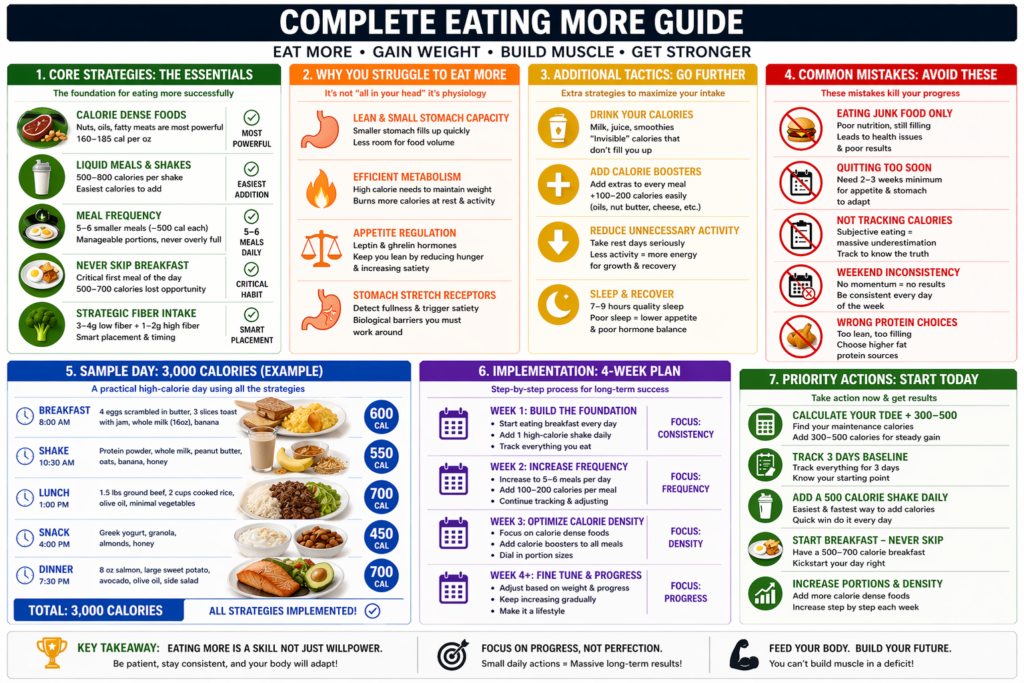
The truth about eating more:
✅ You can’t build muscle without sufficient calories (non-negotiable requirement)
✅ Forcing food doesn’t work (creates aversion and digestive issues)
✅ Strategic eating makes it possible (work with your body, not against it)
✅ Calorie density is the most powerful tool (more calories, less volume)
✅ Liquid calories bypass satiety signals (easiest way to add 500+ calories)
Key takeaways:
Why you can’t eat enough:
- Lean body = smaller stomach capacity
- Efficient metabolism = high calorie needs
- Appetite regulation conspires to keep you lean
- Stomach stretch receptors trigger fullness quickly
- Biological barriers
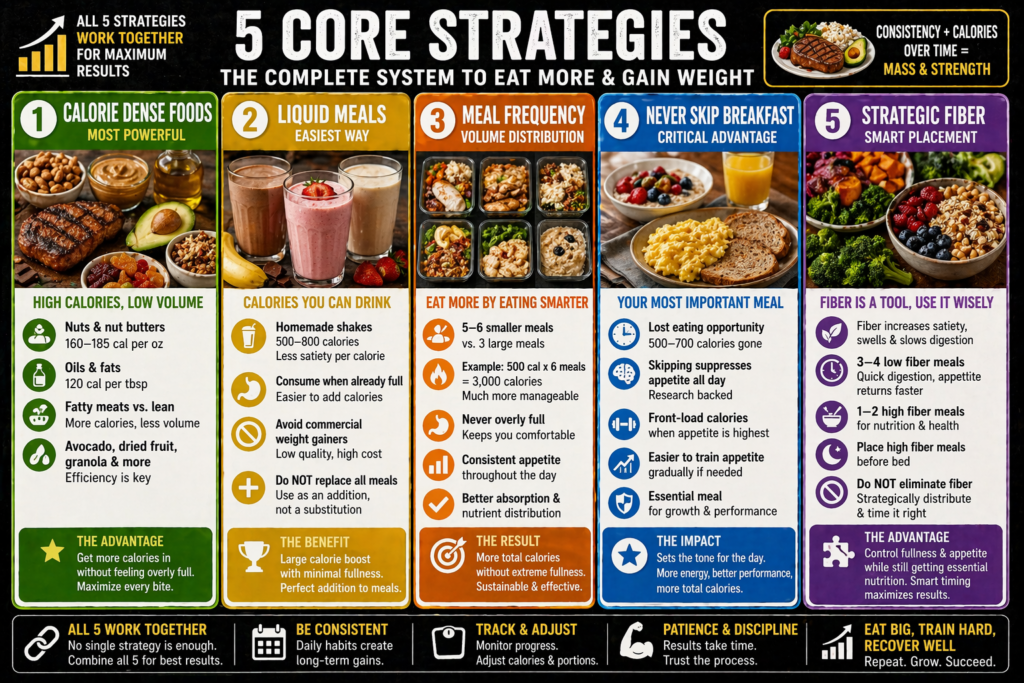
The 5 core strategies:
Strategy 1: Calorie-dense foods
- Nuts, nut butters (160-185 cal per oz)
- Oils and fats (120 cal per tbsp)
- Fatty meats (vs. lean cuts)
- Avocado (240 cal per avocado)
- Dried fruit (vs. fresh)
- Granola (vs. regular cereal)
- Most powerful strategy
Strategy 2: Liquid meals
- Homemade shakes (500-800 cal)
- Less satiety per calorie
- Consume when already full
- Don’t replace all meals
- Avoid commercial weight gainers
- Easiest calorie addition
Strategy 3: Meal frequency
- 5-6 smaller meals vs. 3 large
- 500 cal x 6 = 3,000 (manageable)
- Never overly full
- Consistent appetite
- Volume distribution
Strategy 4: Never skip breakfast
- Lost eating opportunity (500-700 cal)
- Skipping suppresses appetite all day (research-backed)
- Front-loading calories easier
- Train appetite gradually if needed
- Critical meal
Strategy 5: Strategic fiber management
- Fiber increases satiety (swells, slows digestion)
- 3-4 low-fiber meals (quick digestion, appetite returns)
- 1-2 high-fiber meals (nutrition, place before bed)
- Don’t eliminate, strategically distribute
- Smart placement
Additional strategies:
- Drink calories (milk, juice, smoothies)
- Add calorie boosters to every meal (+100-200 cal)
- Reduce unnecessary activity on rest days
- Extra tactics
Common mistakes:
- Junk food only (poor nutrition, still filling)
- Quitting too soon (need 2-3 weeks adaptation)
- Not tracking calories (subjective overestimation)
- Weekend inconsistency (no momentum)
- Wrong protein sources (too lean, too filling)
- Pitfalls to avoid
Sample day (3,000 calories):
- Breakfast 600 cal (eggs, toast, milk, banana)
- Shake 550 cal (protein, peanut butter, milk, banana)
- Lunch 700 cal (ground beef, rice, minimal vegetables)
- Snack 450 cal (yogurt, granola, almonds)
- Dinner 700 cal (salmon, sweet potato, avocado salad)
- All strategies implemented
Implementation timeline:
- Week 1: Start breakfast habit, add one shake daily
- Week 2: Increase meal frequency to 5-6 daily
- Week 3: Optimize food choices for calorie density
- Week 4+: Fine-tune based on results
- Progressive implementation
Priority actions:
- Calculate actual calorie needs (TDEE + 300-500)
- Track current intake for 3 days (establish baseline)
- Add one 500-calorie shake daily (easiest quick win)
- Start eating breakfast immediately (never skip again)
- Gradually increase portions with calorie-dense foods
- Step-by-step start
STOP FORCING FOOD. START EATING STRATEGICALLY. USE CALORIE DENSITY. ADD LIQUID MEALS. EAT MORE FREQUENTLY. BUILDING MUSCLE IS IMPOSSIBLE WITHOUT SUFFICIENT CALORIES.
Ready to build a complete bulking nutrition system with precise calorie calculations, meal planning protocols, progressive eating strategies, and appetite training techniques that make eating enough effortless? Understanding how to eat more is just the beginning. Get comprehensive bulking nutrition guidance that actually works. Stop struggling with appetite. Start gaining systematically.
REFERENCES
SECTION 1 — Liquid vs. solid calories: lower satiety and incomplete dietary compensation
[1] Mattes RD & Almiron-Roig E — PubMed/Obesity Reviews, 2003 Review assessing whether liquid calories fail to trigger physiological satiety mechanisms; published studies were found to be inconclusive, with some showing liquids are less satiating than solids and others showing the reverse; compensation for energy consumed as beverages was frequently found to be imprecise and incomplete; subject characteristics, preload volume, and the time lag between the liquid preload and the next meal all moderated outcomes; despite the inconclusive overall literature, the review documents the mechanistic basis for using liquids strategically to consume calories without triggering the full satiety response, which is the practical principle underlying the article’s Strategy 2 (liquid meals) https://pubmed.ncbi.nlm.nih.gov/14649371/
[2] Pan A & Hu FB — PubMed/Current Opinion in Clinical Nutrition and Metabolic Care, 2011 Review of carbohydrate physical form and satiety; liquid carbohydrates in general produce less satiety than solid forms; some energy from liquids may be compensated for at subsequent meals but compensation is typically incomplete, meaning total energy intake increases; faster gastric emptying and attenuated hormonal responses (lower CCK, GLP-1, and PYY release) account for the reduced satiety of liquid versus solid food; identifies oro-sensory exposure time (brief for liquids) as a key mediating factor; provides mechanistic support for the article’s Strategy 2 claim that liquid shakes allow calorie consumption even when the person is already full from a previous meal https://pubmed.ncbi.nlm.nih.gov/21519237/
SECTION 2 — Breakfast consumption and appetite regulation throughout the day
[3] Leidy HJ et al. — PubMed/American Journal of Clinical Nutrition, 2013 Randomized crossover study (n=13) in breakfast-skipping adolescents comparing a high-protein breakfast (35g), a normal-protein breakfast, and continued breakfast skipping; breakfast consumption reduced daily hunger and ghrelin compared to skipping, with the high-protein condition showing significantly greater appetite suppression and reduced ad libitum lunch energy intake versus skipping (p<0.01); daily PYY concentrations were elevated after both breakfast conditions compared to skipping; neural food cue reactivity in hippocampal and parahippocampal regions was also reduced after breakfast; directly supports the article’s Strategy 4 claim that eating breakfast reduces appetite-stimulating hormone ghrelin and suppresses hunger throughout the day, making it a critical eating opportunity for hardgainers who need to maximize total daily intake https://pubmed.ncbi.nlm.nih.gov/23446906/
[4] Levitsky DA & Pacanowski CR — PubMed/Physiology and Behavior, 2013 Two-study crossover RCT examining the effect of breakfast consumption on total daily energy intake; in Study 2, skipping a 624-calorie breakfast increased lunch intake by only 144 kcal, leaving a net deficit of approximately 408 kcal by end of day; breakfast skippers did not adequately compensate for the missed morning calories at subsequent meals; this “incomplete compensation” effect confirms that skipping breakfast produces a persistent calorie deficit across the day; this finding is repurposed in the article’s Strategy 4 for hardgainers seeking to maximize daily caloric intake: eating breakfast captures calories that would otherwise be permanently lost to the day’s total https://pubmed.ncbi.nlm.nih.gov/23672851/
SECTION 3 — Dietary fiber and satiety: the mechanism behind strategic fiber management
[5] Rebello CJ et al. — PMC/Advances in Nutrition, 2016 Systematic review of dietary fiber and satiety mechanisms; soluble fiber forms a viscous gel in the gastrointestinal tract, slowing gastric emptying and extending transit time, which prolongs stretch receptor activation and hormone signaling (CCK, GLP-1, PYY) from the small intestine; fiber fermentation in the large intestine produces short-chain fatty acids that further modulate appetite hormones; these effects consistently increase fullness and reduce subsequent energy intake; provides the mechanistic basis for the article’s Strategy 5 on strategic fiber management, explaining why high-fiber meals extend satiety and why lean individuals trying to maximize calorie intake should distribute high-fiber meals to times when appetite suppression does not interfere with the next eating occasion https://pmc.ncbi.nlm.nih.gov/articles/PMC4951533/


Leave a Reply
You must be logged in to post a comment.